Key Takeaways
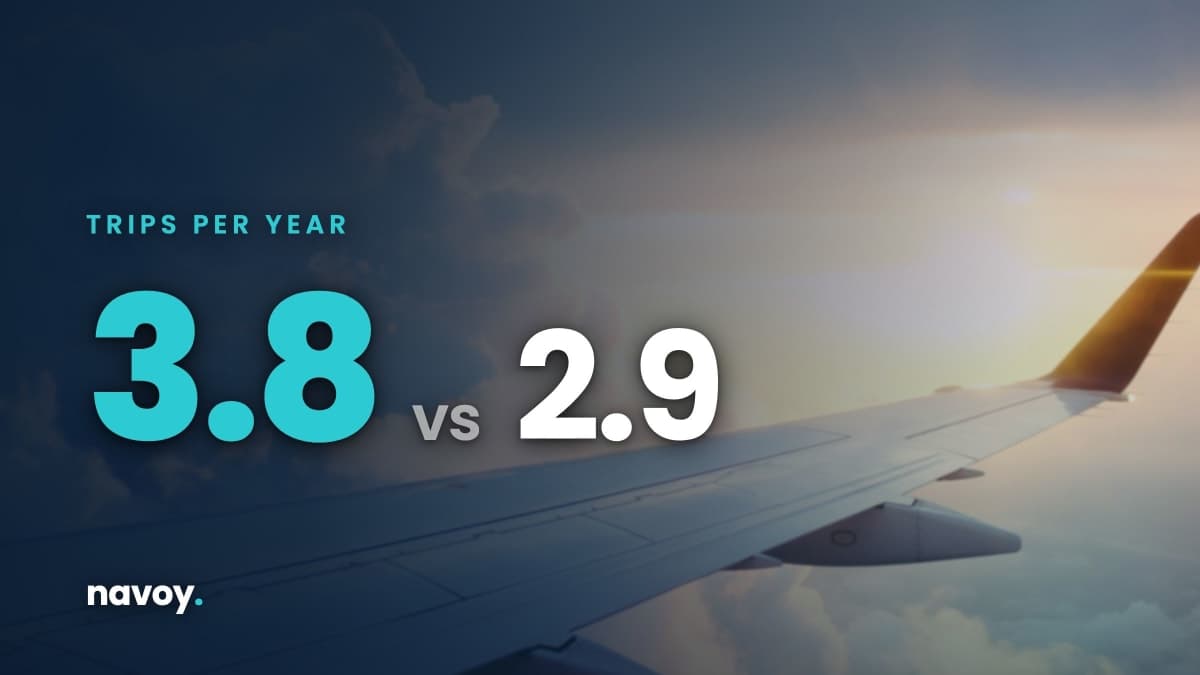
- Travelers who use AI take 3.8 leisure trips a year. Travelers who don't take 2.9 (Phocuswright, February 2026).
- They spend $4,500 a year on leisure travel versus $3,000 for non-users, and their median household income is $129,200 versus $104,000.
- Adoption went 33% to 43% to 56% in twelve months among US leisure travelers, the fastest behavior shift travel has seen in over a decade.
- The honest reading: this is correlation, not cause. Frequent, higher-income travelers adopt new tools first. AI is not manufacturing an extra trip per person.
- What AI does change is the work. AI travelers use four digital tools to research and book; everyone else uses 2.2.
What does the 2026 data say about travelers who use AI?
Travelers who use AI take 3.8 leisure trips a year and spend $4,500 on travel. Travelers who don't take 2.9 trips and spend $3,000. That gap comes from Phocuswright's February 2026 survey of 1,570 US leisure travelers, and it is the clearest picture yet of who is actually using AI to plan trips.
It is also the number that explains most of what you have been reading about AI and travel this year. When an industry moves this hard toward a technology, the reason is rarely the technology. It is who is holding it.
I want to be careful with this data, though, because it is very easy to tell it dishonestly. The tempting version is "use AI, travel more." That is not what the survey found, and the rest of this piece is largely about the difference.
How many travelers actually use AI to plan trips in 2026?
As of February 2026, 56% of US leisure travelers had used AI for at least one trip in the previous twelve months. That is up from 43% in the second half of 2025 and 33% in the first half, more than double the 2024 share. Phocuswright called it the fastest behavioral shift travel has seen in over a decade.
The shape of that curve matters more than the endpoint. Three data points in eighteen months, each one roughly ten points above the last, is not a plateau. It is a line still going up.
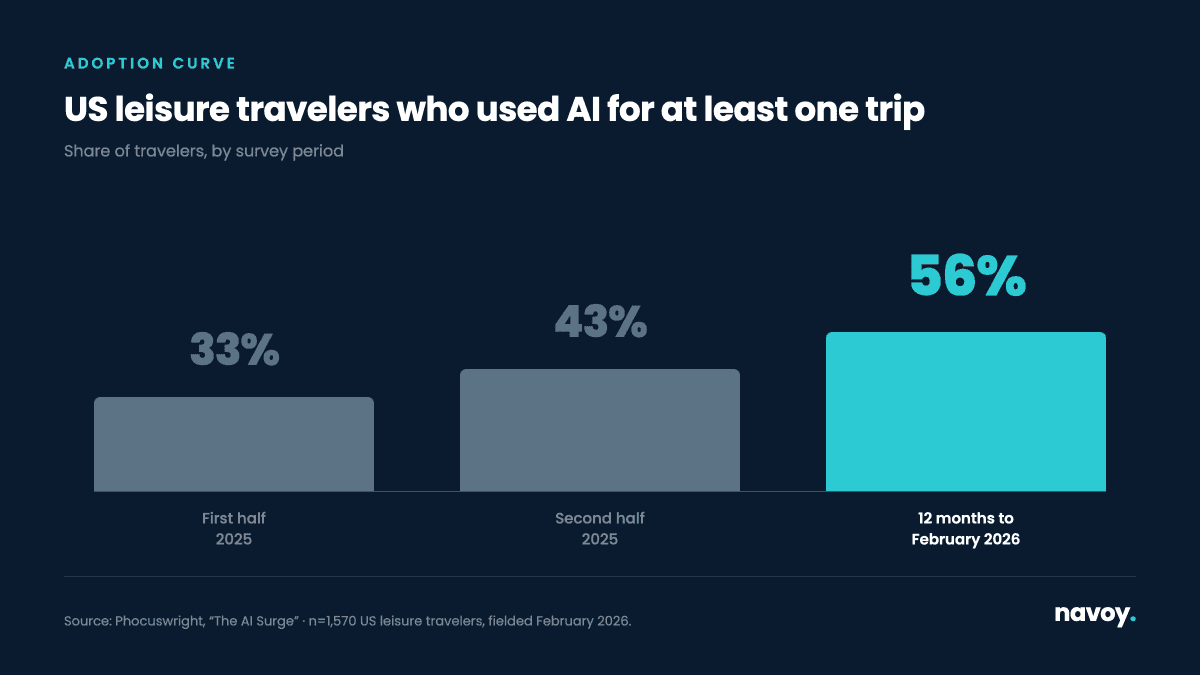
Worth noting what this question actually asked: any AI use across planning, booking, or in-destination help, on at least one trip. It is a broader question than "do you plan your trips with AI," which is why you will see lower numbers elsewhere. We covered the narrower version, and the gap between knowing about AI trip planning and actually trying it, in our breakdown of the AI travel adoption gap.
Do travelers who use AI really spend more?
Yes, and the gap is wide. AI travelers spend $4,500 a year on leisure travel against $3,000 for non-users, take 3.8 trips against 2.9, and report a median household income of $129,200 against $104,000. They are also about eleven years younger at the median.
| Measure | AI travelers | Non-users |
|---|---|---|
| Leisure trips per year | 3.8 | 2.9 |
| Annual leisure travel spend | $4,500 | $3,000 |
| Median household income | $129,200 | $104,000 |
| Digital tools used to research and book | 4.0 | 2.2 |
| Median age | 41 | 52 |
Phocuswright, "The AI Surge: Travel's Fastest Behavioral Shift in a Decade" (n=1,570 US leisure travelers, fielded February 2026).
Read the table as a portrait rather than a scoreboard. The AI traveler in this data is in their early forties, earns above the median, takes roughly one extra trip a year, and spends about half again as much doing it. Every business in travel wants that customer. That, and not any particular model release, is why the industry has spent 2026 rebuilding itself around AI.
Does AI make people travel more, or do frequent travelers just adopt AI first?
Almost certainly the second. Phocuswright measured association, not effect. Younger, higher-income, more frequent travelers have always adopted new travel tools first, and every one of those traits is already baked into the AI-traveler group. Nothing in the data shows AI adding 0.9 trips to anyone's year.
This is the part most coverage skips, so it is worth sitting with. If you took the same survey in 2009 and split it by "uses a smartphone to book travel," you would have found a similar spread: younger, richer, more trips. The smartphone did not create those trips. It found the people already taking them.
So the correct claim is narrow: the people who travel most are the people adopting AI fastest. That is genuinely useful if you are trying to understand where travel is heading. It is not evidence that a planning tool will change how much you travel, and I would not trust anyone who tells you otherwise.
What the data can support is a claim about effort rather than volume. AI travelers reach for four digital tools when researching and booking; non-users reach for 2.2. Something is absorbing that extra surface area.
Which travelers have adopted AI fastest?
Millennials lead in absolute terms at 74%, with Gen Z close behind at 72% and Gen X at 50%. The fastest growth, though, belongs to baby boomers: their adoption doubled from 13% to 27% in six months, a steeper climb than any younger group managed in the same window.
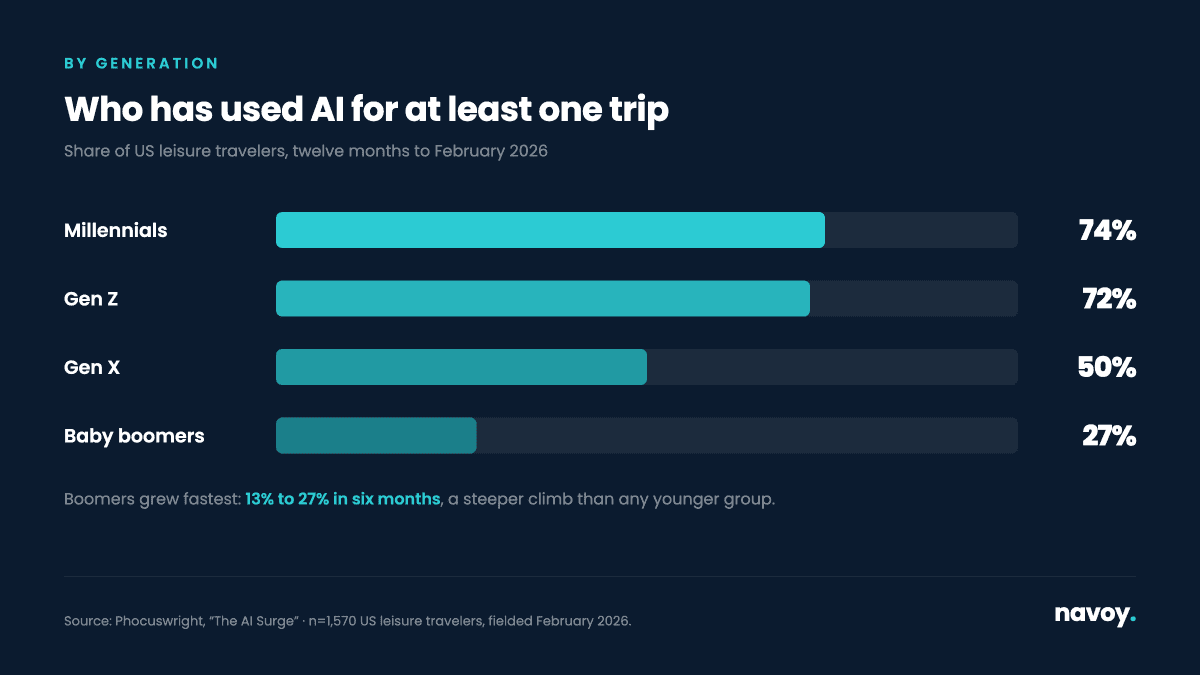
The boomer number is the one I would watch. A group going from one in eight to one in four in half a year is a group in the middle of changing its mind, and it is the group with the most disposable travel income in the market. Ceilings tend to be lower than adoption curves suggest, but doubling is doubling.
What do AI travelers actually do differently?
They use more tools and use them further into the trip. Among AI travelers, 64% used standalone AI platforms and 81% rated those platforms the most useful thing they tried for planning. Just over half, 51%, kept using AI once they arrived, for real-time recommendations on what to do.
Three things stand out in the behavior data.
- They prefer purpose-built tools to general chatbots. Standalone AI travel platforms outscored everything else on usefulness at 81%. General-purpose generative AI sat at 33% for trip research, roughly level with ordinary search engines at 35%.
- They don't stop at the itinerary. The 51% in-destination figure is the one that surprised me. Planning is the obvious use case; using AI on the ground for navigation, neighborhood questions, and reservations is a habit forming much faster than expected. Of those who did, 95% found it helpful.
- They spread the work across more surfaces. Four tools versus 2.2 suggests AI is being added to the research stack rather than replacing it. Nobody has consolidated yet, which is roughly where the opportunity sits.
Where AI adoption still falls off is the booking itself. Travelers are comfortable letting AI plan and recommend, and much less comfortable letting it transact. We pulled that apart separately in our look at the plan-versus-book trust gap.
What does this mean for your next trip?
If you haven't tried AI for a trip yet, the useful takeaway is not that you should travel more. It is that the planning work has gotten meaningfully cheaper, and the people doing the most of it moved first. The catch is that a plan is only worth what it can be booked against.
One honest caveat before you go and try it. Roughly one in three people who have used AI to build an itinerary have run into information that was false or out of date (2026 Klook survey, via CNBC). General chatbots write from training data, not from live inventory, so anything time-sensitive (opening hours, ticketed entry, today's room rate) needs checking against the source. Treat the AI as the drafter and yourself as the editor and the failure mode mostly disappears.
Plan it and book it in one platform with Navoy
That gap between a plan and a booking is the specific problem we built Navoy around. Navoy is an AI travel agent that plans the trip, books the hotel, and arranges the airport transfer in one platform. It doesn't just recommend, it books. You describe the trip in a sentence ("four days in Lisbon, relaxed pace, more budget on food than the hotel") and it builds a day-by-day itinerary shaped by your Travel Pace, your Budget Split, and up to three of twelve trip focus options, then books the hotel against live availability and current pricing rather than a number remembered from training data. The free plan covers three trips of up to 14 days at $0, which is enough to test the idea without deciding anything. One thing to know up front: Navoy doesn't book flights. Those you book with the airline, and Navoy handles the plan, the hotel, and the transfer around them.
If you are still working out where an AI tool fits next to a human agent or a booking site, our explainer on travel agents, OTAs and AI travel agents lays out what each one is actually good at.
Frequently Asked Questions
How many people use AI to plan travel in 2026?
As of February 2026, 56% of US leisure travelers had used AI for at least one trip in the past twelve months, per Phocuswright's survey of 1,570 travelers. That is up from 43% in late 2025 and 33% in early 2025. The figure covers planning, booking, and in-destination help, so narrower questions about trip planning alone return lower numbers.
Do people who use AI to plan trips spend more on travel?
Yes. Phocuswright found AI travelers spend $4,500 a year on leisure travel against $3,000 for non-users, and take 3.8 trips against 2.9. Their median household income is also higher, at $129,200 against $104,000. The spending gap tracks the income and frequency gap rather than being caused by the AI use itself.
Does using AI actually make you travel more?
There is no evidence for that. The survey measured association, not effect. AI users skew younger, higher-income, and more travel-frequent, and those groups have historically adopted new travel tools first. The accurate statement is that frequent travelers adopt AI fastest, not that AI produces more trips.
Are older travelers using AI to plan trips?
Increasingly. Baby boomer adoption doubled from 13% to 27% in six months, the fastest growth of any generation, though they remain lowest in absolute terms. Millennials lead at 74%, followed by Gen Z at 72% and Gen X at 50%. Growth among older travelers is currently outpacing the younger groups that started earlier.
Sources
- Travel Professional News — Majority of U.S. Travelers Now Use AI for Trips, Marking Fastest Behavioral Shift in a Decade, New Phocuswright Study Finds
- Travel Professional News — AI adoption is creating travel's highest-value customers, new Phocuswright study shows
- PR Newswire — TakeUp's "The Rise of AI-Planned Travel in 2026" report
- CNBC — Travelers are turning to AI to plan trips, but hallucinations and trust gaps remain (2026 Klook survey)
Related reading: the AI travel adoption gap: 90% know, only 38% have tried, why 55% of travelers have never planned a trip with AI, and travel agents vs booking sites vs AI travel agents, explained.
Plan the trip, book the hotel, sort the transfer.
Tell Navoy your dates, pace, and budget and it builds the day-by-day plan, then books your hotel and airport transfer in one platform. Free for up to three trips.
About the Author
Haroun Moula
Haroun Moula is the founder and CEO of Navoy. Before Navoy, he worked in luxury travel with VVIPs and high-profile travelers. He built Navoy to bring curated, adaptive trip planning to more travelers through an AI travel agent that plans and books core trip parts in one place.