Key Takeaways
- Japan's departure tax tripled on 1 July 2026, from about $6 to about $19 (¥1,000 to ¥3,000) per person. It is built into your plane ticket.
- Kyoto raised its hotel tax on 1 March 2026. It now runs from about $1.26 (¥200) to about $63 (¥10,000) per person per night, depending on the room rate.
- Tokyo switches to 3% of the room rate on 1 April 2027 for rooms of about $82 (¥13,000) or more per person per night, replacing today's flat $0.63 to $1.26 (¥100 to ¥200).
- Osaka, Sapporo, Fukuoka and the Niseko area charge their own hotel taxes too, and Hokkaido added a prefecture-wide tax on 1 April 2026.
- Our worked example: a couple spending 3 nights in Tokyo and 4 in Kyoto pays about $66 (¥10,400) in travel taxes this winter, against about $30 (¥4,800) under the rules of February 2026.
Japan has no single tourist tax. Visitors pay a stack: a departure tax of about $19 (¥3,000) per person since 1 July 2026, plus a nightly hotel tax in cities such as Kyoto, Tokyo and Osaka. Kyoto's top rate is about $63 (¥10,000) per person per night, and Tokyo moves to 3% of the room rate in April 2027.
For most trips the total is modest, but it has more than doubled in a year. Below is every tax, who collects it, and what it adds up to on a real itinerary. All dollar figures use the European Central Bank rate of 5 October 2026 ($1 = ¥158.2) and are rounded.
Plan your Japan trip with Navoy and see the hotel nights for each city in one itinerary.
What travel taxes does a visitor to Japan pay in 2026?
Two kinds. A national departure tax, charged once per person each time you leave Japan, and local accommodation taxes, charged per person per night by the city or prefecture where you sleep. There is no entry fee yet: Japan's JESTA travel authorisation is law, but its start date (no later than March 2029) and its fee are not set.
| Tax | Where | Rate (per person) | From when | Who collects |
|---|---|---|---|---|
| International Tourist Tax (departure tax) | All of Japan | About $19 (¥3,000) per departure | 1 July 2026 (was ¥1,000) | Your airline or cruise line, in the ticket price |
| Accommodation tax | Tokyo | About $0.63 to $1.26 (¥100 to ¥200) per night; nothing below ¥10,000 | Current rules | Your hotel |
| Accommodation tax | Tokyo | 3% of the room rate if ¥13,000 (about $82) or more per night | 1 April 2027 | Your hotel, ryokan, capsule hotel or private rental |
| Accommodation tax | Kyoto | About $1.26 to $63 (¥200 to ¥10,000) per night | 1 March 2026 | Your hotel or private rental |
| Accommodation tax | Osaka Prefecture | About $1.26 to $3.16 (¥200 to ¥500) per night; nothing below ¥5,000 | 1 September 2025 | Your hotel |
| Accommodation tax | Hokkaido (prefecture) | About $0.63 to $3.16 (¥100 to ¥500) per night | 1 April 2026 | Your hotel |
| Accommodation tax | Sapporo (city + Hokkaido) | About $1.90 to $6.32 (¥300 to ¥1,000) per night, combined | 1 April 2026 | Your hotel |
| Accommodation tax | Kutchan, Niseko area (town + Hokkaido) | 3% of the room rate, combined | 1 April 2026 | Your hotel |
| Accommodation tax | Fukuoka City (city + prefecture) | About $1.26 or $3.16 (¥200 or ¥500) per night | In force since 2020 | Your hotel |
The hotel taxes are worked out on the room-only rate per person per night, so a ¥30,000 twin room shared by two counts as ¥15,000 each. Meals are not part of the rate.
How much is Japan's departure tax now?
About $19 (¥3,000) per person, every time you leave Japan by plane or ship. It rose from ¥1,000 on 1 July 2026, and it applies whatever your nationality. Airlines add it to the fare, so you pay it when you buy the ticket, not at the airport.
The National Tax Agency lists the main exemptions: children under 2, and air transit passengers on a through ticket who leave within 24 hours of arriving. Everyone else pays, including Japanese citizens heading abroad.
One transition rule matters only if you already hold a ticket: a ticket issued on or before 30 June 2026, with the departure date already fixed, keeps the old ¥1,000 rate even for a departure after 1 July. Change the date after the increase and the ¥3,000 rate can apply. Anything you book now carries the ¥3,000 tax.
The government says the money goes to tourism policy, including measures against overtourism and spreading visitors to regional areas. If you are pricing flights, compare fares with taxes included. Search flights to Japan on Navoy.
How much is Tokyo's hotel tax, and what changes in April 2027?
Today Tokyo charges about $0.63 (¥100) per person per night for rooms of ¥10,000 to ¥14,999 per person, and about $1.26 (¥200) from ¥15,000. From 1 April 2027 it becomes 3% of the whole room rate when that rate is ¥13,000 (about $82) or more per person per night. Below ¥13,000 there is no tax.
The detail worth knowing: the 3% applies to the full rate (rounded down to the nearest ¥100), not only to the part above ¥13,000. A ¥13,000 room per person pays ¥390 (about $2.47) a night, almost four times today's ¥100. At ¥50,000 per person, a luxury room, the tax goes from ¥200 to ¥1,500 (about $9.48).
Two other changes take effect the same day:
- More places pay. Capsule hotels and other budget lodgings, and private rentals (minpaku), join hotels and ryokan. The city expects about 30% of private rentals to end up above the threshold.
- The tax-free threshold rises from ¥10,000 to ¥13,000 per person per night, so more budget stays pay nothing.
The Tokyo government says the change makes the burden fairer, since a flat ¥200 meant the most expensive rooms paid the lowest share. Children pay too if their per-person rate crosses the threshold. If you are booking for spring 2027, check whether your nights fall before or after 1 April. Compare Tokyo hotels on Navoy.
How much is Kyoto's accommodation tax in 2026?
Kyoto charges five tiers per person per night, since 1 March 2026: about $1.26 (¥200) under ¥6,000, $2.53 (¥400) up to ¥19,999, $6.32 (¥1,000) up to ¥49,999, $25 (¥4,000) up to ¥99,999, and about $63 (¥10,000) from ¥100,000. The rate is the room-only price, before meals and consumption tax.
| Room rate per person per night | Tax before 1 March 2026 | Tax now |
|---|---|---|
| Under ¥6,000 (about $38) | ¥200 | ¥200 (about $1.26) |
| ¥6,000 to ¥19,999 | ¥200 | ¥400 (about $2.53) |
| ¥20,000 to ¥49,999 | ¥500 | ¥1,000 (about $6.32) |
| ¥50,000 to ¥99,999 | ¥1,000 | ¥4,000 (about $25) |
| ¥100,000 (about $632) or more | ¥1,000 | ¥10,000 (about $63) |
Unlike Tokyo, Kyoto taxes every stay, however cheap, and it already covers private rentals and simple lodgings. The only exemptions are school trips and other school events, and certain nursery outings, with their staff. For a mid-range couple the change is small: ¥400 each a night instead of ¥200. At the top end, a ¥120,000 suite for one person now carries ¥10,000 a night in tax.
Kyoto is the city where the tier you land in matters most, so it pays to know your per-person rate before you book. Compare Kyoto hotels on Navoy.
Which other Japanese cities charge a hotel tax?
Osaka Prefecture charges ¥200 to ¥500 (about $1.26 to $3.16) per person per night from ¥5,000. Hokkaido added ¥100 to ¥500 on 1 April 2026, which stacks on Sapporo's own tax for a combined ¥300 to ¥1,000. Kutchan, in the Niseko ski area, charges 3% in total, and Fukuoka City ¥200 or ¥500.
- Osaka: since 1 September 2025, no tax below ¥5,000; ¥200 from ¥5,000; ¥400 from ¥15,000; ¥500 from ¥20,000. Before that, the starting point was ¥7,000 and the rates were ¥100 to ¥300.
- Hokkaido and Sapporo: in Sapporo you pay both. Under ¥20,000 it is ¥300 (¥200 city plus ¥100 prefecture); ¥20,000 to ¥49,999 is ¥400; ¥50,000 or more is ¥1,000. Bookings made before 1 April 2026 are still taxed for nights from that date.
- Kutchan (Niseko): since 1 April 2026 the town collects 3% of the room rate, which already includes Hokkaido's share. That is up from 2%.
- Fukuoka City: ¥200 under ¥20,000 and ¥500 from ¥20,000, each including ¥50 for Fukuoka Prefecture.
Other Japanese towns levy their own accommodation taxes as well, so check the tax line on any booking outside the big cities.
How much tax does a week in Tokyo and Kyoto cost?
A couple sharing a ¥30,000 (about $190) room for 3 nights in Tokyo and 4 in Kyoto pays about $66 (¥10,400) in travel taxes on a trip this winter. The same trip from April 2027 costs about $75 (¥11,900). Under February 2026 rules it was about $30 (¥4,800).
Here is the sum. The room is ¥30,000 a night room-only, so ¥15,000 per person, and both travellers fly home after the trip.
| Tax | February 2026 rules | This winter (2026-27) | From 1 April 2027 |
|---|---|---|---|
| Tokyo, 3 nights x 2 people | ¥200 x 6 = ¥1,200 | ¥200 x 6 = ¥1,200 | ¥450 x 6 = ¥2,700 |
| Kyoto, 4 nights x 2 people | ¥200 x 8 = ¥1,600 | ¥400 x 8 = ¥3,200 | ¥400 x 8 = ¥3,200 |
| Departure tax x 2 | ¥1,000 x 2 = ¥2,000 | ¥3,000 x 2 = ¥6,000 | ¥3,000 x 2 = ¥6,000 |
| Total | ¥4,800 (about $30) | ¥10,400 (about $66) | ¥11,900 (about $75) |
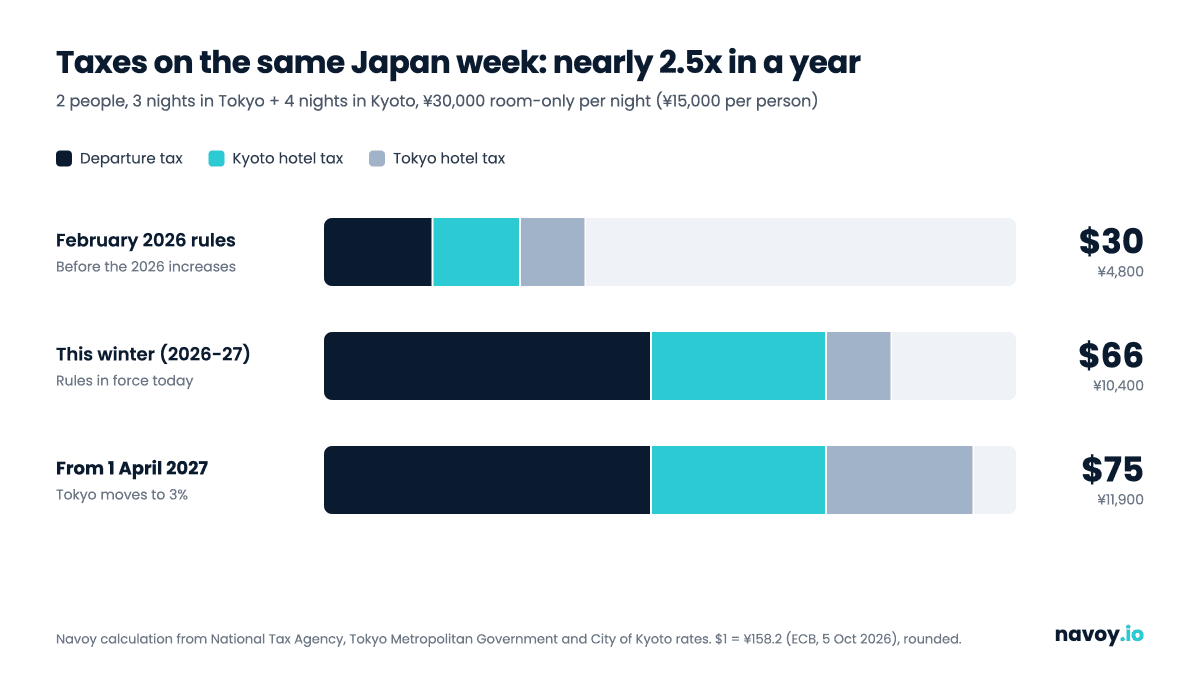
That is our original number: the tax bill on the same mid-range week rises nearly 2.5 times in just over a year, from ¥4,800 to ¥11,900. The departure tax is the largest single part, at more than half of the total. Hotel taxes are the part you can steer by your choice of room, and in Kyoto especially, the tier you land in can matter more than the number of nights.
Even at $75, the taxes are small next to the hotel bill itself: about ¥210,000 (about $1,327) for the seven nights in this example. Plan with the room rate first. If you want to see that week laid out with real hotels, build it in Navoy.
Is JESTA a new fee for visiting Japan?
Not yet. Japan's parliament passed the law creating JESTA, an online travel authorisation for visa-free visitors, on 29 May 2026. It must start by 31 March 2029, on a date the government will set. No fee has been published, and nobody pays it today.
When it arrives, visa-free visitors will apply online before travelling, much like the electronic authorisations several other countries already require. Until the start date is fixed, plan on the departure tax and hotel taxes only.
How do you pay Japan's travel taxes?
You rarely pay them separately. The departure tax is inside your airline or cruise fare. Hotel taxes are collected by the hotel, either in the prepaid total or at check-in, usually as a separate line. If a booking site's price excludes local taxes, expect to settle the difference at the front desk.
A few habits keep it simple:
- Check the tax line before you pay. Some booking totals include the city tax, others list it as "pay at property".
- Carry a little cash for small inns. Most hotels take cards, but a ¥200 or ¥400 charge at a small ryokan may be easier in cash.
- Count per person, not per room. Every tiered city on this list sets its tiers by the per-person, per-night rate.
Frequently asked questions
Do children pay Japan's tourist taxes?
Children under 2 do not pay the departure tax. For hotel taxes it depends on the city: Tokyo taxes children whose per-person rate crosses the threshold, and Kyoto exempts only school trips and events and certain nursery outings.
Is Japan's departure tax included in my flight price?
Yes. Airlines and cruise lines collect the ¥3,000 (about $19) and pass it to the government, so it appears in the taxes and fees on your ticket. You do not pay anything extra at the airport.
Do Japanese residents pay these taxes too?
Yes. The departure tax applies to everyone leaving Japan by air or sea, whatever their nationality, and the hotel taxes apply to every guest, Japanese or foreign.
Is anything changing for tax-free shopping?
Yes. From 1 November 2026, Japan's tax-free shopping moves to a refund system: you pay the consumption tax at the till, and the shop refunds it after customs confirms, when you leave within 90 days of purchase, that you are taking the goods out of Japan.
Sources
- National Tax Agency: International Tourist Tax, basic knowledge - the ¥3,000 rate, the transition for tickets issued by 30 June 2026, exemptions (under 2, air transit within 24 hours), collection by carriers
- Japan Tourism Agency: use of the International Tourist Tax - the revision from 1 July 2026 and the policies it funds
- Japan Tourism Agency commissioner briefing, June 2026 - the increase funds overtourism measures and spreading visitors to regional areas
- Tokyo Metropolitan Government press release, 30 June 2026 - minister's consent, 3% from 1 April 2027, the ¥13,000 threshold
- Tokyo Bureau of Taxation: accommodation tax review - current ¥100 and ¥200 rates, capsule hotels and private rentals added, about 30% of private rentals taxable
- Tokyo Bureau of Taxation: for guests - room-only rate, children taxed above the threshold
- City of Kyoto: accommodation tax - the five tiers from 1 March 2026, previous rates, room-only rate excluding consumption tax, exemptions
- Osaka Prefecture: for guests - rates from 1 September 2025 and the previous rates
- City of Sapporo: accommodation tax - city and Hokkaido rates, start on 1 April 2026
- Town of Kutchan: accommodation tax - 3% including Hokkaido's share from 1 April 2026
- City of Fukuoka: accommodation tax outline - ¥200 and ¥500, each including ¥50 prefectural tax
- Immigration Services Agency: 2026 amendment - JESTA law enacted 29 May 2026, in force by 31 March 2029
- National Tax Agency: tax-free shopping refund system - the refund method from 1 November 2026, customs check within 90 days
- National Tax Agency: International Tourist Tax Q&A (revised April 2026) - conditions of the ¥1,000 transition rule
- European Central Bank reference rates - dollar conversions, 5 October 2026
All figures verified 6 October 2026.
Related reading: Tourist taxes 2026: Greece, Venice, Kyoto and 7 more · Tourist taxes coming in 2027 · How many days in Kyoto
Plan the whole Japan trip in one place. Navoy builds your itinerary city by city, then lets you book the hotels, flights and airport transfers to match. Start your trip plan · Find hotels in Tokyo · Search flights
About the Author
Haroun Moula
Haroun Moula is the founder and CEO of Navoy. Before Navoy, he worked in luxury travel with VVIPs and high-profile travelers. He built Navoy to bring curated, adaptive trip planning to more travelers through an AI travel agent that plans and books core trip parts in one place.