Key Takeaways
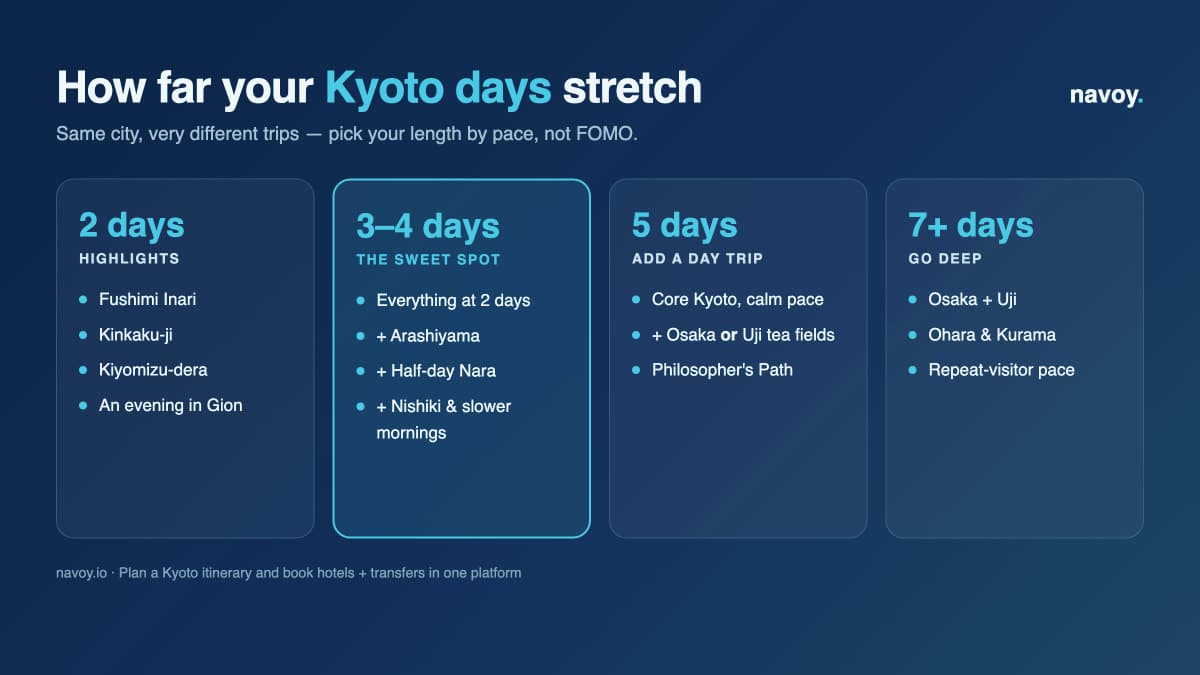
- 3–4 days is the sweet spot for a first Kyoto trip: the headline temples, Gion, Arashiyama, and one day trip without rushing.
- 2 days covers only the highlights; 5+ days adds Nara, Osaka, Uji, and a slower pace.
- From March 2026, Kyoto's lodging tax reaches up to ¥10,000 (about $65) per person, per night at top-end hotels; rooms under ¥6,000 stay at ¥200.
- The best months are late March to April (cherry blossoms) and November (autumn colour) — also the most crowded, so book months ahead.
- Kyoto has 1,600+ Buddhist temples and 400+ Shinto shrines, so the real question is which to skip.
How many days in Kyoto is enough?
For most first-time visitors, 3 to 4 days in Kyoto is enough. Three days covers the essential temples, Gion, and Arashiyama with a half-day in Nara. A fourth day trades the rush for slower mornings, Nishiki Market, and the Philosopher's Path. Two days works only as a highlights sprint; five or more suits repeat visitors and photographers.
Kyoto is not a city you "finish." It holds over 1,600 Buddhist temples and 400 Shinto shrines, from the roughly 10,000 vermillion torii gates of Fushimi Inari to the gold-leaf Kinkaku-ji. So the honest way to choose your trip length is by how much walking, temple-hopping, and quiet garden time you actually want, not by trying to see everything.

Here is what each trip length realistically gets you.
| Trip length | Best for | What you'll cover | What you'll miss |
|---|---|---|---|
| 2 days | A layover or add-on to Osaka/Tokyo | Fushimi Inari, Kinkaku-ji, Kiyomizu-dera, an evening in Gion | Arashiyama, day trips, slow mornings |
| 3 days | First-timers on a tight schedule | Everything above + Arashiyama bamboo grove + a half-day in Nara | Osaka, Uji, northern Kyoto |
| 4 days | The sweet spot for most people | The 3-day plan at a calmer pace + Nishiki Market + the Philosopher's Path | Multi-region deep dives |
| 5–7 days | Repeat visitors and photographers | Adds Osaka, the Uji tea fields, and Ohara or Kurama | Very little that's essential |
What can you do in Kyoto in 2 days?
Two days in Kyoto covers the icons but little else. Spend day one in southern and eastern Kyoto (Fushimi Inari at dawn, then Kiyomizu-dera and the Higashiyama lanes down to Gion), and day two on Kinkaku-ji and central Kyoto. You'll see the postcard sights, but you'll be moving fast and skipping Arashiyama and any day trips.
Two days makes the most sense when Kyoto is one stop on a wider Japan route, for example a base in Osaka with a train hop across. Kyoto and Osaka sit under 30 minutes apart by train, so a short Kyoto visit pairs naturally with a longer stay next door.
What's the ideal 3 to 4 day Kyoto itinerary?
A 3-day plan built around Kyoto's three main zones — Higashiyama, Arashiyama, and central/southern Kyoto — hits every headline sight without backtracking, and a fourth day adds breathing room plus a day trip. Here's a day-by-day version you can lift straight into a trip planner.
Day 1 — Higashiyama and Gion
Start early at Kiyomizu-dera, then walk down through the preserved slopes of Ninenzaka and Sannenzaka toward Yasaka Shrine and the geisha district of Gion. Finish with dinner near Pontocho Alley. This eastern belt is the most atmospheric introduction to old Kyoto.
Day 2 — Arashiyama and Kinkaku-ji
Head west to the Arashiyama bamboo grove and Tenryu-ji temple in the morning, when the light is best and the paths are quieter, then cross the city to Kinkaku-ji, the Golden Pavilion, in the afternoon.
Day 3 — Fushimi Inari and central Kyoto
Beat the crowds with a sunrise walk up the Fushimi Inari torii gates, then spend the afternoon at Nijo Castle and Nishiki Market. If you'd rather swap a temple day for something different, this is the day to take a 45-minute train to Nara to see the great Buddha at Todai-ji and the free-roaming deer.
Day 4 (optional) — Slow down or day-trip
Use a fourth day to breathe: the 2 km cherry-tree canal of the Philosopher's Path, a tea ceremony, or a day trip to the Uji tea fields and the UNESCO-listed Byodo-in. Four days is where Kyoto stops feeling like a checklist.
How many days do you need for day trips from Kyoto?
Add one day per major day trip. Kyoto is one of Japan's best day-trip hubs, so if Nara, Osaka, or Uji are on your list, budget a full day for each on top of your core Kyoto time.
- Nara — about 45 minutes by train; half a day is enough for Todai-ji and Nara Park.
- Osaka — under 30 minutes; a full day for Dotonbori street food, Osaka Castle, and Shinsekai.
- Uji — just south of Kyoto; a relaxed day of tea fields, riverside walks, and Byodo-in.
This is the single biggest reason trips stretch from 3 days to 5. If you want two day trips, plan for 5 days total.
When is the best time to visit Kyoto?
The best times to visit Kyoto are late March to April for cherry blossoms and November for autumn colour — the two most beautiful and most crowded windows of the year. Both bring comfortable temperatures and Kyoto's famous scenery, and both fill hotels months in advance.
If your priority is fewer crowds and lower prices, the early-summer and winter shoulder seasons are far calmer. You'll trade peak foliage for quiet temples and easier bookings, which many repeat visitors now prefer as Kyoto works to manage overtourism. Whichever season you choose, the sights don't change; the crowds and the price do.
How much does a Kyoto trip cost in 2026?
Budget roughly $100–$180 per person, per day for mid-range travel in Kyoto in 2026, and read hotel quotes carefully — a new lodging tax lands in March 2026. From that month, Kyoto introduces Japan's highest accommodation tax, charged per person, per night and collected by your hotel at check-in or check-out.
| Room price per night | Lodging tax before | Lodging tax from March 2026 |
|---|---|---|
| Under ¥6,000 (~$39) | ¥200 | ¥200 (no change) |
| Mid-range | ¥500 | ¥1,000 (~$6.50) |
| ¥100,000+ (~$650) | ¥1,000 | ¥10,000 (~$65) |
Tiers are simplified; Kyoto's structure has several bands. Check your exact rate at booking. Source: Kyoto City via Japan Travel.
The practical takeaway: the tax barely touches budget and mid-range stays, but it adds up fast at luxury hotels, and it's usually added at checkout rather than shown in the advertised nightly rate. Booking early and knowing your tax band up front keeps the final bill from surprising you.
How can you avoid the crowds in Kyoto?
Go early, go west, and respect the local rules. Kyoto's most-photographed spots — Fushimi Inari, the Arashiyama bamboo grove, and Gion — are calm at sunrise and packed by mid-morning. Front-loading them, then saving temples and gardens for the afternoon, changes the whole trip.
A few specifics that matter in 2026:
- Start at dawn. Fushimi Inari is open 24 hours and is genuinely peaceful before 8 a.m.
- Mind Gion's private lanes. After repeated incidents, Gion has restricted photography on some private streets; stick to the public routes and keep your distance from geiko and maiko.
- Consider a base just outside the busiest districts. Staying a short train ride from Higashiyama can mean quieter evenings, easier bookings, and a lower lodging-tax band.
Plan and book your Kyoto trip in one place with Navoy
Kyoto is a lot of moving parts: temple timings, day trips, the right neighbourhood, and now a lodging tax that varies by room. Navoy is an AI travel agent that turns all of that into one booked plan. Describe your trip — how many days, your pace, your budget split between hotels and experiences — and Navoy builds a day-by-day Kyoto itinerary, then lets you book hotels and airport transfers in one platform. For the day-by-day version of the plan above, start with our Kyoto destination guide.
Navoy's free plan covers up to three trips of up to 14 days each, so a 3 or 4-day Kyoto trip fits comfortably at no cost. Navoy does not book flights; it focuses on planning, hotels, and transfers.
Frequently Asked Questions
Is 3 days enough for Kyoto?
Yes, 3 days is enough for a first visit. It covers the essential temples — Kiyomizu-dera, Kinkaku-ji, and Fushimi Inari — plus Arashiyama, an evening in Gion, and a half-day trip to Nara. You'll move at a steady pace and skip Osaka and Uji, but you won't miss anything iconic in Kyoto itself.
How many days should I spend in Kyoto and Tokyo together?
For a first trip covering both, plan 7 to 10 days: 3 to 4 days in Kyoto and 3 to 4 in Tokyo, with travel time between them on the bullet train. That leaves room for a day trip from each city, such as Nara from Kyoto or Hakone from Tokyo.
What is the cheapest time to visit Kyoto?
Winter (December to February, excluding New Year) and the early-summer weeks before the rainy season are the cheapest and least crowded times to visit Kyoto. You'll find lower hotel rates and quiet temples, in exchange for colder or wetter weather and no cherry blossoms or autumn foliage.
Is Kyoto or Osaka better to stay in?
It depends on your trip. Kyoto suits temples, gardens, and a slower, traditional pace; Osaka suits food, nightlife, and lower hotel prices. Since they're under 30 minutes apart by train, many travellers base in one and day-trip to the other rather than splitting hotels.
Sources
- UNESCO World Heritage Centre — Historic Monuments of Ancient Kyoto
- Japan Travel — Kyoto Lodging Taxes to Increase From March 2026
- Fox News Travel — Kyoto tackles overtourism with new hotel tax starting 2026
- Trip To Japan — How Many Days in Kyoto? 2, 3, 4 & 5-Day Itineraries
Related reading: pair this with our Kyoto destination guide, Kyoto vs Osaka: which to base yourself in (publishing next), and how AI trip planning compares to a human travel agent.
Ready to turn "how many days in Kyoto" into a booked plan?
Plan and book your trip with Navoy →
Tell Navoy your dates, pace, and budget, and it builds your day-by-day Kyoto itinerary and books your hotels and airport transfers in one platform.
About the Author
Ranym Garali
Ranym is the Marketing and Content Lead at Navoy. She's been writing about travel for two years and digs into the data behind each piece, flight prices, visa rules and what people are actually searching for , so the advice holds up in practice.