Key Takeaways
- AI travel planners and human travel agents aren't competing on price — they serve different decision modes. AI handles breadth, speed, and iteration; human agents handle leverage, trust, and recovery.
- AI plans the typical trip in minutes for free or under $15/month. Human agents typically charge $100–$500 in planning fees, plus commission baked into bookings.
- DIY is the most expensive option in disguise — travelers spend 15–30 hours researching a single multi-city week, according to industry surveys.
- Travel agents haven't disappeared — the American Society of Travel Advisors (ASTA) reports the industry is consolidating up-market into complex, luxury, and high-stakes trips.
- Most modern travelers need both at different moments. AI for the 80% of standard trips. A human for multi-country logistics, large groups, or anything where something going wrong is unacceptable.
If you're planning a trip in 2026 and comparing AI travel agent vs human travel agent, the most useful answer isn't "which is better?" — it's "which one does this trip actually need?"
AI travel agents and human travel agents serve different decision modes, not different price tiers. AI is built for breadth, speed, and iteration — turning structured preferences into a day-by-day plan in minutes. Human agents are built for leverage, trust, and recovery — handling complex multi-country trips, high-stakes occasions, and the moments when something goes wrong at 3 a.m. in a foreign airport. Here's how each works, what each costs in 2026, and how to decide.
The shift to AI planning is already mainstream: per Phocuswright's 2026 update, 39% of US travelers had already used AI for travel planning by mid-2025. But booking trust hasn't fully followed — Expedia Group's 2026 AI Trust Gap survey (YouGov, 5,700+ adults across US/UK/India) found that 53% are comfortable with AI suggesting options, while 68% still prefer to book through trusted travel brands. Translation: planning has shifted faster than booking confidence — and that gap is exactly where the AI-vs-human decision matters most.
What is an AI travel agent?
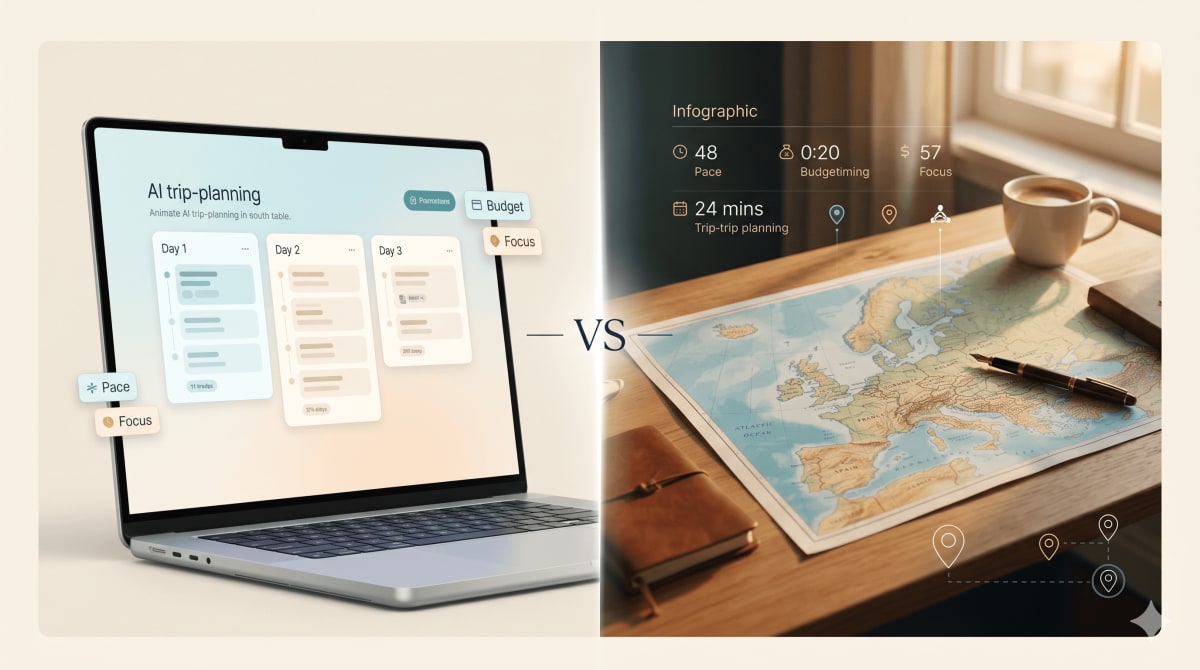
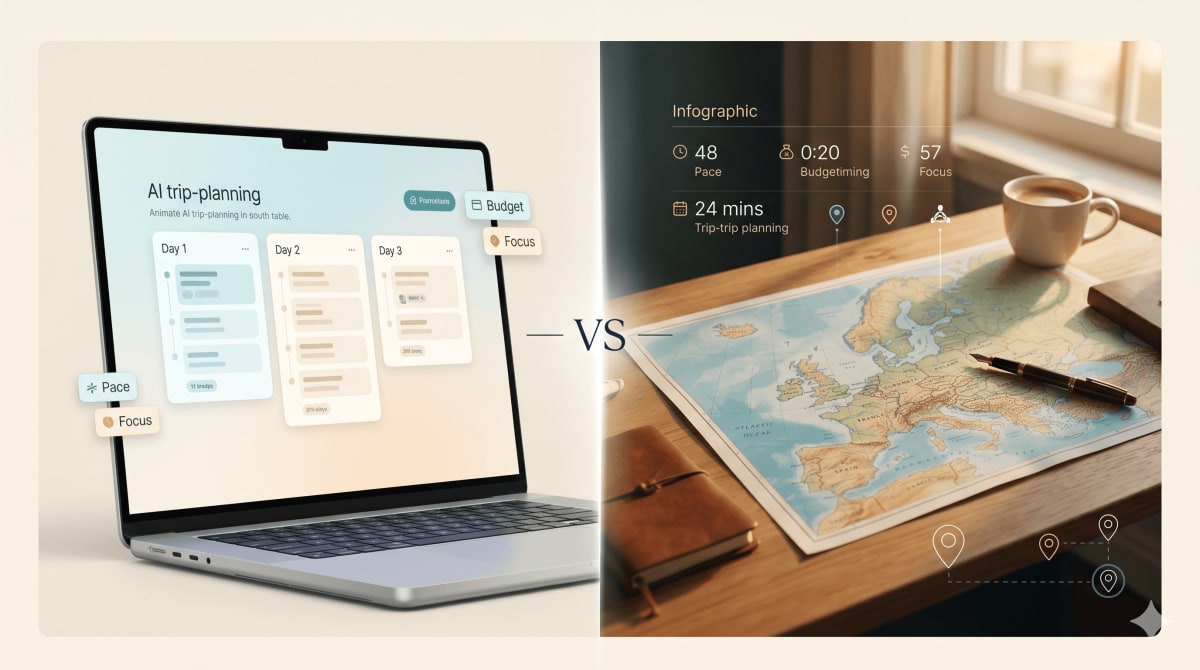
An AI travel agent is software that generates a personalized, day-by-day trip plan from your structured preferences — destination, dates, group, interests, pace, and budget — in minutes. Instead of a generic top-10 list, you get a plan tuned to who you are, what you care about, and how you like to travel.
The core mechanic is structured input. A modern AI planner asks you for explicit signals — pace (relaxed, balanced, packed), trip focuses (food, culture, family, wellness), budget split (more on hotels or more on experiences), accessibility needs, dietary restrictions — and weighs hundreds of options against those signals. The output is a draft itinerary you can refine, regenerate, or swap on the fly.
What AI does well:
- Speed — first draft in minutes, not days.
- Breadth — weighs a much wider pool of hotels, transfers, restaurants, and activities than any single advisor's book.
- Iteration — change one input and the whole plan reshapes around it.
- Cost transparency — most planners are free or low-subscription rather than fee-for-service.
What AI is weaker at: subjective taste, genuinely novel destinations, and high-stakes recovery when something goes wrong on the ground. We'll come back to that.
Pros and cons of AI travel planners
AI travel planners are strongest on speed, cost, and iteration — and weakest on supplier leverage, taste, and crisis recovery. Knowing the trade-off up front saves you from picking the wrong tool for the trip.
Pros:
- Speed. First draft in minutes; full itinerary in under an hour including refinement.
- Cost. Most planners are free or under $15/month — orders of magnitude cheaper than fee-based advisory.
- Iteration. Change one input — pace, budget split, focus — and the plan reshapes instantly.
- Breadth of options. Weighs hundreds of hotels, transfers, and activities a single advisor wouldn't surface.
- Privacy and control. No back-and-forth, no scheduled calls, no advisor preferences shaping the plan.
- Always on. Works at midnight on a Sunday when no agent is picking up.
Cons:
- Limited supplier leverage. AI quotes public rates; it can't phone a hotel GM for an upgrade.
- Weaker on novel destinations. Coverage drops for very remote, very new, or very niche places.
- Self-serve recovery. When a flight cancels, you handle it — no human escalation path.
- Less editorial taste. AI is good at logical fit; humans are better at the feel of a trip.
- Quality depends on inputs. A planner that doesn't ask for pace, budget split, and preferences cannot personalize — only generate.
The honest read: AI handles 80% of trips faster and cheaper than any human could. For the other 20%, the cons start to bite.
What is a traditional travel agent?
A traditional travel agent is a human professional who plans, books, and manages trips on your behalf — paid through some combination of planning fees, supplier commission, and (for higher-end advisors) retainers. The category covers everything from high-street consumer agencies to independent advisors and full-service luxury concierges.
What you actually buy from a human agent isn't a website you couldn't have used yourself. It's four things:
- Time — they do the research, the bookings, and the back-and-forth so you don't.
- Supplier leverage — established advisors have relationships with hotels and operators that can produce upgrades, late availability, or better terms than public rates.
- Trust — a single person on speed dial who knows your trip and your preferences.
- Recovery — when a flight cancels or a strike hits, you call them, not a queue.
According to ASTA, the agent profession hasn't been hollowed out the way headlines suggested in the 2010s — it has consolidated. The basic city-break bookings that didn't need an agent in the first place have moved online. The trips that genuinely benefit from a human — complex multi-country itineraries, large groups, luxury, high-stakes occasions — have stayed.
How do AI travel agents and human travel agents compare?
Side-by-side, they trade off across eight axes — and the right pick depends on which axes matter for your trip.
| Factor | AI Travel Agent | Human Travel Agent |
|---|---|---|
| Speed | First plan in minutes | First draft in days to weeks |
| Cost | Free to ~$15/month | $100–$500 planning fees + commission |
| Personalization | Structured inputs, fast iteration | Conversational, taste-led |
| Supplier leverage | Limited (public rates + integrations) | Strong for established advisors |
| Multi-country complexity | Good for 1–3 cities; weaker beyond | Strong, especially for 4+ legs |
| Disruption recovery | Self-serve; depends on platform | Direct human contact, faster fix |
| Iteration after first draft | Instant — regenerate, swap, refine | Slower, needs back-and-forth |
| Best for | Standard trips, tight budgets, control | Complex trips, special occasions, high stakes |
A few rows do most of the work in deciding.
Speed and iteration are where AI is structurally ahead. Once your inputs are explicit, regenerating an itinerary costs you nothing — you can try a "more relaxed" version, a "more packed" version, and a "less expensive" version in under five minutes. A human advisor optimising for cost will not iterate that fast.
Supplier leverage and recovery are where humans are structurally ahead. An AI planner cannot phone the general manager of a hotel to fix a botched check-in. An established advisor can. For most trips that doesn't matter; for some, it's the entire point.
AI trip planner vs travel agent cost: what does each pay for in 2026?
An AI travel planner is typically free or low-subscription. A human travel agent typically costs $100–$500 in planning fees plus commission baked into bookings — and the most expensive option of all is doing it yourself.
Concrete ranges to anchor expectations:
- AI travel planners. Most have a free tier. Paid plans are usually under $15/month. Navoy, for example, is free for up to 3 trips of up to 14 days each; Pro is $12.99/month and removes those limits (see Navoy pricing).
- Human travel agents. Planning fees of $100–$500 for a leisure trip are typical, depending on complexity and the advisor's tier. Luxury advisors may charge $500–$2,500+ as a retainer for a multi-week, multi-country itinerary. Some agents waive fees and earn through supplier commission, but commission can shape which suppliers they recommend — worth asking about.
- DIY. Cash cost: $0. Time cost: industry surveys repeatedly land in the 15–30 hours range for a multi-city week. At any reasonable hourly value of your time, that's the most expensive option you'll consider.
The point isn't that one is "cheaper." It's that the trip dictates the trade. A weekend in Lisbon almost never justifies a $300 planning fee. A three-week honeymoon across four countries with elderly parents probably does.
When to use a travel agent vs AI
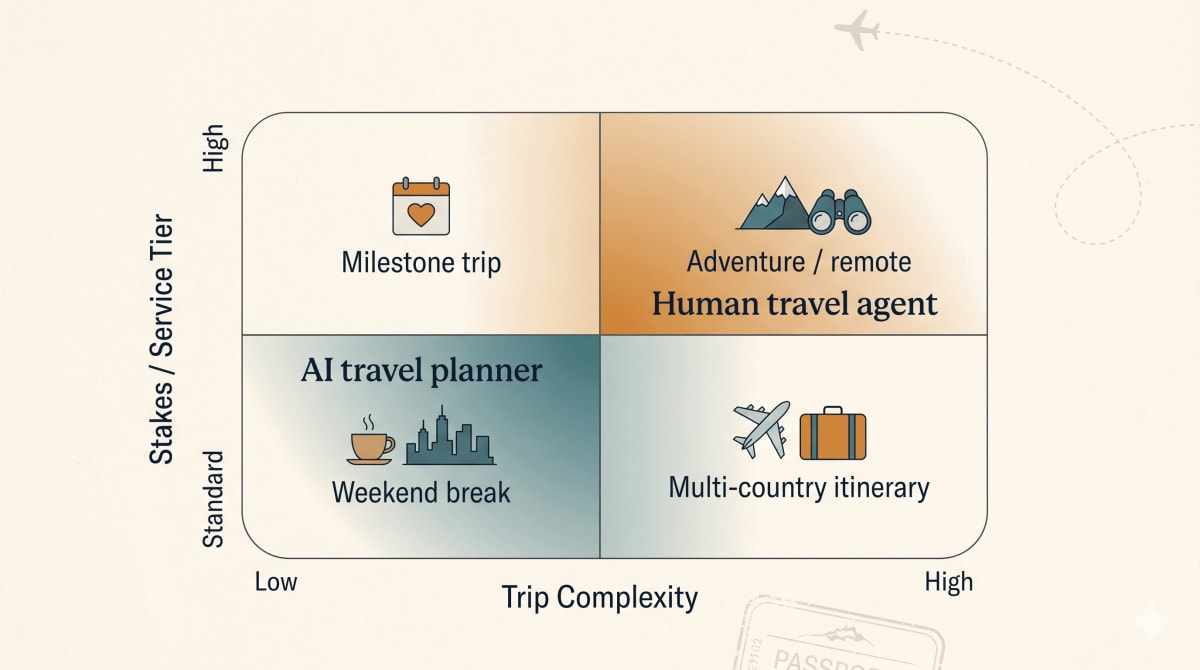
Use AI when the trip is reasonably scoped and you want control. Use a human agent when complexity, stakes, or service tip past what software can carry. For many travelers, the right answer is using both.
A practical decision matrix:
| Trip Type | Better Fit | Why |
|---|---|---|
| Weekend city break | AI planner | Standard destination, low complexity, fast iteration matters |
| 1–2 week single-country trip | AI planner | Plenty of structured options; cost matters |
| Multi-country, 3+ legs | Human agent | Logistics chains compound; supplier leverage helps |
| Family with accessibility needs | Either, often both | AI to draft; human to validate the harder constraints |
| Honeymoon / milestone trip | Human agent | Service tier and recovery matter more than cost |
| Adventure / remote destinations | Human agent | Operator relationships matter; AI coverage thinner |
| Business travel | AI planner | Speed and iteration; preferences are stable |
| Last-minute crisis rebooking | Human agent | Phone-a-human beats self-serve under pressure |
Use AI when:
- The trip is one to three cities and you've got rough dates and a budget in mind.
- You enjoy some control over the plan and want to iterate quickly.
- You're booking on a tight budget and a planning fee would meaningfully eat into the trip itself.
- Your destination is well-covered by mainstream travel data (most are).
Use a human travel agent when:
- The itinerary spans four or more legs, or three or more countries.
- The group includes children with specific needs, elderly travelers, or accessibility constraints that are hard to pre-encode.
- The occasion is high-stakes — a milestone honeymoon, a 70th birthday, a once-in-a-lifetime safari — where service tier and trust matter more than cost.
- You're traveling during a known chaos window (a major event, peak season, an operationally fragile region) where recovery capability is genuinely valuable.
- You simply don't want to think about it. That's a legitimate reason to pay for the service.
Use both when:
- You want a fast draft to argue from before talking to a human.
- You want a human to negotiate or validate after AI has done the legwork.
This stacking pattern — AI to draft, human to refine — is increasingly how travel professionals work internally. There is no rule against using it as a traveler.
Can AI replace travel agents?
No — and that isn't really the question. AI removes friction from the kinds of trips that didn't need a human in the first place. It does not replace the work of a skilled advisor on a complex, high-stakes, or relationship-heavy itinerary.
What's actually happening is segmentation. Standard, well-scoped trips have moved to software, where they're built faster and cheaper than any advisor could match. Complex trips — multi-country, luxury, accessibility-heavy, crisis-prone — have stayed with human advisors, who can deliver leverage, taste, and recovery that software cannot. Both categories are growing; they're just growing in different directions.
Per UN Tourism's barometer, global trip volumes are at or above pre-pandemic levels — there is more travel, planned in more ways, by more people than ever. The category is large enough for both modes to thrive without one having to lose.
FAQ
Are AI travel planners better than travel agents?
Neither is universally better. AI planners are stronger for speed, cost, and iteration on standard trips. Human agents are stronger for supplier leverage, complex multi-country logistics, and recovery during disruption. The right pick is the one that matches the trip's complexity and stakes — not the one that wins on price alone.
Do travel agents still exist in 2026?
Yes. The agent profession has consolidated rather than disappeared. According to ASTA, advisors today concentrate on complex, luxury, and high-stakes trips — exactly the segments where software still struggles. The basic bookings that don't need a human have moved online.
Is it safe to book through an AI travel agent?
Yes, when the platform handles bookings inside its own system rather than redirecting to third parties. Look for clear cancellation policies, transparent pricing, and a visible support channel. On Navoy, hotels and transfers are bookable directly inside the platform; flights are currently selectable at planning stage.
How much does a human travel agent cost?
Planning fees of $100–$500 are typical for a leisure trip, depending on complexity and tier. Luxury advisors may charge $500–$2,500+ as a retainer for multi-week, multi-country itineraries. Some agents waive fees and earn through supplier commission — fair, but worth asking how that shapes their recommendations.
Can an AI travel agent handle a multi-country trip?
For one to three countries with reasonable scope, yes — most modern AI planners coordinate inter-city transport, hotels, and activities cleanly. For four or more legs, complex visa stacking, or unusual operators, a human travel agent typically delivers a more reliable plan because logistics chains compound and supplier relationships matter more.
The Bottom Line
The honest answer to "AI travel agent or human travel agent?" is that they aren't substitutes. They're tools for different decision modes. AI is the right call for the 80% of trips that are well-scoped, time-pressured, or budget-sensitive. A human advisor is the right call for the 20% where complexity, stakes, or service tier tip past what software can carry. Most travelers, over the course of a year, will end up using both — and the most useful skill in 2026 isn't picking one camp, it's knowing which trip belongs to which mode.
Plan your next trip with Navoy
Navoy turns your preferences — focus, pace, budget split, group, accessibility — into a personalized, bookable itinerary in minutes. Free for up to 3 trips; Pro is $12.99/month for unlimited trips. Create your first trip →
Related articles
- Personalized vs Generic Itinerary: Which Works Better?
- The 2026 Eclipse: Why Spain Beats Iceland for Most Travelers
- Explore Lisbon — destination hub
About the Author
Haroun Moula
Haroun Moula is the founder and CEO of Navoy. Before Navoy, he worked in luxury travel with VVIPs and high-profile travelers. He built Navoy to bring curated, adaptive trip planning to more travelers through an AI travel agent that plans and books core trip parts in one place.