Key Takeaways
- Six tourist taxes are confirmed for 2027, starting with Glasgow on 25 January and ending with West Dunbartonshire and Vienna on 1 July.
- VAT is charged on top of the levy in every UK case. Aberdeen's headline 7% works out at roughly 8.4% once VAT is added.
- Most schemes have no night cap. Glasgow, Aberdeen and West Dunbartonshire charge for every night of your stay. Stirling stops at seven.
- No UK scheme exempts business travellers, though several exempt disability benefit recipients and people in temporary accommodation.
- Several places in circulation as "2027 tourist taxes" have not voted. Norway has no approved municipality, and Highland cannot start before 2028.
Six tourist taxes have been voted through with confirmed 2027 start dates: Glasgow, Aberdeen, Cardiff, Stirling, West Dunbartonshire and Vienna. Two details separate what you will actually pay from the headline rate. VAT is added on top of the levy in every UK scheme, so Aberdeen's 7% is closer to 8.4% at the till. And most of these have no night cap at all, which means a fortnight pays for fourteen nights rather than the five or seven that capped schemes allow.
If you want to know what you are charged today rather than next year, we cover the current rates in how much tourist taxes cost in 2026. This article is only about what is coming.
Which tourist taxes are confirmed for 2027?
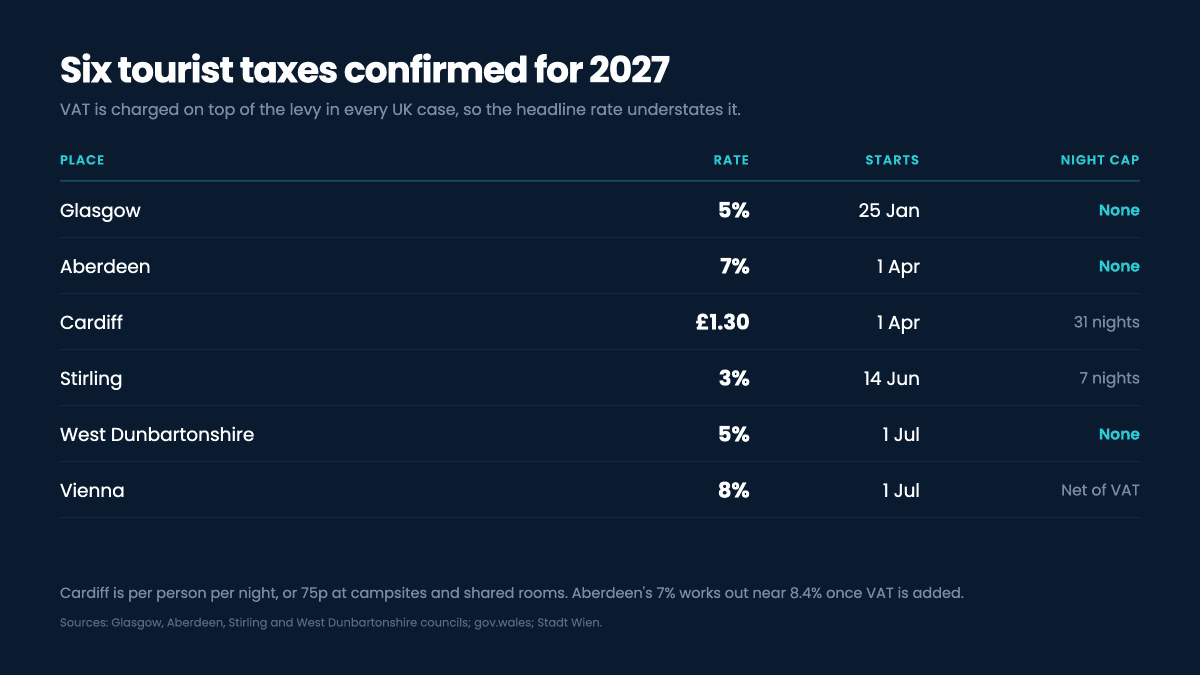
Six, all with a council or government vote behind them and a set start date. Glasgow is first on 25 January 2027, followed by Aberdeen and Cardiff on 1 April, Stirling on 14 June, and West Dunbartonshire and Vienna on 1 July.
| Place | Rate | Applies to | Starts |
|---|---|---|---|
| Glasgow | 5% of the accommodation bill | Hotels, hostels, guest houses, B&Bs, self-catering | 25 Jan 2027 |
| Aberdeen | 7%, calculated before VAT | Accommodation charge only, not parking or meals | 1 Apr 2027 |
| Cardiff | £1.30 per person per night, or 75p | £1.30 hotels and similar; 75p campsites and shared rooms | 1 Apr 2027 |
| Stirling | 3% | All paid overnight accommodation, year-round | 14 Jun 2027 |
| West Dunbartonshire | 5% | Hotels, hostels, B&Bs, self-catering, caravan and camping, yurts | 1 Jul 2027 |
| Vienna | 8%, up from 5%, of the net accommodation charge | Paid accommodation, excluding VAT and breakfast | 1 Jul 2027 |
Two of these already affect bookings you might make now. Glasgow's levy applies to bookings made from 1 April 2026 onwards for stays after the start date, and West Dunbartonshire's to bookings from 1 October 2026. So if you are booking a 2027 trip to either during this winter, the charge is already attached.
Edinburgh is the precedent the rest are following. Its 5% levy went live on 24 July 2026 and is covered in our 2026 article rather than here.
Why is the headline rate not what you pay?
Because VAT is charged on top of the levy in every UK scheme. The council takes its percentage of the accommodation cost, and then VAT applies to that levy amount as well, so a 7% levy adds roughly 8.4% to your bill.
Aberdeen states the mechanism directly: the 7% is calculated on the accommodation charge before VAT, and the levy then carries the same VAT liability as the accommodation itself. Cardiff is more explicit still, confirming that a VAT-registered provider must add 20% VAT to the levy amount.
Worked through on a £150 room in Aberdeen, the 7% levy is £10.50, and the VAT on that levy is a further £2.10. The line on your bill is £12.60, not £10.50.
Vienna works the opposite way. Its 8% is calculated on the net accommodation charge, which specifically excludes both VAT and breakfast. So the Vienna figure is closer to what you actually pay than any of the UK ones, despite being the highest headline rate of the six.
This is the detail almost every round-up of upcoming tourist taxes leaves out, and it is the difference between budgeting accurately and being surprised at checkout.
How many nights do you actually pay for?
Three of the six have no cap at all, so you pay for every night. Stirling stops charging after seven nights and refunds anything collected beyond that. Cardiff applies its charge only to stays of 31 nights or less.
| Place | Night cap |
|---|---|
| Glasgow | None. Full length of stay |
| Aberdeen | None |
| West Dunbartonshire | None |
| Stirling | 7 nights, charged upfront then refunded beyond night 7 |
| Cardiff | Applies to stays of 31 nights or less |
The practical effect is large on a longer trip. A fortnight in Glasgow is charged at 5% across all fourteen nights. The same fortnight in Stirling is charged for seven and free for the rest, which on an identical bill is roughly half the levy.
It also means the uncapped schemes hit long stays hardest, which is the opposite of how Edinburgh's five-night cap works. If you are planning an extended stay in Scotland in 2027, the choice of city changes the arithmetic more than the rate alone suggests.
Who does not have to pay?
The Scottish schemes exempt people receiving UK disability benefits, people in homeless or temporary accommodation, asylum seekers and refugees, and Gypsy and Traveller sites. Stirling additionally exempts local residents. No UK scheme exempts business travellers.
The disability exemption covers Disability Living Allowance, Personal Independence Payment, Attendance Allowance and Pension Age Disability Payment. It is applied at the point of booking or check-in depending on the provider, and normally requires evidence.
Cardiff's exemptions are structured differently: under-18s are exempt at the 75p campsite and hostel rate but not at the £1.30 rate, stays over 31 nights fall outside the scheme, and council-arranged emergency accommodation is excluded.
Vienna exempts under-18s in education, students at Vienna universities, and stays longer than three months.
The business-travel point is worth stating plainly because it is a common assumption. If you are in Glasgow or Aberdeen for work in 2027, you pay the levy exactly as a tourist does.
What is proposed but not confirmed?
Quite a lot, and much of it is being reported as though it were settled. Norway has no approved municipality despite five applications. Highland Council cannot start before 2028. Conwy dropped its levy entirely after public opposition.
Norway passed an enabling law in July 2026 allowing municipalities to charge up to 3% on accommodation, calculated before VAT. Five have applied: Tromsø, Vågan in Lofoten, Lyngen, Karlsøy and Stranda. Tromsø voted locally in June 2026 and submitted its plan in July. But approval rests with the national ministry, and as of September 2026 the ministry had approved none of them. A local regulation is still required after that. Tromsø is the likely first, but it is not legally certain and it does not have a date.
Highland Council is consulting, has not set a rate, and its decision is due at the December 2026 council meeting. An 18-month implementation window follows, which puts any Highland levy into 2028 at the earliest.
Gwynedd and Anglesey are deciding in late September 2026. Gwynedd's earliest possible start is October 2027, not April.
Argyll and Bute reopened its consultation through October 2026.
Conwy is the counterpoint worth knowing. It deferred its levy after 62.1% of 985 valid consultation responses opposed it. These schemes are not inevitable, and public consultation has stopped at least one.
Budgeting a 2027 trip
For a short city break the levy is a rounding error. For a two-week stay in an uncapped city it is a real line item, and it lands on top of accommodation costs that already include VAT.
Navoy can price accommodation across several destinations at once, which is the point at which a 5% uncapped levy in one city and a 3% seven-night-capped one in another actually changes the decision.
Frequently asked questions
When does Glasgow's tourist tax start?
25 January 2027, at 5% of the accommodation bill. It applies to bookings made from 1 April 2026 onwards for stays after that date, so trips booked now for 2027 already carry it. There is no cap on the number of nights charged.
Do I pay VAT on top of a tourist tax?
In the UK, yes. The levy is calculated on the accommodation cost and VAT is then applied to the levy amount as well. Aberdeen's 7% works out at about 8.4% once VAT is added. Vienna's 8% excludes VAT from its base instead.
Is there a limit on how many nights I am charged?
It depends on the city. Glasgow, Aberdeen and West Dunbartonshire charge for every night. Stirling caps at seven nights and refunds beyond that. Cardiff applies only to stays of 31 nights or less.
Do business travellers pay the tourist tax?
Yes. No UK visitor levy scheme exempts business travel. Exemptions cover disability benefit recipients, homeless and temporary accommodation, asylum seekers and refugees, and in Stirling's case local residents.
Sources
- Glasgow City Council committee papers, the approved Glasgow scheme
- Aberdeen City Council, introducing the visitor levy, rate, VAT treatment and scope
- Welsh Government, the visitor levy, the Welsh rates and what they apply to
- Stirling Council, visitor levy scheme, the seven-night cap and resident exemption
- West Dunbartonshire Council, visitor levy scheme, scope and start date
- Stadt Wien, Ortstaxe, the Vienna rate and its net-of-VAT basis
- VisitScotland, visitor levy guidance, scheme-by-scheme summary
Related articles
- How Much Are Tourist Taxes in 2026?
- The 6 Hotel Fees That Were Not in the Price You Clicked
- Is Lisbon Expensive? What Three Days Actually Costs
Comparing 2027 destinations? Let Navoy price the stay with the levy included.
About the Author
Haroun Moula
Haroun Moula is the founder and CEO of Navoy. Before Navoy, he worked in luxury travel with VVIPs and high-profile travelers. He built Navoy to bring curated, adaptive trip planning to more travelers through an AI travel agent that plans and books core trip parts in one place.