Key Takeaways
- A US rule did change the rules in 2025, and it did not ban a single fee. The FTC's own wording: it "does not prohibit any type or amount of fee." It governs how prices are displayed.
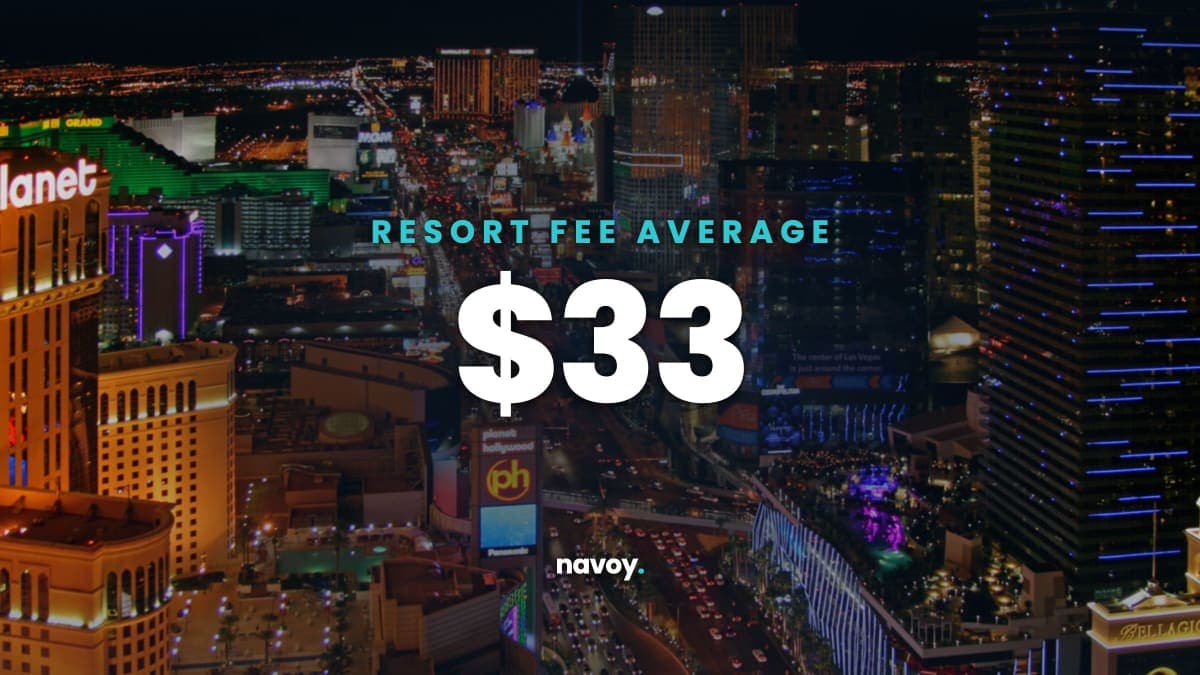
- Resort fees average $33 a night and reach a $55 ceiling in Las Vegas, where the fee is itself taxed at 13.38%, so $55 costs you $62.36.
- Government taxes are legally allowed to sit outside the advertised total in the US, and they run 12 to 17% in most city centres.
- The fees moved rather than disappeared. Mandatory charges went into the headline price, so the growth shifted to optional ones. Hilton spent 2026 putting a price on late checkout across every brand.
- Resort fees are not universal. They hit roughly 6% of US hotels, but disproportionately the ones you actually book in Vegas, Hawaii, Miami and Manhattan.
Six charges routinely land on a hotel bill after the rate you clicked: the resort or destination fee, occupancy taxes, parking, early check-in and late checkout, dynamic currency conversion, and the cleaning fee on a short-term rental. A US rule forced most mandatory ones into the advertised price in May 2025. It banned none of them, and the total you pay has not fallen.
What actually gets added to a hotel bill?
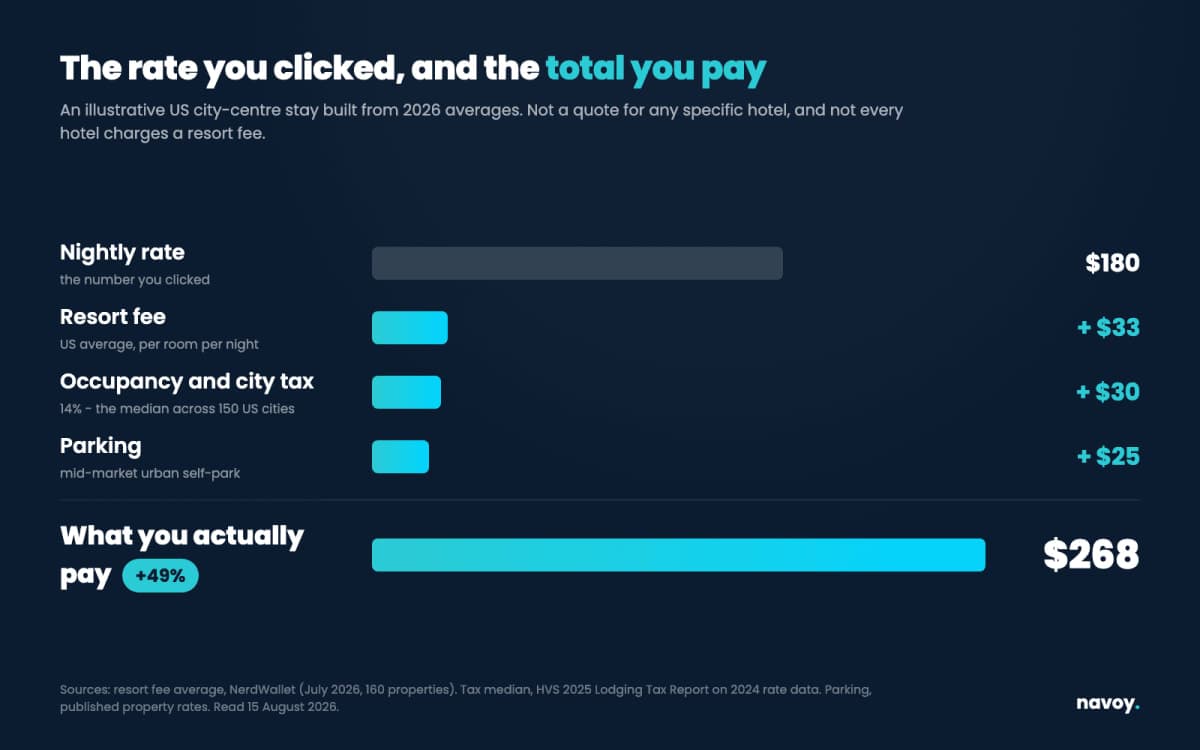
Six things, in rough order of what they cost. A resort fee averages $33 a night and tops out around $55. Government taxes add 12 to 17% in most US city centres. Parking runs $20 to $50 in Las Vegas and $50 to $125 in Manhattan. The rest are smaller individually but easy to trigger by accident.
| Fee | Typical 2026 range | Where it bites | Mandatory? |
|---|---|---|---|
| Resort / destination / amenity fee | $25 to $55 per night | Las Vegas, Hawaii, Miami Beach, Orlando, NYC | Yes |
| Occupancy and city taxes | 12 to 17%, up to 20.5% | Everywhere, worst in Omaha, Cincinnati, St. Louis | Yes |
| Parking | $20 to $50 Vegas, $50 to $125 NYC | Anywhere urban or resort | Usually optional |
| Early check-in / late checkout | $25 to $99 | Chain-wide, newly productised | Optional |
| Dynamic currency conversion | 2 to 5% of the folio | Any hotel abroad | Optional, but opt-out |
| Cleaning fee | $50 to $150 per stay | Airbnb and Vrbo | Yes |
One thing to say plainly before the detail. Resort fees are concentrated, not universal. The American Hotel and Lodging Association puts them at about 6% of US hotels, a share it says has declined over a decade, and the FTC's own 2017 analysis said 7%. The catch is that the 6% skews heavily toward the places people actually book.
What is a resort fee, and why is it separate from the room rate?
A mandatory per-room, per-night charge disclosed separately from the rate, nominally covering pool, gym and Wi-Fi access. It averages $33 a night in the US and reaches $55 at the top of the Las Vegas market. You pay it whether or not you use any of it, and it is charged per room, so a solo traveller pays the same as a family of four.
It travels under several names, and they behave identically: resort charge, amenity fee, facility fee, and in cities, the destination fee or urban destination charge. More than 130 New York hotels charge the urban version.
Where a fee exists, the chain averages run: Marriott $50, Hyatt $33.80, Hilton $33, IHG $32.57, Wyndham $25.
The detail almost nobody knows: in Clark County, the resort fee is itself taxed at 13.38%. So a $55 fee costs $62.36. Whether a fee is taxable depends entirely on how the local code defines the taxable base, and there is no national rule.
Estimates of the national average vary because they measure different things. The $33 figure comes from analysing 160 properties, of which 30 charged a fee. A separate industry figure of $26 divides by all US hotels rather than only the ones charging. Both can be true. Treat any unsourced "$42 to $43 national average" with suspicion, since $42.36 is a Las Vegas figure, not a national one.
How much are hotel taxes, and why are they not in the price?
Because the rule that forced mandatory fees into the advertised price exempts government charges. Across the 150 largest US cities the median lodging tax is 14.04%, the maximum is 20.50%, and most city-centre bills land between 12 and 17%, plus a flat excise of $1 to $5 a night.
Five layers can stack: state sales tax, a state lodging tax (25 states have a dedicated one), a county or city occupancy tax, special-district assessments, and the flat per-room-night excise.
The highest are Omaha at 20.50%, Cincinnati 19.30%, St. Louis 18.93%, Memphis 18.25% and Seattle 17.80%. New York is 14.75% plus per-night state and city charges. Chicago has just moved: its first Tourism Improvement District took effect on 1 May 2026, adding 1.5% for hotels of 100+ rooms downtown and pushing affected properties to about 18.9%.
Two 2026 changes worth planning around. Hawaii raised its Transient Accommodations Tax to 11% on 1 January, the "green fee" earmarked for climate resilience. Edinburgh went live with a 5% visitor levy on 24 July, capped at five nights and charged before VAT, the first of its kind in the UK.
In Europe the structure differs by city. Amsterdam charges 12.5% of the room rate, rising to 16% in 2027. Rome charges a flat 3 to 10 euros per person per night by star rating. Barcelona moved to 6 to 12 euros in April 2026. Lisbon is 4 euros, capped at seven nights.
A correction worth carrying: Venice's 5 and 10 euro access fee applies to day-trippers. If you are staying overnight you are exempt from it, and pay the separate city accommodation tax instead. This is reported wrong constantly.
If you are heading to Europe, the entry side has its own moving parts, which we cover in ETIAS requirements for US travellers.
How much is hotel parking?
Free at most suburban and select-service hotels, $15 to $30 a night in mid-market urban ones, and genuinely expensive in Las Vegas, Miami and New York. MGM properties in Las Vegas charge $20 on weekdays and $25 at weekends to self-park, with valet at $40. Manhattan valet runs $65 to $125 a night, plus $10 to $25 more for an SUV.
Miami Beach sits in between, with valet around $40 to $60. Loews Miami Beach publishes $60 a night including tax for valet and $20 a day to self-park across the street.
Parking is legally allowed to stay outside the advertised total because it is optional, which is exactly why it is a reliable source of revenue.
Two ways to reduce it. Casino loyalty tiers often waive it entirely in Las Vegas, and several properties there charge nothing at all. And rates surge or lose their local discounts on major event nights, so check the date rather than the property.
Why are early check-in and late checkout suddenly priced?
Because the 2025 rule pushed mandatory fees into the headline price and left optional ones alone, so that is where the industry went. In 2026 Hilton began standardising confirmed, purchasable late checkout across its brands at $40, $50 or $60 depending on the brand tier, with every hotel opted in by default. Marriott now sells guaranteed early check-in as a bookable product at around $99.
Hilton's fee excludes tax, so the real cost is 10 to 15% higher, and it is sold during booking and in the app up to 72 hours before check-in.
This is the clearest evidence of what the regulation actually did. A charge that used to be a discretionary favour at the front desk is now inventory with a price on it.
Hilton has also begun introducing paid premium Wi-Fi at four of its select-service brands, announced in mid-2026 and reported at around $5 a day. Free basic Wi-Fi remains standard for loyalty members, so the monetisation is the speed tier rather than access.
Both of these are industry-reported rather than confirmed by the chains, so treat the exact amounts as indicative and check at booking.
What is dynamic currency conversion, and why does it cost me?
It is the offer at checkout to bill your foreign hotel stay in your home currency. Accept, and the conversion is done by a payment provider at a rate it sets, rather than by your card network at the wholesale rate. Fieldwork in 2016 measured the markup on in-store card payments at 2 to 5%. The hotel is frequently paid a share of it.
That last part is the bit that explains the enthusiasm at the desk. Payment providers market the revenue share to merchants openly, describing rebates paid weekly or monthly on conversion fees their customers accept.
Two things are true and worth knowing before you travel.
The markup must be printed on your receipt. Visa's own rules require a dynamic currency conversion receipt to show both currency amounts, the conversion rate, and the commission, fee, markup or margin over the wholesale rate. A folio showing your home currency and no margin figure does not meet that standard. In the EU and UK, the charge must additionally be expressed as a percentage over the European Central Bank reference rate.
Declining costs you nothing. Visa forbids a merchant from imposing any additional requirement to have the transaction processed in local currency, and requires that you agree to conversion yourself on a customer-facing terminal. A receptionist tapping through it on a terminal facing away from you is a breach on its face.
Say it at check-in, before the pre-authorisation, rather than at checkout. And watch the fourth moment nobody thinks about: minibar, damage and no-show charges billed to the card on file after you leave, where you never see a terminal at all.
Why is the Airbnb cleaning fee so high?
Because it is a one-off charge set by the host, not by the platform, and more than 75% of US listings carry one. The typical range is $50 to $150 per stay, and the US average across a very large sample is $188. It has been inside the displayed total price worldwide since April 2025.
Here is where the reporting goes wrong, and it is worth getting right.
You will see the claim that cleaning fees are 64% of the nightly rate. That figure is real, from an analysis of 2.4 million listings, but the denominator is one night's rate, not your booking. The fee is charged per stay. On a five-night booking the same $188 is roughly 13% of the total. Airbnb's own position is that cleaning fees average under 10% of the total reservation cost where charged. A separate study of 1,000 US bookings found taxes and fees combined came to 32% of the booking total.
All of those can be true simultaneously, because they measure different things over different stay lengths. The practical takeaway is simpler than the dispute: a cleaning fee punishes short stays. Two nights and it dominates. Ten nights and it is noise.
On Vrbo there is a second-order effect. The traveller service fee, 6 to 15% on a sliding scale, is calculated on the nightly rate plus mandatory host fees including the cleaning fee. A high cleaning fee therefore inflates the service fee on top of itself.
Did the FTC not ban all this in 2025?
No, and this is the most misreported thing on the topic. The FTC's Rule on Unfair or Deceptive Fees took effect on 12 May 2025 and requires the total price including all mandatory fees to be shown up front, more prominently than any other pricing information. In the FTC's own words it "does not prohibit any type or amount of fee, nor does it prohibit any specific pricing strategies."
It covers hotels, motels, inns and short-term rentals including Airbnb and Vrbo, plus platforms, resellers and travel agents. It carries civil penalties of up to $53,088 per violation. Vague labels are explicitly not good enough: the FTC names "convenience fees", "service fees" and "processing fees" as inadequate.
There are three exclusions, and they matter more than the rule: government charges, shipping, and optional ancillary goods and services. That is why taxes and parking can still appear late.
No federal statute exists. The Hotel Fees Transparency Act passed the House by voice vote in April 2025 and has sat in the Senate since. If you read that Congress banned hotel fees, that is wrong.
Four things say the rule changed the display rather than the charge:
- The FTC says so itself, in the sentence quoted above.
- Fees rose afterwards. The Las Vegas average went from $39.90 in 2025 to $42.36 in 2026, up 6%.
- Renaming is the response. One travel-expense executive described it to the trade press as "a game of whack-a-mole, they change the name of the fee, or they'll call it a tax when it's not really a tax."
- It has happened before. The FTC warned 22 hotel operators about resort fees back in 2012. When Consumer Reports later re-tested the recipients, of the 31 still charging a resort fee, none included it in the first price shown, and add-ons inflated totals by 11% to more than 100%.
Some places go further than the federal rule. New York City is now the strictest in the US: a rule effective 21 February 2026 requires the total including all mandatory fees from the very first price shown, and it also regulates credit-card holds and deposits. California has required all-in lodging pricing since July 2024, with penalties to $10,000 per violation.
The UK is stricter still, and the contrast is instructive. Under the Digital Markets, Competition and Consumers Act, in force since April 2025, tourist taxes and resort fees must be inside the headline figure. Under the US rule, taxes may sit outside it. The competition regulator issued its first fine under that regime in April 2026: £4.2 million over a mandatory £3 booking fee kept out of an advertised price.
How do you see the real total before you book?
- Search the property name plus "resort fee" before you compare rates. If two hotels are $20 apart on the headline and one charges $45 a night in fees, the cheaper one is the expensive one.
- Look for the tax line separately. It is legally allowed to be outside the US total, and 12 to 17% on a five-night stay is real money.
- Decide about parking before you arrive, not in the driveway. In Las Vegas, check whether your loyalty tier waives it.
- Check the checkout time against your flight. If you need the room until 3pm, that is now a priced product at some chains rather than a favour.
- On a rental, divide the cleaning fee by the number of nights. It is the single biggest driver of short-stay cost.
- Abroad, refuse currency conversion at check-in. Ask to be billed in the local currency, and get it noted on the reservation.
What if a fee was never disclosed?
Ask for it to be removed at the desk first, and be specific about what was not shown. Properties are exposed to real penalties, and most will fix it rather than argue.
If a currency conversion was applied without your express agreement, the remedy is unusually strong: the card dispute covers the entire transaction amount, not just the markup. Visa's dispute condition for incorrect currency applies where conversion occurred and the cardholder did not expressly agree or was refused the choice of paying in local currency. Mastercard has an equivalent code. Photograph the folio and the terminal screen at the time, because the receipt is the evidence.
For an early departure fee, the mechanism is different: both major chains generally waive it if you tell them you are shortening the stay at or before check-in. The fee exists to penalise changes made after check-in, when the room can no longer be resold.
Booking without the guesswork
None of this is avoidable by choosing a different booking channel. A resort fee is set by the property and a city tax is set by the municipality, so they follow the room whoever takes the reservation. What changes is how early you see them and how much digging it takes.
That is worth saying plainly, because plenty of travel marketing implies otherwise.
Navoy is an AI travel agent that plans the trip and books hotels and airport transfers inside the platform rather than handing you off to someone else, with 2.9M+ properties on hotels.navoy.io, unified checkout and multi-currency display. You can browse destinations at navoy.io/hotels. It will not make a resort fee disappear, and neither will anything else. Knowing the six above is what actually protects the budget.
If you are building a longer route, our 2026 trip planning guide covers the sequencing, and planning a multi-country trip with AI covers the stops.
Frequently Asked Questions
Can I refuse to pay a resort fee?
Rarely with success. A resort fee is a mandatory contractual charge, and since May 2025 US properties have been required to include mandatory fees in the advertised total, which strengthens their position rather than yours. The realistic strategy is to compare total prices before booking, or choose one of the properties that charges nothing.
Are hotel taxes included in the price I see?
In the US, often not. Government charges are one of only three exclusions from the FTC's total-price requirement, so a quoted total can legally exclude 12 to 17% in tax. In the UK, the opposite is true: the competition regulator's guidance requires local taxes and resort fees to be inside the headline figure.
Should I ever pay in my own currency abroad?
Generally no. Choosing your home currency at a foreign hotel hands the conversion to a payment provider that sets its own rate, and the hotel is often paid a share. Ask to be billed in the local currency. Declining cannot be penalised, and the markup is required to appear on your receipt if you want to check it.
Do resort fees apply to every hotel?
No. They affect roughly 6% of US hotels, and the industry says that share has fallen over the last decade. The difficulty is that they concentrate in Las Vegas, Hawaii, Miami Beach, Orlando and Manhattan, so the average traveller meets them far more often than 6% suggests.
Sources
Figures were read on 15 August 2026. Fees and tax rates change without notice, so confirm with the property and the local tax authority before you book.
- FTC, Rule on Unfair or Deceptive Fees, frequently asked questions
- FTC, rule takes effect 12 May 2025
- FTC, Economic Analysis of Hotel Resort Fees (2017, PDF)
- NerdWallet, hotel resort fees
- HVS 2025 Lodging Tax Report USA
- City of Chicago, Tourism Improvement District effective 1 May 2026
- City of Edinburgh Council, visitor levy
- Comune di Venezia, 2026 access contribution
- Visa Core Rules and Product and Service Rules (PDF)
- Visa, decoding dynamic currency conversion
- BEUC, Dynamic Currency Conversion position paper (PDF)
- Airbnb Help, cleaning fees
- AirROI, Airbnb cleaning fee economics
- Loews Miami Beach, FAQs
- NYC Department of Consumer and Worker Protection, hotel junk fees rule
- CMA209, Price Transparency guidance (PDF)
- California Attorney General, hidden fees
Related reading: Your 2026 trip planning guide · How to plan a multi-country trip with AI · ETIAS requirements for US travellers
Planning a trip and want the hotel and the airport transfer handled in one place? Start planning free.
About the Author
Haroun Moula
Haroun Moula is the founder and CEO of Navoy. Before Navoy, he worked in luxury travel with VVIPs and high-profile travelers. He built Navoy to bring curated, adaptive trip planning to more travelers through an AI travel agent that plans and books core trip parts in one place.