
Key Takeaways
- Planning a multi-country trip with AI takes 6 steps: pick a route shape, cap the countries, fly open-jaw, let AI draft each stop, verify the borders yourself, and book it all in one place.
- 2 to 3 countries per two weeks is the rule that saves trips — every border hop costs about half a day door-to-door.
- Fly open-jaw (into your first city, home from your last): it removes the backtracking leg that wrecks most multi-country routes.
- Trains vs budget flights is a real math problem in 2026: a 5-day Eurail pass runs €320, while "cheap" flights add ~€30 per checked bag per leg (€60–75 if you pay at the airport).
- The border layer is yours, not the AI's: Schengen's 90/180 rule is one clock for the whole zone, and ETIAS (€20) starts in late 2026.
How do you plan a multi-country trip with AI in 2026?
Six steps: pick a route shape, cap yourself at 2–3 countries per two weeks, fly open-jaw, let AI draft the day-by-day plan for each stop, verify borders and opening hours yourself, and book the hotels and transfers in one place. The AI does the heavy drafting in minutes; the route logic and the border rules are where you earn your trip.
Multi-country trips are the exact case where DIY planning used to hurt most — five tabs per city, three rail sites, two currencies — and the case travel agents charged the most to untangle. In 2026 the workflow looks like this:
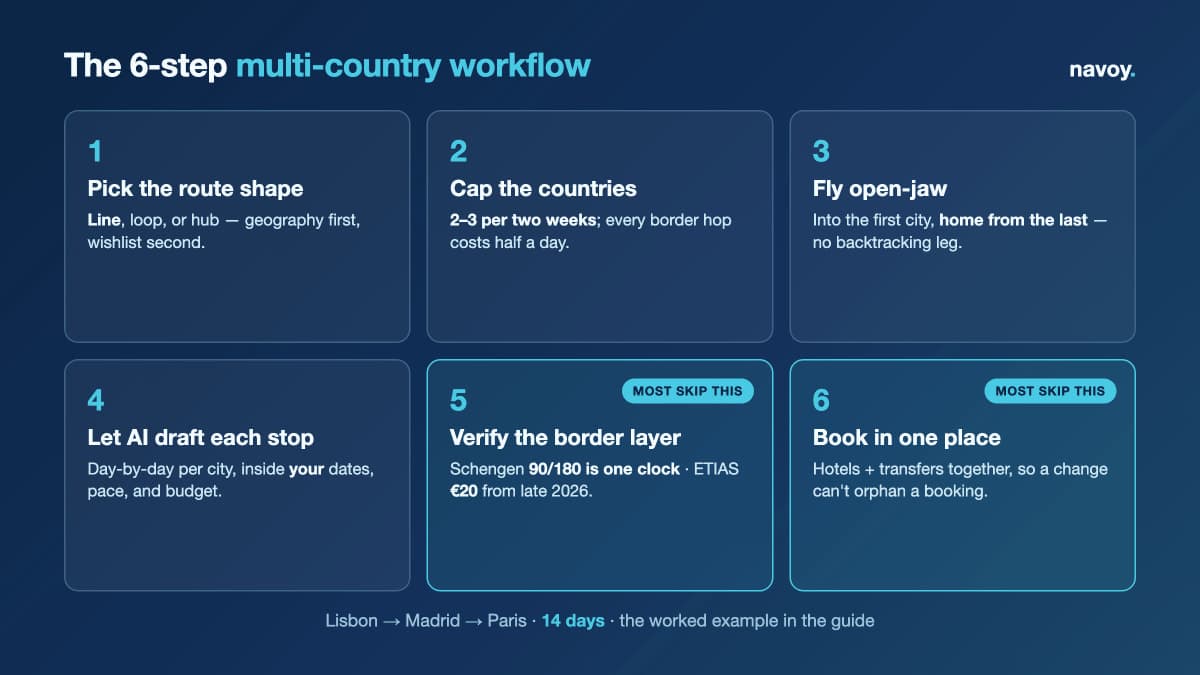
- Pick the route shape — a line, a loop, or a hub (next section)
- Cap the countries — 2–3 per two weeks, at least 3–4 nights per stop
- Fly open-jaw — into your first city, home from your last
- Let AI draft each stop — day-by-day, matched to your pace and budget
- Verify the border layer yourself — entry rules, the Schengen clock, anything time-sensitive
- Book it in one place — hotels and transfers together, so the plan survives contact with reality
The rest of this guide walks each decision with real 2026 numbers.
What order should you visit countries in?
| Route shape | How it works | Best when |
|---|---|---|
| Line | A → B → C, fly home from C (open-jaw) | Stops sit along one corridor (Lisbon → Madrid → Paris) |
| Loop | Round trip from your arrival city | Return fares into one hub are much cheaper |
| Hub | One base + day/overnight trips | You hate packing and the region is dense |
The single biggest upgrade is the open-jaw flight: fly into the first city and home from the last, booked as one "multi-city" ticket. A line route that ends with a flight back to where you started quietly burns a full day and the price of an extra leg. And a rule of thumb that protects the whole plan: every hop between countries costs roughly half a day door-to-door, however fast the train looks on paper. Three countries in two weeks is comfortable; five is a logistics project.
Should you take trains or budget flights between countries?
In Europe, book point-to-point trains early for a 2-leg trip, consider a rail pass at 4+ legs, and price budget flights with the bag fees included — the "€19 fare" rarely survives a real suitcase. The 2026 numbers:
| Option | Real 2026 numbers | Watch out |
|---|---|---|
| Eurail Global Pass | 5 travel days/1 month €320 (~€64/day) · 10 days/2 months €450 · 15 days/2 months €553 · youth (≤27) up to −25% | Seat reservations cost extra on many high-speed routes |
| Budget flights | Fare + ~€30 per 20kg bag per leg booked online, €60–75 at the airport; the free allowance is only a small under-seat bag | Airport time: add 3+ hours door-to-door per flight |
| Point-to-point trains, booked early | Often the cheapest for 2–3 legs | Prices climb steeply near departure |
One 2026 change in your favour: the EU now requires airlines and booking sites to display fares with the essential cabin-bag allowance included, so comparison shopping finally shows closer-to-real prices (bag-fee details).
The honest tiebreaker isn't only money: a train goes city-centre to city-centre with no security theatre, which is why the half-day-per-hop rule punishes flights harder than rail on short legs.
What does AI get wrong on multi-country trips?
The border layer. AI itineraries cross countries in seconds; your passport doesn't — and entry rules, the Schengen clock, and travel-authorisation fees are exactly the details AI states confidently and gets wrong. Roughly one in three AI-itinerary users hit false or outdated information in 2026 research; on a one-country trip that's an annoyance, across three borders it compounds.
The three things to verify yourself, every time:
- The Schengen 90/180 rule is one clock, not per country. Days in Portugal, Spain, and France all draw from the same 90-day allowance in any 180-day window.
- ETIAS starts in late 2026: a €20 travel authorisation for visa-free visitors to 30 European countries, on top of the EES biometric border checks running since April 2026. Our ETIAS guide for US travellers covers the details.
- Entry rules per country — always from official government sources, never from a chat window.
For the deeper question of what AI does and doesn't get right — and why your role is editor, not audience — we've written the honest version separately: Can AI plan my whole trip? This guide assumes the answer and focuses on the route.
What does the 6-step workflow look like in practice?
Here's the worked example: 14 days, Lisbon → Madrid → Paris, open-jaw, by rail. A line route along one corridor, three countries, two borders, zero backtracking.
- Shape: line. Fly into Lisbon, home from Paris on a multi-city ticket.
- Cap: three stops, roughly 5 + 4 + 5 nights — every city gets real time. (Start with our Lisbon guide for the first leg.)
- Open-jaw: booked as one ticket, it also fixes your trip's start and end anchors before any itinerary work.
- AI drafts each stop: give it the fixed frame — dates, pace (relaxed vs packed), how you split budget between hotels and experiences — and let it fill the days, not choose the route. AI is at its best inside constraints you set.
- You verify the border layer: the Schengen clock covers all 14 days here (one zone), ETIAS applies from late 2026, and the two rail legs want booking early at 2026 prices.
- Book in one place: hotels for three cities and the airport transfers on both ends, together — so a change in Madrid doesn't orphan a booking in Paris.
Do you still need a travel agent for a multi-country trip?
For a 2–3 country trip: no. AI planning plus a single booking platform now covers the route logic, the day-by-day plan, and the bookings that used to justify an agent's fee. Agents still earn it on genuinely complex trips: 5+ countries, group logistics, complex visas, or high-end trips where you're buying access, not planning.
The fair comparison isn't "agent vs nothing" anymore, it's "agent vs an hour of structured work with good tools." What an agent still does better: accountability when things break mid-trip, negotiated perks at luxury hotels, and visa paperwork for difficult passports. What the AI-plus-platform stack does better: speed, midnight replanning, and costing nothing extra. If you're weighing the options in detail, our explainer on travel agents vs booking sites vs AI travel agents breaks down who does what.
Plan and book the whole route in one platform with Navoy
Multi-country trips are the exact problem Navoy is built for. Describe the route — "14 days, Lisbon, Madrid, Paris, relaxed pace, more budget on experiences than hotels" — and Navoy's AI builds the day-by-day plan across all three stops, using your trip focuses (pick up to 3 of 12, from Food & Culinary to Cultural Exploration), your Travel Pace, and your Budget Split. Then it books the hotels and airport transfers in one platform, so the whole route lives in one place instead of nine tabs.
The free plan covers up to three trips of up to 14 days each — a two-week multi-country route fits exactly, at no cost. Navoy doesn't book flights; book your open-jaw ticket with the airline, and Navoy handles the plan, the hotels, and the transfers around it.
Frequently Asked Questions
How many countries can you visit in 2 weeks?
Two or three, comfortably. Each country deserves at least 3–4 nights, and every border hop costs about half a day door-to-door, so a fourth country usually subtracts more than it adds. If you want more stamps than that, plan a longer trip or accept that each stop becomes a highlights sprint.
Can AI book an entire multi-country trip?
Not end to end. AI tools draft strong multi-stop itineraries, and platforms that combine planning with booking can complete the hotels and airport transfers in one flow. Flights — especially open-jaw tickets — are still booked with the airline. Always confirm each reservation actually went through rather than trusting the plan.
What is an open-jaw flight and why does it matter?
An open-jaw ticket flies you into one city and home from a different one, booked as a single "multi-city" fare. On a line-shaped route it eliminates the return leg to your starting city, saving a travel day and often real money — it's the single highest-value booking trick in multi-country planning.
Do you need a separate visa for each Schengen country?
No. The Schengen area works as one zone: visa-free visitors get 90 days in any 180-day window across all member countries combined, not per country. From late 2026, visa-free travellers will also need ETIAS, a €20 online travel authorisation. Verify your specific situation with official government sources before booking.
Sources
- Seat61 — Eurail Pass Guide 2026: prices and how it works
- Rick Steves — Eurail Global Pass
- Upgraded Points — Ryanair baggage fees 2026
- CNBC — Travelers turn to AI to plan trips despite hallucinations and trust gaps (2026 Klook survey)
- US Department of State — International travel: country information
Related reading: Can AI plan my whole trip? An honest 2026 answer, travel agents vs booking sites vs AI travel agents, explained, and ETIAS requirements for US travellers.
Route picked? Let the AI fill the days.
Plan and book your multi-country trip with Navoy →
Tell Navoy your route, dates, pace, and budget, and it builds the day-by-day plan across every stop and books your hotels and airport transfers in one platform.
About the Author
Haroun Moula
Haroun Moula is the founder and CEO of Navoy. Before Navoy, he worked in luxury travel with VVIPs and high-profile travelers. He built Navoy to bring curated, adaptive trip planning to more travelers through an AI travel agent that plans and books core trip parts in one place.