
Key Takeaways
- January is the cheapest month to fly to Japan from the US, at a median $849 round trip to Tokyo on KAYAK's last 12 months of data. February is close behind at $862.
- June is the most expensive month ($1,316), despite Japan's rainy season, followed by December ($1,302). June's median is $467, or 55%, above January's.
- Fares follow American demand. In 2025, January and February were the two quietest months for US visitors to Japan, and June was the busiest, with 1.89 times January's arrivals (JNTO).
- 2027 dates to avoid: Golden Week (29 April, then 1 to 5 May), Obon (around 13 to 16 August) and the New Year break (29 December to 3 January).
- Cherry blossom dates for 2027 are not out yet. The first private forecasts usually appear around the turn of the year; Tokyo's average flowering date is 24 March.
The cheapest time to fly to Japan from the US is January, at a median $849 round trip to Tokyo, then February at $862 and September at $971, per KAYAK's data for the past 12 months. The most expensive months are June ($1,316) and December ($1,302). Avoid Golden Week, Obon and New Year in 2027.
Below is every month with its fare, how busy Japan was with American visitors, and the 2027 holidays that move prices. Fares are KAYAK's monthly medians for round trips from the United States to Tokyo, read on 6 October 2026. Visitor numbers are the Japan National Tourism Organization's (JNTO) official 2025 figures.
Plan your Japan trip with Navoy and line up flights and hotels around the cheap weeks.
What is the cheapest month to fly to Japan?
January. KAYAK's median round trip from the US to Tokyo was $849 in January over the past 12 months, about 23% below the route's average. February is almost as cheap at $862. After that comes September at $971, more than $100 above January.
Both winter months share one thing: fewer Americans fly. JNTO counted 182,556 US visitors in January 2025 and 191,494 in February, the two lowest months of the year. KAYAK's own demand data agrees, naming January the least popular month to travel to Tokyo.
Winter in Tokyo is cold but dry (December to February are its three driest months on JMA averages), and it is the season for hot springs and ski trips in Hokkaido. If your dates are flexible, the first two months of the year are where the money is. Search flights to Tokyo.
How do fares change month by month?
From $849 in January to $1,316 in June. Fares rise in March, cherry blossom season ($1,138), dip in April ($1,050), then peak from May to July, the US summer travel season. September is the autumn low, and December climbs to $1,302 over the holidays.
| Month | Median US-Tokyo round trip (KAYAK) | US visitors in 2025 (JNTO) | What moves prices in 2027 |
|---|---|---|---|
| January | $849 (cheapest) | 182,556 (quietest) | New Year break ends 3 January |
| February | $862 | 191,494 | Lunar New Year, 6 February |
| March | $1,138 | 342,752 | Cherry blossom; long weekend 20 to 22 March |
| April | $1,050 | 327,542 | Blossom ends; Golden Week starts 29 April |
| May | $1,217 | 311,933 | Golden Week, 1 to 5 May |
| June | $1,316 (priciest) | 345,150 (busiest) | Rainy season starts around 7 June (Tokyo) |
| July | $1,251 | 277,080 | Rainy season ends around 19 July |
| August | $1,054 | 194,525 | Obon, around 13 to 16 August |
| September | $971 | 224,793 | Long weekend 18 to 20 September |
| October | $1,034 | 335,744 | Long weekend 9 to 11 October |
| November | $1,032 | 302,547 | Autumn leaves in Kyoto |
| December | $1,302 | 270,704 | Year-end break from 29 December |
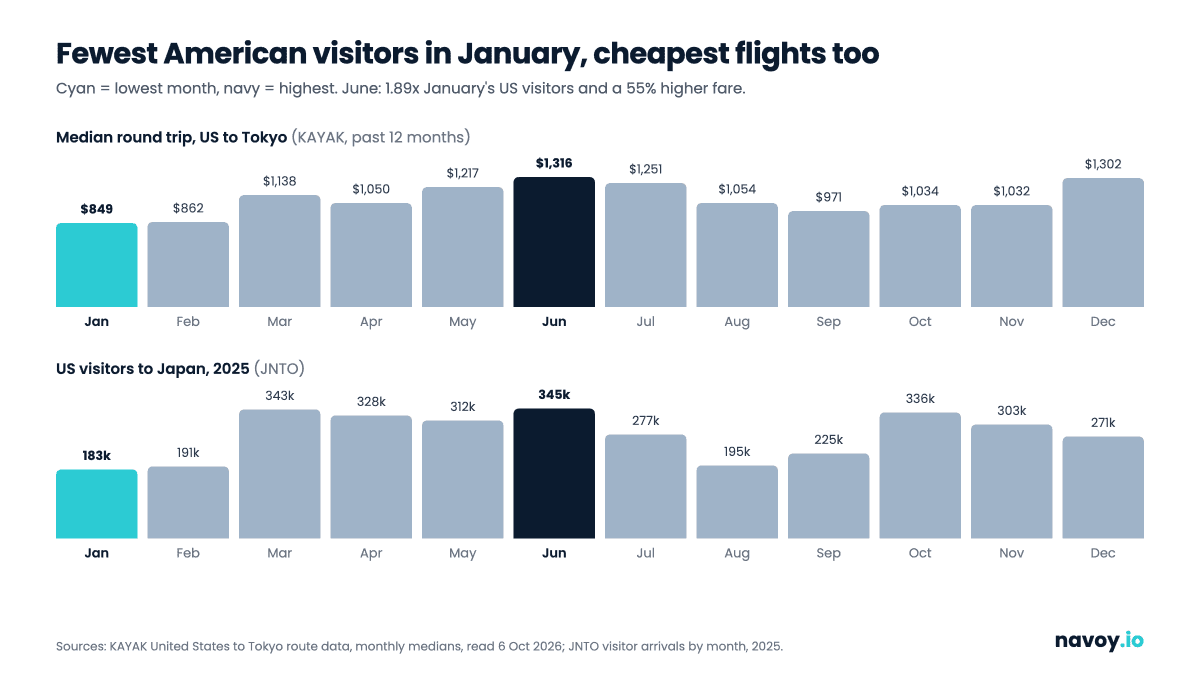
That is our original number: in 2025, June brought 1.89 times as many American visitors to Japan as January (345,150 against 182,556), and the median fare in June was 55% higher. The quietest months for US travellers are the cheapest ones to fly in, so if your dates can move, move them toward January or February.
Why is June so expensive if it is rainy season?
Because the fares are set by who is flying, not by Japan's weather. June is the start of the US summer holidays, and it was the busiest month of 2025 for American visitors to Japan. The rainy season keeps some travellers away, but not enough to pull the price down.
The Japan Meteorological Agency's average puts the start of the rainy season in the Tokyo region around 7 June and the end around 19 July (1991 to 2020 normals). Rain is frequent but rarely all day. The flight from the US is a different story: at $1,316, June was the single most expensive month on KAYAK's data, and July ($1,251) and May ($1,217) were not far behind.
If summer is your only option, late August is the better bet. American arrivals fell to 194,525 in August 2025, and the median fare was $1,054. Just steer clear of Obon week.
Which dates should you avoid in 2027?
Golden Week, Obon and the New Year break, when Japan itself is on holiday. In 2027, Golden Week is Thursday 29 April plus Saturday 1 to Wednesday 5 May. Obon falls around 13 to 16 August, a Friday to Monday. The year-end break runs from 29 December to 3 January.
JNTO warns that Golden Week brings "crowds and fully booked transport", and that during Obon "many people travel back to their hometowns". Book trains and hotels for those weeks early, or avoid them.
- Golden Week 2027: the national holidays are 29 April (Showa Day) and 3, 4 and 5 May. With the weekend, that gives most workers five days off in a row, from Saturday 1 May to Wednesday 5 May.
- Obon 2027: not a national holiday, and dates vary by region, but JNTO gives 13 to 16 August as typical. Mountain Day, Wednesday 11 August, sits just before it.
- New Year: government offices close from 29 December to 3 January, and JNTO notes that many businesses close for several days.
- Long weekends: 20 to 22 March (spring equinox, with Monday as a substitute holiday), 17 to 19 July, 18 to 20 September and 9 to 11 October. Domestic hotels fill, especially in Kyoto.
Also note Lunar New Year on Saturday 6 February 2027. It is not a Japanese holiday, but it is a big travel week for visitors from Hong Kong, Taiwan and mainland China. In 2025, when it fell on 29 January, January was Japan's busiest month of the year for visitors overall. US fares are lowest that month anyway, but expect busier hotels in the big cities that week. We cover what is open and closed in Chinese New Year 2027 in Asia.
When is cherry blossom season in 2027, and is it worth the price?
Nobody knows the 2027 dates yet. The Japan Meteorological Corporation, the main private bloom forecaster, issued its first 2026 forecast on 18 December 2025, so expect the 2027 one around the turn of the year. On average, Tokyo flowers around 24 March and reaches full bloom around 31 March; Kyoto around 26 March and 4 April.
Blossom season costs more, but less than you might think. March's median fare was $1,138, about $289 above January, and April's was $1,050. The bigger squeeze is on the ground: March was the second-busiest month for American visitors in 2025, and in 2026 Tokyo's trees flowered five days earlier than average, on 19 March.
Our advice: pick a week that covers late March and early April, book flights and hotels early, and check the forecast once it is out. Hotels in Kyoto go first, so if you are splitting the trip, read how many days to spend in Kyoto and Kyoto vs Osaka before you choose a base. Compare Kyoto hotels or hotels in Osaka.
When should you book flights to Japan?
About 25 weeks ahead, on KAYAK's data: flights to Tokyo were cheapest roughly six months before departure, at about 10% less than a fare bought in the last two weeks. For a late-March 2027 blossom trip, that window is now.
Counting back 25 weeks gives these booking dates for 2027 trips:
| Trip | Book around |
|---|---|
| Mid-January 2027 | Late July 2026 (passed; book soon) |
| Late March 2027 (cherry blossom) | Early October 2026 |
| Late April 2027 | Early November 2026 |
| Early June 2027 | Early December 2026 |
| Mid-September 2027 | Late March 2027 |
These are averages, not guarantees, and a 10% difference is small next to the 55% swing between months. Choosing the right month matters far more than the day you click "buy". We looked at the booking-day question in the cheapest day to book flights in 2026.
One cost every fare now includes: Japan's departure tax rose to ¥3,000 (about $19) per person on 1 July 2026, collected in your ticket price. We break down every fee in Japan's tourist taxes for 2026-27.
Is the cheapest month the same from Europe or Australia?
No. The pattern depends on when your own country takes holidays. In 2025 January was the quietest month for American visitors but the busiest for Australians (140,185), whose summer holidays fall then. British visitors peaked in April (69,496) and October.
The fares above are US-to-Tokyo medians, so treat them as a guide for North America. JNTO's 2025 arrivals show how different the calendar looks elsewhere:
| Market | Busiest month (2025) | Quietest month (2025) |
|---|---|---|
| United States | June (345,150) | January (182,556) |
| United Kingdom | April (69,496) | January (26,378) |
| Australia | January (140,185) | August (41,250) |
| All visitors | April (3,909,128) | February (3,258,491) |
As a rule, your cheapest month is your country's quietest month for Japan, minus Japan's own holiday weeks.
Frequently asked questions
What is the cheapest month to fly to Japan in 2027?
From the US, January, with a median round trip to Tokyo of $849 on KAYAK's past 12 months of data, then February ($862). Fly after the New Year break ends on 3 January for the quietest weeks.
Is it cheaper to fly to Japan in winter or summer?
Winter, by a wide margin. January and February are the two cheapest months from the US, while June ($1,316) and July ($1,251) are among the most expensive.
Is Golden Week a bad time to visit Japan?
For your budget and your patience, yes. In 2027 it runs from Thursday 29 April to Wednesday 5 May, and JNTO warns of crowds and fully booked transport. Come the week after instead.
Are flights to Japan cheaper in September?
Yes. September was the third-cheapest month on KAYAK's data, at $971, and the second-quietest month of 2025 for visitors to Japan overall.
Sources
- KAYAK: flights from the United States to Tokyo - monthly median round-trip fares over the past 12 months ($849 January to $1,316 June), January as the least popular month, cheapest about 25 weeks ahead at about 10% below last-minute fares; read 6 October 2026
- JNTO: visitor arrivals by country and month, 2003 to 2026 - 2025 monthly arrivals for all visitors, the United States, the United Kingdom and Australia (file dated 16 September 2026)
- Cabinet Office of Japan: national holidays - 2027 national holiday dates
- JNTO: business hours and holidays - Golden Week, Obon and New Year as peak periods
- JNTO: Japan in August - Obon typically 13 to 16 August
- Japan Meteorological Agency: rainy season in Kanto-Koshin - normal start around 7 June and end around 19 July (1991 to 2020)
- Japan Meteorological Agency: cherry blossom data - Tokyo and Kyoto flowering and full-bloom normals (1991 to 2020)
- JMA Tokyo: 2026 flowering announcement - Tokyo flowered 19 March 2026, five days early
- Japan Meteorological Agency: climate normals - Tokyo precipitation lowest December to February
- Japan Meteorological Corporation: news archive - first 2026 cherry blossom forecast issued 18 December 2025
- e-Gov: Act on Holidays of Administrative Organs - government offices closed 29 December to 3 January
- Hong Kong government: general holidays for 2027 - Lunar New Year on 6 February 2027
- National Tax Agency: International Tourist Tax - ¥3,000 per departure from 1 July 2026
All figures verified 6 October 2026. Dollar conversion: $1 = ¥158.2 (European Central Bank, 5 October 2026).
Related articles
Found your cheap month? Build the trip around it. Navoy plans your Japan itinerary city by city, then lets you book the flights, hotels and airport transfers to match. Start your trip plan · Find hotels in Tokyo · Search flights to Japan
About the Author
Ranym Garali
Ranym is the Marketing and Content Lead at Navoy. She's been writing about travel for two years and digs into the data behind each piece, flight prices, visa rules and what people are actually searching for , so the advice holds up in practice.