
Key Takeaways
- International fares have been lowest 49 days or more before departure, according to Google's analysis of flights on its own platform.
- Domestic is tighter at 39 days, with a low-price range of 23 to 51 days.
- Europe sits at 48 days or more; Mexico and the Caribbean at 50 days, with a wide 26 to 79 day range.
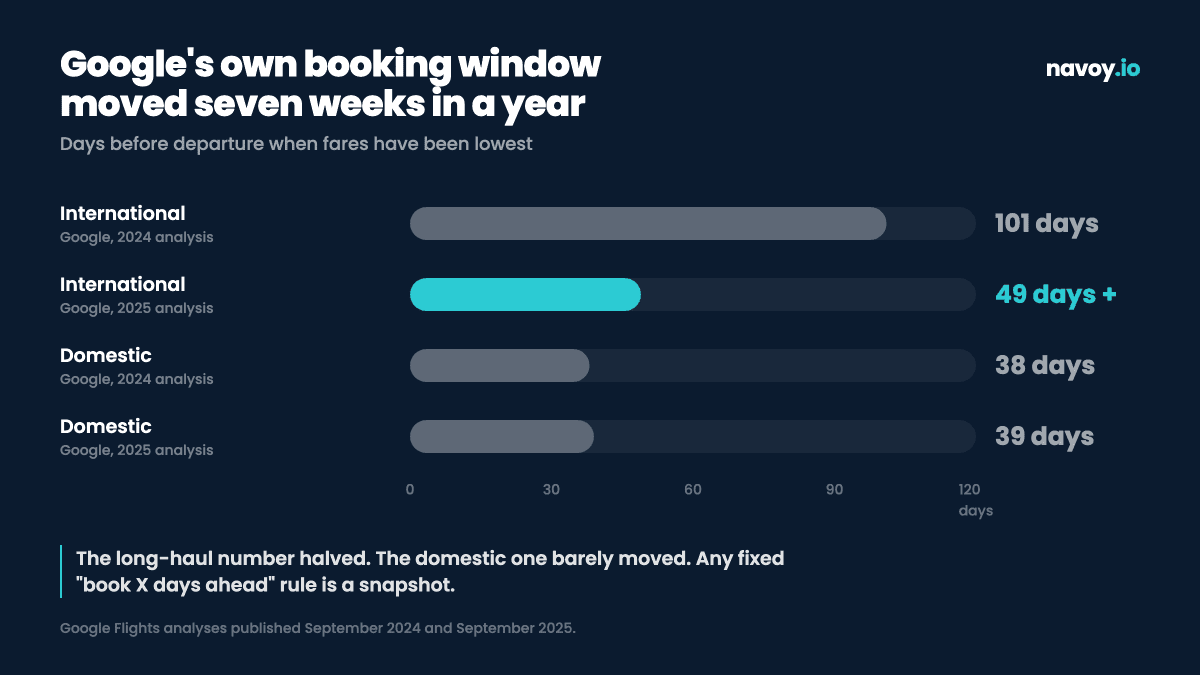
- The window moves every year. Google's international figure was 101 days in its 2024 analysis and 49 or more in 2025.
- These are historical averages, not forecasts. Any single number you see quoted is a snapshot of a moving target.
Google's most recent analysis puts the lowest international fares at 49 days or more before departure. For domestic trips the window is tighter, around 39 days, with prices generally low anywhere between 23 and 51 days out. Both figures are averages drawn from past bookings rather than predictions, and both have moved substantially from one year to the next.
That last point is the one worth holding on to. The reason every website gives you a different number is not that some of them are lying. It is that they are quoting different years, different datasets, and sometimes different companies entirely.
How far in advance should you book an international flight?
Forty-nine days or more, on Google's numbers. Its 2025 analysis of fares on Google Flights found international round trips were cheapest at that point or earlier, while domestic trips bottomed out around 39 days before departure with a low-price band running from 23 to 51 days.
Google states the methodology openly: the figures cover "average round trip airfares observed January 1, 2021 through August 1, 2025 on Google Flights". That is a large sample over four and a half years, and it is explicitly backward-looking. The wording throughout is past tense, "have been", not "will be".
So treat 49 days as a sensible default rather than a deadline. Booking on day 48 does not trigger a price rise.
Does the right booking window depend on where you are going?
Yes, and Google publishes two regional figures. Trips to Europe have been cheapest 48 days or more before departure. Mexico and the Caribbean bottom out around 50 days, but with a much wider low-price range of 26 to 79 days, which means the timing is far less critical for those routes.
The width of that Caribbean range is the useful detail. A 53-day spread means you have most of two months in which prices are broadly similar, so there is little value in agonising over the exact week you book.
| Trip type | Lowest prices have been | Low-price range |
|---|---|---|
| Domestic | 39 days before departure | 23 to 51 days |
| International, overall | 49 days or more before departure | not published |
| Europe | 48 days or more before departure | not published |
| Mexico and the Caribbean | 50 days before departure | 26 to 79 days |
All four rows are Google's 2025 analysis. Other regional figures circulate widely, and most of them come from somewhere else entirely, which is the next section.
Why does every website give a different number?
Because they are quoting different publishers and different years without saying so. The figures you see for Asia, the Caribbean and Europe frequently come from CheapAir's airfare studies rather than Google, and are often several years old. Numbers get copied between articles until the original source is lost.
Three examples of figures in heavy circulation, with what they actually are:
- "94 days for Europe." This was Google's 2024 analysis. Google's current figure for Europe is 48 days or more. The older number is still being republished as though it were current.
- "29 days for the Caribbean." This is CheapAir's 2024 International Airfare Study, not Google. It is frequently credited to Google Flights by writers who read it second-hand.
- "71 days for Asia." Also CheapAir, from the same 2024 study. CheapAir has since revised its own guidance for Asia to roughly 120 days.
None of those are dishonest on their own. They become misleading when the publisher and the year get stripped off in the retelling.
How much has the booking window actually moved?
Enough to make any fixed number unreliable. Google's 2024 analysis put international fares lowest at 101 days before departure. Its 2025 analysis says 49 days or more. That is a shift of roughly seven weeks in a single year, from the same company measuring the same platform.
Domestic has been far more stable: 38 days in the 2024 analysis, 39 days in 2025, with almost identical low-price ranges. So the further you fly, the less you should trust a precise number.
Other publishers land in different places again, which is worth knowing when you compare advice:
| Source | Domestic guidance | International guidance |
|---|---|---|
| Google, 2025 analysis | 39 days | 49 days or more |
| CheapAir, 2026 study | 28 to 35 day sweet spot, 21 to 60 day window | varies by region |
| Going | 1 to 3 months | 2 to 8 months |
These are not contradictions so much as different methods. CheapAir's 2026 study draws on 917 million fares and reports a tighter domestic sweet spot; Going publishes deliberately broad ranges. Read the range, not the headline day.
What should you do if your dates are fixed?
Set an alert as soon as the trip is real, and check whether your route sits inside a wide low-price band or a narrow one. For Mexico and the Caribbean, where the band runs 26 to 79 days, the timing barely matters. For long-haul international, where the published guidance has swung by seven weeks in a year, watching the actual fare beats following any rule.
The practical order:
- Know your band, not your day. A range like 23 to 51 days tells you when to start paying attention, which is more useful than a single date.
- Watch the fare rather than the calendar. The windows are averages across millions of trips. Yours is one trip.
- Book when the price is acceptable to you. Waiting for a theoretical optimum on a route you have already decided to fly is how people end up paying more.

Planning around the window
Navoy is an AI travel agent that plans trips and books hotels and airport transfers in one platform. Booking windows are only half the question: once the flight dates move, the hotel nights and the airport transfer move with them, and the total is what decides whether the earlier fare was actually cheaper.
Frequently asked questions
Is it cheaper to book international flights months in advance?
Not usually. Google's 2025 analysis found international fares were lowest around 49 days before departure or earlier, not many months out. Booking very early tends to mean paying the airline's opening price, before demand-based discounting begins. The exception is peak periods, where seats sell out rather than getting cheaper.
What is the best time to book flights to Europe?
Google's most recent figure is 48 days or more before departure. Older articles quoting 94 days are citing Google's 2024 analysis, which has since been replaced. Treat both as averages: the useful move is to start tracking your specific route around the seven-week mark.
Do last-minute international flights ever get cheaper?
Rarely, and it is not a strategy. Google's low-price ranges all close well before departure, and fares typically rise in the final weeks as remaining seats are sold to travellers with no flexibility. Occasional last-minute drops exist but they are not predictable enough to plan around.
Why do booking window figures change so much year to year?
Because they reflect real market conditions: fuel costs, capacity, and how far ahead people are actually booking. Google's international figure moved from 101 days to 49 or more between its 2024 and 2025 analyses. A number published two years ago describes a market that no longer exists.
Sources
- Google, Holiday travel trends 2025 - published 9 September 2025. Source of the 39 day domestic, 49+ day international, 48+ day Europe and 50 day Mexico/Caribbean figures. Methodology: average round trip airfares observed 1 January 2021 through 1 August 2025 on Google Flights.
- Google, Holiday travel trends and insights 2024 - published 5 September 2024. The superseded 101 day international and 38 day domestic figures, used here to show how far the window moves.
- CheapAir, The best time to buy international flights - the origin of the regional figures often misattributed to Google, and of CheapAir's later revisions.
- Going, The best time to book a cheap flight - the 1 to 3 month domestic and 2 to 8 month international ranges.
All figures verified 10 September 2026.
Related articles
- The cheapest day to book flights in 2026
- Shoulder season 2026: when flights are actually cheaper
- The 6 hotel fees that were not in the price you clicked
Know the window, then plan the rest of the trip around it. Try Navoy.
About the Author
Ranym Garali
Ranym is the Marketing and Content Lead at Navoy. She's been writing about travel for two years and digs into the data behind each piece, flight prices, visa rules and what people are actually searching for , so the advice holds up in practice.