
Key Takeaways
- For UK travellers, flying abroad in September and October costs 26% less than the July-August peak in 2026, according to KAYAK's August data.
- Hotels did not follow. International room rates fall about 10% in shoulder season, domestic ones about 3%, per KAYAK's 2025 study.
- In the top 10 US destinations, fall lodging now costs 20% more than summer, not less. The old advice has stopped working there.
- The break is the first week of September, and the soft stretch runs to late October.
- Airfares are still up 25.5% year on year. Cheaper than August is not the same as cheap.
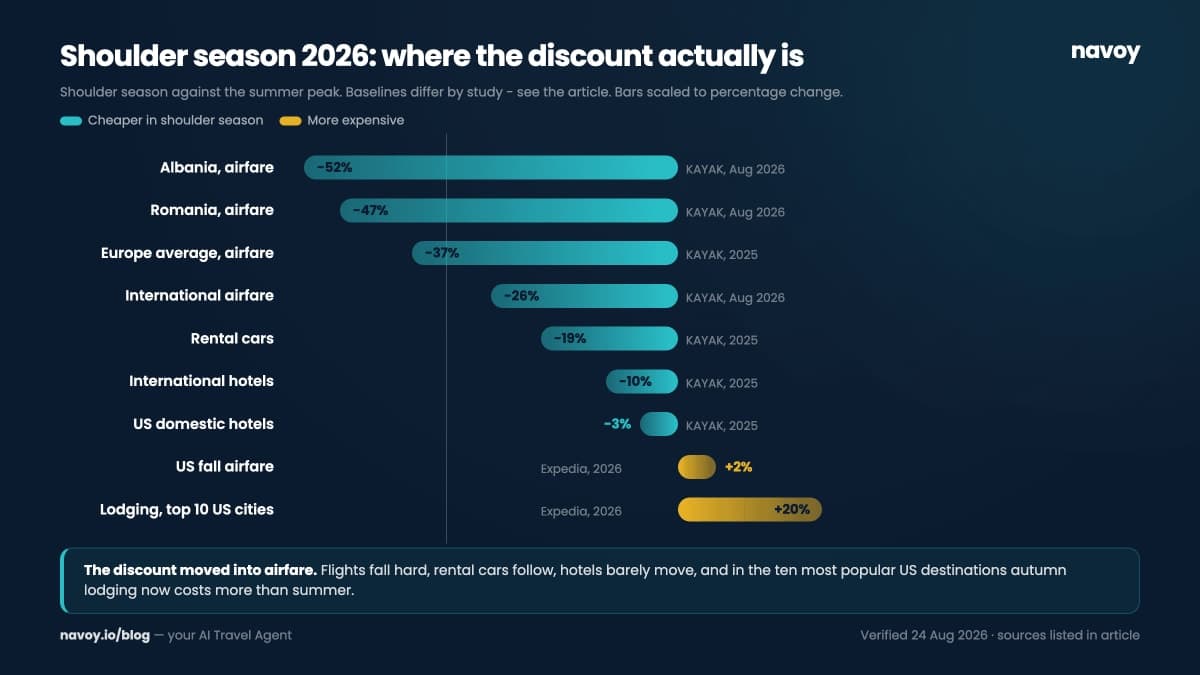
Shoulder season still works in 2026, but almost entirely on airfare. For UK travellers, flying abroad in September and October costs 26% less on average than the July-August peak. Hotel rates barely move: KAYAK's 2025 study put international rooms at about 10% off and domestic ones at 3%. And in the ten most popular US destinations, fall lodging now runs 20% higher than summer.
That last number is the one that breaks the usual advice. "Travel in shoulder season and everything gets cheaper" was true for a long time. It is not evenly true anymore, and in some places it is simply false.
We went looking for a week-by-week price map for this piece and did not find a credible one. Plenty of sites publish confident tables of exact weeks with exact percentages. When we traced those numbers back, most led to affiliate blogs citing sources that do not contain the figures, or to a genuine dataset that happens to be from 2023. What follows is only what the current data actually supports.
How much cheaper is shoulder season in 2026?
About 26% on international airfare for UK travellers, comparing September-October departures against the July-August peak. That is the headline figure from KAYAK's August 2026 analysis. Hotels are a different story: KAYAK's 2025 study found roughly 10% off international rates and 3% off domestic, and in popular US cities fall lodging is now more expensive than summer.
Here is the split that matters, drawn from the two datasets that actually publish methodology. Note the baselines differ: the 2026 release compares against a July-August peak, the 2025 study against June-July.
| What you are buying | Shoulder vs peak | Source |
|---|---|---|
| International airfare | -26% (2026, UK) / -33% (2025, US) | KAYAK |
| Europe airfare | -37% | KAYAK, 2025 data |
| Domestic airfare (US) | -21% | KAYAK, 2025 data |
| Rental cars | -19% | KAYAK, 2025 data |
| International hotels | -10% | KAYAK, 2025 data |
| Domestic hotels (US) | -3% | KAYAK, 2025 data |
| Lodging, top 10 US destinations | +20% | Expedia, fall 2026 |
Read down that column and the pattern is hard to miss. The further you get from the plane ticket, the smaller the discount, until it inverts.
Which weeks are actually the cheap ones?
The break is the first week of September. Expedia's fall pricing window opens 7 September 2026, and KAYAK's shoulder definition starts the same week. The soft stretch runs from mid-September through late October, and it closes as holiday demand builds in November.
We are deliberately not giving you a table of individual weeks with individual percentages. No source publishes a credible week-by-week index, and the ones that appear to are working backwards from a guess. What is defensible is the shape of the window:
- Before 7 September. Still peak pricing in most of Europe and the US. School holidays and August demand are still in the system.
- Mid-September to late October. The genuine soft stretch. This is where the 26% average lives. KAYAK's UK guidance is narrower still: return before mid-September, or push the trip to late October.
- Late April to May. The other shoulder window, and the better one for Mediterranean destinations where autumn brings rain.
- November onward. Holiday demand starts pricing in. The window is closed.
If your dates flex by a week, moving from late August into the second half of September is the single change that moves the price most.
Accommodation runs on its own calendar. In KAYAK's UK analysis, early October looks like the best-value window for stays abroad, with prices climbing again later in the month. That is a different pattern from the airfare curve, which is the whole reason to price the two separately.
Where did the discount actually go?
Into airfare, and into specific destinations rather than across the board. Expedia's own read is that savings are now "concentrated in specific places instead of showing up everywhere automatically." Six US destinations still deliver real fall discounts. The other four in their top ten cost more.
The destinations where the drop is steepest, from KAYAK's August 2026 data on flights from the UK. These are average return economy fares, not guaranteed prices:
- Albania - GBP 111 return, down 52%. The largest drop on the list.
- Romania - GBP 123, down 47%.
- Bulgaria - GBP 146, down 43%.
- Cape Town - down 32% on fares. Long-haul, and the seasons are inverted, so this is spring there rather than autumn.
- Paphos, Cyprus - down only 14%, with searches up 129%. A useful warning: when everyone discovers a shoulder-season destination, the shoulder-season price goes with it.
In the US, Expedia found combined airfare-and-lodging savings of about 45% in Aspen, 40% in Anchorage, 30% in Fort Walton Beach, 15% in San Diego, 10% in Honolulu and 5% in Bozeman. Those are the exceptions, not the rule.
Why do some destinations barely have a shoulder season at all?
Because their tourism is concentrated almost entirely in summer, so there is no off-peak capacity to discount. Mabrian's summer-dependence data puts Croatia at 79.1% and Greece at 72.9%, against 52.8% for Spain and 54.5% for Portugal.
That single statistic explains a lot of disappointed trips. In a place where four fifths of the year's visitors arrive between May and September, October is not a cheaper version of August. It is a closed version of August. Ferries thin out, restaurants shut, and the hotel that would have discounted is simply not open.
Spain and Portugal are at the other end. Lower summer dependence means a real off-season economy, which means genuine shoulder pricing and somewhere to eat in October. Our Lisbon guide covers a city where April to June and September to October are genuinely the best months rather than the consolation ones. Santorini has the same nominal window, but Greece's 72.9% figure is the reason to book the September end of it rather than late October.
Is shoulder season still worth it if fares are up 25% year on year?
Yes, but set expectations correctly. Airfares in July 2026 ran 25.5% above July 2025 according to Bureau of Labor Statistics data, while lodging rose 2.6%. Shoulder season is a discount against this year's peak, not against last year's prices.
This is the part that catches people out. A 26% saving on a fare that is 25% more expensive than it was last year lands you roughly back where you started. The saving is real and worth taking. It is not time travel.
The practical read: shoulder season is now primarily a flight-cost strategy. If your trip's biggest line item is the plane ticket, moving your dates into late September is the single change that will save you the most money. If you are driving to a US beach town and the hotel is the main cost, the calendar will do considerably less for you this year than it did in 2023.
We wrote about the other half of this pattern in 7 things to book before summer prices spike, which covers booking windows for each part of a trip. The broad 15-30% shoulder-season range in that piece still holds across a full season. What has changed in 2026 is that the lodging half of it has compressed hard, which is why this article splits flights and hotels apart rather than quoting one number for both.
How to actually use this
Move the flight first, then check whether the hotel followed. In 2026 it often has not. Price your dates in both windows before committing to either.
The mechanical version:
- Price the same trip in late August and the third week of September. On an international route the gap should be substantial. If it is not, your destination is one of the peak-dependent ones.
- Price the hotel separately. Do not assume it moved with the fare. This is the step people skip.
- Check whether the place is open. For Greece, Croatia and small Mediterranean islands, late October is a real risk.
- Book the fare when you find the window. Fares in the soft stretch are not stable, and the 26% is an average, not a floor.
You can map dates, destinations and a full itinerary in Navoy and compare two sets of dates side by side before anything is booked, with live pricing on hotels and airport transfers so the number you see is the number that day. Navoy does not book flights, so once your dates are set, book the fare with the airline directly.
Frequently Asked Questions
What months are shoulder season in 2026?
September and October are the main shoulder window in the northern hemisphere, with late April and May as the spring equivalent. KAYAK's 2026 release compares September-October departures against a July-August peak, its 2025 study used a June-July one, and Expedia's 2026 fall window opens on 7 September. Destinations with inverted seasons, such as Dubai or Tulum, do not follow this pattern at all.
How much can I actually save in shoulder season?
On international airfare from the UK, about 26% on average against the July-August peak in 2026, rising to roughly 37% on European routes in KAYAK's 2025 data, which measured against a June-July peak. On hotels, expect far less: around 10% internationally and 3% domestically. In the ten most popular US destinations, fall lodging is currently running about 20% higher than summer.
Is September or October cheaper?
Both sit inside the same soft window, and no source publishes a reliable split between them. October tends to be quieter, but it also carries more risk that seasonal businesses have closed, particularly in Greece, Croatia and smaller Mediterranean islands. September is the safer half of the window if you want everything still open.
Why are hotels not getting cheaper in shoulder season anymore?
Fall demand has grown. Expedia reports summer demand spilling into autumn, which keeps lodging rates high in popular destinations even after the traditional peak ends. Airlines still cut fares to fill seats on a fixed schedule, so airfare continues to fall while hotel pricing, which responds directly to occupancy, does not.
Sources
- KAYAK Shoulder Season Savings Guide, 19 August 2026 - the 26% average and the destination-level drops. UK-origin fares, quoted in GBP.
- KAYAK UK, shoulder-season holidays, 17 August 2026 - the accommodation window and the return-date guidance. Based on kayak.co.uk searches 1 May to 19 July 2026 for September-October departures. Economy return averages; savings vary and are not guaranteed. A separate publication from the press release above.
- KAYAK shoulder season guide, September 2025 - the flight-versus-hotel split. Based on searches made 15 April to 31 July 2025 for travel between 15 September and 15 November 2025.
- Expedia Fall Travel Outlook 2026 - the +20% US lodging figure and the six exception destinations. Compares 7 September to 26 November 2026 against 25 May to 7 September 2026.
- NerdWallet Travel Price Index, August 2026 - year-on-year airfare and lodging inflation, built on Bureau of Labor Statistics CPI data.
- Mabrian, South Mediterranean summer dependence - country-level summer-dependence rates for Spain, Portugal, Italy, Greece and Croatia.
All figures verified 24 August 2026. Prices move constantly, so treat these as the shape of the market rather than a quote.
Related reading: 7 Things to Book Before Summer Prices Spike, The 7 Best Places to Travel in September 2026, How Much Are Tourist Taxes in 2026?
Two sets of dates, one honest comparison. Map your trip in Navoy and price late August against late September side by side, with live hotel and transfer rates. You will see quickly whether your destination actually has a shoulder season, or just a quieter one.
About the Author
Haroun Moula
Haroun Moula is the founder and CEO of Navoy. Before Navoy, he worked in luxury travel with VVIPs and high-profile travelers. He built Navoy to bring curated, adaptive trip planning to more travelers through an AI travel agent that plans and books core trip parts in one place.