Key Takeaways
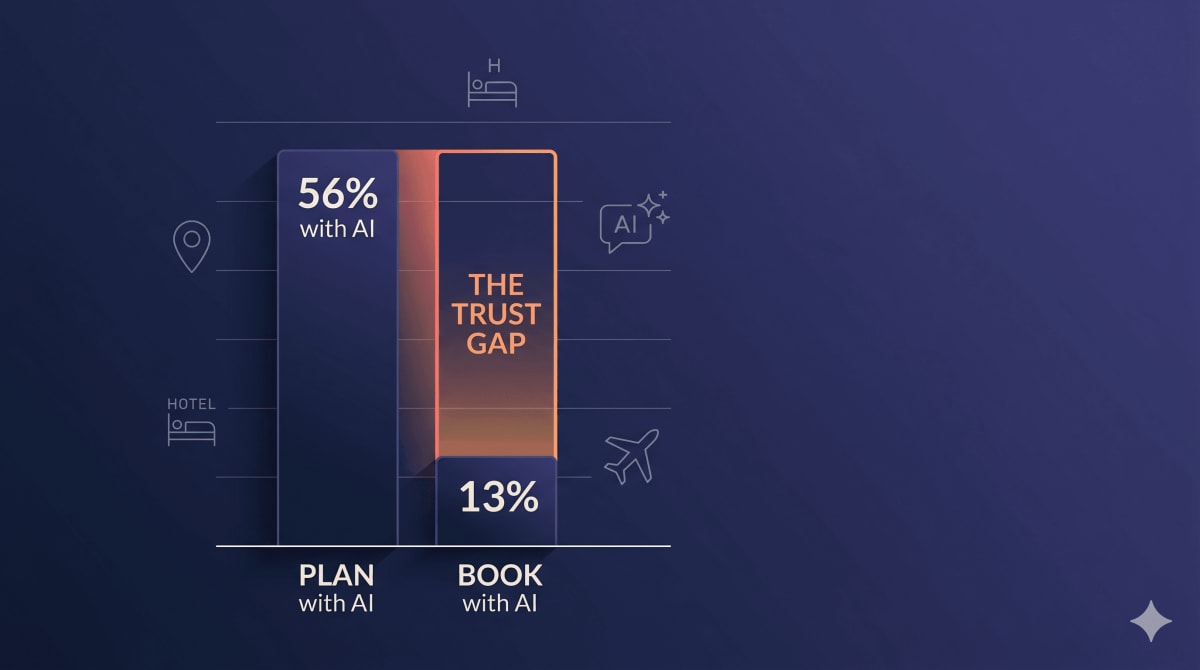
56% of US travelers now use AI to plan trips in 2026 — up from 43% in late 2025, and more than double the 2024 figure. Researchers are calling it the fastest behavioral shift in travel in over a decade.
- But only 13% trust AI for the actual booking. Planning adoption is high; booking trust falls off a cliff.
- Travelers happily use AI for recommendations (75%), itineraries (70%), and ideas (69%) — then switch back to old habits at checkout.
- The gap exists because most AI tools hand you suggestions, not confirmed reservations: stale prices, no live availability, and a hand-off to some other site to actually book.
- Closing the gap takes AI planning wired to real, bookable inventory — which is exactly what Navoy is built to do: plan a day-by-day trip and book hotels and transfers in one place, with live pricing and no affiliate redirect.
56% of Travelers Now Use AI to Plan Trips — But Only 13% Trust It to Book. Here's the Gap.
More than half of US travelers now plan trips with AI, but only about one in eight trust it to handle the booking. That split, high trust for planning and low trust for paying, is the defining tension in how people travel in 2026. AI has won the research phase. It hasn't won the checkout.
This isn't a story about whether AI travel tools are coming. They're here, and adoption is moving faster than almost anyone predicted. It's a story about where travelers draw the line, why they draw it there, and what it would actually take to move it.
If you want the upstream context first, our travel agent, OTA, and AI travel agent explainer maps the three planning models. This piece is about the trust gap inside the newest one.
How many travelers actually use AI to plan trips in 2026?
As of 2026, 56% of US travelers use AI to help plan their trips — up from 43% in late 2025, and more than double where it sat in 2024. Industry analysts at ITIJ describe it as the fastest behavioral shift in travel in over a decade.
The detail that should make every search engine nervous: 33% of travelers now use generative AI tools like ChatGPT, Gemini, and Claude for trip research, versus 35% using traditional search engines. That's near-parity. The blue links that owned travel research for twenty years are now in a dead heat with a chat box.
And it's sticky. Among travelers who've used AI to plan, 63% say they rely on it for most or every trip, and 96% say they'll probably or definitely use it again. People don't try AI planning once and bounce. They keep it.
What do travelers use AI for — and where does it stop?
Travelers use AI most for soft, low-risk tasks (recommendations, itineraries, ideas) and least for the one task that involves their credit card. The drop-off is dramatic.
Here's the usage ladder among travelers who use AI, top to bottom:
| What travelers use AI for | Share who use it |
|---|---|
| Getting recommendations | 75% |
| Planning itineraries | 70% |
| Discovering new ideas | 69% |
| Making comparisons | 55% |
| Booking (the actual transaction) | 13% |
Read that bottom row again. Three out of four travelers trust AI to tell them where to go. Roughly one in eight trust it to book the room. Everything AI is great at sits at the top of the funnel. The moment money moves, people close the tab and go book the old way.
That's the trust gap. It's not that travelers doubt AI can plan. They've decided it can. It's that planning and booking have been split across two different tools, and AI only owns the first one.
Why don't travelers trust AI to book their trips?
Because most AI travel tools give you words, not reservations — a list of hotel names, not a confirmed, paid booking with a real price. When you look closely at what breaks, the hesitation is rational, not stubborn.
Five reasons the gap exists:
- Recommendations aren't bookable. Ask ChatGPT or Gemini for a 4-day Lisbon plan and you'll get a genuinely good outline — and then you're on your own to go find, price, and book every piece of it somewhere else.
- Prices and availability go stale. General-purpose chatbots aren't wired to live inventory. The "$120 boutique hotel in Alfama" might be sold out, or $260 tonight, and the model has no way to know.
- No real-time data means no real confidence. A plan you can't trust to be current isn't a plan you'll pay against.
- The affiliate hand-off breaks the flow. Many "AI" travel features just bounce you to a third-party booking site. Every redirect is a moment to second-guess and abandon.
- Handing your card to an autonomous agent still feels risky in 2026 — especially when there's no booking to manage if something goes wrong.
None of these are about AI being dumb. They're about a missing connection between the plan and the inventory you can actually buy.
What would it take to trust AI with the whole trip?
The gap closes when AI planning is wired directly to real, bookable inventory — live prices, real availability, and a checkout that doesn't dump you onto another website. That's a different product than a chatbot that writes itineraries.
In practice, an AI travel tool earns booking trust when it can:
- Pull live availability and real pricing, not a guess from training data
- Turn the plan into bookable items in the same place — no copy-pasting hotel names into a separate site
- Keep one checkout and one record of what you booked, so there's something to manage
- Personalize to how you actually travel (budget, pace, the kind of trip) instead of a generic top-10 list
- Be honest about its limits, so you know what to double-check yourself
This is the difference between an AI that recommends and an AI that plans and books. The first is a smarter search result. The second is closer to an actual travel agent that happens to run on software.
Where Navoy fits the gap
Navoy is built specifically for the half of the funnel where AI usually quits: it plans a personalized, day-by-day trip and lets you book hotels and airport transfers in one flow, with live pricing and no affiliate redirect. That's the whole point of the product.
Here's how that maps to the five trust problems above:
| The trust problem | How Navoy is built to answer it |
|---|---|
| Recommendations aren't bookable | The itinerary connects to bookable hotels and transfers on Navoy |
| Stale prices / availability | Real-time pricing and live availability, not a guess |
| Affiliate redirect breaks flow | You book on Navoy — no bounce to a third-party site |
| Nothing to manage after | One trip wallet, one checkout, one record of your bookings |
| Generic, one-size plans | Personalized from your inputs: up to 3 trip focuses, pace, and budget split |
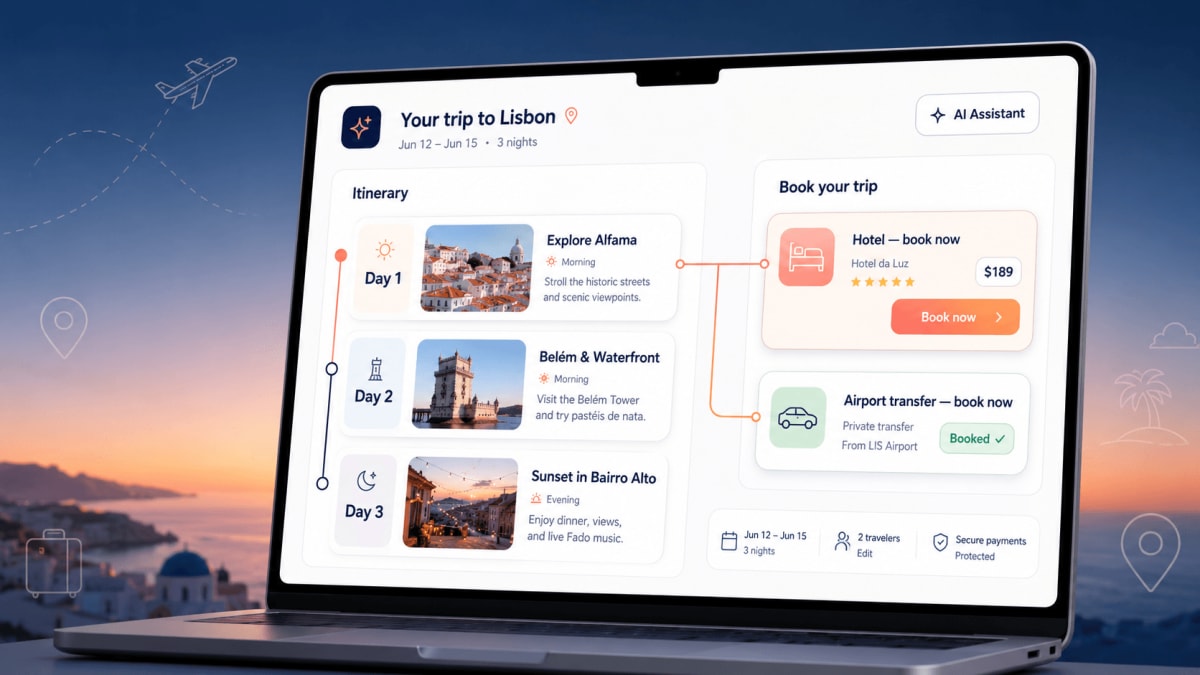
You describe the trip, get a structured day-by-day plan in minutes, adjust it, and book the core pieces without rebuilding everything on five other tabs. It's the planning quality people already trust AI for, attached to the booking layer they don't yet — which is how you go from "AI helped me plan" to "AI helped me book."
To be clear about scope: you can build the plan and book hotels and transfers today. Flights can live in your plan as selections; full in-app flight booking is still rolling out. And nothing here means turning your brain off — passports, visa rules, and anything truly mission-critical still deserve a human double-check.
Navoy is in public beta, runs a free tier (3 trips) and a Pro plan at $12.99/month, and currently holds a 4.8/5 rating across 150 reviews. If you've used ChatGPT to plan a trip and then felt the work stall at booking, that stall is the exact thing it's built to remove.
So should you let AI book your next trip?
Use AI for what 56% of travelers already trust it with (planning, recommendations, and itineraries) and only let it book when it's connected to real, current inventory you can verify. The 13% who book with AI today aren't wrong to be cautious about chatbots that can't see live prices. They're right.
The smarter move in 2026 isn't "trust AI with everything" or "trust it with nothing." It's matching the tool to the job: lean on AI to kill the 50-tab research grind, then book through something wired to real availability so the plan doesn't fall apart at checkout. When the planning layer and the booking layer are the same product, the gap mostly disappears.
For a deeper look at when to lean on AI versus a person, read AI travel agent vs human travel agent.
FAQ: AI travel planning and booking in 2026
Can I trust AI to book my travel?
Trust the booking when the AI is connected to live, real inventory (current prices and actual availability) and keeps you in one checkout rather than redirecting you elsewhere. General chatbots like ChatGPT can plan well but can't see live availability, which is why only 13% of travelers trust them to book. Tools built to plan and book on real inventory close that gap.
What's the difference between ChatGPT and an AI travel agent?
ChatGPT is a general-purpose assistant: it writes a good itinerary from training data but can't pull live prices or complete a booking. An AI travel agent like Navoy is purpose-built for travel — it personalizes a day-by-day plan and connects it to bookable hotels and transfers with real-time pricing, so the plan becomes a trip you can actually pay for.
Is AI trip planning accurate?
For structure, ideas, and recommendations, it's strong — 96% of travelers who've tried it say they'll use it again. The accuracy risk is in live details: prices, availability, and rules that change. Use AI for the plan, then verify anything time-sensitive (rates, visa requirements, opening hours) against a real-time source before you commit money.
Do most people use AI to plan travel in 2026?
Yes. As of 2026, 56% of US travelers use AI to help plan trips, up from 43% in late 2025 — and 33% now use generative AI for trip research, nearly matching the 35% who still use traditional search engines. Adoption for planning is mainstream; adoption for booking is still early at 13%.
Sources
- ITIJ — AI use surges among US travellers as trip planning habits rapidly shift
- Hotel News Resource — Survey: Travelers Plan More Trips in 2026, AI Use in Planning Rises
- Travala — How Many Travelers Use AI for Booking? Key Insights for 2026
- Hotel Management — Report: AI-planned travel surges in 2026, growth still ahead
- Travel Daily News — Travel Outlook Survey highlights 2026 destinations and AI adoption trends
Related articles
- AI Travel Agent vs Human Travel Agent: What's the Difference in 2026? — when to lean on AI versus a person
- What Is a Travel Agent, an OTA, and an AI Travel Agent? (2026 Explainer) — the three planning models, defined
About the Author
Haroun Moula
Haroun Moula is the founder and CEO of Navoy. Before Navoy, he worked in luxury travel with VVIPs and high-profile travelers. He built Navoy to bring curated, adaptive trip planning to more travelers through an AI travel agent that plans and books core trip parts in one place.