Key Takeaways
- A travel agent is a human professional who plans and books trips for you: strong on judgment and recovery, limited by time and cost.
- An OTA (online travel agency) is a self-serve booking site: strong on inventory and price visibility, weak on personalized guidance.
- An AI travel agent is software that builds personalized itineraries from your inputs: strong on speed and iteration; quality depends on how well it connects to real booking.
- They are three categories, not one replacement for another. Most travelers still mix human help, self-serve sites, and AI planners depending on the trip.
- Navoy merges agent-style planning with OTA-style access, then uses AI to compound the experience (what we mean by 10×): faster planning, better-fitting options, more convenience, and core booking in one flow.
A travel agent is a human trip planner, an OTA is a self-serve online booking platform, and an AI travel agent is software that builds personalized itineraries from your preferences, often in minutes. All three can get you on a plane and into a hotel, but they solve different problems: expertise, access, or guided planning at scale.
Travel planning did not start with apps. It started with people. Then the internet gave us access and took away a lot of the guidance. AI travel agents are the third wave because they try to bring both back.
If you already know the labels and want help choosing between AI and a human advisor, read our AI travel agent vs human travel agent guide. This piece is the map before that decision.
What Is a Travel Agent in 2026?
A travel agent is a human professional who researches, recommends, and books travel on your behalf, and stays accountable when plans change.
Traditionally that meant:
- Designing itineraries around how you actually travel (pace, budget, style)
- Recommending hotels, routes, and experiences that fit you, not just what's popular
- Handling bookings, tickets, and logistics across suppliers
- Stepping in when flights cancel, dates shift, or plans go sideways
At the high end of the market, that work can feel almost invisible: preferences remembered, details handled early, plans adjusted before you have to ask. The trade-off is structural: it's high-touch, manual, and does not scale to every traveler at every price point. You are paying for a person's time, relationships, and judgment.
Agents still matter in 2026 for complex, high-stakes, or emotionally loaded trips: multi-country routing, celebrations, accessibility needs, or "I don't know what I don't know" planning. Industry groups such as UN Tourism continue to track global travel recovery and demand; human advisors remain part of that mix, especially where trust and recovery are the product.
What Is an OTA (Online Travel Agency)?
An OTA is a website or app where you search, compare, and book flights, hotels, and activities yourself, without a human planner in the loop.
Then came the model most people recognize today: online travel agencies (OTAs). Well-known examples include Booking.com and Expedia. They are not the only OTAs, but they are the reference point for how this category works.
OTAs changed travel in the 2000s by giving everyone:
- Access: Millions of listings in one place
- Transparency: Side-by-side prices and filters
- Speed: Instant confirmation on many products
What OTAs generally do not do is decide the trip for you. The traveler still:
- Chooses destinations and dates without a coherent day-by-day plan
- Scrolls through near-duplicate hotel listings
- Opens new tabs for flights, stays, and ground transport
- Wonders whether they are optimizing for the right thing (cost, location, vibe, logistics)
In short: OTAs solved distribution and booking. They did not solve decision quality or itinerary shape. That gap is why "I booked everything myself and I'm still not sure it's right" is so common.
What Is an AI Travel Agent?
An AI travel agent is software that turns your trip preferences into a structured, day-by-day plan, and on stronger platforms lets you book parts of that plan without rebuilding it elsewhere.
Compared with a human agent and an OTA, the category is new but the logic is simple:
| Capability | Typical human agent | Typical OTA | AI travel agent |
|---|---|---|---|
| Who does the planning work? | The agent | The traveler | The software (from your inputs) |
| Personalization | High (relationship-based) | Low (filters and past searches) | High (built from stated preferences) |
| Scale / availability | Limited by human hours | High (always on) | High (always on) |
| Booking | Agent-coordinated | Self-serve checkout | Varies (plan-only vs in-app booking) |
| Best when | Complexity, recovery, trust | Simple stays, known routes | Iteration, speed, structured preferences |
A useful AI travel agent should do more than chat. In practice that means:
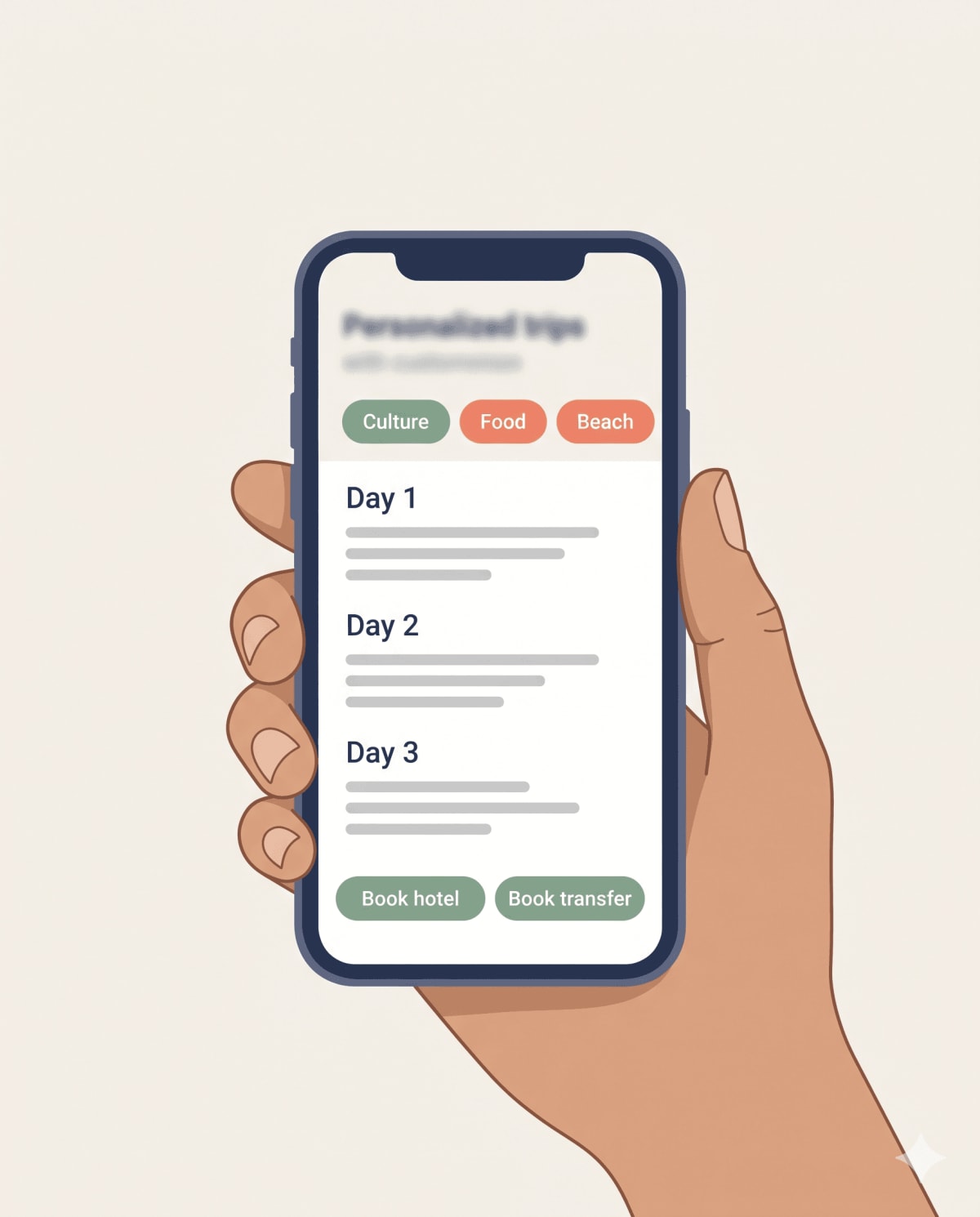
- Structured inputs: dates, budget, pace, trip focus (culture, beach, food, etc.)
- A real itinerary: days, neighborhoods, and activities in order
- Iteration: revise the plan when constraints change
- Booking path: ideally hotels and ground transport without re-entering everything on another site
Weak AI trip tools stop at inspiration or link lists. Stronger ones behave like a planning layer that can connect to inventory.
How Did We Get From Travel Agents to AI Travel Agents?
Travel planning moved in three waves: human expertise, self-serve booking at scale, then AI-guided planning that tries to combine guidance with scale.
Before algorithms and booking engines, there was one main way to plan a great trip: you talked to someone who knew better than you. OTAs like the Booking.com and Expedia model later put millions of listings online. AI travel agents are the next step, not because we needed another website, but because access without guidance still leaves most people guessing.
None of these waves fully replaces the others. You might use self-serve booking for a one-night airport hotel, a human agent for a complex honeymoon, and an AI planner for a two-city week where you want speed and a clear day-by-day structure.
Where Navoy Comes In (and Why I Built It)
I did not start Navoy from the tech side. I started from the luxury travel side.
Before this company, I worked with VVIPs and celebrities in luxury travel, where a trip was never "just booking." It was curated, adaptive, and deeply personal:
- No endless browsing
- No generic recommendations
- No wasted time on decisions that should have been made earlier
The best trips I saw were not built from more options. They were built from better decisions: early, specific, and continuously adjusted.
The problem is that level of service was locked behind high fees and human bandwidth. Most people never got it.
That is why we built Navoy: to bring that standard of planning to far more travelers, using AI where it actually helps: speed, structure, and iteration at scale.
What Navoy Is Today (Product Facts)
Navoy is an AI travel agent on navoy.io: you describe your trip, get a personalized day-by-day itinerary in minutes, and can book hotels and transfers on Navoy surfaces, without the usual pile of separate tabs.
Navoy is not just combining a travel agent and an OTA and calling it a hybrid. The point is to merge what each category is good at, then 10× the overall travel experience with AI. Not one feature multiplied by ten, but several upgrades stacking at once.
From travel agents (the human standard)
- Taste, personalization, and itineraries that feel curated, not assembled from random tabs
- Judgment on what is worth your time, money, and energy on a trip
- A trip that feels thought through, not just booked
From OTAs (access and scale)
- Access to broad hotel inventory and real-time pricing context
- Convenience of booking without a back-and-forth with an advisor
- Options you can actually compare in one place (even when the hard part is choosing well)
Then 10× it with AI (why the experience compounds)
This is where the 10× comes in. When I say 10×, I do not mean we guarantee the cheapest rate on every hotel or that every trip is ten times cheaper. I mean the full planning-and-booking experience gets dramatically better because these factors improve together:
| What improves | What that feels like for you |
|---|---|
| Planning | A structured first draft in minutes, not hours lost across tabs |
| Relevance | Options and days that fit your style, not endless generic rows |
| Convenience | One flow for plan → revise → book core stays and transfers |
| Access | Serious inventory and pricing context without rebuilding the trip elsewhere |
| Decision quality | Less "did I miss the better choice?" after you have already paid |
That compound lift is what I mean by 10×: agent-level intent, platform-level reach, AI-level speed, in one product.
In practice, that shows up as:
- Fast drafts and trip focus tags (up to three per trip), with room to change the plan before you book
- Real-time itinerary updates when dates, budget, or priorities change
- Hotels and transfers you can book on Navoy, so the itinerary is not a static export you rebuild on other sites
This is not "a better booking site." It is a shift:
- Searching → being guided
- Planning → co-creating
- Booking → experiencing
We sometimes describe Navoy internally as an AI-native OTA, a category label for next-gen online travel, not a replacement for our public headline: AI Travel Agent — Plan & Book Any Trip in Minutes. For you as a reader: an AI travel agent that plans and books the core pieces of a trip in one place, with more connective tissue still on the roadmap.
Which Option Should You Use for Your Next Trip?
Use an OTA when the trip is simple and you already know exactly what to book; use a human agent when complexity or recovery matters; use an AI travel agent when you want a fast, personalized plan you can iterate, especially multi-stop or multi-priority trips.
| Your situation | Start here |
|---|---|
| One hotel, familiar city, no itinerary needed | OTA-style self-serve booking |
| Multi-country logistics, VIP access, heavy disruption risk | Human travel agent |
| Clear preferences, want a day-by-day plan quickly | AI travel agent |
| Unsure between AI planner vs human advisor | AI travel agent vs human travel agent (2026) |
For how personalized planning beats generic lists, see personalized vs generic itinerary.
Why This Shift Matters for Everyday Travelers
Most people do not enjoy planning trips. They enjoy taking them.
Until now, planning has often been time-consuming, fragmented, and mentally draining. AI travel agents are not magic, but when they are wired to real inventory and honest constraints, they can give you clarity instead of overwhelm, personalization instead of guesswork, and speed without pretending a spreadsheet is a vacation.
For years, luxury travel felt like a different universe. I believe that is changing. The question is no longer whether software can suggest a hotel. It is whether it can help you make the right trip and let you book the parts that matter without starting over on five other sites.
Final Thought
Travel agents gave you expertise. OTAs gave you access. AI travel agents aim to give you both, plus structured intelligence.
That is where the real shift happens. The future of travel is not about having more choices. It is about having the right ones, faster, and a path to book them that does not fall apart the moment you leave the planner.
If you want to try the way we are building that on Navoy, free tier or Pro, start a trip here.
FAQ: Travel Agents, OTAs, and AI Travel Agents
Is an AI travel agent the same as an OTA?
No. An OTA is primarily a booking interface: you search and checkout. An AI travel agent produces a plan from your inputs (dates, budget, style) and may connect that plan to bookable inventory. Some OTAs add AI features; the category difference is whether guidance and itinerary structure are the core product.
Is an AI travel agent the same as a human travel agent?
No. A human agent provides judgment, supplier relationships, and live recovery. An AI travel agent provides speed, iteration, and consistent structure from data, best when you know roughly what you want and need help executing across options. Many travelers use both at different stages; see our comparison guide.
What does OTA stand for?
OTA means online travel agency, a digital business that sells travel products (especially hotels and flights) to consumers through its own website or app. Booking.com and Expedia are common examples of the model; they are not the only OTAs.
Can an AI travel agent book my whole trip?
On Navoy, you can go from a blank trip idea to booked hotels and transfers in one flow: plan, revise, and book without rebuilding everything on other sites. That is what "whole trip" means for most travelers today: the structure of the trip plus the parts you book inside the product. Flight choices can sit in your plan; full in-app flight booking is still rolling out in the main dashboard flow.
Related articles
- AI Travel Agent vs Human Travel Agent: What's the Difference in 2026? — when to use AI vs a human advisor
- Personalized vs Generic Itinerary: Which Works Better? — why structured preferences beat generic lists
About the Author
Haroun Moula
Haroun Moula is the founder and CEO of Navoy. Before Navoy, he worked in luxury travel with VVIPs and high-profile travelers. He built Navoy to bring curated, adaptive trip planning to more travelers through an AI travel agent that plans and books core trip parts in one place.