Key Takeaways
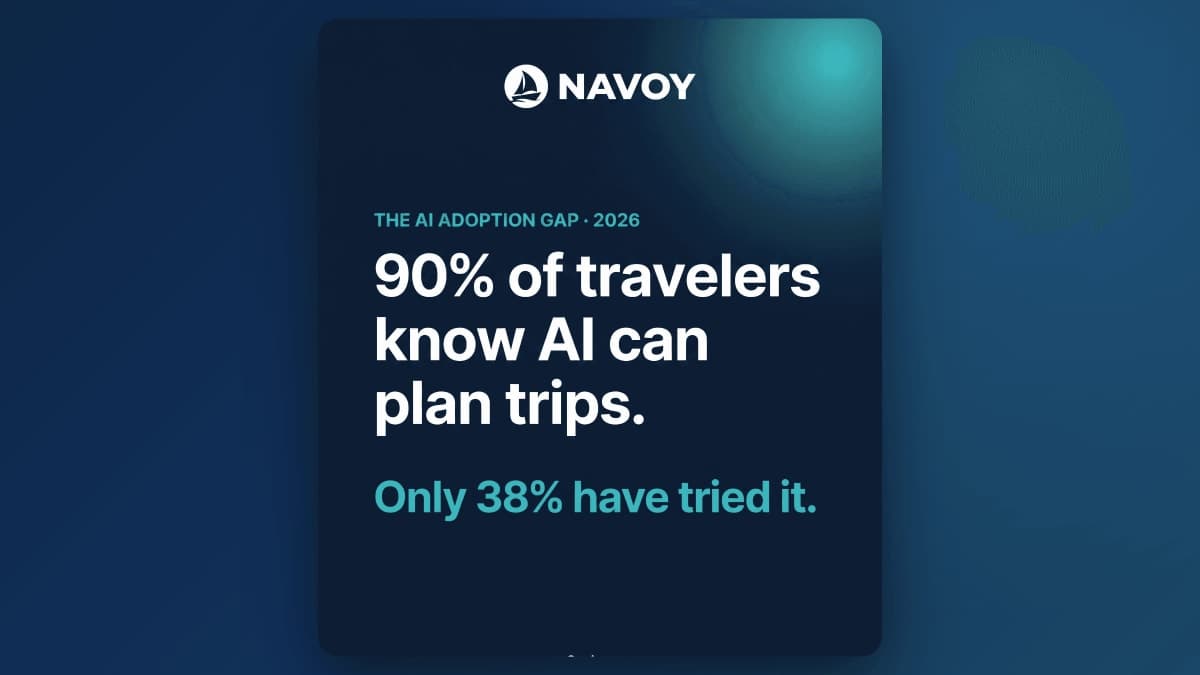
- 90% of travelers know AI can plan trips, but only 38% have actually tried it — a wide awareness-to-trial gap (TakeUp, 2026).
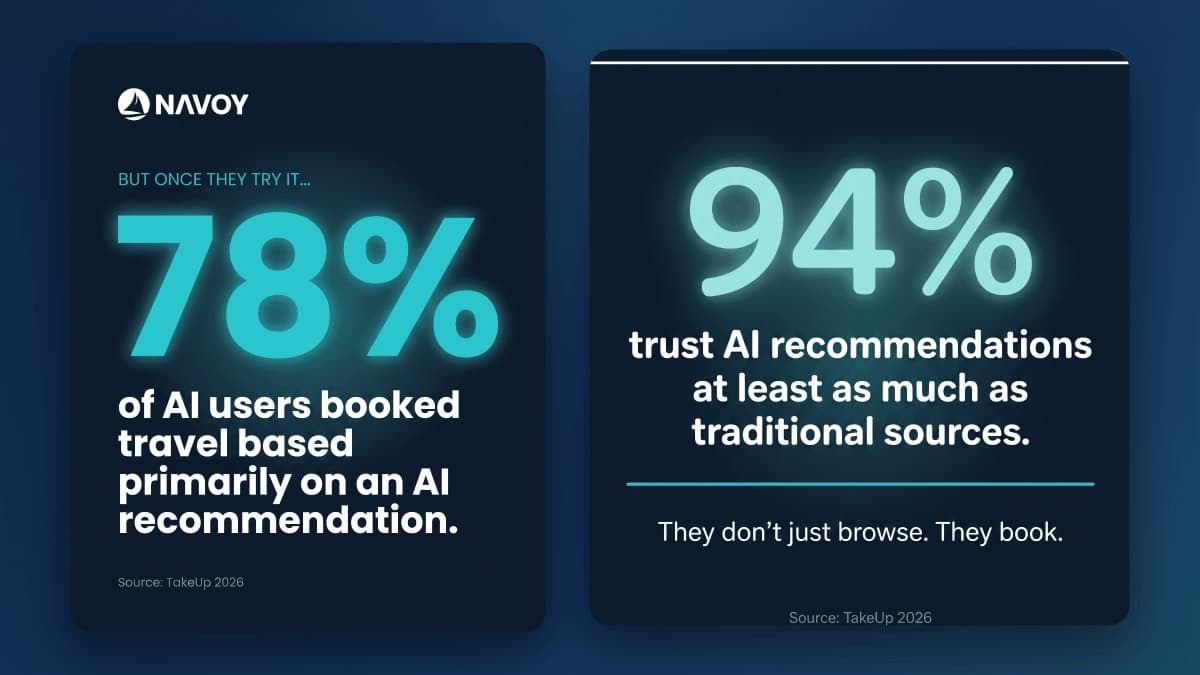
- Once they try, they convert: 78% of AI users booked travel based primarily on an AI recommendation.
- Trust is not the blocker for people who try — 94% trust AI recommendations at least as much as traditional sources.
- The real bottleneck is the first try: habit, plus worry that the plan won't hold up on real hotels and real prices.
- The tools that win will make the first AI-planned trip feel safe — real hotels, real prices, a bookable itinerary.
What Is the AI Travel Adoption Gap?
The AI travel adoption gap is the distance between awareness and action: about 90% of travelers know AI can help plan a trip, but only 38% have actually tried it, according to TakeUp's 2026 research. Awareness is nearly universal. Trial is not. That gap, not the technology, is the real story of AI travel in 2026.
It matters because the people who cross the gap rarely go back. Once travelers try AI for a trip, most keep using it and start trusting it with real decisions. So the interesting question is not "will AI plan travel," it's "why haven't more people tried it yet, and what happens when they do."
| Travelers who… | Share | Source |
|---|---|---|
| Know AI can plan or book travel | 90% | TakeUp, 2026 |
| Have actually used AI to plan a trip | 38% | TakeUp, 2026 |
| Have not tried it yet | ~55% | TakeUp, 2026 |

Why Do So Few Travelers Try AI Trip Planning?
Most non-users are held back by habit and by one specific worry: that an AI plan won't survive contact with reality — real hotels, real availability, real prices. Roughly 55% of travelers have not yet used AI for a trip, and their hesitation clusters around accuracy, real-time pricing, and personalization.
That worry is not irrational. AI travel planners have surged in popularity, but hallucinations and trust gaps are real, and stories of made-up hotels or wrong prices travel fast. When the downside of a bad first try is a ruined trip, people default to what they know: open tabs, past bookings, a friend's advice. The gap is less "I don't believe AI can do this" and more "I'm not ready to bet a real trip on my first attempt."
What Happens Once Travelers Actually Try AI?
Once travelers cross the gap, they convert and they come back: 78% of AI users have booked travel based primarily on an AI recommendation, and 94% trust AI recommendations at least as much as traditional sources. The first try, not the technology, was the barrier all along.
The rest of the picture is just as strong. This is not casual browsing — people are acting on what AI tells them, and returning for the next trip.
| Once travelers try AI… | Share | Source |
|---|---|---|
| Booked travel primarily on an AI recommendation | 78% | TakeUp, 2026 |
| Trust AI recs at least as much as traditional sources | 94% | TakeUp, 2026 |
| Used AI to find or book accommodations | 86% | TakeUp, 2026 |
| More likely to book a hotel with a trusted AI rec | 84% | TakeUp, 2026 |
| Rely on AI for most or every trip | 63% | TakeUp, 2026 |
| Will probably or definitely use AI again | 96% | TakeUp, 2026 |
The Bottleneck Isn't the Tech — It's the First Try
The numbers point to one conclusion: the bottleneck is the first try, not the capability. Adoption is already moving fast. Phocuswright reported that 56% of US leisure travelers used AI for at least one trip in the past year as of early 2026, up from 43% about nine months earlier, one of the quickest behavior shifts the travel industry has seen.
Put the two datasets together and the pattern is clear. Awareness is saturated, trial is climbing fast, and satisfaction among people who try is very high. The winners in AI travel will not be the ones with the flashiest model. They will be the ones who remove the risk from that first attempt, so a curious traveler can go from "I'll try it" to "I booked it" without a leap of faith.
How to Make the First AI-Planned Trip Feel Safe
You make the first AI-planned trip feel safe by grounding it in reality: real hotels, real prices, and an itinerary you can actually book, not just a list of suggestions. The moment a plan turns into something bookable at a price you can see, the fear behind the first try goes away.
That is where Navoy is built to fit. You describe a trip, Navoy builds a day-by-day itinerary, and then you book the hotels and airport transfers in the same place, with real-time pricing so you see the actual cost before you commit. It is a bookable itinerary rather than a screenshot of ideas, which is exactly the reassurance a first-time AI traveler needs. For more on the wider shift, see our take on the AI travel planning trust gap, what an AI travel agent actually is, and how an AI travel agent compares to a human one.
Frequently Asked Questions
How many travelers use AI to plan trips?
About 38% of travelers have actively used AI for trip planning, while roughly 90% are aware AI can help, according to TakeUp's 2026 research. Adoption is rising quickly: Phocuswright reported 56% of US leisure travelers used AI for at least one trip in the past year, up from 43% about nine months earlier.
Do travelers actually trust AI travel recommendations?
Among people who have tried it, yes. TakeUp's 2026 data found 94% of AI users trust AI travel recommendations at least as much as traditional sources, 78% have booked travel primarily on an AI recommendation, and 96% say they will use AI again. Trust builds fast once someone crosses the first-try gap.
Why haven't more people tried AI trip planning?
The main barriers are habit and doubt that an AI plan will hold up in the real world, with concerns about accuracy, real-time pricing, and personalization. AI planners have grown fast, but hallucinations and trust gaps still make some travelers wary of betting a real trip on a first attempt.
Can AI actually book a trip, not just suggest one?
Yes, depending on the tool. Navoy plans a day-by-day itinerary and then books hotels and airport transfers directly, with real-time pricing, so the plan is bookable rather than just a set of ideas. Navoy does not book flights; flights are selectable while you plan, and you book the ticket with your airline.
Sources
- TakeUp — The Rise of AI-Planned Travel in 2026
- PR Newswire — TakeUp's "The Rise of AI-Planned Travel in 2026" Report
- Hotel Management — Report: AI-planned travel surges in 2026, growth still ahead
- CNBC — Travelers are turning to AI to plan trips, but hallucinations and trust gaps remain
More from Navoy: the AI travel planning trust gap, what a travel agent, an OTA, and an AI travel agent are, and AI travel agent vs human travel agent.
Ready to try your first AI-planned trip?
About the Author
Haroun Moula
Haroun Moula is the founder and CEO of Navoy. Before Navoy, he worked in luxury travel with VVIPs and high-profile travelers. He built Navoy to bring curated, adaptive trip planning to more travelers through an AI travel agent that plans and books core trip parts in one place.