Key Takeaways
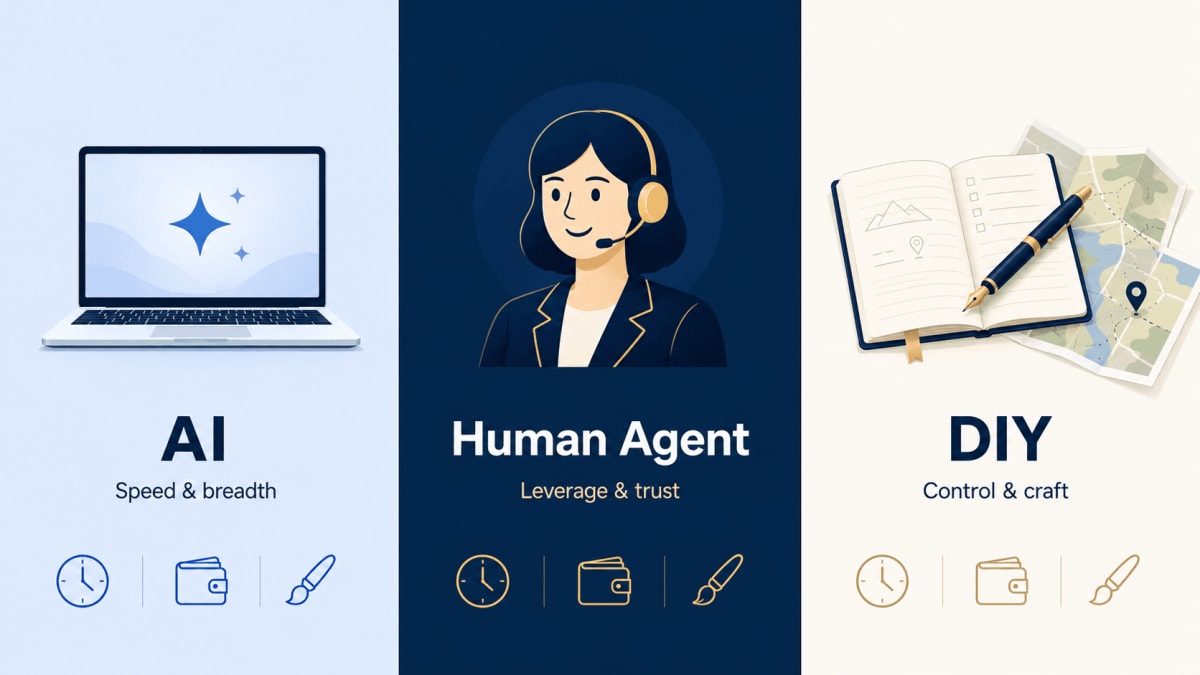
- AI, human agents, and DIY don't compete on price — they serve different decision modes and different time/control trade-offs. AI is built for breadth and speed, agents for leverage and recovery, DIY for control and craft.
- AI plans the typical trip in minutes for free or under $15/month. Human agents typically charge $100–$500 in planning fees plus baked-in commission. DIY is "free" only if your time is worth nothing.
- DIY actually takes 15–30 hours per multi-city trip — the honest cost is your opportunity cost, not zero.
- Booking confidence still lags planning adoption. Per Expedia Group's 2026 AI Trust Gap survey, 53% are comfortable with AI suggesting options, but 68% still prefer to book through trusted brands — which is exactly why hybrid planning is now mainstream.
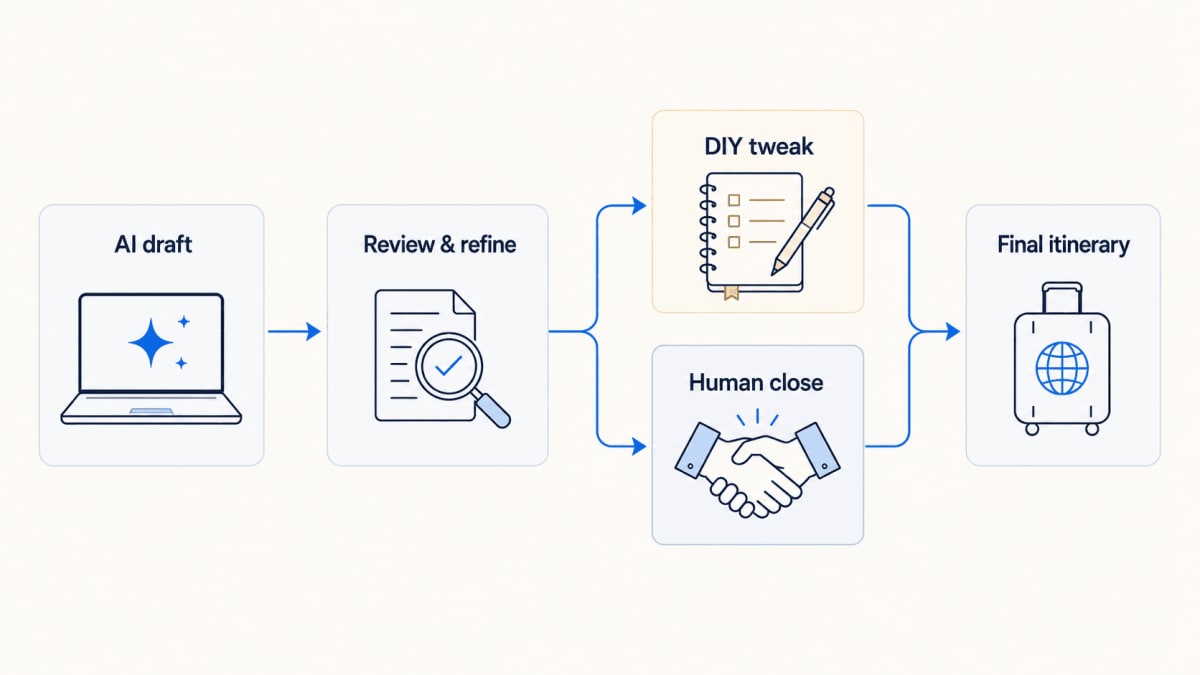
- The honest answer for most travellers is hybrid. AI to draft, then either DIY tweaks or a human to close the high-stakes parts.
AI vs Human vs DIY Travel Planning: Honest 2026 Comparison
If you're planning a trip in 2026 and weighing whether to use an AI travel planner, a human travel agent, or to plan it yourself, the most useful answer isn't "which is cheapest?" — it's "what does this trip need, and how do I want to spend my time?"
AI planners, human agents, and DIY aren't really competing on price. They serve three different decision modes and three different relationships with your time. AI is built for breadth and speed — turning structured preferences into a draft itinerary in minutes. Human agents are built for leverage and recovery — handling complex multi-country logistics and the moments when something goes wrong on the ground. DIY is built for control and craft — for the traveller who genuinely enjoys the research. Most modern travellers use two of the three.
The shift toward AI planning is already mainstream: per Phocuswright's 2026 update, 39% of US travellers had already used AI for travel planning by mid-2025. But trust hasn't fully followed — Expedia Group's 2026 AI Trust Gap survey (YouGov, 5,700+ adults across US/UK/India) found that 53% are comfortable with AI suggesting options, while 68% still prefer to book through trusted travel brands. Planning has shifted faster than booking confidence — and that gap is exactly where the AI vs human vs DIY decision sits.
What is AI travel planning?
AI travel planning is software that generates a personalized, day-by-day trip plan from your structured preferences — destination, dates, group, interests, pace, and budget — in minutes. Instead of a generic top-10 list, you get a plan tuned to who you are and how you actually travel.
The core mechanic is structured input. A modern AI planner asks for explicit signals — pace (relaxed, balanced, packed), trip focuses (food, culture, family, wellness), budget split (more on hotels or more on experiences), accessibility needs, dietary restrictions — and weighs hundreds of options against those signals. The output is a draft itinerary you can refine, regenerate, or swap on the fly.
What AI does well: speed (first draft in minutes), breadth (a much wider pool of hotels, transfers, restaurants and activities than any single advisor's book), iteration (change one input and the whole plan reshapes around it), and cost transparency (most planners are free or low-subscription rather than fee-for-service).
What AI is weaker at: subjective taste, genuinely novel destinations, and high-stakes recovery when something goes wrong on the ground. For the full breakdown of AI's strengths and weaknesses against a human advisor specifically, see our sister article on AI travel agent vs human travel agent.
What is human travel agent planning?
A human travel agent is a professional who plans and books trips on your behalf, paid through planning fees, commission, or a mix. What you're buying isn't really "the plan" — it's the agent's time, supplier relationships, and judgement when things go wrong.
There are two broad flavours in 2026. High-street agencies (often franchised) handle the volume end — packages, cruises, all-inclusive resorts. Independent travel advisors sit closer to private concierge work — bespoke multi-country trips, special-access experiences, high-budget itineraries. The market is consolidating up-market: per the American Society of Travel Advisors (ASTA), the industry is moving toward complex, luxury, and high-stakes trips, with simpler bookings increasingly handled online.
What you actually get from a human agent: leverage (relationships with hotels, ground operators, and DMCs that produce upgrades, late check-outs, or favours unavailable to walk-in customers), recovery (a real person on speed dial at 3 a.m. when your connecting flight is cancelled), trust (a single human accountable for the whole trip), and time saved (you outsource the entire planning workload).
What you pay: typically $100–$500 in upfront planning fees for a custom trip, plus commission baked into bookings (often 5–15% depending on supplier), or a retainer for ongoing concierge work.
What is DIY travel planning?
DIY travel planning is when you build the trip yourself across multiple tools — search engines, OTAs, review sites, maps, spreadsheets — without an AI agent or a human advisor. It's the default mode most travellers still start with, and for the right trip it's genuinely the right call.
The honest case for DIY: control (every choice is yours), craft (for some travellers, the planning is part of the trip — researching neighbourhoods, reading deeply on a region, building the itinerary is a hobby in itself), loyalty optimisation (if you have airline status, hotel chain points, or a credit card strategy, DIY lets you stack everything precisely), and deep familiarity (when you've been to a city five times, you know what you want — an AI or agent would slow you down).
The honest cost: time. Industry surveys consistently put DIY planning at 15–30 hours per multi-city week-long trip — researching destinations, comparing flights, reading hotel reviews, sequencing days, booking pieces in the right order. Psychologist Barry Schwartz's The Paradox of Choice calls out the underrated tax: decision fatigue. Every additional option you weigh makes the next decision harder.
DIY is the right answer for planning-as-hobby travellers, deep-familiarity trips, and loyalty-stack optimisers — and the wrong answer for almost everyone else.
AI vs human vs DIY travel planning — the full comparison
The cost ladder framing — "DIY is free, AI is cheap, agents are expensive" — is wrong. Once you count your time and what you actually get for the money, the picture flips for most trips.
| Factor | AI travel planner | Human travel agent | DIY |
|---|---|---|---|
| First-draft planning time | Minutes | 2–5 days back-and-forth | Hours of research before any plan exists |
| Planning effort from you | Low (answer 5–8 questions) | Low (brief, then review) | High (15–30 hours per multi-city trip) |
| Direct fee | Free or ~$13/month | $100–$500 planning fee + commission | $0 |
| Hidden cost | Low | Commission baked into bookings | Your time × 15–30 hours |
| Personalisation depth | High — re-prompted instantly | High — depends on the advisor | Total — every choice is yours |
| Supplier leverage | Low (no relationships) | High (relationships, upgrades, late check-outs) | None |
| Iteration speed | Seconds — regenerate the plan | Days — back-and-forth | Hours — start sections over |
| Recovery when things go wrong | Self-serve | A person on speed dial | All on you |
| Best for | Standard multi-destination trips, budget-conscious travellers | High-complexity, luxury, special-access trips | Familiar destinations, planning-as-hobby travellers, loyalty optimisers |
Two rows matter more than the others. Hidden cost is where the cost ladder breaks: DIY at 20 hours and a $50/hour opportunity cost is $1,000 of your time — more than most human-agent planning fees and roughly 75× a Navoy Pro subscription. Supplier leverage is where human agents are genuinely irreplaceable: a relationship-built suite upgrade or a recovered hotel room during a strike doesn't show up in any AI's database.
The third axis to weigh is what you want from the planning process itself. If you actively enjoy it, DIY's "cost" is negative — it's a hobby. If you don't, every hour spent is a tax.
What does AI vs human vs DIY trip planning actually cost in 2026?
Once you count your time, DIY is the most expensive option for travellers who don't enjoy planning. Here's the honest math.
- AI travel planner. Most options are free for casual use or low-subscription. Navoy's free tier covers the typical traveller; Navoy Pro is $12.99/month for unlimited trips, deeper personalisation, and faster regeneration. There are no per-booking commissions or hidden planning fees.
- Human travel agent. $100–$500 in planning fees for a custom itinerary is the typical 2026 range, depending on complexity. Independent advisors handling luxury or multi-country trips often charge a retainer ($150–$300/month) plus commission on bookings (often 5–15%, embedded in supplier prices). You're paying for time, relationships, and accountability.
- DIY. $0 direct cost. The real cost is 15–30 hours per multi-city week. At a conservative $40/hour opportunity cost (what most professionals would value an off-day at), that's $600–$1,200 of your time for a single trip. At a $100/hour rate, $1,500–$3,000.
A worked example: a typical $3,000 trip planned three ways.
- AI: $0 (free tier) or $12.99 (Pro), about an hour of your time including refinement.
- Human agent: $250 planning fee + ~$240 in baked commission (8% average), about two hours of your time across calls.
- DIY: $0 direct + 20 hours × $50/hour = $1,000 of opportunity cost.
The agent and AI are less expensive than DIY once you count what your time is worth. Which is why the "DIY is free" framing is the single most expensive piece of folk wisdom in travel planning — unless you genuinely enjoy the process, in which case the calculus inverts.
When should you use AI vs human vs DIY trip planning?
The right mode depends on two axes — trip complexity and how much you enjoy planning. Match the trip to the mode rather than defaulting.
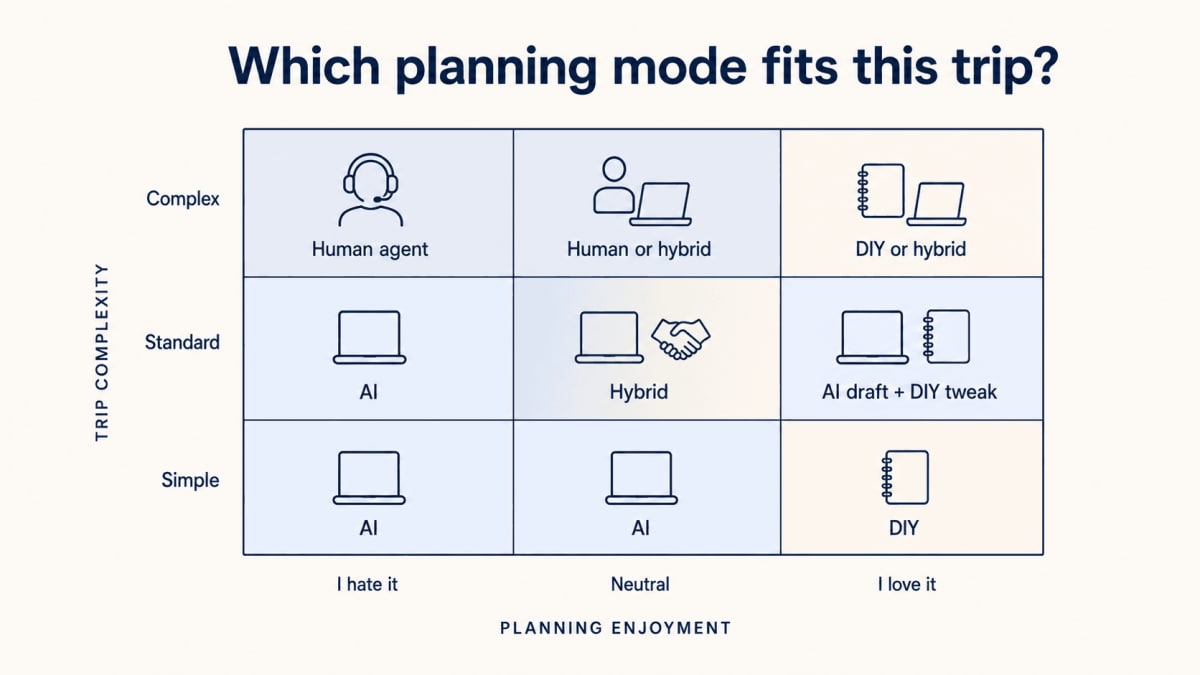
Use AI when:
- The trip is standard — 1–14 days, 1–4 destinations, common accommodation types.
- You want to iterate — try different cities, paces, or budget splits without starting over.
- You're budget-conscious — every dollar saved on planning fees goes to better hotels or experiences.
- You're comfortable online — happy reviewing options on a screen rather than over the phone.
- The trip is multi-destination — sequencing 3–4 cities is exactly what AI does fastest.
Use a human travel agent when:
- The trip is highly customised or luxury — private guides, special-access experiences, top-tier hotels where relationships unlock upgrades.
- It's a large group or family with special needs — accessibility, dietary, medical, age range.
- You're going to a high-risk or politically unstable destination — having a person accountable matters.
- You're booking during peak event chaos — World Cup, Olympics, major festivals where supplier leverage decides whether you have a room at all.
- Something going wrong is unacceptable — honeymoons, milestone birthdays, work trips with a board meeting attached.
Use DIY when:
- You're going somewhere you know deeply — a city you've visited five times.
- You have a strong loyalty or points strategy — airline status, hotel chain credit, card stacks you want to optimise.
- You genuinely enjoy planning — the research, the maps, the spreadsheets are part of the holiday.
- The trip is a simple single-city trip and you have abundant free time.
For 2026 travel trends and the broader workflow context, see our 2026 trip planning guide.
Use hybrid (most experienced travellers) when: none of the above purely fits — which is most trips. More on hybrid below.
The hybrid plays — how experienced travellers actually plan in 2026
For most trips, the honest answer is two modes, not one. The three hybrid patterns that work in 2026:
- AI draft + DIY refinement. Use an AI planner to generate the structural backbone — cities, sequence, pace, hotel tier, day shape — in minutes. Then tweak the details yourself: swap one restaurant for a personal favourite, move a museum day to fit jet lag, layer in your loyalty bookings. You get 80% of the plan for free and full ownership of the last 20%.
- AI plan + human close. Use AI to build the full itinerary, then hand it to an independent advisor for the booking and the high-stakes pieces — flights with status, the suite upgrade, the table at the booked-out restaurant. You pay for leverage on the parts where it matters and skip the planning fee on the parts where it doesn't.
- Human pitch + AI vetting. An advisor proposes an itinerary; you run it through an AI planner to compare alternatives, sanity-check pricing, and spot anything missed. You keep the relationship and the accountability but verify the recommendation rather than trusting blind.
The hybrid mindset matches where the market is heading: AI is the first step for most trips, but for the trips where leverage, recovery, or trust matter, a human still finishes the work. DIY survives where the planning is genuinely a hobby — or where you know a destination so well that anything else is friction.
FAQ
Is DIY trip planning still worth it in 2026?
Yes — but for fewer trips than most travellers assume. DIY is genuinely the right call when you know a destination deeply, when you're optimising a loyalty or points strategy, or when you actively enjoy the planning process. For standard trips you don't have deep familiarity with, AI is faster and usually produces a better outcome once you count your time.
Can AI travel planning replace a human travel agent?
No — and that's not the point. AI handles roughly 80% of trips that were always over-served by human agents (city breaks, weekend trips, well-known destinations). Human agents are moving up-market into complex, luxury, and high-stakes work where supplier leverage and trust matter. The category isn't shrinking; it's segmenting. Most experienced travellers now use both.
How long does DIY trip planning actually take?
Industry surveys consistently put DIY planning at 15–30 hours for a multi-city week-long trip — researching destinations, comparing flights, reading hotel reviews, sequencing days, and booking pieces in the right order. Add 5–10 hours for any additional country. Most travellers underestimate this by half because they don't count the small evening sessions.
Should I use AI to plan a multi-country trip?
Yes — multi-country sequencing is where AI saves the most time. A modern AI planner can produce a draft for a 3-country, 12-day trip in minutes, including the right flight order to minimise cost. DIY for the same trip typically takes 25–40 hours. For the highest-budget multi-country trips, layer a human advisor on top for the booking and supplier leverage.
Is it safe to book through an AI travel agent?
Yes — provided the AI agent uses established booking partners. Per Expedia Group's 2026 AI Trust Gap survey, 68% of travellers still prefer to book through trusted brands, which is why most reputable AI planners (Navoy included) route bookings through known supplier networks rather than holding traveller funds directly. Read who the booking partners are before you commit.
The bottom line
The honest 2026 answer isn't "AI vs human vs DIY." It's "which mode fits this specific trip, and how do I want to spend my time on it?" AI travel planning, human travel agents, and DIY each fit a different decision mode — breadth and speed, leverage and recovery, control and craft.
Once you count the time DIY actually takes, the cost ladder framing breaks: for most travellers on most trips, DIY is the most expensive option. And once you accept that planning trust and booking trust are two different things, the hybrid pattern — AI to draft, human or DIY to close — stops being a workaround and starts looking like the right answer.
The category isn't a competition. It's a stack. Pick the modes that fit the trip you're actually planning, not the trip you wish you were planning.
Plan your next trip with Navoy
If you want to skip the 15–30 hours of DIY research and get a personalized, day-by-day plan in minutes — including hotels, transfers, and activity sequencing — Navoy's AI travel agent does that for free on the standard tier, or $12.99/month on Pro for unlimited trips and deeper personalisation.
Start planning your trip with Navoy →
Related reading
- AI travel agent vs human travel agent: what's the difference in 2026? — the sister deep-dive on AI vs human specifically.
- Personalised vs generic itineraries: which works better? — the pillar piece on why personalisation matters.
- Your 2026 trip planning guide — the broader workflow and what's changing this year.
- Lisbon destination guide — example of a destination where AI itineraries shine for multi-day exploration.
About the Author
Haroun Moula
Haroun Moula is the founder and CEO of Navoy. Before Navoy, he worked in luxury travel with VVIPs and high-profile travelers. He built Navoy to bring curated, adaptive trip planning to more travelers through an AI travel agent that plans and books core trip parts in one place.