Key Takeaways
- The booking window is usually much shorter than people assume. Septime in Paris opens 21 days ahead. DiverXO in Madrid opens 90.
- Five patterns cover almost every hard-to-book restaurant: fixed-calendar drop, rolling daily drop, batch drop, request-and-approve, and closed network.
- The exact hour matters more than the date. Rolling releases happen at a fixed clock time, and tables can be gone within minutes.
- Some restaurants cannot be booked at all. Sushi Saito works by referral and Rao's by long-standing table rights. Persistence does not help.
- Most restaurants do not date their booking policy pages, so confirm the mechanics on the restaurant's own site before planning around them.
If you have ever tried to book a famously difficult restaurant, you have probably been told to book a year in advance. For most of them that is wrong, and it is wrong in a way that costs you the table. The majority of hard-to-book restaurants release tables on a rolling basis a few weeks or a few months ahead, at a fixed hour, and they are gone quickly. Septime in Paris opens bookings 21 days out at 10am. Knowing the pattern matters more than booking early, because you cannot book early if the calendar does not exist yet.
How far ahead do restaurant bookings actually open?
The range across the restaurants examined here runs from three weeks to about seven months, and the short end is more common than the long. Septime opens 21 days ahead, Den in Tokyo up to two months, DiverXO 90 days, Central in Lima up to four months, and Osteria Francescana releases a calendar month at a time roughly six to seven months out.
The "book a year ahead" advice comes from a handful of genuinely exceptional cases and from a general sense that difficult restaurants must have long queues. What is actually happening is different: restaurants keep their booking horizons short deliberately, because a table booked eleven months out is a table likely to be cancelled.
That has a practical consequence for trip planning. If you are going to Paris in four months and want Septime, there is nothing you can do about it today. The calendar for your dates will not open until three weeks before you travel. Trying to book now is not early, it is impossible, and the useful action is to set a reminder for the right morning.
What are the five ways bookings are released?
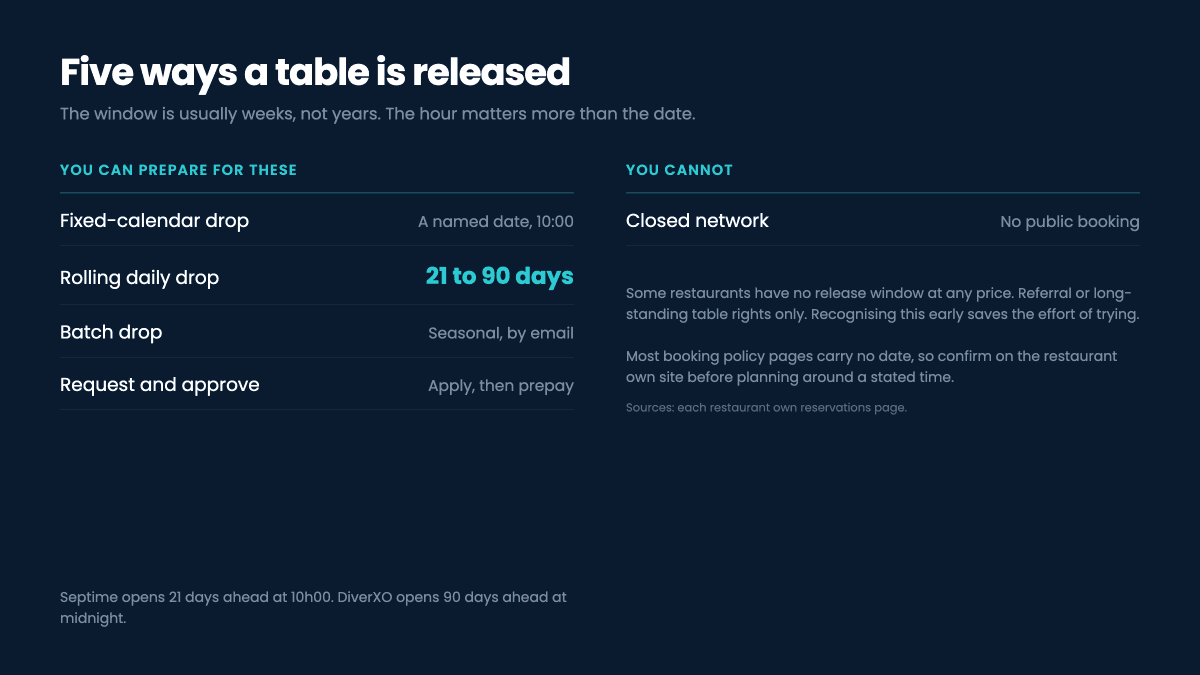
Nearly every hard-to-book restaurant uses one of five mechanisms: a fixed-calendar drop, a rolling daily drop, a batch drop, request-and-approve, or no public release at all.
| Pattern | How it works | Example |
|---|---|---|
| Fixed-calendar drop | A whole month opens on a named date at a named hour | Osteria Francescana, 10:00 |
| Rolling daily drop | One new date becomes available each day at a fixed time | DiverXO, Septime, Den |
| Batch drop | Irregular releases covering a season, usually announced by email | Alchemist, Noma |
| Request-and-approve | You apply, they decide, then you pay | Asador Etxebarri |
| Closed network | No public booking exists | Sushi Saito, Rao's |
Fixed-calendar drop. Osteria Francescana in Modena publishes which date each future month opens on: April 2027 opened on 1 October 2026, May 2027 on 2 November 2026, each at 10:00. This is the most plannable pattern, because the restaurant tells you in advance exactly when to be ready. It is also the one where being a few minutes late is most costly.
Rolling daily drop. A new date becomes bookable every day, keeping a constant horizon. DiverXO in Madrid releases one date daily at midnight, 90 days out. Septime in Paris releases at 10h00, 21 days out. Den in Tokyo takes bookings from noon for dates up to two months ahead. If you want a specific date, you work backwards from it to find the morning you need to act.
Batch drop. Alchemist in Copenhagen releases tickets roughly every three months, covering the following two or three months. Noma releases by season. Neither publishes a fixed day and time, which makes the mailing list the actual mechanism rather than a marketing afterthought. For these, subscribing is the strategy.
Request-and-approve. Asador Etxebarri opens its calendar progressively and works on request: you submit dates, the restaurant approves, then you prepay. You are not booking a table so much as applying for one.
Closed network. Some restaurants have no public release at any price. More on those below.
Why does the exact hour matter so much?
Because in a rolling daily release, every table for a given date becomes available in the same instant, and the restaurants that use this pattern are the ones where demand far exceeds supply. The date is easy to work out. The hour is what decides whether you get the table.
Midnight for DiverXO, 10h00 for Septime, 10:00 for Osteria Francescana's monthly drop. These are local times, which is the detail most often missed by people booking from another country. A 10:00 release in Modena is 04:00 in New York.
Den in Tokyo is the interesting exception, and worth knowing about because it defeats a specific modern problem. Den takes bookings by phone only, Monday to Saturday between noon and 5pm, and does not use an online platform. That is inconvenient if you do not speak Japanese and are in a different time zone. It also means no booking bot can take the table before you, which is increasingly not true of platform-based releases.
The practical approach for a rolling release is unglamorous. Work out the release date and the local release time, convert it to your own time zone, set an alarm, be logged in beforehand with your details already saved, and try at the moment it opens rather than a few minutes after.
Which restaurants cannot be booked at all?
A small number have no public booking system in any form. Sushi Saito in Tokyo operates through referrals from existing customers. Rao's in New York runs on long-standing table rights held by regulars. For these, there is no window to wait for and no queue to join.
This is worth stating plainly because most writing on the subject implies that persistence always works eventually. For this pattern it does not. There is no number to call at the right hour, no list to join, and no price that opens the door. The absence of a mechanism is the mechanism.
Recognising a closed-network restaurant early saves you the effort of trying, which is the practical value of knowing the pattern exists. If you find no booking page, no platform listing and no stated policy, that is usually the answer rather than a gap in your research.
How do you plan a trip around a booking window?
Where the booking window is short, book the restaurant first and the flights afterwards. A 21-day window cannot be planned around a trip that is already fixed, but a trip can easily be planned around a table you have secured.
This reverses the usual order, and it only applies to the short-window restaurants. The logic is straightforward: flights and hotels are available continuously and can be booked at almost any point, while a table at Septime exists for about three weeks and then does not. Fixing the scarce thing first and the abundant thing second is the right sequence.
For longer windows the ordinary order works. Osteria Francescana's six-month horizon comfortably precedes most flight bookings, and our guide to how far in advance to book international flights covers the other half of that timing question.
Once the table is confirmed, build the trip around that date in Navoy and work outwards from it.
One caveat that applies to all of this. Most restaurants do not date their booking policy pages, so a stated window may have changed without any visible sign. Before you build a trip around a specific release time, check the restaurant's own site rather than a listing, and treat any policy you read as something to confirm rather than rely on.
Building the trip around the table
If a specific restaurant is the reason for the trip, the booking window is the fixed point and everything else moves around it. Navoy can work out routing and accommodation from a date you have already secured, rather than the other way round.
Plan your trip free. Tell Navoy the date your table is booked for, your budget and how long you want to stay, and it builds the itinerary around that fixed point. The free plan covers up to three trips of up to 14 days each. Start planning
Hotels in the five cities above, with live prices:
- Tokyo: compare hotel prices
- Paris: compare hotel prices
- Copenhagen: compare hotel prices
- New York: compare hotel prices
- Lima: compare hotel prices
Frequently asked questions
How far in advance should I book a Michelin-starred restaurant?
It depends entirely on the restaurant's release pattern, and the window is usually shorter than expected. Some open three weeks ahead, some 90 days, some about six months. Check the restaurant's own reservations page for its stated window rather than assuming a year.
Why can I not book a restaurant table months in advance?
Because most restaurants deliberately keep a short booking horizon, often a few weeks to a few months, to reduce cancellations. The calendar for your dates simply does not exist yet, so there is nothing to book until the release date arrives.
Do restaurant booking bots take all the tables?
On online platforms this is an increasing problem for popular releases. It is part of why some restaurants, such as Den in Tokyo, take bookings by phone only, and why others use request-and-approve or prepaid ticketing instead of open online releases.
What does it mean when a restaurant is ticketed?
You pay in full or leave a substantial deposit at the moment of booking, rather than paying at the end of the meal. DiverXO and Alchemist both work this way. It functions like a theatre ticket, and the terms for changes and refunds are set by the restaurant.
Sources
- Osteria Francescana, reservations
- DiverXO, reservations
- Septime, reservation
- Den, Tokyo
- Alchemist, tickets
- Asador Etxebarri
- Noma, reservations
- Central, Lima
Related articles
- How Far in Advance Should You Book International Flights?
- Shoulder Season Price Windows for 2026
- Hotel Fees That Are Not in the Price
Got the table? Plan the trip around it, free - Navoy: your AI Travel Agent
About the Author
Haroun Moula
Haroun Moula is the founder and CEO of Navoy. Before Navoy, he worked in luxury travel with VVIPs and high-profile travelers. He built Navoy to bring curated, adaptive trip planning to more travelers through an AI travel agent that plans and books core trip parts in one place.