Key Takeaways
- There is no single national rule any more. Heathrow, Gatwick, Edinburgh, Birmingham, Bristol and Dublin allow up to 2 litres. Manchester, Stansted, Luton, Schiphol and Paris still cap at 100ml.
- At Frankfurt the limit changes between gates in the same terminal. Gates C1, C2, C4 and C6 stay at 100ml while most of Terminal 1 and all of Terminal 3 allow 2 litres.
- A new scanner does not mean a higher limit. Luton, Schiphol and Madrid all have next-generation scanners and all still enforce 100ml.
- Connecting passengers are the ones who get caught. Zurich allows 2 litres for departing passengers and 100ml for transfers, and Frankfurt does the same at its transfer checkpoints.
- Only two of the twenty airport pages checked carry a date. Both of those say 100ml.
Fly from Heathrow and you can carry a two-litre bottle through security. Fly from Manchester, three hours up the same motorway, and anything over 100ml is confiscated. Fly from Frankfurt and the answer depends on which gate you are departing from, because gates C1, C2, C4 and C6 still enforce 100ml while most of the rest of the airport does not. The rule that used to be national is now set checkpoint by checkpoint, and no single source tells you which one applies to you.
All figures below were verified on 18 September 2026, each from that airport's own passenger information page. Every airport is linked so you can check it yourself on the day you fly, which you should, for reasons that become clear below.
Is the 100ml rule still in force?
Officially yes, and in practice it depends. The European Commission's own passenger guidance still states 100ml in a one-litre bag as the rule. The UK government's guidance no longer states a single rule at all: it says "at most airports" the 100ml limit applies, and then tells you to go and check.
That GOV.UK wording is worth quoting in full, because it is the clearest admission that a national rule has stopped existing:
Before you travel, check the rules: at the airport you're flying from, at any other airports you'll be travelling through, including your return journey.
Heathrow says the same thing from the other direction, on its own site: "Many airports outside Heathrow still have a 100ml liquids limit."
When the country's biggest airport and the government's own guidance both tell you to check elsewhere, the practical rule is that there is no rule. There is a default of 100ml, and a growing list of exceptions.
Which airports allow 2 litres?
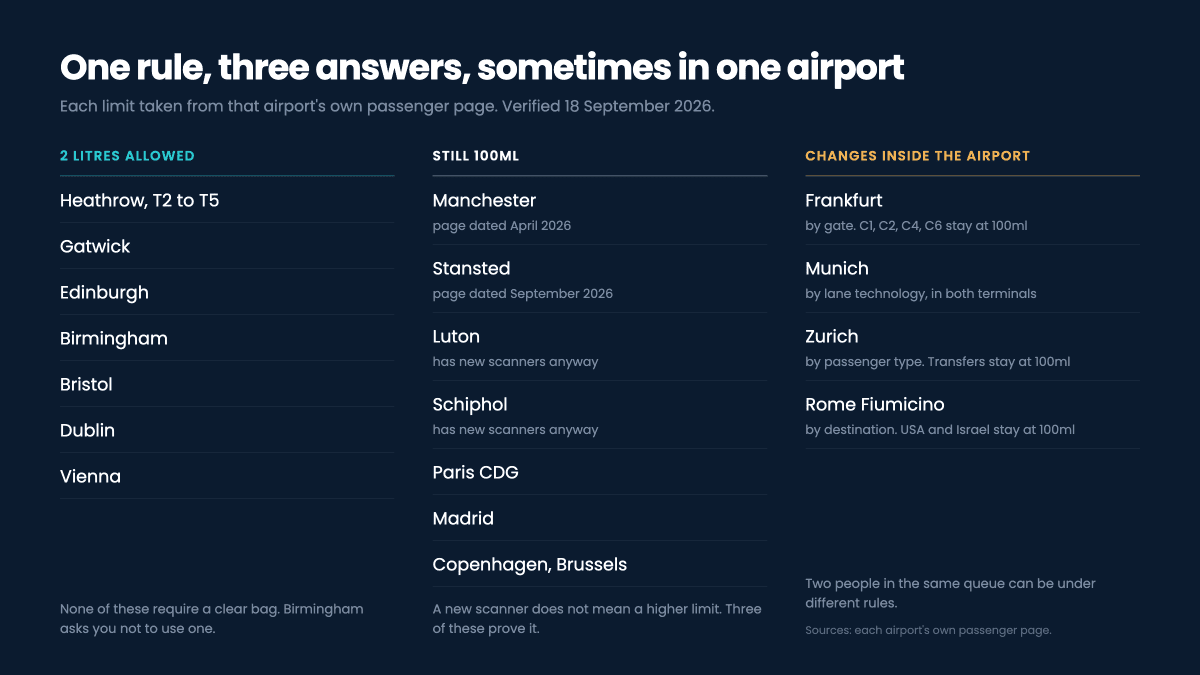
Six of the airports checked allow containers up to 2 litres across the whole airport, and five still enforce 100ml everywhere. The rest vary internally.
| Airport | Limit | Clear bag needed? |
|---|---|---|
| Heathrow, T2 to T5 | 2 litres | No |
| Gatwick | 2 litres | No |
| Edinburgh | 2 litres | No |
| Birmingham | 2 litres | No, and bags are discouraged |
| Bristol | 2 litres | No |
| Dublin | 2 litres | No |
| Vienna | 2 litres | No |
| Manchester | 100ml | No |
| Stansted | 100ml | No, except duty free |
| Luton | 100ml | No |
| Schiphol | 100ml | Yes |
| Paris CDG | 100ml | Yes |
| Madrid | 100ml | Yes |
| Copenhagen | 100ml | Yes, shown in a tray |
| Brussels | 100ml | Yes |
Note that the clear plastic bag has come uncoupled from the limit. Several 100ml airports have dropped the bag requirement, while others still insist on it, and Copenhagen requires it presented separately in a tray. Birmingham has gone further than dropping it: it asks passengers not to use bags and to leave liquids loose in hand luggage.
Brussels is the outlier worth knowing about if you are planning ahead. It states that new scanners arrive only "as of 2028", so it is not about to change.
Where does the rule change inside one airport?
At four of the airports checked, two passengers standing in the same building are subject to different limits. The split runs on four different axes: by gate, by lane, by passenger type, and by destination.
Frankfurt splits by gate. Most checkpoints in Terminal 1 and all of Terminal 3 allow 2 litres with no bag. But gates C1, C2, C4 and C6, plus certain special Terminal 1 checkpoints, still require containers of 100ml or less in a transparent one-litre bag. Fraport's advice is to check which gate you are flying from before you pack.
Munich splits by lane technology. Its CT lanes allow up to 2 litres, in both terminals. Its conventional lanes do not. Which lane you are sent to is not something you can determine from your boarding pass.
Zurich splits by passenger type. Departing passengers have been allowed 2 litres since 26 June 2026. Transfer passengers are still held to 100ml with a bag, and Zurich states this will continue beyond 2026.
Rome Fiumicino splits by destination. Terminals 1 and 3 generally allow 2 litres, but passengers flying to the United States or Israel from Terminal 1 are held to 100ml with a bag, as are some extra-Schengen transit passengers. Two people in the same queue, different rules, decided by where their aircraft is going.
Does a new scanner mean you can take 2 litres?
No, and this is the assumption that costs people their bottles. Luton, Schiphol and Madrid have all installed next-generation scanners and all three still enforce 100ml.
The logic seems obvious: the scanners were the reason the limit could be raised, so an airport with scanners should allow more. It does not follow, because the limit is a regulatory permission rather than a technical capability.
Luton is the clearest proof. Its scanners are good enough that liquids and electronics no longer need to come out of your bag, and its page says so. The limit is still 100ml per container. Schiphol has the same combination.
So the presence of modern equipment, the absence of a plastic-bag requirement, and the instruction to leave your laptop in your bag are all unreliable signals. The only reliable signal is the airport's own published limit.
What happens when you connect?
Connecting passengers are the most exposed, because a liquid bought legally at one airport can be confiscated at the next. Zurich and Frankfurt both apply the stricter limit specifically at transfer checkpoints.
The scenario is easy to fall into. You buy a one-litre bottle airside at Heathrow, entirely within Heathrow's rules. You connect through Zurich, where transfer passengers are held to 100ml. The bottle is taken.
Four separate sources confirm this trap, each of them official. Zurich publishes the local-versus-transfer split directly. Frankfurt applies 100ml plus a bag at transfer checkpoints. Rome applies it to some extra-Schengen transit. And the European Commission's own leaflet states that passengers departing from outside the EU and connecting within it must respect the 100ml rule.
Birmingham Airport puts the practical advice plainly on its own website:
Passengers should check respective restrictions with airlines and airports they will be travelling from and through on their outward and return journeys as some airports still only allow 100ml containers in hand baggage.
The return leg is the part people forget. A bottle that came out with you on the way there may not come back.
How do you know which rule applies to you?
Check three things: your departure airport, every airport you transfer through, and your return airport. Nothing else is reliable, and there is a specific reason to distrust what you read.
Of the roughly twenty airport pages checked for this article, exactly two carry a visible last-updated date: Manchester, dated April 2026, and Stansted, dated September 2026. Both of them say 100ml.
Every airport claiming 2 litres publishes that claim on an undated page. The pages telling you the rule has relaxed are the ones that will not tell you when they were last checked. That is not an accusation of inaccuracy, but it does mean a screenshot from a travel article six months old is worthless, and so is this table if you read it in a year.
One more thing worth knowing: even where 2 litres is allowed, the UK Civil Aviation Authority notes that airports retain discretion to confiscate anything they consider dangerous, regardless of the published list.
And a practical footnote that nobody mentions. A two-litre bottle weighs about two kilograms, against a typical ten-kilogram cabin allowance. The liquid freedom is real, and it collides with the airline's weight limit long before you reach the 2-litre ceiling.
Planning a trip with a connection
If you are routing through two or three airports, the liquids rule is one more thing that varies by which airport you happen to be in, alongside transfer times and terminal changes.
Navoy can build a route with realistic connection times, which matters more than it sounds when a tight transfer through a stricter airport is where purchases get lost.
Frequently asked questions
Can I take a 2 litre bottle through UK airport security?
At Heathrow, Gatwick, Edinburgh, Birmingham and Bristol, yes, as of 18 September 2026. At Manchester, Stansted and Luton, no: the limit there is still 100ml per container. Check your specific airport's page before you fly.
Why do some airports still say 100ml if they have new scanners?
Because the limit is a regulatory permission, not a technical one. Luton, Schiphol and Madrid all have next-generation scanners that let you leave liquids in your bag, and all three still cap containers at 100ml.
Will my duty free be taken at a connection?
It can be, if you connect through an airport that applies 100ml to transfer passengers, which Zurich and Frankfurt both do. Keep duty free sealed in its tamper-evident bag with the receipt inside, and check the transfer airport's rule before buying.
Do I still need a clear plastic bag?
It depends on the airport, and it is no longer tied to the limit. Schiphol, Paris CDG, Madrid, Copenhagen and Brussels still require one. Most UK airports have dropped it, and Birmingham asks you not to use one.
Sources
- GOV.UK, hand luggage restrictions: liquids, the instruction to check every airport including the return journey
- UK Civil Aviation Authority, safety advice on what to pack, airport discretion
- European Commission, liquids, aerosols and gels, the EU baseline and the transfer rule
- Frankfurt Airport, security check, the gate-level split
- Munich Airport, security screening, the lane split
- Zurich Airport, security check, the local versus transfer split
- Aeroporti di Roma, passenger checks, the destination split
Related articles
- Can You Bring Food on a Plane? The Official Test
- How Early Should You Get to the Airport in 2026?
- ETIAS Requirements for Americans Flying to Europe
Connecting through two airports? Let Navoy build the route with transfer times that work.
About the Author
Ranym Garali
Ranym is the Marketing and Content Lead at Navoy. She's been writing about travel for two years and digs into the data behind each piece, flight prices, visa rules and what people are actually searching for , so the advice holds up in practice.