
Key Takeaways
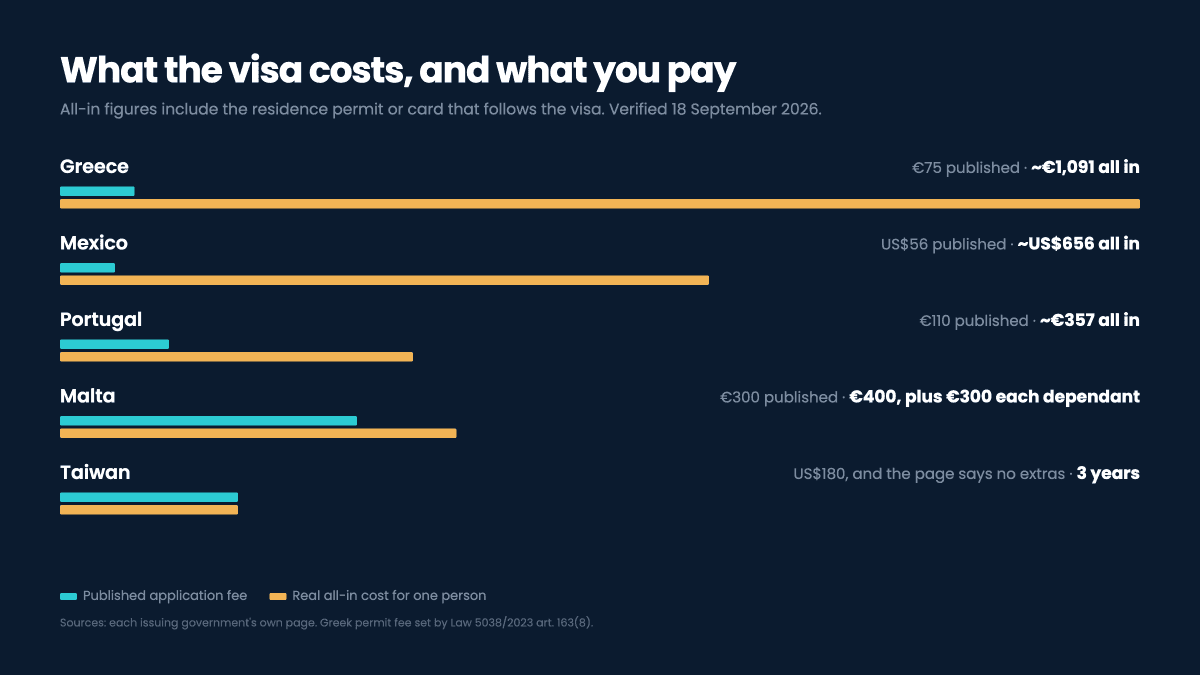
- Greece publishes a €75 visa fee. The real all-in cost is about €1,091, because a €1,000 residence permit sits behind it. The visa is 7% of the price.
- Fifteen countries genuinely come in under US$500 all in, once permit cards, biometrics and mandatory extras are counted.
- Three cost nothing. Mauritius is free, Japan is free for visa-exempt nationals, and Georgia needs no visa at all for over 95 nationalities.
- Taiwan gives you three years for about US$180, roughly US$60 a year, and its own page states there are no extras. Thailand gives five years for about US$400.
- The threshold breaks the moment a partner comes along. Malta charges €300 per dependant and Sri Lanka charges US$500 per person, per year.
Greece's digital nomad visa costs €75. That is the number on the consulate's page, and it is accurate. It is also about 7% of what you will actually pay, because the visa gets you into the country and a separate €1,000 residence permit lets you stay. This pattern repeats almost everywhere: Portugal's €110 is roughly a third of the true cost, and Mexico's US$56 is only a sticker in your passport. Here is what nineteen digital nomad visas actually cost, taken from the issuing governments' own pages and verified on 18 September 2026.
Which digital nomad visas cost under $500 all in?
Fifteen of the nineteen countries checked come in under US$500 once every mandatory charge is counted. Three of those are free. The figures below are all-in totals for one person, not headline application fees.
| Country | Real all-in cost | What you get |
|---|---|---|
| Mauritius | Free | 1 year, multiple entry |
| Japan | Free for visa-exempt nationals | 6 months, non-renewable |
| Georgia | No visa needed | 365 days, over 95 nationalities |
| South Korea | about US$70 | 1 year, renewable once |
| Croatia | about US$97 | 18 months |
| Latvia | about US$106 | 1 year, extendable to 2 |
| Estonia | about US$140 | 365 days |
| Taiwan | about US$180 | 3 years |
| Malaysia | about US$237 | 12 months, renewable |
| Romania | about US$391 | 1 year |
| Portugal | about US$397 | 2-year permit |
| Thailand | about US$400 | 5 years |
| Indonesia | about US$425 | 1 year |
| Malta | about US$445 | 1 year |
Four fall outside. Sri Lanka lands exactly on US$500. Greece and Mexico break the threshold once their mandatory extras are counted, which is the subject of the next section. The United Arab Emirates could not be settled at all: two of its own government service pages give materially different totals, one around US$199 and another closer to US$490, so we are not printing a figure for it.
Why is the published fee not the price?
Because in most countries the visa and the permission to stay are two separate transactions with two separate fees. The visa gets you through the border. A residence permit or identity card, issued after you arrive, is what actually lets you live there.
Greece is the starkest case. The national visa costs €75. The residence permit that follows costs €1,000, set in law rather than by an agency, with a further €16 for the card itself. Total: about €1,091, or roughly US$1,213. Someone budgeting from the published visa fee would be out by a factor of fourteen.
Portugal works the same way with smaller numbers. The D8 visa is €110, and the residence permit issued by the immigration agency after arrival adds about €247. The headline is roughly 31% of the real figure.
Mexico is the one most likely to catch people out, because the headline is genuinely cheap. The consular visa is about US$56. But that visa is only a sticker: within 30 days of entering Mexico you must exchange it for a residence card, and that card's fee rose by roughly 109% on 1 January 2026. The all-in figure is likely to be several hundred dollars rather than fifty.
The lesson generalises. When you see a digital nomad visa fee quoted anywhere, including here, the question to ask is whether it covers the visa, the permit, or both.
What happens if you are not travelling alone?
The under-$500 threshold is per person, and several countries charge the full amount again for each dependant. A couple applying together can double the cost of an application that looked comfortably affordable alone.
Malta charges €300 for the main applicant and another €300 for each dependant, plus €100 for the card. A couple is looking at roughly €700 before anything else.
Sri Lanka is harsher still: its US$500 fee applies per person, per year. A family of four renewing annually is paying US$2,000 every year, which puts it in a completely different category from the single-applicant figure.
Malaysia is more forgiving, at RM 500 per dependant against RM 1,000 for the main applicant.
If you are applying as a couple or a family, the ranking above reorders substantially, and the free options move even further ahead.

Which give you the most time for the money?
Taiwan and Thailand, by a wide margin. Taiwan's employment gold card costs about US$180 and runs for three years, which works out at roughly US$60 a year. Thailand's destination visa costs about US$400 and runs for five.
Neither appears near the top of a list sorted by application fee, because both look mid-priced until you divide by duration.
Taiwan's page is also the clearest of any checked. It states explicitly that the fee is a combined document covering the visa, the residence permit, the work permit and the re-entry permit, with no separate charges to follow. That is unusual enough to be worth naming.
South Africa offers three years too, and its fee is low. The trap there is not money but tax: holders are required to register with the South African Revenue Service, which is a compliance obligation rather than a line item, and it may matter more than any fee on this page.
Which cost nothing at all?
Three, though one of them is not really a visa. Mauritius charges nothing for its Premium Travel Visa. Japan charges nothing if you hold a visa-exempt passport. And Georgia does not require a visa in the first place.
Georgia's arrangement is the one worth understanding properly, because it is frequently listed as a "free digital nomad visa" and it is not a visa at all. Citizens of over 95 countries may enter and remain for 365 days with no application, no fee and no permit. If your nationality is on that list, there is nothing to apply for.
Japan's route is free for nationals of visa-exempt countries, which covers most of Western Europe, the United States, Canada and Australia. It runs for six months and cannot be renewed, so it suits a defined stay rather than a base.
Mauritius is a genuine zero-cost visa: one year, multiple entry, no fee.
What changed in 2026?
Three significant increases landed this year, so any figure you find that is more than a few months old is likely to be wrong.
- Romania raised its fee from €120 to €300 on 27 April 2026.
- Japan raised its visa fees by 400% on 1 July 2026, the first revision since 1978. This does not affect visa-exempt nationals, who still pay nothing.
- Mexico's residence card rose by about 109% on 1 January 2026.
A further complication: seven countries price by nationality rather than charging a flat fee. Spain, Brazil, Thailand, Türkiye, South Korea, Taiwan and Colombia all vary the fee depending on the passport you hold, and Colombia waives it entirely for Spanish nationals. For those, no single global number exists and any article giving you one has picked a nationality without telling you which.
One verified absence worth recording. The Philippines digital nomad visa was signed into law in April 2025, but it is not operational and no fee has been published. Every figure in circulation for it, usually quoted around US$200 to US$300, traces to no official source.
Planning the move rather than the application
The fee is a one-off. What it buys you is time in a place, and the countries that look expensive per application often look cheap per year.
Navoy can plan the trip around the stay you are actually entitled to, which matters when a six-month non-renewable visa and a five-year multiple-entry one cost roughly the same.
Frequently asked questions
What is the cheapest digital nomad visa?
Three cost nothing: Mauritius is free, Japan is free for visa-exempt nationals, and Georgia requires no visa at all for over 95 nationalities. Among paid options, South Korea at about US$70 and Croatia at about US$97 are the lowest all-in.
Why do digital nomad visa fees vary so much between sources?
Because most countries charge twice: once for the visa and again for the residence permit issued after you arrive. Many published figures quote only the first. Seven countries also price by nationality, so no single number applies to everyone.
Is the Greek digital nomad visa really only 75 euros?
The visa is, but it is not the full cost. A residence permit of €1,000 plus a €16 card fee follows once you are in Greece, taking the real total to around €1,091. The permit fee is set in national law.
Which digital nomad visa lasts longest?
Thailand's destination visa runs five years for about US$400. Taiwan gives three years for about US$180, roughly US$60 a year, with no additional permit fees. South Africa also offers three years.
Sources
- Taiwan Employment Gold Card, the combined fee and its four-in-one scope
- Malta Nomad Residence Permit, the per-dependant charge
- Estonia digital nomad visa, the fee and duration
- Latvia remote work visa, fee updated 18 March 2026
- Croatia temporary stay for digital nomads, the in-country fee structure
- Economic Development Board Mauritius, Premium Travel Visa
- Ministry of Foreign Affairs of Japan, visa fees, effective 1 July 2026
- Greek Law 5038/2023, article 163(8), the residence permit fee
Related articles
- The Cheapest Digital Nomad Visa Countries in 2026
- Digital Nomad Visas With No Income Requirement
- The Cheapest Countries to Get Residency in 2026
Working out where to base yourself? Let Navoy plan the trip around the stay you are entitled to.
About the Author
Haroun Moula
Haroun Moula is the founder and CEO of Navoy. Before Navoy, he worked in luxury travel with VVIPs and high-profile travelers. He built Navoy to bring curated, adaptive trip planning to more travelers through an AI travel agent that plans and books core trip parts in one place.