Key Takeaways
- 8 countries issue digital nomad visas with no minimum income requirement in 2026: Uruguay, Argentina, the Bahamas, Seychelles, Curaçao, Saint Lucia, Anguilla, and Aruba.
- Uruguay is the cheapest of the eight: no visa fee and no income test, just a sworn declaration that you can support yourself. 6 months, renewable to 12.
- "No income requirement" never means no paperwork: every program still wants proof you work remotely for foreign clients, plus bank statements, insurance, or both.
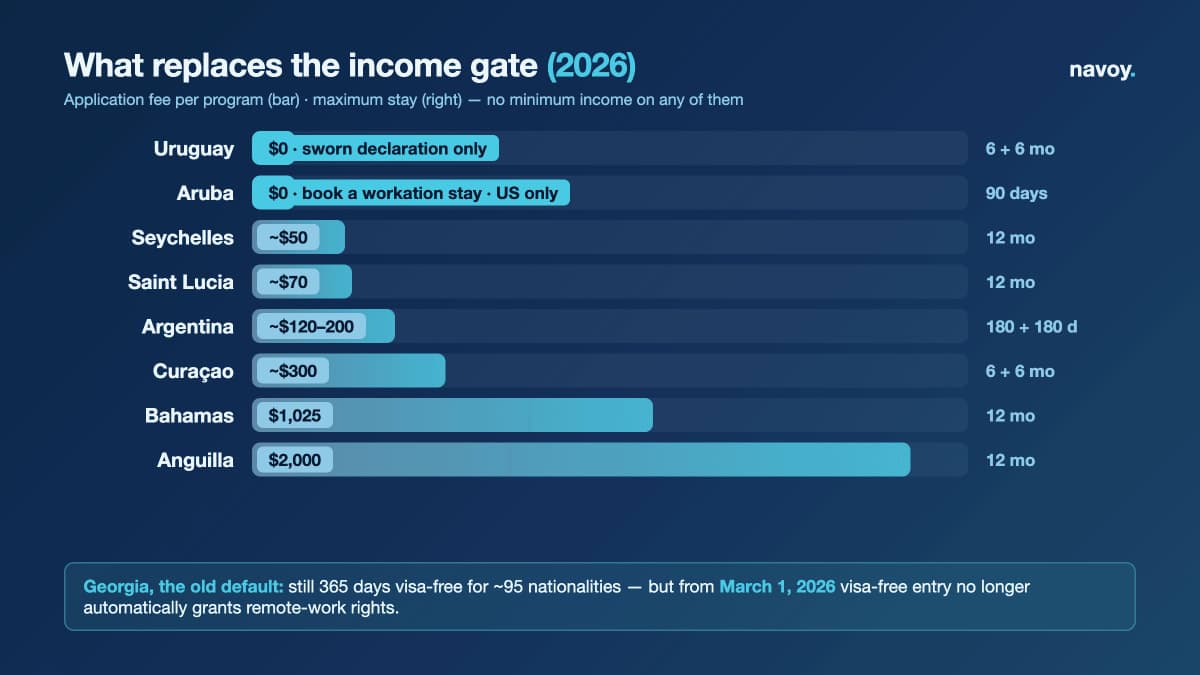
- The fees run from $0 (Uruguay, Aruba) to $2,000 (Anguilla) — where the salary gate disappears, a flat fee or a funds test usually takes its place.
- Georgia changed in 2026: 365-day visa-free entry continues for ~95 nationalities, but amendments effective March 1, 2026 mean visa-free entry no longer automatically covers remote work.
Which digital nomad visas have no income requirement in 2026?
Eight countries offer digital nomad visas with no minimum income requirement in 2026: Uruguay, Argentina, the Bahamas, Seychelles, Curaçao, Saint Lucia, Anguilla, and Aruba. Uruguay is the standout: no visa fee, no income test, just a sworn declaration that you can support yourself. The rest swap the salary gate for something else, from bank statements to a flat fee.
That matters because the income gate, not the application fee, is what locks most people out of nomad visas. More than 50 countries run dedicated remote-work visas in 2026 (Immigrant Invest), and the typical program demands $1,250 to $5,000 per month in provable foreign income. If your freelance income is real but lumpy, those thresholds are the wall. We ranked the affordable programs by fee in our guide to the cheapest digital nomad visas in 2026; this list is different: it only includes programs where the monthly-income box simply doesn't exist.
| Country | Program | Application fee (USD) | Max stay | What you show instead of income |
|---|---|---|---|---|
| Uruguay | Digital Nomad Permit | $0 | 6 mo + 6 mo renewal | Sworn declaration of means |
| Aruba | One Happy Workation | $0 (book a participating stay) | 90 days | US passport + proof of remote work |
| Seychelles | Workcation Program | ~$50 | 12 months | Bank statements + remote-work proof |
| Saint Lucia | "Live It" visa | ~$47–70 | 12 months | Sufficient funds for the stay |
| Argentina | Digital Nomad Visa | ~$120–200 | 180 days + renewal | Contracts or invoices showing stable foreign income |
| Curaçao | @HOME in Curaçao | ~$300 | 6 mo + 6 mo renewal | Remote-work proof + insurance |
| Bahamas | BEATS | $1,025 ($25 + $1,000 permit) | 12 months | 3–6 months of bank statements |
| Anguilla | Work From Anguilla | $2,000 | 12 months | Remote-work proof, insurance, clean record |
All figures are approximate 2026 rates converted to USD, and they move: governments update fees, and embassies add their own charges. Verify the current requirements on each country's official immigration site before you apply — visa rules are the one part of nomad life you never take from a blog, ours included.
What do you have to prove instead of income?
"No income requirement" removes the salary threshold, not the paperwork. Every program on this list still requires proof that you work remotely for foreign employers or clients, and most want evidence you can support yourself, typically bank statements or a sworn declaration. The gate moves; it doesn't vanish.
Across the eight programs, expect some mix of:
- Remote-work proof — an employment contract, business registration, or client agreements showing your income comes from outside the country
- Solvency evidence — bank statements (3–6 months for the Bahamas) or Uruguay's simple sworn affidavit
- Health or travel insurance — required almost everywhere
- A clean criminal record — Anguilla asks up front; Uruguay asks at renewal
- The universal red line: no working for local companies or clients. Every nomad visa here voids if your income turns domestic.
The honest framing: these programs don't care how much you earn, but they all care where you earn it.
How does each no-income visa stack up?
Uruguay wins on cost, Seychelles and Saint Lucia win on stay-length-per-dollar, the Bahamas and Anguilla effectively price-gate instead of income-gate. Here's the one-paragraph version of each.
1. Uruguay — Digital Nomad Permit ($0)
The only program where both the fee and the income test are zero. You apply, sign an affidavit that you can support yourself, and get 6 months, renewable to 12 (the renewal needs a clean criminal record). Work must be for clients or employers outside Uruguay. Montevideo isn't the cheapest base in Latin America, but the visa itself couldn't be simpler.
Best for: anyone whose income is real but hard to document month-by-month.
2. Aruba — One Happy Workation ($0, but 90 days)
No visa fee and no income minimum: you book a participating accommodation package and select the program on the entry form. The catches are big, though — it's US citizens only and capped at 90 days, the shortest stay on this list. It's a workation, not a residency.
Best for: US remote workers testing the nomad life one quarter at a time.
3. Seychelles — Workcation Program (~$50)
Roughly €45 buys up to 12 months on the islands, with approvals often issued within a day. There's no official income floor, though officers expect bank statements that show you can cover an expensive destination. Apply online at least two weeks before flying.
Best for: the longest stay per dollar of any program here.
4. Saint Lucia — "Live It" (~$47–70)
Saint Lucia's non-immigrant visa covers up to 12 months: about EC$190 (~$70) for multiple entry, or ~$47 single-entry for 3 months. No minimum income, just evidence of sufficient funds. One of the quietest bargains in the Caribbean.
Best for: Caribbean base-building without the four-figure fees its neighbours charge.
5. Argentina — Digital Nomad Visa (~$120–200)
Argentina publishes no official income minimum; you demonstrate stable foreign income with contracts, invoices, or statements (most advisers suggest showing around $2,000/month to be comfortable, but it's evidence, not a threshold). Fees total roughly $120–200, for 180 days renewable once to 360. Buenos Aires remains one of the best cost-of-living plays anywhere.
Best for: nomads who want a major city and can paper their income informally.
6. Curaçao — @HOME in Curaçao (~$300)
No minimum income requirement, a ~$300 fee, and 6 months renewable to 12. You're explicitly not a tax resident during the permit, so foreign income isn't taxed locally. A Dutch-Caribbean middle ground between the cheap paperwork of Saint Lucia and the premium fees of Anguilla.
Best for: EU-adjacent structure (Dutch kingdom) with Caribbean weather.
7. Bahamas — BEATS ($1,025)
The Extended Access Travel Stay charges $25 to apply plus $1,000 for the annual permit ($500 per dependent), with no income minimum — just 3–6 months of bank statements. Processing runs about 5 business days. The flat fee effectively replaces the salary test.
Best for: families: dependents price in at half rate, and there's no household income bar to clear.
8. Anguilla — Work From Anguilla ($2,000)
No income requirement, but a $2,000 individual fee (~$3,000 for a family of four) for up to 12 months. Add proof of remote work, insurance, and a clean record, and approval typically lands in 7–14 days. You're paying the income gate as a lump sum, on one of the Caribbean's most expensive islands.
Best for: high earners who value zero income disclosure over cost.
Is Georgia still the no-paperwork option in 2026?
Partly. Citizens of roughly 95 countries can still enter Georgia visa-free and stay up to 365 days, with no application, fee, or income test. But amendments passed in June 2025 introduce mandatory work permits for foreign nationals from March 1, 2026 — visa-free entry no longer automatically grants the right to work remotely from Georgia. The old "Remotely from Georgia" program is discontinued (legal.ge).
This is the part most 2026 nomad lists haven't caught up with. Georgia spent a decade as the default answer to "easiest country for nomads," and the 365-day stamp still exists. What changed is the legal status of working during that stay. If Georgia is your plan, check the current work-permit rules with official Georgian government sources before committing: the tax side (183+ days makes you tax resident; a 1% small-business regime exists for registered individual entrepreneurs) is still attractive, but the entry stamp alone no longer settles the question.
What if you have savings but no steady salary?
Three more routes skip the monthly-salary test in favour of savings or bank-balance checks: Cape Verde (~$1,620 average balance over 6 months), Brazil ($18,000 in savings instead of $1,500/month), and Albania's Unique Permit (roughly €400/month in evidence, with no fixed statutory bar). If you've saved well but invoice irregularly, these are your bridge options.
| Route | Instead of monthly income | Fee (USD) | Stay |
|---|---|---|---|
| Cape Verde — Remote Working Program | ~$1,620 average bank balance (last 6 months) | ~$58 | 6 mo, renewable |
| Brazil — VITEM XIV | $18,000 savings (or $1,500/mo) | ~$100–120 | 1 yr + renewal |
| Albania — Unique Permit | ~€400/mo in evidence, no fixed statutory threshold | ~€100 | 1 yr, renewable |
Full fee-by-fee context for Cape Verde and Brazil, including the hidden admin costs, is in our cheapest digital nomad visa countries ranking.
Which no-income-requirement visa should you pick?
Pick Uruguay if you want the cheapest legitimate paperwork on Earth, Seychelles or Saint Lucia for a full year under $75, the Bahamas for a family, Aruba for a US-passport test run, and Anguilla only if the $2,000 is a rounding error to you. In one pass:
- Cheapest overall: Uruguay ($0 fee, sworn declaration, 12 months max)
- Longest stay per dollar: Seychelles (
$50 for 12 months) and Saint Lucia ($70 for 12 months) - Best for families: Bahamas BEATS ($500 per dependent, no household income bar)
- Shortest commitment: Aruba (90 days, US citizens, book-and-go)
- Zero income disclosure, cost no object: Anguilla ($2,000 flat)
- Watchlist, not shortlist: Georgia — 365 days visa-free, but confirm the post-March-2026 work-permit position first
And if Europe is on your route between visa stints, note that US travellers will also need ETIAS travel authorisation for the Schengen area — a separate, much smaller piece of paperwork.
Plan your nomad base in one platform with Navoy
A visa gets you in; the trip still needs building. Navoy is an AI travel agent that turns "three months in Montevideo, then a month in the Seychelles" into a day-by-day plan, then books the hotels and airport transfers in one platform. Tell it your dates, pace, and budget split, and you get a bookable itinerary instead of another research tab. Scouting bases first? See how a nomad-friendly city lays out in our Lisbon destination guide.
Navoy's free plan covers up to three trips of up to 14 days each, which is exactly what a scouting run at a new base looks like. Navoy doesn't book flights; it focuses on planning, hotels, and transfers.
Frequently Asked Questions
Can you get a digital nomad visa with no proof of income?
Yes, but only a narrow set. In 2026, Uruguay, Argentina, the Bahamas, Seychelles, Curaçao, Saint Lucia, Anguilla, and Aruba issue digital nomad visas with no minimum income requirement. You'll still need to prove you work remotely for foreign clients and can support yourself, usually via bank statements or, in Uruguay's case, a sworn declaration.
Which digital nomad visa is the cheapest with no income requirement?
Uruguay's Digital Nomad Permit is the cheapest: no visa fee and no income test, just an affidavit of financial means, for 6 months renewable to 12. Seychelles ($50) and Saint Lucia ($47–70) are the cheapest paid options, both covering stays of up to 12 months.
Is Georgia still visa-free for digital nomads in 2026?
Entry, yes; working, it's complicated. Citizens of about 95 countries can still stay 365 days visa-free. But amendments effective March 1, 2026 require work permits for foreign nationals, so visa-free entry alone no longer settles your right to work remotely from Georgia. Check official Georgian government guidance before relying on it.
Do "no income requirement" visas mean no paperwork at all?
No. These programs drop the salary threshold, not the application. Expect to show proof of remote work for foreign employers or clients, some evidence of funds, health or travel insurance, and sometimes a clean criminal record. The one universal rule: you can't work for local companies or clients while on any of these visas.
Sources
- Citizen Remote — Uruguay Digital Nomad Visa (2026)
- The Rio Times — Argentina Digital Nomad Visa: $200, 180 Days (2026)
- My Nomad Space — Bahamas BEATS: Requirements & Application
- Stamped Nomad — Seychelles Digital Nomad Visa Guide 2026 · Aruba One Happy Workation
- Nomads Embassy — Curaçao Digital Nomad Visa
- VisaGuide.World — St Lucia Digital Nomad Visa: Live-It Program
- Freaking Nomads — Anguilla Digital Nomad Visa
- Legal.ge — Georgia tightens controls as digital-nomad era faces regulatory shift (2026)
- Immigrant Invest — 55 Digital Nomad Visas in 2026
Related reading: our ranking of the cheapest digital nomad visa countries in 2026, ETIAS requirements for US travellers, and the Lisbon destination guide for scouting your first base.
Found your visa? Now build the trip.
Plan and book your nomad trip with Navoy →
Tell Navoy your dates, pace, and budget, and it builds your day-by-day itinerary and books your hotels and airport transfers in one platform.
About the Author
Ranym Garali
Ranym is the Marketing and Content Lead at Navoy. She's been writing about travel for two years and digs into the data behind each piece, flight prices, visa rules and what people are actually searching for , so the advice holds up in practice.