Key Takeaways
- Mauritius is the only fully free option — no government application fee, $1,500/month income threshold, valid 1 year and renewable.
- Cape Verde costs just €20 — the cheapest paid nomad visa in 2026, with a 6-month bank-balance test instead of a monthly salary minimum.
- Application fees range from €0 to ~$430 — but the real cost driver is the income requirement, which swings from ~$925/month (Colombia) to $5,000/month (Indonesia E33G).
- More than 50 countries now offer dedicated digital nomad visas as of 2026, almost double the 2021 count (Immigrant Invest 2026 Index).
- Cheap doesn't always mean accessible — most "low-fee" visas still require notarised bank statements, apostilled documents, and private health insurance, easily adding $300–$1,000 in admin costs.
What Are the Cheapest Digital Nomad Visa Countries in 2026?
Mauritius leads with a fully free Premium Visa, followed by Cape Verde at ~$58, Brazil at ~$100, and Colombia — every affordable nomad visa in 2026 still costs less than a return flight, even before factoring in income thresholds.
More than 50 countries now offer dedicated remote-work residence visas, almost double the count from 2021 (Immigrant Invest 2026 Digital Nomad Visa Index). For freelancers and remote employees comparing options, the application fee is only half the story — the income threshold often costs you more than the visa itself. We've ranked the 10 cheapest and most accessible digital nomad visas in 2026 — weighing both the application fee and the income threshold — then mapped each against validity and the hidden admin costs most blogs skip.
How Cheap Is a "Cheap" Digital Nomad Visa, Really?
A nomad visa has two price tags: the headline application fee, and the income or savings minimum that gates eligibility. A $58 visa is meaningless if you can't prove the bank balance to qualify.
We separate cost into three layers:
- Direct fee — the government charge to lodge the application (the "headline" number)
- Income gate — the minimum monthly income or savings you must demonstrate
- Admin tail — apostilled documents, certified translations, mandatory private health insurance, residence card printing, and (in some countries) a local rental contract before approval
The cheapest visa for you is the one where all three columns line up with your real-world numbers — not just the smallest fee.
The 10 Cheapest Digital Nomad Visas in 2026 (Ranked)
Mauritius and Cape Verde sit at the bottom of the cost ladder, while Indonesia's E33G is the priciest in this top 10 — but also the most flexible for high earners. Rank reflects a blend of application fee and income threshold, so the most affordable and accessible programs come first. All fees below are approximate, converted to USD, and reflect official 2026 government charges; agency-assisted applications cost more.
| Rank | Country | Visa / Program | Application Fee (USD) | Min. Monthly Income (USD) | Validity & Renewal |
|---|---|---|---|---|---|
| 1 | Mauritius | Premium Visa | Free | $1,500/mo | 1 yr, renewable |
| 2 | Cape Verde | Remote Working Program | ~$58 total | ~$1,620/mo (6-mo bank avg) | 6 mo, renewable |
| 3 | Brazil | VITEM XIV Digital Nomad Visa | ~$100–120 | $1,500/mo (or $18,000 savings) | 1 yr + 1 renewal |
| 4 | Colombia | V Digital Nomad Visa | ~$55 + ~$177 issuance | ~$1,250–1,400/mo | Up to 2 yr |
| 5 | Argentina | Digital Nomad Permit | ~$120 | No fixed minimum (~$2,000+/mo advised) | 180 days + extension |
| 6 | Spain | Digital Nomad Visa | ~$80–100 | ~$3,080/mo (gross) | 1 yr abroad / 3 yr in-country |
| 7 | Hungary | White Card | ~$120 | ~$3,250/mo | 1 yr + 1 renewal |
| 8 | Croatia | Digital Nomad Residence Permit | ~$65–90 | ~$3,920/mo | Up to 18 mo |
| 9 | Estonia | Digital Nomad Visa | ~$108 | ~$4,870/mo (gross) | Up to 1 yr |
| 10 | Indonesia | E33G Remote Worker Visa | ~$430–450 | $5,000/month ($60k/year) | 1 yr |
Note: All figures above are approximate and may change over time due to:
- Government policy updates.
- Exchange rate fluctuations.
- Embassy-specific fees.
- Annual minimum wage adjustments.
Before applying, always verify the latest requirements directly through the official immigration or government websites of each country, or consult the relevant embassy/consulate.
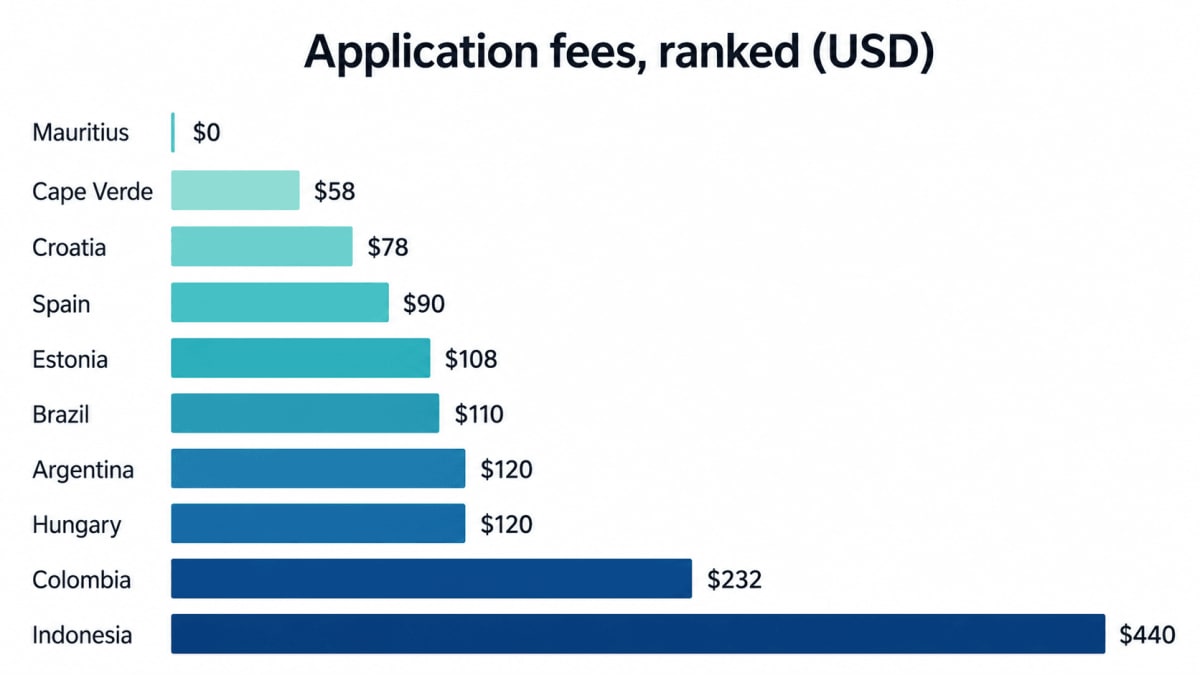
Government fees only — agency-assisted applications add $200–$500 across most programs. Mauritius and Cape Verde lead on cost; Indonesia's E33G is the only program above $400.
How Each of the Top 10 Stacks Up
1. Mauritius Premium Visa — Free
The Premium Visa is the only major nomad route in 2026 with no government fee at all. Applications are submitted online through the Passport and Immigration Office portal, with zero processing charge (govmu.org). The income threshold of $1,500/month is among the lowest on this list (only Colombia's is lower), and stays are valid for 1 year and renewable. Trade-off: Mauritius is a small island, so cost of living is moderate (~$1,800/month for a single nomad in Grand Baie).
Best for: Solo nomads with proof of stable freelance or salaried foreign income.
2. Cape Verde Remote Working Program — ~$58
At roughly $58 all-in (a small processing fee plus a fee paid on arrival), Cape Verde's nomad program is one of the cheapest paid options globally. The income test is unusual — you don't need a monthly salary minimum; you need an average bank balance of about $1,620 over the last 6 months for solo applicants, with a higher figure if bringing dependents. The visa is valid for 6 months and renewable, and is currently restricted to citizens of Europe, North America, the CPLP, and ECOWAS countries.
Best for: Freelancers with savings rather than a steady salary.
3. Brazil VITEM XIV — ~$100–120
Brazil's digital nomad visa launched in early 2022 and remains one of the cheapest gateways to Latin America, at roughly $100–120 in consular fees. The income threshold is just $1,500/month (or $18,000 in savings), and the visa is valid for 1 year and renewable for another. Brazil also doesn't tax foreign income unless you become a tax resident (180+ days), which most nomads can avoid by structuring stays carefully.
Best for: Latin America-bound nomads on lower incomes.
4. Colombia V Digital Nomad Visa — ~$232 total
Colombia's V-class digital nomad visa is split into ~$55 to lodge the application plus ~$177 on issuance — about $232 all-in, and you only pay the larger fee once approved. Critically, it has the lowest income threshold of any well-known nomad visa: ~$1,250–1,400/month (3× the Colombian minimum monthly wage, SMMLV). Validity is up to 2 years.
Best for: Nomads on lower foreign incomes — the gentlest income gate of any major program.
5. Argentina Digital Nomad Permit — ~$120
Argentina's digital nomad permit charges roughly $120 in government fees. Unusually, there is no fixed official income minimum — but applicants are advised to show around $2,000+/month in foreign-source income via contracts or bank statements. The permit runs 180 days and can be extended for a further period. Buenos Aires remains one of the strongest cost-of-living plays on this list — a furnished one-bedroom in Palermo runs about $700–$1,000/month in 2026.
Best for: Nomads who want city life on a relatively low budget.
6. Spain Digital Nomad Visa — ~$80–100
Spain's digital nomad route (under Law 28/2022) costs roughly $80–100 in government and consular fees combined. The income requirement is set at 200% of the Spanish minimum wage — about $3,080/month for the main applicant in 2026 — with dependents adding more. The big draw: a special 24% flat tax rate on Spanish-source income up to €600,000/year under the "Beckham Law" regime. The visa is issued for 1 year when applied for from abroad, or as a 3-year residence permit when applied for inside Spain, and can ultimately extend toward long-term residency.
Best for: EU-curious nomads who want optional long-term residency.
7. Hungary White Card — ~$120
Hungary's White Card costs around $120 when applied for from outside the country (a reduced forint-denominated fee applies via the online Enter Hungary platform after entering as a tourist) (oif.gov.hu). The income requirement is roughly $3,250/month for the previous 6 months. Valid 1 year and renewable once for a second year, but the White Card explicitly cannot be a path to permanent residency — Hungary has been clear about that.
Best for: Nomads wanting a 2-year EU base without permanent residency intent.
8. Croatia Digital Nomad Residence Permit — ~$65–90
Croatia's permit is split across a few small government charges that total about $65–90 depending on submission route. The income requirement is high — roughly $3,920/month in 2026 (indexed to 2.5× the average Croatian net salary, so it rises each January) — but the upside is no Croatian income tax on foreign-earned income during the visa period. Critical limitation: the permit can be issued for up to 18 months but cannot be renewed, and you must wait 6 months after expiry before re-applying.
Best for: Higher earners who want a fixed Mediterranean stint, not long-term residency.
9. Estonia Digital Nomad Visa — ~$108
Estonia was the first EU country to launch a dedicated nomad visa, and it remains a benchmark. The ~$108 application fee (for the long-stay Type D visa most nomads need) is paired with a hefty gross income requirement of about $4,870/month. Validity is up to 1 year, non-renewable. Estonia's appeal isn't the price — it's the e-Residency ecosystem and the ability to run an EU-based company alongside the visa.
Best for: Nomads who want to incorporate an EU company.
10. Indonesia E33G Remote Worker Visa — ~$430–450
The E33G visa replaced Indonesia's older "B211A" workaround in 2024 and is the only formal route to live in Bali long-term as a remote worker. Official government fees total roughly $430–450, though typical agent-assisted applications run $600–$1,000. The catch is the income gate: $60,000/year (~$5,000/month) — the highest in our top 10. The E33G is valid 1 year; to continue your stay you generally need to exit Indonesia and re-apply.
Best for: Senior remote workers committed to Bali or Jakarta.
Honorable Mention: Georgia — Free for ~94 Nationalities
Georgia is the cheapest "nomad visa" in 2026 because there isn't one — citizens of approximately 94 countries can enter visa-free and stay up to 1 year on a passport stamp (Visa policy of Georgia, Wikipedia). No fee, no income test, no application form.
The catch: effective May 16, 2025, citizens of 17 countries face stricter rules under the updated visa policy, so verify your passport's status before booking. For nomads from the US, UK, EU, Canada, Australia, and most of Latin America, Georgia remains the lowest-friction long-stay option on the planet — Tbilisi cost of living averages $1,200–$1,500/month for a solo nomad with a one-bedroom rental.
What Are the Hidden Costs Behind a Cheap Nomad Visa?
The application fee is rarely the biggest line item — apostilles, translations, and mandatory health insurance typically add $300–$1,000 to any "cheap" nomad visa. We've costed these out across the top 10:
| Hidden cost | Typical range | Notes |
|---|---|---|
| Apostille on background check | $20–$80 | Most countries require a clean criminal record |
| Certified document translation | $50–$200 | Required in Spain, Croatia, Hungary, Brazil |
| Private health insurance | $40–$150/month | Mandatory for nomad visa approval in nearly all cases |
| Local rental contract / address proof | Variable | Required before approval in Hungary, Spain, Croatia |
| Biometric residence card printing | ~$16–$40 | EU countries only |
| Tax representative (optional) | $200–$500 | Recommended in Spain, Croatia, Estonia |
Budget ~$500–$1,200 of admin overhead on top of the headline visa fee for any of the cheap European options. Mauritius and Cape Verde have the leanest admin tails.
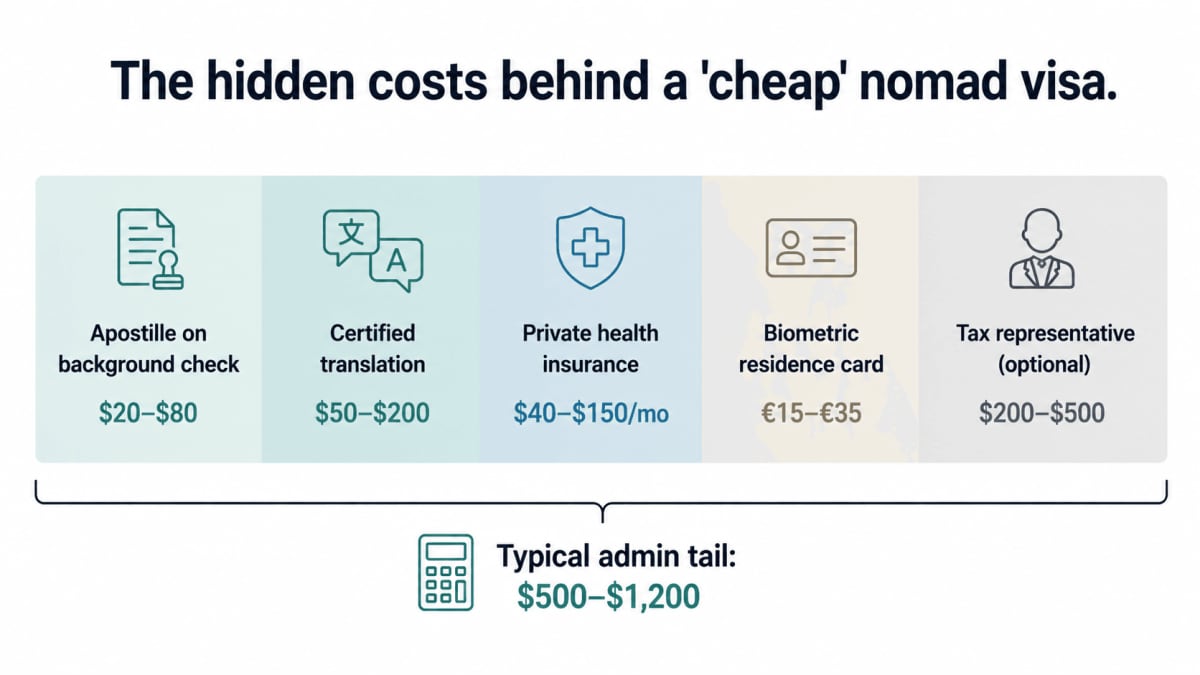
Apostilles, translations, and mandatory health insurance typically add $500–$1,200 on top of the headline visa fee — even on "free" programs like Mauritius.
Which Cheap Nomad Visa Fits Your Income?
If your foreign income sits around $1,500/month or below, your realistic options are Colombia, Mauritius, Brazil, and Cape Verde. Above $5,000/month, all 10 visas (including Indonesia's E33G) are available.
| Income band (foreign-earned) | Eligible visas |
|---|---|
| Under $1,500/mo | Colombia (~$1,250–1,400) |
| $1,500–$2,500/mo | + Mauritius, Brazil, Cape Verde, Argentina |
| $2,500–$3,500/mo | + Spain, Hungary |
| $3,500–$5,000/mo | + Croatia, Estonia |
| $5,000+/mo | All including Indonesia E33G |
FAQ
Can I work for local companies on a digital nomad visa?
No. Every digital nomad visa on this list — without exception — requires that your income comes from foreign clients or employers, not domestic ones. Spain, Indonesia, and Hungary are particularly strict, with explicit clauses voiding the visa if you take on local clients. The single allowed exception is usually short, paid speaking gigs, but treat any local income as a red line.
Are digital nomad visas tax-free?
Not automatically. Most countries on this list become a tax resident after 183 days in a calendar year, at which point your worldwide income may be taxable locally. Spain offers a 24% flat-tax regime for the first 5 years, and Croatia and Brazil don't tax foreign income while on the nomad visa. Always speak to a cross-border tax advisor before relocating — the wrong setup can cost more than the visa.
Can a digital nomad visa lead to citizenship?
Sometimes. Spain's visa can extend to 5 years and counts toward the 10-year residency required for citizenship. Estonia, Hungary, and Croatia explicitly do not count nomad-visa time toward permanent residency or citizenship. Colombia's V Digital Nomads visa can be converted to a Migrant (M) visa, which does count. Always confirm the conversion path before treating a nomad visa as an immigration strategy.
What's the easiest digital nomad visa to get approved?
Cape Verde and Mauritius have the highest approval rates because their tests are simple — bank balance for Cape Verde, $1,500/month for Mauritius, both with online-only submission. Colombia and Brazil are also relatively forgiving thanks to low income thresholds. The toughest are Spain and Estonia: stricter document audits, longer processing (45–90 days), and frequent requests for additional information.
The Bottom Line
The cheapest digital nomad visa is rarely the best one for your situation — Mauritius wins on fee, Colombia wins on income flexibility, Spain wins on long-term residency potential, and Georgia wins on simplicity for visa-free nationalities. Pick on the basis of three numbers — fee, income gate, and admin tail — not just the headline price. Most importantly: plan your tax exposure before you commit, because saving $100 on a visa fee while triggering an unexpected $10,000 tax bill is the most expensive "cheap visa" mistake we see.
Ready to scout your next nomad base?
Plan Your Nomad Trip with Navoy →
Navoy compares flights, accommodation, and on-the-ground transit for any of the 10 countries above — so you can pressure-test a destination before you commit to a visa.
About the Author
Ranym Garali
Ranym is the Marketing and Content Lead at Navoy. She's been writing about travel for two years and digs into the data behind each piece, flight prices, visa rules and what people are actually searching for , so the advice holds up in practice.