
Key Takeaways
- The cheapest residency fees in 2026 belong to Colombia (
$55 study fee), Armenia ($272), and Portugal (~$280) — all 8 routes on this list stay under $2,000 in government fees. - The fee is never the real gate: most routes ask for an income instead, from a $1,000/month pension (Nicaragua) to ~$4,300/month (Mexico).
- Paraguay and Armenia are the two routes with no fixed income minimum — Paraguay's DIY total runs $700–1,000 and leads to permanent residency after 21 months.
- Three rules changed mid-2026: Armenia tightens on August 1, Mexico doubled its resident-card fees, and Paraguay made direct-from-abroad permanent residency investor-only in April.
- Cheap doesn't mean short-term: Portugal's D7 (~$280 in fees, €920/month passive income) starts a path to EU citizenship in 5 years.
What's the cheapest country to get residency in 2026?
Colombia has the cheapest residency paperwork in 2026: its pension visa starts at roughly $55 in study fees. Armenia ($272 via a sole proprietorship), Portugal's D7 ($280), Cambodia's retirement extension (~$300 a year), and Ecuador's rentista ($320) follow — every route on this list stays under $2,000 in government fees. The catch is never the fee; it's what each country asks you to prove instead.
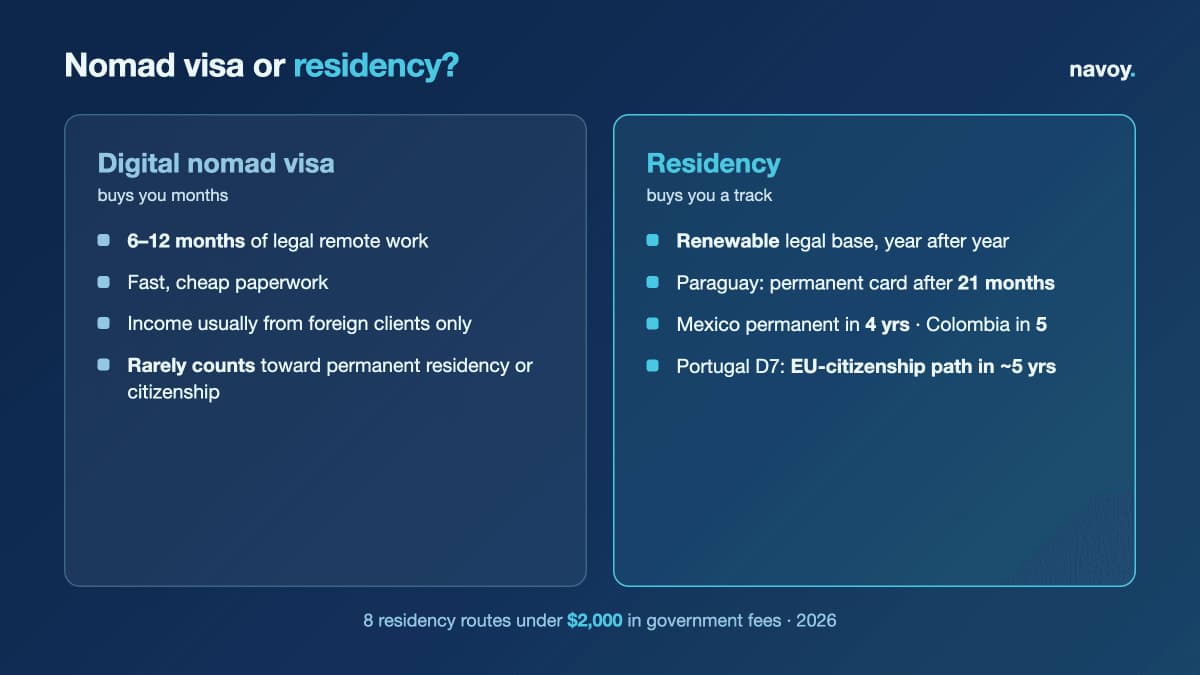
Residency is a different product from the nomad visas we've ranked before. A cheap digital nomad visa buys you 6–12 months of legal remote work; residency buys you a renewable legal base, and often a track toward permanent status or citizenship. The price of entry, though, follows the same two-price-tag logic: a headline fee, and a financial gate behind it.
| Rank | Country | Route | Gov't fees (USD) | The gate | Leads to |
|---|---|---|---|---|---|
| 1 | Colombia | M Pensionado visa | ~$55 + issuance | Lifetime pension ≥ ~$1,382/mo (3× min. wage, set in COP) | 3-yr visa; permanent (R) after 5 yrs |
| 2 | Armenia | Sole-proprietor residence | ~$272 | No income minimum; ~$2,600 business turnover/balance evidence | 1 yr, renewable |
| 3 | Portugal | D7 passive-income visa | ~$280 | Passive income ≥ €920/mo (2026) | Renewable permit; EU citizenship path ~5 yrs |
| 4 | Cambodia | ER retirement extension | ~$300/yr | Age 55+, ~$1,500/mo income evidence | Annual renewal |
| 5 | Ecuador | Rentista visa | $320 | Passive income ≥ $1,446/mo (3× SBU) | 2-yr temporary → permanent |
| 6 | Mexico | Temporary Resident | ~$450 | ~$4,300/mo income OR ~$73,000+ savings | 1–4 yrs → permanent |
| 7 | Paraguay | Temporary residency (standard) | $700–1,000 DIY | No income minimum; solvency shown at upgrade | Permanent after 21 months |
| 8 | Nicaragua | Pensionado | $1,000–2,000 | Pension ≥ $1,000/mo, age 45+ | Renewable; 6 mo/yr presence required |
All figures are approximate 2026 government charges converted to USD. Immigration rules moved three times this year alone (Armenia, Mexico, Paraguay — details below), so treat this table as a shortlist, not legal advice, and verify current requirements with each country's immigration authority before committing.
What does "cheapest residency" actually include?
A residency has three price tags: the government fee, the financial gate (income, pension, or business evidence), and the admin tail of documents and helpers. The fee is the smallest of the three almost everywhere. A $55 Colombian visa still requires a $1,382-a-month pension for life; Paraguay charges more in paperwork but asks for no income at all.
The three layers:
- Direct fees — what the government charges to process and issue the permit (the number we ranked by)
- The gate — a pension, passive income, savings balance, or registered business you must document
- Admin tail — apostilles, certified translations, health insurance, and (in Paraguay or Nicaragua especially) the local lawyer most applicants end up hiring
The cheapest residency for you is the one whose gate matches something you already have. Pensioners are spoiled for choice; freelancers with lumpy income should look hardest at Paraguay and Armenia.
How does each cheap residency route stack up?
Colombia wins on fees, Paraguay and Armenia win on having no income test, Portugal wins on where it leads. Here's each route in one honest paragraph.
1. Colombia — M Pensionado (~$55 + issuance)
The visa study fee is about $55, paid through the ministry's portal, with an issuance fee on approval. The gate: a lifetime pension of at least 3× the Colombian minimum wage — roughly $1,382/month, set in pesos, so the dollar figure moves with the exchange rate. US Social Security, corporate, and military pensions all qualify. The M visa runs 3 years, and 5 continuous years lead to permanent residency.
Best for: retirees with a qualifying pension — nothing on this list is cheaper to file.
2. Armenia — sole-proprietor residence (~$272)
Register as a private entrepreneur (~$7.60), then apply for the temporary residence permit (~$264). There's no fixed income minimum; under the 2026 rules you show about AMD 1,000,000 (~$2,600) in business turnover in the 60 days before applying, or that balance in your business account. Sole proprietors pay a flat 5% turnover tax. One warning: reforms take force on August 1, 2026 and may add quotas and stricter presence rules — apply before, or check the final text after.
Best for: working freelancers who can invoice through a tiny Armenian business.
3. Portugal — D7 passive-income visa (~$280)
About €260 in direct government fees end to end, processed in 3–6 months. The gate rose in January 2026 to €920/month of passive income (pensions, rentals, dividends), plus roughly €20,000 parked in a Portuguese bank while the application runs. What you're really buying: the only route on this list with a realistic EU citizenship path after about 5 years. Scouting a base first? Our Lisbon destination guide shows how the city lays out.
Best for: anyone whose endgame is an EU passport, not just a cheap year abroad.
4. Cambodia — ER retirement extension (~$300/year)
Enter on an ordinary visa, convert to the ER retirement category in-country, and renew for about $285–300 per 12 months. You must be 55+, genuinely retired, and able to evidence around $1,500/month in income or meaningful savings. There's no permanent-residency ladder here; it's an annual rinse-and-repeat, and by far the simplest ongoing process on the list.
Best for: retirees who value simplicity over a citizenship track.
5. Ecuador — Rentista visa ($320)
A $50 application fee plus $270 on approval. The gate is $1,446/month of passive income (3× the $482 basic salary, indexed each year; +$250 per dependent). The rentista starts as a 2-year temporary residency with a route to permanent status afterward.
Best for: passive-income earners under Portugal's radar who want the Americas time zone.
6. Mexico — Temporary Resident (~$450, but read the gate)
The consular visa costs about $54, and the resident card at INM adds the rest — card fees doubled for 2026, putting the typical first-year government total near $450. The real wall is financial: roughly $4,300–4,500/month of income over 6 months, or ~$73,000+ in savings held for 12 months, UMA-indexed and varying ±5–10% by consulate. Renewable to 4 years, then permanent.
Best for: higher earners who want North America without US or Canadian paperwork.
7. Paraguay — temporary residency, standard route ($700–1,000 DIY)
The migration office charges about $370; with apostilles and translations a do-it-yourself application lands around $700–1,000, or $1,500–2,500 with an agency. There's no income requirement — solvency evidence (a diploma, a job, a company, a pension, or a refundable ~$4,562 deposit) only appears when you upgrade to permanent residency after 21 months. The 2026 change to know: since April, direct-from-abroad permanent residency is investor-only (from $70,000), so the cheap route means applying in person in Asunción.
Best for: the lowest total barrier to a permanent-residency track anywhere — if you can show up.
8. Nicaragua — Pensionado ($1,000–2,000)
Fees run $1,000–2,000 for the primary applicant, and the gate is a pension or stable income of $1,000/month (recently raised from $600), age 45+. The operational catch: you must spend 6 months a year in-country to keep the status — this is residency for people who actually want to live there.
Best for: committed early retirees on a modest pension.
Do you need residency, or just a digital nomad visa?
If you want 6–12 months of legal remote work, a nomad visa is cheaper and faster; if you want a renewable base, lower long-run friction, or a shot at permanent residency and citizenship, residency is the better product. Most nomad visas explicitly don't count toward citizenship — most residencies on this list do, or can.
The quick test: how does the trip end? If the answer is "I go home," get a nomad visa — start with our cheapest digital nomad visas ranking, or the 8 nomad visas with no income requirement if your income is hard to document. If the answer is "maybe I stay," residency pays for itself: Portugal reaches EU citizenship territory in about 5 years, Colombia reaches permanent status in 5, Mexico in as little as 4, and Paraguay's permanent card arrives after 21 months.
What are the hidden costs of a cheap residency?
Budget an extra $300–1,500 on top of any government fee — apostilles, certified translations, mandatory insurance, and local legal help are where cheap residencies get less cheap. The good news: even fully loaded, every route here stays an order of magnitude below the $70,000+ investor programs.
| Hidden cost | Typical range | Where it bites |
|---|---|---|
| Apostilled background check & documents | $20–80 per document | Everywhere |
| Certified translations | $50–200 | Portugal, Ecuador, Paraguay, Colombia |
| Health insurance | $40–150/month | Portugal, Ecuador, Mexico |
| Local lawyer / agency | $200–2,500 | Paraguay, Nicaragua especially |
| Renewal & upgrade filings | $100–700 | Paraguay upgrade, Cambodia annual, Mexico renewals |
Which cheap residency should you pick?
Match the gate to what you already have: a pension points to Colombia, Cambodia, or Nicaragua; passive income points to Portugal or Ecuador; no provable income points to Paraguay or Armenia; a high salary points to Mexico. In one pass:
- Cheapest filing on Earth: Colombia (~$55 study fee, if you have the pension)
- No income proof: Paraguay ($700–1,000 DIY, permanent track in 21 months) or Armenia (~$272, business route — before the August 1 reform)
- EU endgame: Portugal D7 (~$280 in fees, €920/month passive, citizenship path ~5 years)
- Simplest renewals: Cambodia ER (~$300 a year, 55+)
- The Americas with a big income: Mexico (~$450 in fees, ~$4,300/month gate)
- Full-time move on a pension: Nicaragua ($1,000/month pension, 6 months/year presence)
Whatever you pick, verify the current rules on the country's official immigration site and get proper tax advice before you move — residency and tax residency are related but not identical, and the 183-day rule catches people every year.
Scout your next base in one platform with Navoy
Residency starts with a scouting trip: a week or two on the ground before you commit years to a place. Navoy is an AI travel agent built for exactly that. Tell it your dates, pace, and budget split, and it turns "10 days across Lisbon and Porto" or "two weeks in Medellín" into a day-by-day plan, then books the hotels and airport transfers in one platform. The free plan covers up to three trips of up to 14 days each — three scouting runs, at no cost. Navoy doesn't book flights; it focuses on planning, hotels, and transfers.
Frequently Asked Questions
What is the cheapest residency in the world in 2026?
By government fees, Colombia's M Pensionado visa, at roughly $55 in study fees plus an issuance charge — but it requires a lifetime pension of about $1,382 a month. The cheapest residency without any income requirement is Paraguay's standard route, at $700–1,000 all-in for a do-it-yourself application.
Can you get residency without proof of income?
Yes, two routes on this list skip the income test. Paraguay's standard temporary residency has no income minimum (solvency evidence only appears at the permanent upgrade after 21 months), and Armenia grants residence to registered sole proprietors showing about $2,600 in business turnover rather than a personal salary.
Which cheap residency leads to citizenship?
Portugal's D7 is the standout: around 5 years of residence can open a path to EU citizenship. Colombia reaches permanent residency after 5 years and Mexico after 4, each with eventual citizenship options. Paraguay grants permanent residency after 21 months. Cambodia's retirement extension, by contrast, never converts — it's renewed annually.
Is getting residency the same as becoming a tax resident?
No. Legal residency is permission to live somewhere; tax residency usually triggers separately, most often after 183 days in a year, and it can apply even without a residence permit. Some countries tax worldwide income once you cross that line. Get cross-border tax advice before relocating — the tax side can cost far more than any visa fee.
Sources
- Colombia Visas — Colombia Retirement Visa 2026: Income Requirements · Golden Harbors — Colombia Retirement Visa
- Team2B — New Residence Permit Law in Armenia (2026) · ArmLegal — New rules for residency in Armenia from 2026
- Movingto — Portugal D7 Visa 2026: €920/Month Requirement · Global Citizen Solutions — Portugal D7 Visa Guide
- LegalClarity — Cambodia Retirement Visa: Requirements, Process and Costs · Khmer Times — Guide to Retiring in Cambodia in 2026
- EcuaPass — Ecuador Visa Costs 2026 · 2026 Ecuador Visa Income Requirements
- Mexperience — Financial Criteria for Legal Residency in Mexico 2026 · Mexico Relocation Guide — 2026 Income Requirement Updates
- GoParaguay — Paraguay Permanent Residency Guide 2026 · Golden Harbors — Paraguay Residency and Citizenship 2026
- International Living — Nicaragua Visa and Residency · IMI Daily — Nicaragua Rentista and Pensionado Visas
Related reading: the cheapest digital nomad visa countries in 2026, 8 nomad visas with no income requirement, and our Lisbon destination guide for the D7 scouting trip.
Found your country? Scout it before you commit.
Plan and book your scouting trip with Navoy →
Tell Navoy your dates, pace, and budget, and it builds your day-by-day itinerary and books your hotels and airport transfers in one platform.
About the Author
Ranym Garali
Ranym is the Marketing and Content Lead at Navoy. She's been writing about travel for two years and digs into the data behind each piece, flight prices, visa rules and what people are actually searching for , so the advice holds up in practice.