
Key Takeaways
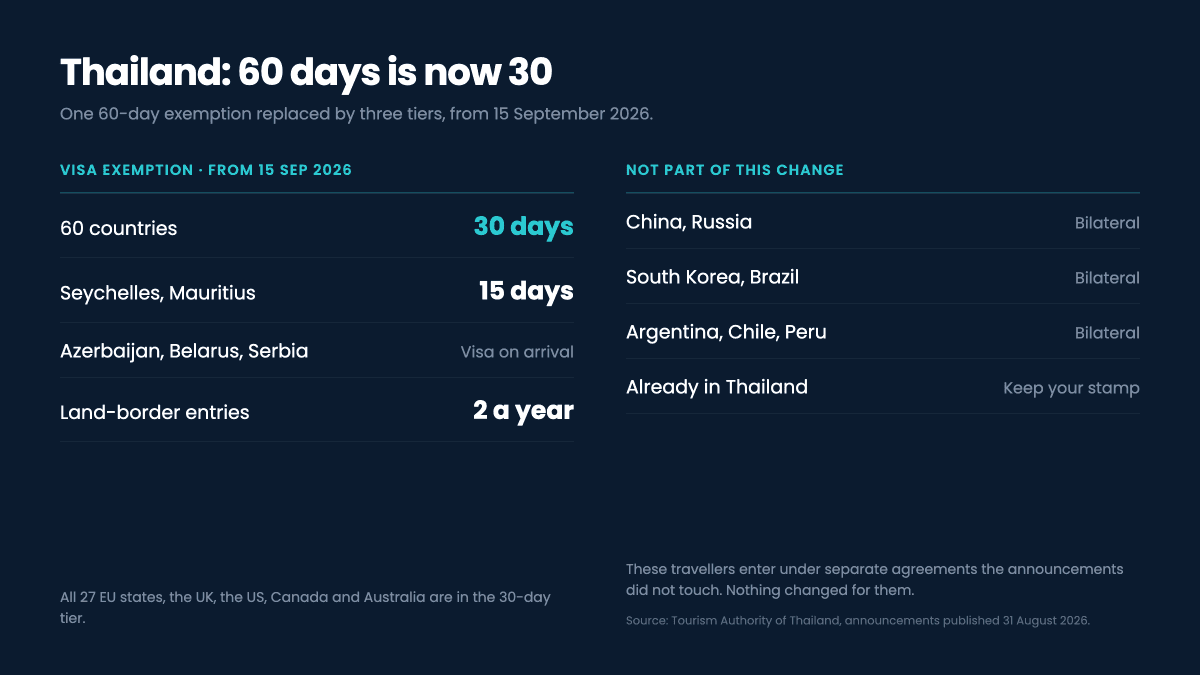
- From 15 September 2026, Thailand grants 30 days visa-free instead of 60 to citizens of 60 countries, including the UK, the US, Canada, Australia and all 27 EU member states.
- If you are already in Thailand, you keep the period you were stamped. Someone admitted for 60 days on 14 September keeps all 60.
- Several major nationalities are unaffected, because they were never in this scheme. China, Russia, South Korea, Brazil and Argentina enter under separate bilateral agreements.
- Land-border entries are now capped at two per calendar year, with exceptions for Malaysia, Brunei, Indonesia and Singapore. The cap does not apply to arrivals by air.
- A 30-day stay can be extended once by 30 days at an immigration office for 1,900 THB, giving a practical maximum of about 60 days.
Thailand replaced its 60-day visa exemption with a 30-day one on 15 September 2026. If you hold one of 60 listed passports, including British, American, Canadian, Australian and every EU passport, a visa-free arrival now gets you 30 days rather than 60. Two things soften that. If you are already in the country you keep whatever you were stamped, and if you hold a Chinese, Russian, South Korean, Brazilian or Argentine passport, nothing has changed for you at all, because you were never in this scheme.
What changed on 15 September 2026?
Thailand repealed the 60-day visa exemption introduced in 2024 and replaced it with a three-tier system: 30 days for 60 countries, 15 days for two, and visa on arrival for three. The change took effect on 15 September 2026.
| Tier | Duration | Who |
|---|---|---|
| Visa exemption | 30 days | 60 countries, including the UK, US, Canada, Australia and all 27 EU states |
| Visa exemption | 15 days | Seychelles, Mauritius |
| Visa on arrival | 15 days, 2,000 THB in cash | Azerbaijan, Belarus, Serbia |
The change was made through four Ministry of Interior announcements published in the Royal Gazette on 31 August 2026, according to the Tourism Authority of Thailand, and came into force 15 days later. The Cabinet had approved scrapping the 60-day scheme back in 19 May 2026.
One detail worth knowing if you are reading older coverage: the version the Cabinet approved in May is not the version that became law. The proposal circulating in May put the Maldives at 15 days and India at visa on arrival. Both ended up on the 30-day list instead. Articles published before September may still carry the proposal's numbers.
Which countries get 30 days?
Sixty countries are on the 30-day visa exemption list. All 27 European Union member states are included, along with the UK, the US, Canada, Australia, New Zealand, Japan, Taiwan, India, South Africa and most of the Gulf states.
The full list, as published:
Europe: Austria, Belgium, Bulgaria, Croatia, Cyprus, Czech Republic, Denmark, Estonia, Finland, France, Georgia, Germany, Greece, Hungary, Iceland, Ireland, Italy, Latvia, Liechtenstein, Lithuania, Luxembourg, Malta, Netherlands, Norway, Poland, Portugal, Romania, Slovakia, Slovenia, Spain, Sweden, Switzerland, Türkiye, Ukraine, United Kingdom
Americas and Oceania: Australia, Canada, Fiji, New Zealand, United States of America
Asia: Bhutan, Brunei Darussalam, India, Indonesia, Israel, Japan, Kyrgyzstan, Malaysia, Maldives, Philippines, Singapore, Taiwan
Middle East and Africa: Bahrain, Jordan, Kuwait, Oman, Qatar, Saudi Arabia, South Africa, United Arab Emirates
If your passport is not on that list and not in the 15-day or visa-on-arrival tiers, check your nearest Royal Thai Embassy before booking, because you may need a visa arranged in advance or you may fall under a separate arrangement entirely.
Who is not affected by this at all?
Citizens of China, Russia, South Korea, Brazil and Argentina are not affected, because they were never part of the visa exemption scheme. They enter Thailand under separate bilateral agreements, and the four announcements published on 31 August do not touch those agreements.
This is the part most coverage of the change gets wrong. Headlines saying Thailand has "halved visa-free stays for everyone" are inaccurate for several of the country's largest visitor markets.
The bilateral arrangements cover a group that includes China, Russia, South Korea, Brazil, Argentina, Chile, Peru, Hong Kong, Macao, Kazakhstan, Mongolia, Laos, Vietnam, Timor-Leste, Cambodia and Myanmar. The Tourism Authority of Thailand notes only that "separate bilateral and related entry arrangements will continue to apply", without restating the durations.
Because those durations are not set out in the announcements themselves, we are not going to print a number against each country here. If you hold one of those passports, the reliable answer is your nearest Royal Thai Embassy or consulate rather than any article, including this one. What is certain is that your entitlement comes from a bilateral agreement that this change did not alter.
What if you are already in Thailand?
You keep the period you were stamped on arrival. The new rules apply to entries from 15 September 2026 onwards and are not applied retroactively.
The wording is unambiguous: foreign nationals who entered before the new measures took effect remain authorised to stay for the period originally granted upon entry. Someone admitted for 60 days on 14 September still has 60 days. Nobody is being asked to leave early, and no stamp has been shortened.
The same applies to anyone holding an actual visa rather than a visa exemption. A tourist visa, a DTV or any other visa issued before the change continues on its own terms.
How do you stay longer than 30 days?
A 30-day visa exemption can be extended once by a further 30 days at an immigration office, using form TM.7 and paying 1,900 THB. That takes a visa-free stay to roughly 60 days, the same as before, but it now costs a fee and a trip to an immigration office.
The extension is granted at the officer's discretion and cannot be chained: you get one, not a rolling series. If you need longer or want certainty, there are three routes:
- Tourist visa (TR or e-Visa). Sixty days on arrival, and itself extendable. Applied for before you travel.
- Destination Thailand Visa (DTV). Aimed at remote workers and long-stay visitors, giving 180 days per entry over a five-year multiple-entry validity, extendable once by a further 180 days for 1,900 THB. Reported fees for the DTV sit around 10,000 THB, though you should confirm the current figure with an embassy rather than relying on secondary reports.
- Long-Term Resident (LTR) visa, for those who meet its specific eligibility categories.
One useful consequence: holding an actual visa takes you out of the exemption scheme entirely, which means the land-border cap described below does not apply to you.
What is the land-border cap?
Visa-free entries through land checkpoints are now limited to two per calendar year. Citizens of Malaysia, Brunei, Indonesia and Singapore are exempt from the cap, and it does not apply to arrivals by air.
This is aimed at people who repeatedly left and re-entered overland to reset their permitted stay. From 15 September, the third land crossing in a calendar year on a visa exemption will not be granted.
Two clarifications, because this is the most misreported part of the change. The cap applies to land checkpoints only: arriving by air remains subject to normal officer discretion rather than a hard annual count. And some official summaries, including at least one Royal Thai Embassy page, state the twice-yearly limit without the land qualifier, which reads as stricter than the announcements are.
Before you fly
Two requirements that have not changed but catch people out. The Thailand Digital Arrival Card is mandatory and free, submitted online within three days before you arrive. And immigration can ask for proof of funds, set at 20,000 THB per person or 40,000 THB per family.
If you had a five or six-week Thailand trip booked on the old 60-day rule, that itinerary now needs either an extension partway through or a tourist visa arranged before you go. Navoy can rebuild the routing around a 30-day window, or around the immigration-office stop if you would rather extend.
Frequently asked questions
How long can I stay in Thailand without a visa in 2026?
Thirty days for citizens of the 60 listed countries, from 15 September 2026. Seychelles and Mauritius get 15 days. Azerbaijan, Belarus and Serbia get visa on arrival. Before 15 September the exemption was 60 days.
Does the new 30-day rule apply to Chinese and Russian travellers?
No. China and Russia are not part of the visa exemption scheme and never were. They enter under separate bilateral agreements that these announcements did not change. The same is true for South Korea, Brazil and Argentina.
Can I extend a 30-day visa exemption in Thailand?
Yes, once, by a further 30 days. You apply in person at an immigration office using form TM.7 and pay 1,900 THB. It is granted at the officer's discretion and cannot be repeated, so the practical maximum on a visa exemption is about 60 days.
How many times can I enter Thailand by land in a year?
Twice per calendar year on a visa exemption, from 15 September 2026. Citizens of Malaysia, Brunei, Indonesia and Singapore are exempt from the limit, and the cap does not apply to arrivals by air or to anyone holding an actual visa.
Sources
- Tourism Authority of Thailand, new 30-day and 15-day visa exemption rules, the country lists and the land-border cap
- Royal Thai Embassy, London: visa exemption, visa on arrival countries and fee
- Royal Thai Embassy, Washington DC: visa exemption and visa on arrival, proof of funds requirement
- Thailand Digital Arrival Card, the mandatory arrival card
Related articles
- Passports That Gained and Lost Visa-Free Countries in 2026
- ETIAS Requirements for Americans Flying to Europe
- How Much Are Tourist Taxes in 2026?
Booked a long Thailand trip before the change? Let Navoy rebuild it around the 30-day window.
About the Author
Ranym Garali
Ranym is the Marketing and Content Lead at Navoy. She's been writing about travel for two years and digs into the data behind each piece, flight prices, visa rules and what people are actually searching for , so the advice holds up in practice.