Key Takeaways
- The UAE passport is the story of 2026. It climbed from 5th to 2nd between January and July, and over twenty years it has added 153 destinations and risen 57 places, the largest gain the index has ever recorded.
- A lower score does not mean a country lost access. Scores fell almost universally between the 2025 and 2026 editions because the index recalibrated. Singapore, the top passport, dropped three points. Rank movement is the honest measure.
- The US and UK recorded their steepest annual losses, shedding seven and eight destinations respectively in that order, though no official source names which countries revoked access.
- China is why the UK and Canada moved up. Both were added to China's 30-day visa-free scheme on 17 February 2026. Americans are still not on that list, though they can use China's separate 240-hour transit scheme.
- ETIAS has no start date at all now. The EU removed its Q4 2026 target in July, and Thailand's 60-to-30-day cut has not taken effect either. The EU Entry/Exit System, by contrast, has been live since April.
The UAE passport gained the most in 2026, climbing from 5th to 2nd place. The UK and Canada also rose after China opened visa-free entry to both in February. The US and UK recorded their steepest annual losses on record, seven and eight destinations. But most of the score drops you will read about this year are not lost access at all.
Which passports gained and lost the most in 2026?
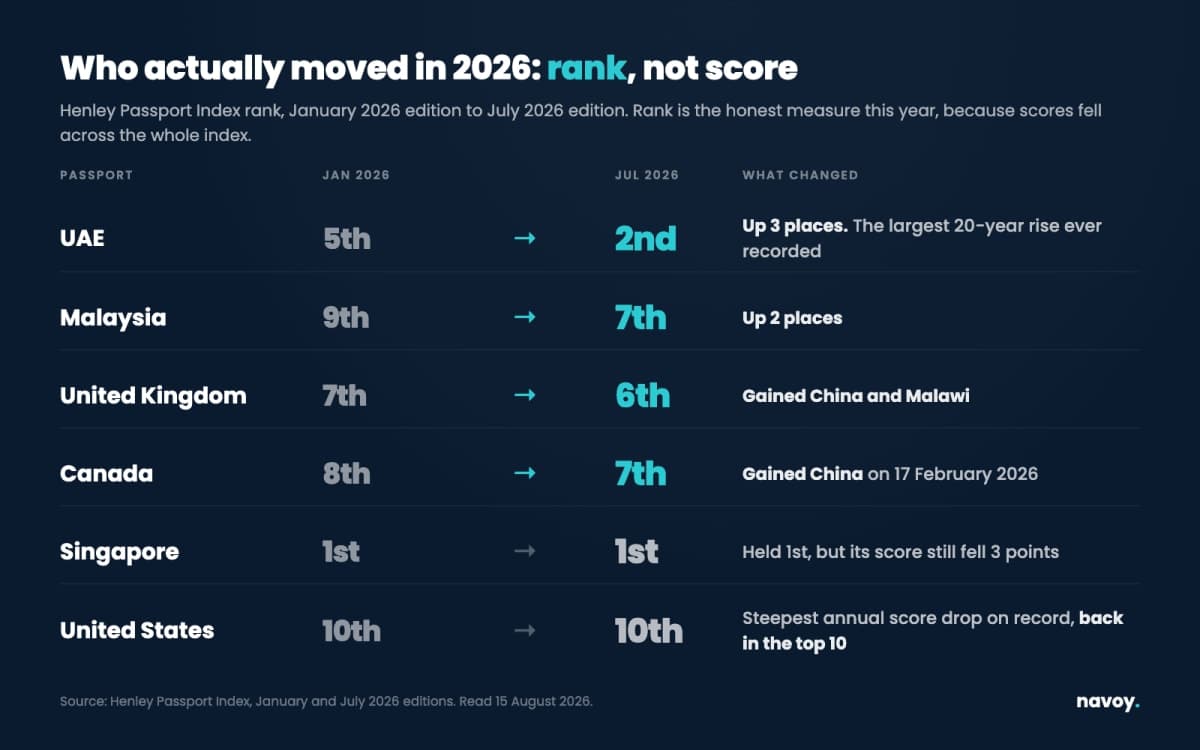
The UAE was the clearest gainer, rising from 5th to 2nd in the Henley Passport Index between its January and July 2026 editions. The UK and Canada each climbed one place. The US and UK posted the largest annual score declines, seven and eight points, though the US still sits 10th. Almost every passport's raw score fell because the index recalibrated.
| Passport | Jan 2025 | Jan 2026 | Jul 2026 | Score change, Jan to Jan |
|---|---|---|---|---|
| Singapore | 1 / 195 | 1 / 192 | 1 / 192 | -3 |
| Japan | 2 / 193 | 2 / 188 | 2 / 188 | -5 |
| South Korea | 3 / 192 | 2 / 188 | 2 / 188 | -4 |
| UAE | 10 / 185 | 5 / 184 | 2 / 188 | -1, and up 5 ranks |
| UK | 5 / 190 | 7 / 182 | 6 / 184 | -8 |
| Canada | 7 / 188 | 8 / 181 | 7 / 183 | -7 |
| Australia | 6 / 189 | 7 / 182 | 7 / 183 | -7 |
| US | 9 / 186 | 10 / 179 | 10 / 180 | -7 |
| China | 59 / 86 | 59 / 81 | 60 / 83 | -5 |
| India | 85 / 57 | 80 / 55 | 81 / 55 | -2 |
Rank / score, where the score is the number of destinations reachable without a prior visa. Figures read from Henley's own ranking PDFs on 15 August 2026. The index covers 199 passports and 227 destinations.
One caveat before the detail. This article uses a single index, Henley's, because it publishes its full ranking tables openly. Other indices count destinations slightly differently and will not always agree.
Which passport gained the most in 2026?
The UAE. It moved from 5th to 2nd between the January and July 2026 editions, reaching a score of 188 and drawing level with Japan and South Korea. Over the last twenty years the UAE has added 153 destinations and climbed 57 places, which is the largest rise ever recorded in the index.
The mechanism is unglamorous and worth understanding, because it explains why the climb has held rather than spiked. The UAE has pursued mutual visa-waiver agreements bilaterally and continuously, treating passport strength as a long-term policy objective rather than a diplomatic side effect. Most passports near the top of the index inherited their position. The UAE built its own.
For a traveller on an Emirati passport, the practical difference in 2026 is that the list of places requiring paperwork in advance is now shorter than it is for an American.
Why did the UK and Canada climb the rankings in 2026?
China. Both countries were added to China's visa-free scheme effective 17 February 2026, which lets their citizens enter for up to 30 days without a visa. Henley credits the UK's rise specifically to gaining China and Malawi. The UK moved from 7th to 6th and Canada from 8th to 7th.
China's scheme now covers 50 countries. It applies to ordinary passports and covers business, tourism, family visits, exchanges and transit, for stays of up to 30 days. Sweden was added in November 2025, then the UK and Canada in February 2026, and those two remain the only nationalities added during 2026.
One detail almost every roundup misses: the scheme runs on three separate clocks. The core group and Sweden are covered to 24:00 on 31 December 2026, the UK and Canada from 17 February 2026 to the same date, and Russia has been extended separately to 31 December 2027. Nothing beyond those dates has been announced.
This is the clearest example of how these rankings actually move. One large destination opening its border shifts a passport up a place. It is rarely a broad trend, and it is almost never the passport itself getting stronger.
Did the US passport really lose visa-free countries?
The US score fell seven points between the January 2025 and January 2026 editions, its steepest annual decline on record. But the US sits 10th in both 2026 editions, and it returned to the top 10 after briefly dropping out in late 2025. Most articles reporting that exit as current news are a year out of date.
Two things are worth separating here.
The decline is real over a multi-year view. The US and UK jointly held first place in 2014 and both have slid since. What no source will tell you is which specific countries revoked access, because Henley records the decline without naming the revoking states. If you see an article listing the exact countries that dropped Americans, treat it with suspicion.
The other thing is that 2026 was not uniformly bad for the American passport. Uzbekistan became visa-free for US citizens on 1 January 2026, for stays up to 30 days, under a presidential decree signed the previous November. The US score also ticked back up a point between the January and July editions.
Which passport actually lost visa-free access in 2026?
Georgia, and only for official travel documents. On 6 March 2026 the EU suspended visa-free travel for holders of Georgian diplomatic, service and official passports for twelve months. Ordinary Georgian passports are unaffected. It is the first use of the EU's revised suspension mechanism, which came into force in December 2025.
This is worth knowing for two reasons. It is the clearest documented revocation of the year, and it is not the kind of story that makes headlines, because it touches officials rather than tourists.
It also shows what the EU's new powers allow. The revised mechanism added grounds including operating an investor-citizenship scheme and a deterioration in external relations, and it lets Brussels target officials first and extend later. The Commission has said it may extend the Georgian suspension to all citizens.
Beyond that, the honest position is that no country can be confirmed on an official source as having revoked visa-free access from ordinary US, UK or EU passport holders in 2026. Every 2026 change hitting those passports is an authorisation scheme rather than a visa. That distinction is where most coverage of this topic goes wrong.
Why did almost every passport's score fall?
Because the index recalibrated, not because 199 countries simultaneously closed their borders. Singapore, the strongest passport in the world, lost three points. Japan lost five. When the top of the table falls alongside the bottom, the change is in the measurement rather than in anyone's travel rights.
This matters more than it sounds. A headline saying a passport "lost seven countries" implies seven specific borders closed to seven specific groups of travellers. What the number usually reflects is a scoring change applied across the whole index.
The honest way to read this year's data is to follow rank, not score. Rank is relative, so index-wide adjustments cancel out. That is why the UAE's move from 5th to 2nd is a genuine finding and why a three-point drop for Singapore, which stayed 1st throughout, is not.
Do Americans need a visa for China in 2026?
For a normal trip, yes. The 30-day visa-free scheme covers 50 countries and the United States is not among them. But Americans are eligible for China's separate 240-hour visa-free transit scheme, which covers 55 countries and does include the US. The two get conflated constantly and they are not the same thing.
The difference is worth being precise about, because it decides whether your trip is legal.
| 30-day visa-free | 240-hour visa-free transit | |
|---|---|---|
| Who | 50 countries, not the US | 55 countries, including the US |
| Length of stay | 30 days | 10 days |
| Onward ticket to a third country | Not required | Required, with a confirmed date and seat |
| Where you can go | Nationwide | Designated areas only |
| Expiry | 31 December 2026 | No stated end date |
In plain terms: an American cannot fly to Beijing, spend a week there and fly home without a visa. An American can stop in China for up to ten days while travelling on to a third country. Both tourism and business are permitted on the transit scheme; work, study and news reporting are not.
This is almost certainly what the roundups claiming "China made entry easier for Americans" were describing, and it is a materially narrower thing than they imply.
Is the EU Entry/Exit System live?
Yes. The EES has been fully operational since 10 April 2026, after a progressive rollout that began in October 2025. It covers 29 countries, replacing passport stamping with a digital record of entries and exits and registering your face and fingerprints at the border. Ireland and Cyprus are outside it.
The practical effect for a visitor is a slower first crossing while biometrics are captured, and faster ones afterwards. It does not change who may enter, and it is not something you apply for in advance. It happens at the border.
Is ETIAS live yet?
No, and it now has no confirmed start date at all. The European Commission removed its Q4 2026 target in July 2026 and says only that it will announce the date several months in advance. Most reporting now points to 2027. The fee will be EUR 20. Anyone telling you to apply today is wrong, and possibly running a scam.
ETIAS and EES get conflated constantly, and they are different things: EES is a border system that operates on you, while ETIAS will be a travel authorisation you apply for. We cover the detail in our guide to ETIAS requirements for US travellers.
Which 2026 changes are not actually in force yet?
This is the section worth saving. Each of these is widely reported as current and none of them is.
| Reported change | What is actually true |
|---|---|
| ETIAS is live, apply now | Not operational, and the Q4 2026 target was removed from the Commission's own page in July 2026. No date exists; reporting points to 2027 |
| Thailand cut visa exemption from 60 to 30 days | Cabinet approved it on 19 May 2026, but the announcements remain unpublished in the Royal Gazette and take effect 15 days after publication. The 60-day rule still stands |
| South Korea reinstated K-ETA in January 2026 | False. The exemption was extended through 31 December 2026 |
| Australia now requires an ETA from visa-exempt nationals | Australia has never had visa-free entry, so there is nothing to change |
| The EU suspended visa facilitation with Russia in 2026 | That happened in September 2022. Multi-entry visas ended in 2025 |
| Brazil started requiring visas from Americans in 2026 | It began on 10 April 2025. Not a 2026 change |
| Romania joined the US Visa Waiver Program in March 2026 | False. The designation was never implemented and was rescinded in May 2025. Romanians still need a visa |
| Montenegro now requires visas from Chinese, Russian and Turkish citizens | The decree was adopted in July 2026 but takes effect 1 November 2026. US, UK, EU, Canadian and Australian passports are unaffected |
The Thailand one is the most likely to cost someone a trip, because a traveller who plans around 30 days when 60 is still available loses time they did not need to.
One genuine 2026 change that does restrict travel: the US travel ban proclamation signed on 16 December 2025 took effect on 1 January 2026 and covers 39 countries, 19 with full restrictions and 19 partial, plus Palestinian Authority travel documents.
What this means for planning a trip in 2026
Rankings make good headlines and poor planning tools. What matters for a specific trip is the rule for your nationality, at your destination, on your date, and that is the thing changing fastest right now. A passport index tells you nothing about whether Thailand's rule changed last week.
Two habits are worth keeping. Check the destination government's own page rather than a roundup, including ours, because these move without notice. And check again close to departure if you booked months ahead.
Once entry requirements are settled, the rest of the trip is logistics. Navoy is an AI travel agent that plans the itinerary and books the hotels and airport transfers in one platform, which is useful when a route touches several countries with different rules. It does not handle visas, entry authorisation or immigration, and flights are selectable while you plan but booked with the airline. For multi-country routing, our guide to planning a multi-country trip with AI goes deeper, and if a long stay is the goal, the cheapest digital nomad visa countries covers the residence side.
Frequently Asked Questions
What is the strongest passport in 2026?
Singapore, with a score of 192 destinations in Henley's July 2026 edition. Japan, South Korea and the UAE are tied at 2nd on 188, followed by Sweden on 187. Singapore has held the top position across both 2026 editions, though its score fell three points from 195 in January 2025 as the index recalibrated.
How many countries can a US passport visit visa-free?
180, according to Henley's July 2026 ranking, placing the US 10th. That is up one point from the January 2026 edition and down seven from January 2025. The US briefly dropped out of the top 10 in late 2025 and has since returned. Always confirm the rule for your specific destination before booking.
Did any country stop letting Americans in visa-free in 2026?
Not that we could confirm on an official source. Henley records the decline without naming any country, and reports that Malawi ended visa-free entry in January 2026 sit oddly against Henley crediting the UK's rise partly to gaining Malawi. Treat specific revocation lists with caution. Uzbekistan moved the other way, going visa-free for Americans on 1 January 2026.
Do I need ETIAS to visit Europe right now?
No. ETIAS is not operational, no applications are being accepted, and there is no confirmed start date. The EU dropped its Q4 2026 target in July 2026 and most reporting now expects 2027. The fee will be EUR 20. What is already running is the Entry/Exit System, live since 10 April 2026, which captures your biometrics at the border and requires nothing in advance.
Sources
Ranking figures were read from Henley's published tables on 15 August 2026. Entry rules change without notice, so confirm on the destination government's official page before you book.
- Henley Passport Index, July 2026 global ranking (PDF)
- Henley Passport Index, January 2026 global ranking (PDF)
- Henley Passport Index, January 2025 global ranking (PDF)
- Chinese Ministry of Foreign Affairs, visa-free expansion announcement
- The State Council of China, visa-free policy news
- European Commission, differences between EES and ETIAS
- GOV.UK, apply for an Electronic Travel Authorisation
- Government of Uzbekistan, visa-free entry for US citizens
- Korean Ministry of Foreign Affairs, K-ETA exemption extension
- Congressional Research Service, 2026 travel restrictions
- European Commission, ETIAS official page
- China National Immigration Administration, visa-free country list
- Commission Implementing Regulation (EU) 2026/496, Georgia visa suspension
Related reading: ETIAS requirements for US travellers · The cheapest digital nomad visa countries · How to plan a multi-country trip with AI
Entry rules sorted? Plan the rest in one place. Navoy builds the itinerary and books your hotels and airport transfers around it. Start planning free.
About the Author
Ranym Garali
Ranym is the Marketing and Content Lead at Navoy. She's been writing about travel for two years and digs into the data behind each piece, flight prices, visa rules and what people are actually searching for , so the advice holds up in practice.