
Key Takeaways
- No statistics office anywhere publishes an average restaurant meal price. Every per-day food budget you have read was estimated by somebody.
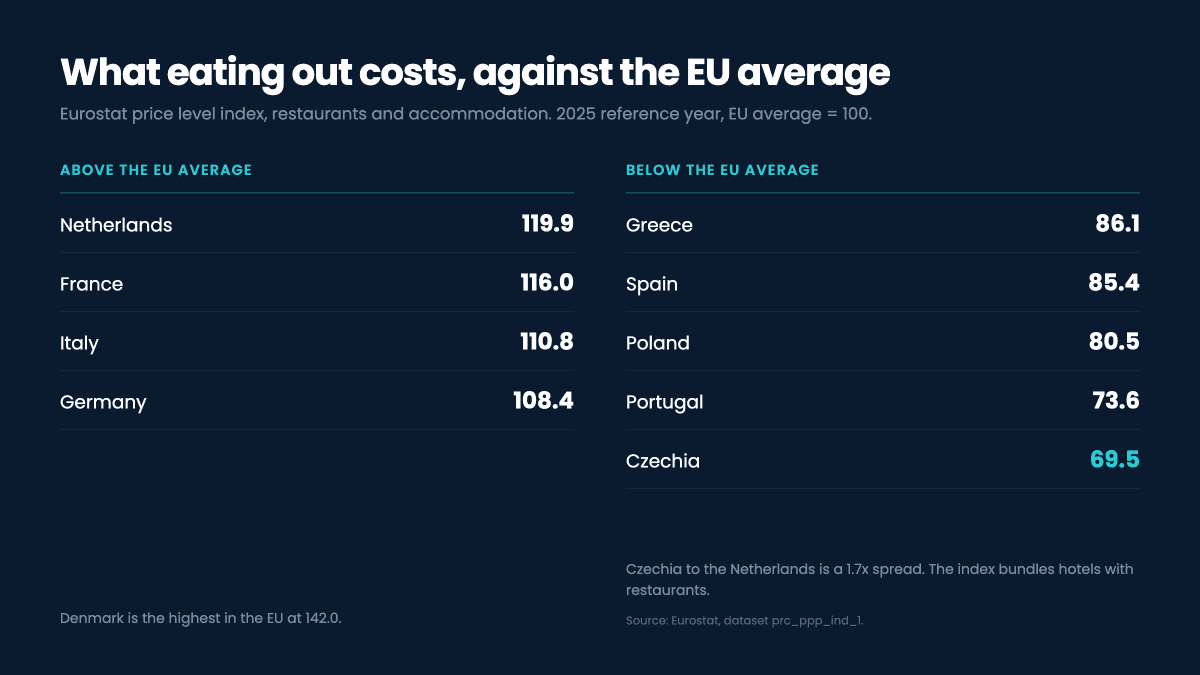
- What is measured is the comparison. Eurostat indexes restaurant price levels against an EU average of 100: Czechia sits at 69.5, the Netherlands at 119.9.
- In Portugal and Greece, eating out is cheap but groceries are not. Portugal is 73.6 for restaurants and 102.0 for food shopping, which inverts the usual advice to self-cater.
- Alcohol is taxed differently from food almost everywhere. France charges 10% VAT on a restaurant meal and 20% on the wine.
- Germany cut restaurant VAT from 19% to 7% in January 2026 and prices still rose 3.1%.
No statistics office in Europe publishes an average restaurant meal price. Not Eurostat, not INSEE, not Destatis. So any article telling you to budget €45 a day for food in Italy is quoting a number somebody invented. What is actually measured is the comparison: how much more or less expensive eating out is in one country than another. On that measure, Czechia costs 42% less than the EU average and the Netherlands 20% more, which is a 1.7x spread between two countries an hour apart by plane.
How much does eating out cost in each European country?
Eurostat publishes a price level index for restaurants and accommodation, setting the EU average at 100 and indexing every country against it. In 2025, the most recent year measured, Czechia came in at 69.5 and the Netherlands at 119.9. The same restaurant basket that costs 100 in the EU average costs 69.50 in one and 119.90 in the other.
Two things about this table before you read it. It describes 2025, because the index is published with roughly an eighteen-month lag, so it is the most recent measurement rather than a description of today. And Eurostat's category bundles restaurants with accommodation, so hotel prices are inside these numbers. The Netherlands' 119.9 is partly hotels. That is a real limitation and it is worth knowing before you use the figures.
| Country | Restaurants and accommodation, 2025 | Food and non-alcoholic drinks, 2025 |
|---|---|---|
| Netherlands | 119.9 | 99.4 |
| France | 116.0 | 106.8 |
| Italy | 110.8 | 101.1 |
| Germany | 108.4 | 102.4 |
| EU average | 100.0 | 100.0 |
| Greece | 86.1 | 105.3 |
| Spain | 85.4 | 95.3 |
| Hungary | 82.4 | 95.2 |
| Poland | 80.5 | 89.5 |
| Portugal | 73.6 | 102.0 |
| Czechia | 69.5 | 89.8 |
Across the full EU the range is wider still. Denmark is the most expensive member state at 142.0 and Bulgaria the cheapest at 55.7. Outside the EU, Switzerland reaches 163.1 and Iceland 173.2.
Why can nobody tell you a per-day food budget?
Because no official body measures it. Statistics offices track price changes and price levels relative to other countries, but none of them publishes "a restaurant meal in Spain costs €X". The per-day figures in circulation come from bloggers recording their own spending or from calculator sites that do not say where their numbers came from.
This is worth understanding rather than just accepting, because it explains why those figures vary so wildly between sources. There is no authority to check them against.
It also explains why a comparison is more useful than an absolute. Your food budget depends on whether you eat one restaurant meal a day or three, whether you drink wine, whether you are in the capital or a small town. No single euro figure survives those variables. But the ratio between countries holds regardless: if you eat the same way in Prague as you would in Amsterdam, the Prague version costs a little over half as much.
So the practical use of the table above is not to set a budget. It is to adjust one you already have. If you know what a week of eating out costs you at home, the index tells you roughly what the same week costs somewhere else.
Where is eating out cheap relative to groceries?
In Portugal and Greece, restaurants are well below the EU average while supermarket food is above it. Portugal is 73.6 for restaurants and 102.0 for groceries. Greece is 86.1 and 105.3. In both countries, cooking for yourself saves less than you would expect, and may save nothing at all.
This inverts the standard travel advice. The usual guidance is that self-catering is the cheap option and eating out is the indulgence, which holds in northern Europe: in the Netherlands, restaurants are at 119.9 while groceries sit at 99.4, so the gap between cooking and eating out is large.
In Portugal the gap runs the other way. Groceries cost slightly more than the EU average while restaurants cost a quarter less. If you are staying somewhere with a kitchen in Lisbon or Athens, the saving from using it is much smaller than the same decision would produce in Amsterdam or Paris.
Spain, Poland and Czechia behave more conventionally, with both measures below average. Czechia is the cheapest on both counts, at 69.5 and 89.8.
How much of your bill is tax, and does it change what you order?
Restaurant VAT ranges from 5% in Hungary to 25% in Denmark. More usefully for a traveller, alcohol is taxed differently from food in most countries. France charges 10% on a restaurant meal and 20% on the wine, Italy 10% and 22%, Germany 7% on food and 19% on all drinks.
| Country | VAT on restaurant food | VAT on alcoholic drinks |
|---|---|---|
| Hungary | 5% | Not separately verified |
| Germany | 7% | 19% on all beverages |
| Poland | 8% | Not separately verified |
| Netherlands | 9% | Not separately verified |
| France | 10% | 20% |
| Italy | 10% | 22% |
| Spain | 10% | Not separately verified |
| Czechia | 12% | Not separately verified |
| Greece | 13% | Not separately verified |
| Portugal | 13% | Not separately verified |
The food and drink split is the part worth knowing. In France and Italy, ordering a bottle of wine roughly doubles the tax rate on that portion of the bill. It does not make the wine a bad idea, but it does mean that a meal with drinks is more expensive relative to a meal without than the headline VAT rate suggests.
Germany has just run an unintentional experiment on whether these rates reach diners at all. VAT on restaurant food was cut from 19% to 7% on 1 January 2026, a substantial reduction. Destatis reported restaurant service prices still rose 3.1% in the year to August 2026. The cut did not turn into lower menu prices.
Part of the explanation is that the same date carried a cost increase in the other direction: Germany's statutory minimum wage rose from €12.82 to €13.90 an hour on 1 January 2026, and rises again to €14.60 in January 2027. Restaurants absorbed a tax cut and a wage rise simultaneously.
What gets added to your bill?
In France the price on the menu is the final price, by law. In Italy there is no national rule on cover charges at all, so a coperto is legal if it was disclosed in advance, except in Lazio where it is banned outright. So Rome has no cover charge and Florence does.
France settled this in 1987. The arrêté du 27 mars 1987 states that in establishments where a service charge is collected, the displayed price is understood to include taxes and service. What you read is what you pay.
Italy never legislated nationally. The coperto is a per-person charge covering bread, linen and table service, and it is enforceable only if the customer was told about it before ordering, under a general rule about disclosed prices. The exception is regional: Lazio's regional law 21/2006 prohibits applying additional costs for the coperto, and Rome is in Lazio.
The practical consequence for a traveller is small in money and large in irritation. A coperto is typically a couple of euros per person. Knowing whether it is coming is the difference between a fair charge and feeling overcharged.
How fast are restaurant prices rising?
Restaurant and accommodation prices across the EU rose 4.0% in the year to July 2026. The spread is wide: Germany at 2.9% and France at 3.3% at the low end, Hungary at 6.0% and Spain at 5.1% at the high end.
This is a different measurement from the price level index above, and the two should not be combined. The index tells you how expensive a country is relative to other countries, using 2025 data. The inflation rate tells you how fast prices are changing within a country, using July 2026 data. A country can be cheap and rising quickly at the same time, which is exactly what Czechia and Hungary are doing.
| Country | Restaurant and accommodation inflation, July 2026 |
|---|---|
| Hungary | 6.0% |
| Netherlands | 5.4% |
| Spain | 5.1% |
| Czechia | 4.6% |
| Portugal | 4.2% |
| Greece | 4.2% |
| Poland | 4.1% |
| EU average | 4.0% |
| Italy | 3.4% |
| France | 3.3% |
| Germany | 2.9% |
National statistics offices report their own versions with slightly different definitions and reference months. Destatis put German restaurant services at 3.1% in August 2026. ISTAT put Italian restaurants and accommodation at 3.4% in July, accelerating from 2.9%. Greece's ELSTAT reported 5.8% overall for restaurants and accommodation, with restaurants alone at 6.4% while hotel prices fell.
Planning a trip around what you will actually spend
The index is most useful at the point where you are choosing between two destinations rather than once you have booked. A week in Prague and a week in Amsterdam are not the same financial proposition, and the difference in eating out is larger than most people assume.
Navoy can price accommodation and routing across several destinations at once, so you can see the comparison before committing rather than discovering it on arrival.
Frequently asked questions
How much should I budget per day for food in Europe?
No official source can tell you, because no statistics office publishes an average meal price. What is measurable is the comparison between countries. Take what a similar week costs you at home and adjust it using Eurostat's index: Czechia at 69.5 against the Netherlands at 119.9.
Which European country is cheapest for eating out?
Among the larger destinations, Czechia at 69.5 against an EU average of 100, followed by Portugal at 73.6 and Poland at 80.5. Across the whole EU, Bulgaria is cheapest at 55.7. These are 2025 figures, the most recent Eurostat has measured.
Is it cheaper to cook than eat out in Europe?
It depends on the country. In the Netherlands restaurants are at 119.9 and groceries at 99.4, so cooking saves a lot. In Portugal restaurants are at 73.6 and groceries at 102.0, so the saving is small or nil.
Do I have to pay a cover charge in Italian restaurants?
Usually yes, and it is legal provided it was disclosed before you ordered. Italy has no national law on the coperto. The exception is Lazio, where regional law bans it, so restaurants in Rome do not charge it while restaurants in Florence generally do.
Sources
- Eurostat, comparative price levels, dataset prc_ppp_ind_1, the price level index for restaurants and accommodation, 2025 reference year
- Eurostat, HICP restaurants and hotels, dataset teicp110, annual inflation to July 2026
- Destatis, consumer prices August 2026, German restaurant service prices
- ISTAT, consumer prices July 2026, Italian restaurants and accommodation
- ELSTAT, consumer price index July 2026, Greek restaurants and accommodation
- Légifrance, arrêté du 27 mars 1987, French rule that displayed prices include service
- Regione Lazio, legge regionale 21/2006, the Lazio ban on cover charges
Related articles
- Is Lisbon Expensive in 2026?
- Countries Where You Can Live Comfortably on 1,200 a Month
- Shoulder Season Price Windows for 2026
Comparing two destinations? Let Navoy price the whole trip side by side before you choose.
About the Author
Ranym Garali
Ranym is the Marketing and Content Lead at Navoy. She's been writing about travel for two years and digs into the data behind each piece, flight prices, visa rules and what people are actually searching for , so the advice holds up in practice.