
Key Takeaways
- Dynamic currency conversion is the option to pay in your home currency instead of the local one, offered by card machines and ATMs abroad. It is almost always the expensive choice.
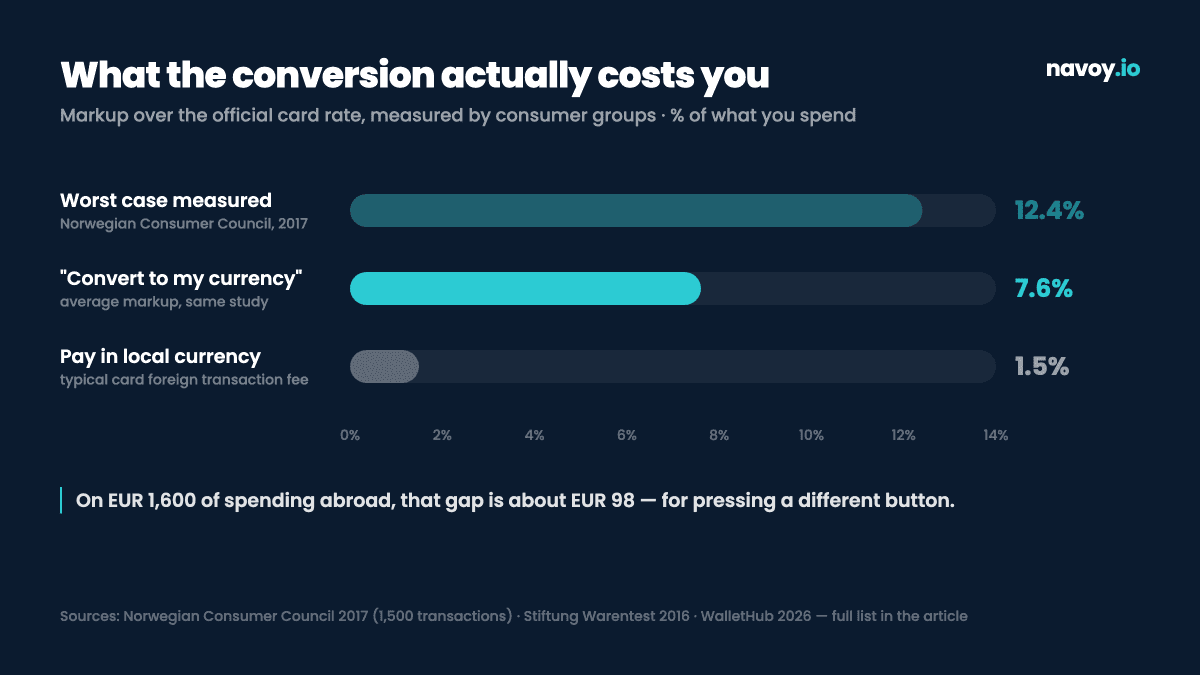
- The average markup is 7.6% over the official card rate, with a maximum of 12.4% measured by the Norwegian Consumer Council across 1,500 transactions.
- Travelers came out worse in 99.7% of those transactions. Only 4 of 1,500 were cheaper.
- Paying in the local currency costs about 1.5% instead, the average card foreign transaction fee.
- Visa's rules say the machine must let you decline, and must not choose for you.
Dynamic currency conversion, or DCC, is the offer you get when a card machine or ATM abroad asks whether you would like to pay in your own currency instead of the local one. Saying yes lets the merchant or ATM operator set the exchange rate rather than your card network. The Norwegian Consumer Council measured an average markup of 7.6% over the official Visa rate, peaking at 12.4%. Paying in local currency instead typically costs the 1.5% or so your own bank charges.
The screen is designed to feel like a courtesy. It shows you a familiar number, in a familiar currency, at the exact moment you are standing at a counter with people behind you. What it is actually offering is to move the currency conversion from your bank, which does it at close to the interbank rate, to a company that has an incentive to do it badly.
Half of travelers say yes. The academic estimate is that 50% to 60% of international customers accept DCC when offered.
What is dynamic currency conversion?
DCC is a service that converts a foreign transaction into your home currency at the point of sale, before it reaches your bank. The merchant, ATM operator or their payment provider sets the rate and keeps the difference between it and the real one. It is offered on card terminals, at ATMs, and at some online checkouts.
Here is the mechanic, which the screen never explains.
When you pay in the local currency, the transaction travels to Visa or Mastercard, who convert it at their own rate. That rate sits very close to the mid-market rate, typically within about half a percent. Your own bank may then add a foreign transaction fee on top.
When you accept DCC, the conversion happens before any of that. The merchant's payment provider picks a rate, marks it up, and hands you a total in dollars, pounds or euros. Your bank sees a transaction already denominated in your own currency and passes it straight through. There is nothing left for your card network to do, and no better rate for it to apply.
The markup is the entire business model. As BEUC noted, a DCC provider's own merchant-facing materials advertised that the service "grants you, the merchant, a commission on each transaction." The convenience is real. It is just not free, and the price is not the one on the screen.
How much does dynamic currency conversion actually cost?
An average of 7.6% over the official card rate, according to the Norwegian Consumer Council's study of 1,500 transactions, with the worst case at 12.4%. German consumer group Stiftung Warentest found a range of 2.6% to 12% across 11 countries. Paying in local currency instead costs whatever your card charges in foreign transaction fees, averaging 1.59% in 2026.
Put those two rates against a realistic trip and the gap stops being abstract. Say you spend 1,600 euros on your card over two weeks abroad, across hotels, restaurants and a few ATM withdrawals:
| Your choice at the screen | Rate applied | Cost on EUR 1,600 |
|---|---|---|
| "Convert to my currency" (DCC) | +7.6% average markup | EUR 121.60 |
| Pay in local currency | ~1.5% card foreign transaction fee | EUR 24.00 |
| Difference | EUR 97.60 |
That is roughly 98 euros for pressing a different button. The 1,600 euro figure is an assumption you should replace with your own spending; the percentages are the measured part, and the arithmetic is simple enough to redo in your head at the counter. One percent of your total trip spend, per point of markup.
Two things worth noticing. The DCC markup and your card's foreign transaction fee are not alternatives to each other in every case: some banks still apply their fee to a DCC transaction, which means you can pay both. And the 12.4% maximum was not a rare outlier in an obscure country. Stiftung Warentest's worst results came from the Czech Republic, Poland and Hungary, all ordinary European city-break destinations.
Why do ATMs and card machines push it so hard?
Because the markup is shared between the merchant, the ATM operator and their payment provider, so everyone touching the screen earns from a yes. That is also why the wording is designed to sound reassuring, with phrases about locking in or guaranteeing your rate.
Watch for the specific language. Screens rarely say "we will charge you a markup." They offer to let you "pay in your own currency," to "lock in" a rate, or to know "exactly what you will pay." Each of those is technically true and materially misleading, because the certainty on offer is certainty about a worse number.
The layout does work too. The home-currency option is often the larger button, the highlighted one, or the default that a hurried tap will select. This is precisely what regulators went after: the 2023 study in the Journal of Public Policy & Marketing found that preselected DCC options, which the authors call evil defaults, hit less financially literate customers hardest, because those travelers were the least likely to reduce their DCC use as the markup grew.
Regulation has pushed back without solving it. EU Regulation 2019/518 requires that the markup be shown as a percentage over the European Central Bank reference rate. Lawmakers deliberately chose not to ban DCC or cap the markup, so the practice remains legal and widespread; you are simply entitled to see what it costs before you agree.
What should you press instead?
Always choose the local currency: koruna in Prague, yen in Tokyo, baht in Bangkok. On an ATM, that usually means selecting "continue without conversion" or "decline conversion" rather than the button showing a friendly home-currency total. Visa's rules require the machine to offer you that choice and forbid it from choosing on your behalf.
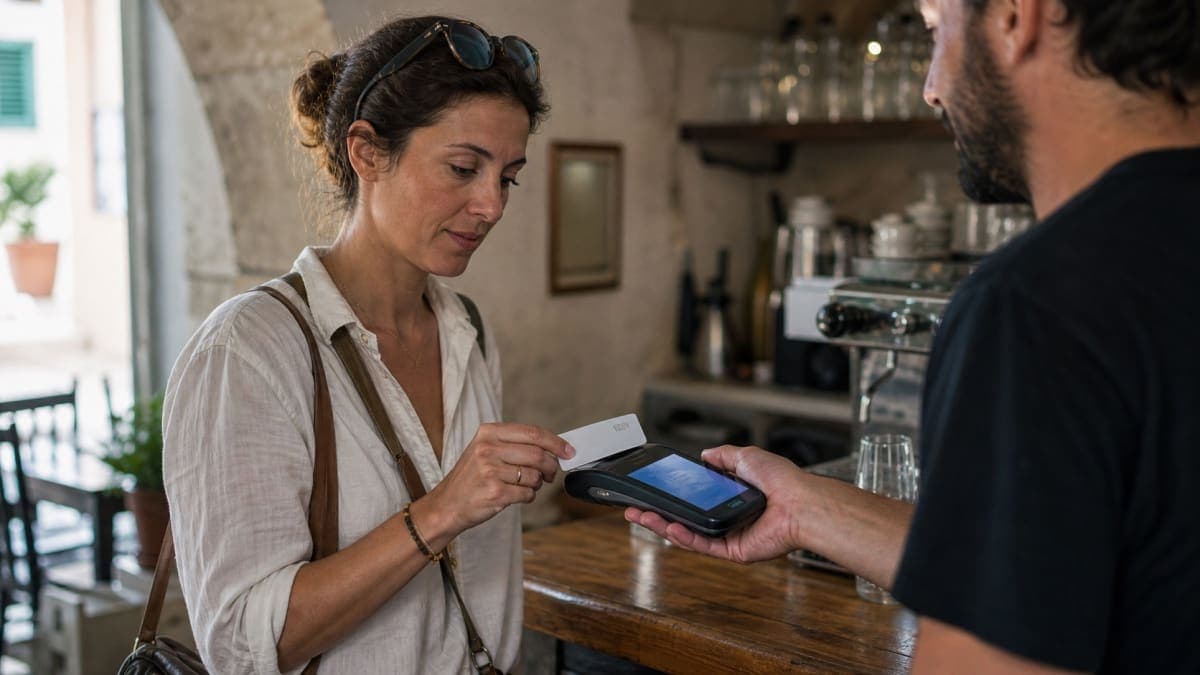
Visa's own consumer guidance is unusually direct about your rights here. The provider must display the amount in both currencies, the exchange rate used, and any additional fees or markup, and it "should not use language or procedures such as different font size or color to influence your decision." If that information is missing or you feel pressured, Visa says to decline the conversion and report the incident to your card issuer.
In practice, at the machine:
- Read the screen before tapping. The DCC offer is the one showing your home currency.
- Pick the local currency. On an ATM this is often phrased as continuing without conversion.
- Check the receipt. If it shows a home-currency total when you chose local, the conversion was applied anyway.
- If it was applied without asking, contest it. A merchant that selects the currency for you is breaking network rules, and your card issuer is the place to raise it.
One important caveat, because most advice on this skips it. Declining conversion does not make the withdrawal free. The ATM operator's own access fee is charged either way, and it is a separate thing from the exchange rate. Declining DCC fixes the rate you get, not the surcharge. If you want to avoid that too, use a machine attached to an actual bank branch rather than a standalone box in a tourist area, and withdraw larger amounts less often so a fixed fee is spread across more cash.
What if the machine already converted it?
If you were not offered a choice, or the terminal defaulted to your home currency without asking, that is a violation of Visa and Mastercard rules rather than bad luck. Keep the receipt, which must show the rate and markup, and raise it with your card issuer.
You will not always win it back, and for a few euros it is rarely worth the time. But the reporting matters more than the refund: enforcement against merchants and operators who select the currency for cardholders depends on issuers hearing that it happened. Australia's competition regulator penalised Visa AUD 18 million over DCC conduct in 2015, and that kind of action starts with complaints.
For an already-completed transaction where you did knowingly accept DCC, there is no recourse. You agreed to the rate on the screen. That is the whole reason the screen exists.
Does this apply to online bookings too?
Yes. Some international booking sites and airlines offer to charge you in your home currency at checkout, using the same mechanic and the same kind of markup. The tell is a currency selector near the payment step, or a total that switches to your currency only once you reach the card form.
Online it is easier to catch, because there is no queue behind you. If a checkout shows a price in the local currency throughout and then offers a home-currency total at the payment stage, that is DCC. Choosing the local currency and letting your own card convert is the same correct answer as at a physical terminal.
This is the same family of cost as the fees that appear between the price you clicked and the price you pay. We covered the accommodation version of that in 6 hotel fees that were not in the price you clicked, and the government-levied version in how much tourist taxes cost in 2026. DCC belongs to the same category: money that is disclosed somewhere, at a moment when you are least able to act on it.
Planning is where most of these get caught. When you map a trip in Navoy, hotels and airport transfers are priced and booked in one platform, so the total you are working from is the total, rather than a base rate that grows at three separate checkouts. Navoy does not book flights, so book those with the airline directly, and pay in the local currency when you do.
Frequently Asked Questions
Should I ever accept dynamic currency conversion?
Almost never. In the Norwegian Consumer Council's study of 1,500 transactions, accepting DCC was cheaper in only 4 cases, or 0.3% of the time. The one situation where it can be defensible is if the disclosed markup is genuinely lower than your own bank's foreign transaction fee, which the screen must now show you as a percentage in the EU. Check the number rather than assuming.
Is dynamic currency conversion a scam?
It is legal and disclosed, so not a scam in the legal sense, though BEUC titled its factsheet on the subject "the great currency conversion scam" and called for an outright ban. EU Regulation 2019/518 chose transparency instead of prohibition, requiring the markup be shown as a percentage over the ECB rate. It remains legal, widespread, and almost always worse for you.
Does declining conversion avoid all ATM fees?
No, and this is the most common misunderstanding. Declining DCC controls the exchange rate you receive. The ATM operator's own access fee is charged separately and applies either way, as may your bank's withdrawal fee. To reduce those, use ATMs attached to bank branches rather than standalone machines in tourist areas, and make fewer, larger withdrawals.
How do I know if I was charged for DCC?
Check the receipt or your statement. If the transaction was converted at the terminal, the receipt must show both currency amounts, the exchange rate used, and the markup applied. A statement entry already denominated in your home currency for a purchase made abroad is the signal that conversion happened before it reached your bank.
Sources
- Visa, What is Dynamic Currency Conversion? - cardholder rights, required disclosures, and Visa's advice to decline and report when information is missing.
- BEUC, The great currency conversion scam - factsheet BEUC-X-2017-131, November 2017. Source of the 99.7% figure and the GBP 500 million UK estimate, which BEUC attributes to the Financial Times, October 2017.
- Stiftung Warentest, Geld abheben im Ausland - Finanztest 6/2016. 20 investigators across 13 non-euro countries; DCC offered in 11, with markups of 2.6% to 12%.
- Gerritsen, Lancee and Rigtering, Journal of Public Policy & Marketing, 2023 - DCC acceptance rates, the effect of preselected defaults, and the financial-literacy findings. Also the route to the Norwegian Consumer Council's 7.6% average and 12.4% maximum.
- Regulation (EU) 2019/518 - the transparency requirement to express markup as a percentage over the ECB reference rate, in force since April 2019.
- WalletHub, How much are foreign transaction fees in 2026? - the 1.59% average card foreign transaction fee used in the comparison.
The markup figures come from consumer-group testing conducted in 2016 and 2017, which remains the most recent large-scale measurement published. All sources verified 31 August 2026. This is general information about how card payments work, not financial advice.
Related reading: 6 Hotel Fees That Weren't in the Price You Clicked, How Much Are Tourist Taxes in 2026?, Shoulder Season 2026: Which Weeks Actually Get Cheaper
One button, about 98 euros. Plan your trip in Navoy and book hotels and airport transfers in one platform, with live pricing so the total you plan against is the total you pay. Then pay in the local currency, every time.
About the Author
Ranym Garali
Ranym is the Marketing and Content Lead at Navoy. She's been writing about travel for two years and digs into the data behind each piece, flight prices, visa rules and what people are actually searching for , so the advice holds up in practice.