Key Takeaways
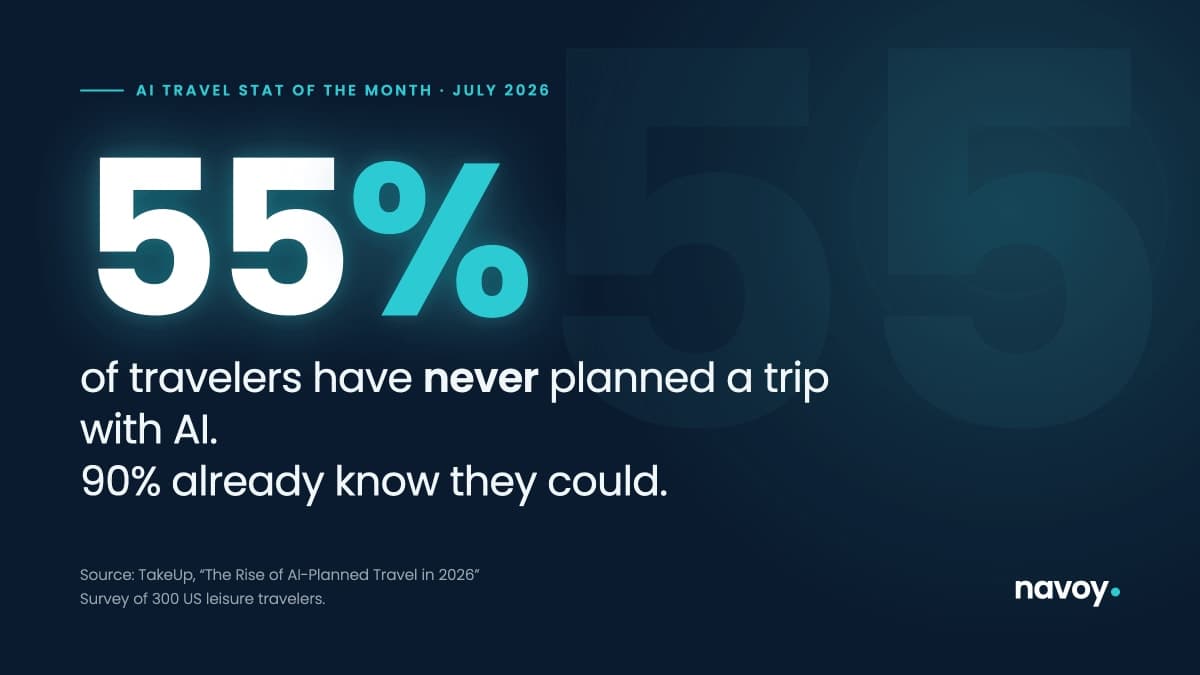
- 55% of travelers have never planned a trip with AI, per TakeUp's 2026 survey of 300 US leisure travelers — even though 90% know it's possible.
- The holdouts aren't rejecting AI — they're skipping the first try: accuracy, real-time pricing, and personalization are their top three concerns (TakeUp, 2026).
- The concerns are fair for chatbots, fixable with the right tool: roughly 1 in 3 AI-itinerary users have hit false or outdated info (Klook survey via CNBC, 2026).
- Once travelers try it, they rarely go back: 78% of AI users have booked travel primarily on an AI recommendation, and 96% say they'll use AI again (TakeUp, 2026).
- Make trip one low-stakes: one city, clear constraints, verify anything time-sensitive, and book through a platform with live prices — not a chat window.
What does the 55% stat actually say?
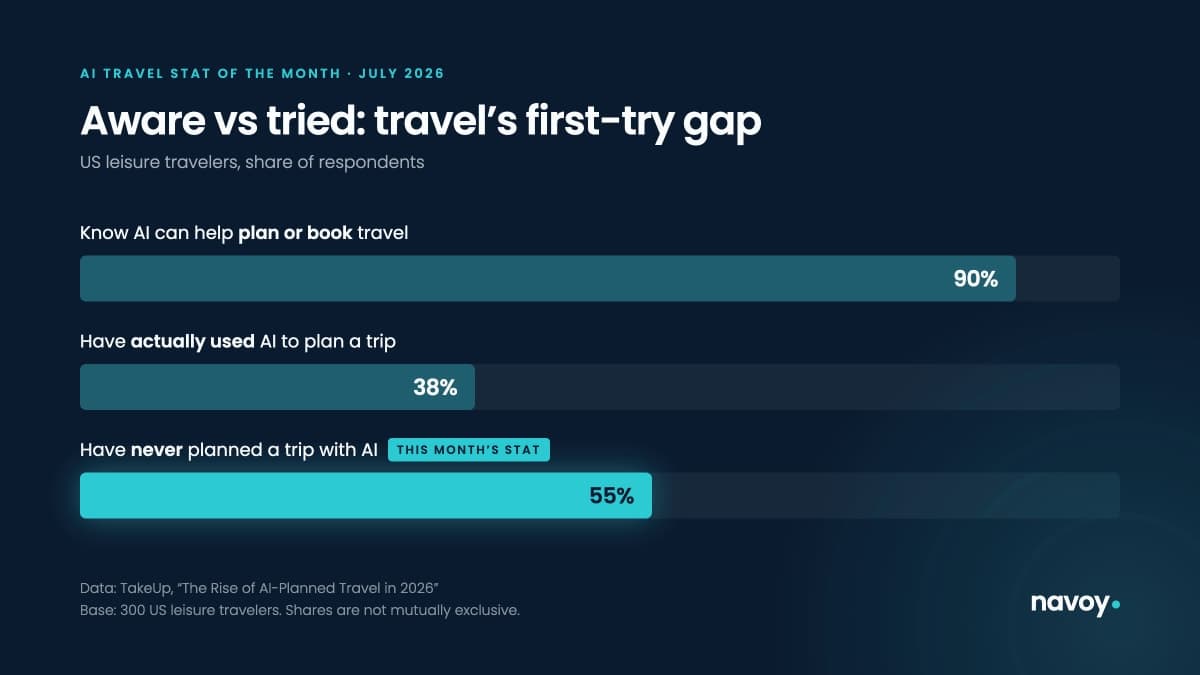
Per TakeUp's 2026 report "The Rise of AI-Planned Travel," only 38% of US leisure travelers have actively used AI to plan a trip — which means roughly 55% know AI trip planning exists but have never tried it. Awareness isn't the problem: 90% already know AI can help plan or book travel.
Welcome to the first AI Travel Stat of the Month, a short monthly look at one number that says something real about how people travel now. The number for July comes from TakeUp's survey of 300 US leisure travelers who took at least one overnight leisure trip in the past year (per TakeUp, 2026).
What makes this one interesting is the shape of it. This isn't a story about an unknown technology — nine in ten travelers already know AI can plan or book a trip. It's a story about a first try that most people keep postponing. We took apart the full dataset in our deep dive on the AI travel adoption gap; this post is about the other side of that gap — the 55% who haven't crossed it, and whether their reasons still hold up.
Why haven't most travelers tried AI trip planning yet?
Three concerns keep the holdouts out, per TakeUp 2026: accuracy (will the places be real and open?), real-time pricing (will the quoted price match checkout?), and personalization (will the plan actually fit me?). Underneath all three sits habit — most people's planning routine predates AI, and nobody wants to test a new tool on a non-refundable week off.
None of these are silly. Travel is one of the few purchases where a bad recommendation doesn't just waste money — it wastes your only two weeks off. And the holdouts have heard the horror stories: itineraries built around a restaurant that closed years ago, or a "hidden gem" that never existed.
There's also a quieter reason the survey can't fully capture: for many of the 55%, "AI trip planning" still means pasting a question into a general-purpose chatbot and getting a wall of suggestions back. If that's your mental model, skipping it is rational — a list of suggestions is the part of trip planning that was never hard. The hard part is turning the list into real reservations.
Are the holdouts' concerns still fair in 2026?
Partly. Each concern is real for general-purpose AI chatbots, which write itineraries from training data rather than live inventory — roughly 1 in 3 AI-itinerary users have hit false or outdated information (2026 Klook survey, via CNBC). But each concern also has a practical fix, and travelers who found the fixes report 96% satisfaction (TakeUp, 2026).
Here's each barrier, why it's earned, and what actually de-risks it:
| The concern (TakeUp, 2026) | Why it's fair | How to de-risk your first AI trip |
|---|---|---|
| Accuracy — will the places be real and open? | ~1 in 3 AI-itinerary users have hit false or outdated info (Klook via CNBC, 2026) | Treat AI as the drafter and yourself as the editor: verify hours, tickets, and entry rules on official sites before you commit |
| Real-time pricing — will the price hold? | General-purpose chatbots quote from training data, not today's rates | Plan on a platform connected to live hotel prices, so the number you see is the number you book |
| Personalization — will it fit me? | Ask a vague question, get a top-10 list anyone could have written | Give real constraints up front — dates, pace, budget split, what the trip is for — and the plan changes shape |
The pattern across all three: the concerns are about open-ended chatbots, and the fixes are about constraints and live data. The holdouts aren't wrong about the tools they're picturing. They're often picturing the wrong tools.
What happens when travelers do try it?
They convert, and they stay. Among travelers who've used AI for trip planning, 78% have booked travel based primarily on an AI recommendation, 94% trust AI recommendations at least as much as traditional sources, 63% rely on it for most or every trip, and 96% say they'll use it again — all per TakeUp, 2026.
That's the part of the dataset that should make the 55% curious. Almost nobody tries AI trip planning once and walks away; the drop-off happens entirely before the first attempt. The gap, in other words, isn't a technology problem. It's a first-try problem. (The full funnel, and what it means for where travel is heading, lives in our adoption-gap breakdown.)
How should you plan your first trip with AI?
Start with low stakes and clear constraints: pick one city for a weekend, tell the AI your dates, pace, and budget, double-check anything time-sensitive yourself, and book through a platform that shows live prices. The goal of trip one isn't perfection — it's proving to yourself that the plan holds up.
A four-step version of that:
- Choose a trip that's allowed to be imperfect. A weekend city break, not the honeymoon. If the plan has a weak afternoon, you've lost an afternoon.
- Front-load your constraints. Dates, pace, who's coming, and how you'd rather spend the budget (nicer hotel vs more experiences). Specific inputs are the difference between a plan for you and a plan for anyone.
- Keep the editor's job. Verify opening hours, bookings that sell out, and anything with a deadline yourself, on official sites. That's the honest answer to the accuracy concern — and it takes minutes, not evenings.
- Book where you planned. If the itinerary and the booking live in the same place, prices are current and a change in one spot doesn't strand the rest of the plan. If you're weighing who should handle what, our explainer on travel agents vs booking sites vs AI travel agents breaks it down.
Make your first AI-planned trip a booked one with Navoy
The first-try problem is exactly what Navoy is built to remove. Describe the trip — "3 days in Lisbon, relaxed pace, more budget on experiences than the hotel" — and Navoy's AI builds a day-by-day itinerary shaped by your trip focuses (pick up to 3 of 12, from Food & Culinary to Cultural Exploration), your Travel Pace, and your Budget Split. Then it books the hotel and the airport transfer in one platform — it doesn't just recommend, it books — with live hotel availability and pricing, so the rate you see is current.
The free plan covers up to three trips of up to 14 days each, at $0 — which makes it a low-stakes way to run the exact experiment this post is about. One honest note: Navoy doesn't book flights; book those with the airline, and Navoy handles the plan, the hotel, and the transfer around them.
Frequently Asked Questions
How many travelers use AI to plan trips in 2026?
Per TakeUp's 2026 survey of 300 US leisure travelers, 38% have actively used AI for trip planning, while about 55% have never tried it — even though 90% know AI can help plan or book travel. Among those who have tried it, 96% say they'll use it again.
Is it safe to book a trip planned by AI?
Yes, with one habit: verify time-sensitive details yourself. Roughly 1 in 3 AI-itinerary users have run into false or outdated information (2026 Klook survey, via CNBC), so check hours and entry rules on official sites, and book through a platform with live prices rather than trusting numbers from a chat window.
Why don't more people use AI for travel planning?
Per TakeUp's 2026 research, non-users' top concerns are accuracy, real-time pricing, and personalization. Habit plays a role too: most travelers' planning routine predates AI, and a vacation feels like a risky place to test a new tool for the first time.
Will AI replace travel agents?
Not across the board. For straightforward trips, AI planning plus a booking platform now covers what most people paid an agent for. Agents still earn their fee on complex itineraries, difficult visas, and high-end trips where you're buying access and accountability rather than planning.
Sources
- TakeUp — The Rise of AI-Planned Travel in 2026
- PR Newswire — TakeUp's "The Rise of AI-Planned Travel in 2026" report announcement
- Hotel Management — Report: AI-planned travel surges in 2026, growth still ahead
- CNBC — Travelers are turning to AI to plan trips, but hallucinations and trust gaps remain (2026 Klook survey)
Related reading: The AI travel adoption gap: 90% know, only 38% have tried, travel agents vs booking sites vs AI travel agents, explained, and can AI plan my whole trip? An honest 2026 answer.
Ready to leave the 55%?
Plan and book your first AI trip with Navoy →
Tell Navoy your dates, pace, and budget, and it builds the day-by-day plan and books your hotel and airport transfer in one platform — free for up to three trips.
About the Author
Navoy Team
The Navoy Team consists of engineers, AI researchers, and travel specialists working to build the next generation of online travel agencies. Our mission is to make planning and booking travel as simple as talking to a great travel agent.