
Key Takeaways
- In Japan, South Korea and mainland China, tipping is not part of the culture — staff may decline the money, and in Japan a tip left on the table is often returned as forgotten change.
- In much of Europe, service is already in the price: French menu prices include service by law (typically 15%), and UK restaurants usually add a 12.5% service charge to the bill.
- In the US, 18–20% is the expected range at sit-down restaurants, because the federal tipped minimum wage is $2.13 an hour.
- The fastest way to get it right anywhere: check the bill for a service charge before adding anything.
There is a story travelers keep telling about Tokyo: you leave a 20% tip after a good meal, make it half a block, and a member of staff comes running after you to hand it back. It is not a myth — travel journalists have documented exactly this, because money left on a table in Japan usually reads as forgotten change, not gratitude. Meanwhile, the same 20% that caused a small panic in Tokyo is roughly the minimum expected at a sit-down restaurant in New York.
Tipping is one of the few travel rules that flips completely depending on where you land. Here is the 2026 map: where tipping is unwelcome, where it is already in the price, where you round up, and where it is effectively part of the wage.
Where is tipping considered rude?
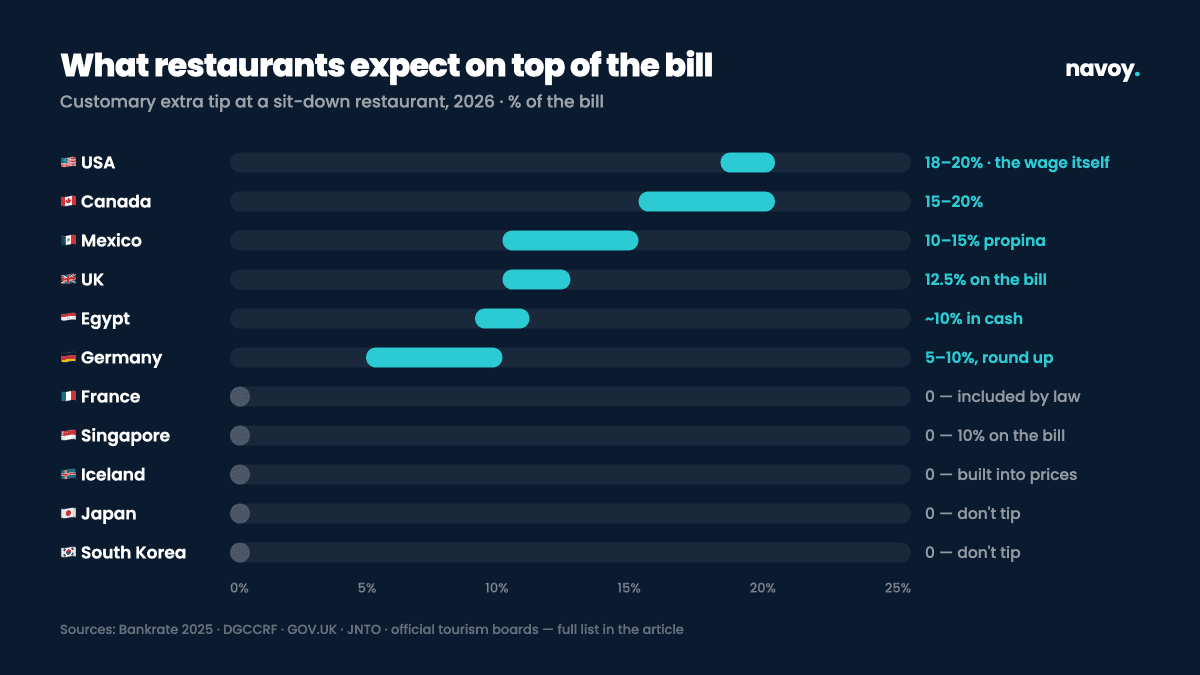
In Japan, South Korea and mainland China, tipping is not done — the correct amount is zero. Japan's national tourism organization says tips can cause discomfort and confusion; staff are salaried and the price includes service. In South Korea and China the money may simply be declined. Great service is the baseline, not a transaction.
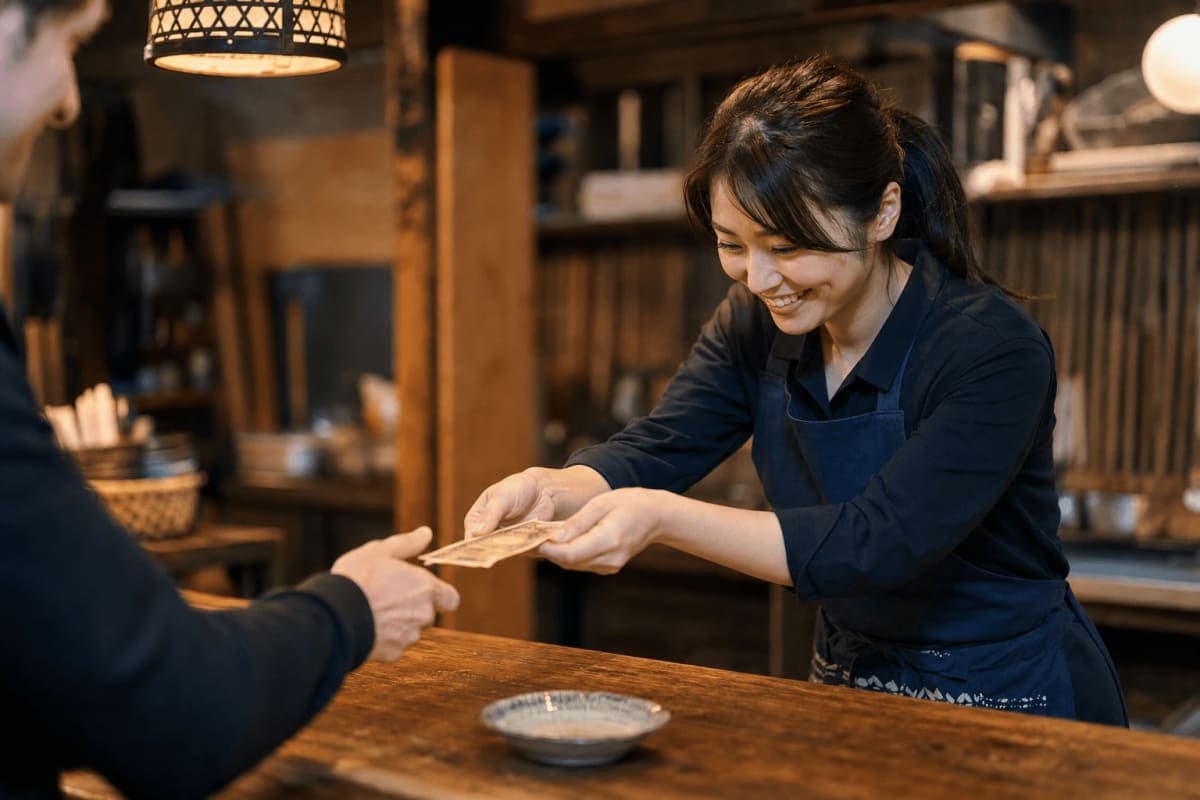
Japan is the clearest case. There is no tip line, no expectation, and staff have been known to run after customers to return cash left on the table. The exceptions are narrow and formal: some hotel and high-end restaurants add a 10% service charge to the bill, izakayas charge a small seating fee called otoshi (usually ¥300–500 — it is not a tip and not optional), and the one sanctioned gratuity, kokorozuke, is cash in a decorative envelope handed with both hands to a private guide or ryokan attendant. Loose cash pressed into someone's hand is exactly what not to do.
South Korea works the same way at street level: you typically pay at the front counter, and there is a call button at the table for service. High-end hotels fold a 10–15% service charge into the bill, and nothing extra is expected on top. Mainland China has no tipping at any everyday restaurant tier — with one real exception: tour guides and private drivers on tourist circuits do expect tips, roughly RMB 100 or more per day for a guide.
Which countries include the tip in the bill?
In much of Europe, the tip is already in the price. French menu prices must include service by law — typically 15% — and anything extra is a small voluntary gesture. In the UK, most mid-range and upmarket restaurants add a discretionary 12.5% service charge, increasingly 15% in London. Iceland and the Nordics build service into prices entirely.
France is the one travelers get wrong most often, in both directions. Every displayed price in a French restaurant already includes service ("prix service compris"), so the American-style 20% on top is double-paying. A pourboire — rounding up, or €1–2 per person — is appreciated and entirely optional, ideally in cash, since many French card terminals have no tip prompt. If a terminal offers to charge you in your home currency instead, decline: dynamic currency conversion typically adds 2 to 5% to the bill.
The UK's system is different but ends in the same place: the tip arrives as a line on the bill. That 12.5% service charge is discretionary — you can ask for it to be removed — and since October 2024, UK law requires 100% of tips and service charges to reach the staff. If there is no service charge, 10–12.5% is a normal voluntary tip. One rule with no exceptions: nobody tips at a pub bar.
Italy sits in between. The line items that confuse visitors — the coperto (a €1–3 per-person cover charge that goes to the restaurant, not the server) and the occasional 10–15% servizio at touristy places — must be disclosed on the menu. If the bill says servizio incluso, you are done; otherwise rounding up or €1–2 per person is the local norm.
In Iceland, service and tax are baked into every price, there is usually no tip line on the card terminal, and — unlike Japan — a tip causes no awkwardness at all. Australia and New Zealand run on the same logic for a structural reason: Australia's minimum wage is AU$24.95 an hour as of July 2025, and New Zealand's is NZ$23.50, so hospitality pay does not depend on tips.
Where do you just round up?
Germany, Spain, the Nordics and most of Southeast Asia treat tipping as a small courtesy, not an obligation. In Germany, 5–10% or rounding up is the norm — and you say the total out loud instead of leaving cash on the table. In Spain, small change at a tapas bar is plenty. In Thailand and Vietnam, check for a service charge first; without one, 5–10% is generous.
Germany has the mechanic worth learning before you go: when the server tells you the bill is €18.30, you hand over a twenty and say "make it twenty." Leaving coins on the table is not how it is done. Sweden's version is rounding a 280 SEK bill up to 300; Denmark is the strictest no-tip culture in the Nordics, where even taxi fares legally include the tip.
Across Thailand, Vietnam and Indonesia the pattern repeats: mid-range and upscale places often add a 10% service charge (in Bali, bills frequently show "++" for service plus tax), and where there is no charge, rounding up or 5–10% is appreciated but skipping it is not rude. Nobody tips at a street-food stall.
Where is tipping actually expected?
In the US, 18–20% of the pre-tax bill is the expected range at sit-down restaurants, and 15% is now read as the floor. Canada runs 15–20%, Mexico 10–15%, and in Egypt small cash tips — baksheesh — are a near-constant part of daily service. In these countries, tips are part of the wage, not a bonus.
The US number has a legal explanation: the federal tipped minimum cash wage is $2.13 an hour, with tips expected to make up the difference to the $7.25 federal minimum (many states set higher rates). Skipping the tip directly cuts the server's income, which is why the social rule is so firm. It is also genuinely contested at home — in Bankrate's 2025 survey, 41% of Americans said tipping culture has gotten out of control, and only 35% actually tip 20% or more. Expected and popular are not the same thing.
Canada expects 15–20%, with payment terminals nudging toward 18–25%. Mexico's standard propina is 10–15% at sit-down restaurants — and worth knowing in 2026: Mexico's consumer agency PROFECO has warned about tourist-area restaurants in Cancún automatically adding a 15% "service" line, which is illegal there. Tips in Mexico are voluntary by law, so you can ask for an auto-added charge to be removed. Tip in pesos, not foreign coins.
Egypt is less about percentages than habit: baksheesh of 5–100 EGP accompanies most small services — restaurant servers (about 10% in cash if service is not included), porters, bathroom attendants. Carry small notes; you will use them daily.
What are the special cases that catch travelers out?
Singapore and Dubai both put a 10% service charge on the bill, but the etiquette differs: in Singapore you add nothing on top, while in Dubai many diners still leave AED 5–10 in cash because the service charge usually goes to the establishment, not the server. In both, check the bill before you tip twice.
Singapore's "++" pricing is the single most useful thing to know before you land: a S$100 menu price becomes S$119.90 after the 10% service charge and the 9% GST calculated on top of it. Tipping beyond that is not expected anywhere, and at hawker centres it simply is not done.
Dubai is the most tip-friendly place on this list. Hotel restaurant bills carry a 10% service charge plus municipality fees, but cash tips are common and always welcome — AED 5–10 at a casual place, or 10–15% where no charge applies.
Tipping rules by country: the full table
| Country | The rule | Restaurants | Taxis | The one thing to remember |
|---|---|---|---|---|
| 🇯🇵 Japan | Don't tip | 0% — may be returned | 0% | Money on the table reads as forgotten change |
| 🇰🇷 South Korea | Don't tip | 0% | 0%, round up at most | Pay at the counter, not the table |
| 🇨🇳 China | Don't tip | 0% | 0% | Exception: tour guides (~RMB 100+/day) |
| 🇸🇬 Singapore | Included | 10% service charge + 9% GST ("++") | 0%, round up | S$100 on the menu = S$119.90 on the bill |
| 🇮🇸 Iceland | Included | 0% expected, tips harmless | 0% | No offence either way — official tourism board's words |
| 🇦🇺 Australia | Not expected | 0%; ~10% fine dining if exceptional | 0% | Skip the terminal's tip prompt guilt-free |
| 🇳🇿 New Zealand | Not expected | 0%; holiday surcharges ≠ tips | 0% | ~15% public-holiday surcharge is a wage cost, not a tip |
| 🇫🇷 France | In the price | Service included by law (typically 15%); round up | Round up | Extra 20% on top is double-paying |
| 🇮🇹 Italy | In the price | Coperto €1–3; round up if no servizio | Round up | Coperto goes to the house, not the server |
| 🇪🇸 Spain | Optional | Small change; 5–10% formal dining | Round up | Nobody expects more at a tapas bar |
| 🇩🇪 Germany | Round up | 5–10%; say the total when paying | Round up | "Machen Sie zwanzig" — don't leave coins on the table |
| 🇬🇧 UK | On the bill | 12.5% service charge (15% spreading); else 10–12.5% | Round up ~10% | Never tip at a pub bar |
| 🇩🇰🇸🇪🇳🇴 Nordics | Not expected | Round up; Norway up to 5–10% high-end | 0% (DK fares include it) | Denmark is the strictest no-tip culture in Europe |
| 🇦🇪 UAE / Dubai | Optional, common | 10% service charge + AED 5–10 cash or 10–15% | Round up to AED 5–10 | The service charge rarely reaches the server — cash does |
| 🇹🇭 Thailand | Optional | 10% service charge common; else round up–10% | Round up 10–20 baht | Never at street-food stalls |
| 🇻🇳 Vietnam | Optional | 5–10% generous if no service charge | Round up | Not tipping is not rude |
| 🇮🇩 Indonesia/Bali | Optional | "++" bills = service + tax included | Small notes | Hand money with the right hand or both hands |
| 🇺🇸 USA | Expected | 18–20% pre-tax; 15% is the floor | 15–20% | Tipped wage is $2.13/hr — the tip is the wage |
| 🇨🇦 Canada | Expected | 15–20% | 10–15% | Terminal presets run 18–25%; 15% is still acceptable |
| 🇲🇽 Mexico | Expected | 10–15% propina | Not expected — round up | Auto-added "service" in Cancún is illegal — ask to remove it |
| 🇪🇬 Egypt | Expected (small) | ~10% cash; service charge goes to the house | Round up 5–10 EGP | Carry 5–50 EGP notes — baksheesh is constant |
Bookmark the table; the rules do not change often, but the amounts above are the 2026 state of play.
How do you keep the rules straight on a multi-country trip?
Check the bill first, everywhere. A service charge line — servizio, service compris, "++", or 10% service — means the tip question is already answered. No line, and you are in round-up territory in most of the world; the 15–20% reflex only belongs in North America.
The harder version of this problem is a trip that crosses rule zones — Tokyo to Singapore to London to New York is four different tipping cultures in one itinerary, on top of four currencies and four sets of tourist taxes and hotel fees that never show up in the advertised price. That budgeting layer is exactly where planning tools earn their keep.
Navoy is an AI travel agent that plans the trip, books the hotels and arranges the airport transfers in one platform. Tell it you are doing two weeks across three countries and you get one itinerary with the stays and transfers attached — so the only local math left at the table is whether to round up.
FAQ
Is tipping rude in Japan?
Tipping in Japan is unnecessary and can cause genuine awkwardness — Japan's national tourism organization says it leads to discomfort and confusion rather than gratitude, because staff are salaried and service is included in the price. Cash left on the table is often returned as forgotten change. The polite move is a sincere thank you, not money.
Do you tip in Europe?
Usually not the way North Americans do. Service is included in the price in France by law and built into prices across the Nordics and Iceland; the UK adds a 12.5% service charge to most restaurant bills. Where nothing is included, rounding up or 5–10% is the norm. A 20% tip on top of an included service charge is double-paying.
How much do you tip in the US in 2026?
18–20% of the pre-tax bill at sit-down restaurants, with 15% now considered the floor. The expectation is anchored in the pay structure: the federal tipped minimum wage is $2.13 an hour, so tips make up most of a server's income. Per Bankrate's 2025 survey, only about 35% of Americans consistently tip 20% or more — but as a visitor, 18–20% is the safe range.
What happens if you tip in Japan?
Most often the money is politely declined or returned — staff may assume you forgot your change, and travel journalists have documented employees running after customers to hand cash back. In formal settings there is one accepted format: kokorozuke, cash in a decorative envelope handed with both hands, used for private guides or ryokan attendants, never loose bills.
Sources
- Japan National Tourism Organization — Tipping in Japan — official guidance on Japan's no-tipping culture.
- Trafalgar — Tipping in Japan: dos and don'ts, updated 14 November 2025 — staff returning tips; envelope etiquette.
- The Points Guy — Tipping around the world, 2 February 2019 — returned-tip reporting for Japan; Iceland norms.
- DGCCRF (French Ministry of the Economy) — Le pourboire — French law: displayed prices include service; tips voluntary.
- Afar — When and How Much to Tip in France, updated 24 February 2026.
- GOV.UK — Distributing tips fairly: statutory code of practice — UK Tips Act, in force 1 October 2024.
- Time Out London — Why are so many London restaurants now charging a 15% service charge?, 3 October 2025.
- Rick Steves — Tipping in Europe — country-by-country European norms.
- Visit Sweden — Tipping in Sweden · Visit Norway — Currency and prices · VisitDenmark — Plan your trip FAQ — official Nordic tourism boards.
- Visit Reykjanes — The tipping culture in Iceland, 3 June 2024.
- Fair Work Ombudsman (Australia) — Minimum wage increase, 1 July 2025 — AU$24.95/hour.
- New Zealand Government — Minimum wage set for 2025 — NZ$23.50/hour.
- Tourism New Zealand — Tips for gratuities — tipping not obligatory.
- US Department of Labor — Fact Sheet #15: Tipped Employees Under the FLSA — the $2.13 federal tipped minimum wage.
- Bankrate — Tipping Culture Survey, 4 June 2025 — US tipping attitudes and behavior.
- Pew Research Center — Tipping in America, 9 November 2023.
- Angus Reid Institute — Canada: tipflation and tip creep, 16 February 2023.
- Afar — When and How Much to Tip in Mexico, updated 8 July 2026 · Mexperience — Mexico's Tipping Culture, updated 2 July 2026.
- Lonely Planet — Things to know before traveling to Egypt · Rough Guides — Egypt travel tips — baksheesh norms.
- Lonely Planet — Tipping customs in Asia · Things to know before Singapore · Things to know before Indonesia.
- TravelChinaGuide — Tipping in China, updated 14 August 2025.
- Bayut — Tipping in Dubai · Lonely Planet — Tipping customs in the Middle East.
Facts verified 31 August 2026.
Related articles
<!-- Fill at Strapi time from the live blog index. -->Plan it in one platform ✈️ navoy.io - Navoy: your AI Travel Agent
About the Author
Ranym Garali
Ranym is the Marketing and Content Lead at Navoy. She's been writing about travel for two years and digs into the data behind each piece, flight prices, visa rules and what people are actually searching for , so the advice holds up in practice.