
Key Takeaways
- The nightly rate is not the price. In AirROI's 2026 modeled comparison of 28 US markets, the median three-night rental checkout landed 55.9% above the displayed nightly subtotal.
- For one or two people on a short stay, hotels won almost everywhere - cheaper in 27 of 28 markets at three nights. New York City was the only exception.
- For a group that would need two hotel rooms, it reverses: rentals cheaper in 19 of 28 markets at three nights, and 22 of 28 at seven.
- The cleaning fee is the charge to check first. A $120 fee adds about $17 a night across seven nights, but $60 a night across two.
- This is a directional model, not a live search. Your own dates, neighborhood and party size decide the actual answer.
Key takeaways
- The listed nightly rate is not enough to compare stays. It is still the largest part of what you pay, but mandatory charges land later in the booking flow.
- In AirROI's 2026 modeled comparison of 28 US markets, the median three-night rental checkout total came out 55.9% above the displayed nightly-rate subtotal. AirROI reports a range of 45.0% to 72.9% across markets, though its published table labels Portland as both the low and the high end.
- For one or two people booking a single hotel room for three nights, hotels came out cheaper in 27 of 28 markets. New York City was the exception.
- For a group that would otherwise need two hotel rooms, rentals came out cheaper in 19 of 28 markets at three nights, rising to 22 of 28 at seven nights.
- A large fixed cleaning fee is a warning sign on a short stay, because it does not shrink with the length of your trip. It is a reason to check the total, not a verdict on its own.
You compare a rental at $90 a night against a hotel at $130. The rental looks like the obvious win. Then you reach checkout, the total works out closer to $140 a night, and the comparison you made was never really a comparison.
This is not a story about one type of stay beating the other. In 2026 the answer depends on two things you already know before you start searching: how many of you are traveling, and how long you are staying. Timing matters too: shoulder-season flights run about 26% cheaper, though lodging does not follow the same curve. Once you know those, the decision gets much faster.
Why Is the Nightly Rate Not Enough to Compare Stays?
The nightly rate still matters. It is the single biggest component of what you pay. It just is not sufficient on its own, because the rest of the bill arrives after you have formed an opinion.
Depending on the property, platform, market and booking flow, a rental's final price may include a cleaning fee, a platform service fee, local lodging taxes and other mandatory charges. AirROI's 2026 model used the nightly subtotal plus a cleaning fee, a guest service fee of roughly 14%, and local lodging taxes. That 14% is the study's modeled assumption, not a fixed rate every booking carries.
The fixed cleaning fee is the charge that distorts short stays most, because it does not scale with the length of your trip. A $120 cleaning fee spread across seven nights adds about $17 a night. The same fee across two nights adds $60 a night. Identical listing, very different effective price, determined entirely by how long you booked.
Hotels are not exempt either. Taxes, destination or resort fees and parking are all real, and some are fixed nightly charges rather than percentages - we broke down the six hotel fees that are not in the price you clicked separately. AirROI puts mandatory destination and amenity fees at roughly $30 to $35 a night in urban hotels and $40 to $50 in resort markets, with lodging tax applied on top in most places. AirROI does not publish the sample behind those two figures, so treat them as its modeling assumption rather than a measured market average. For comparison, NerdWallet's own survey of 30 fee-charging US hotels found an average resort fee of $33 a night.
The real difference is narrower than it looks: hotels generally have no per-stay cleaning fee, so a very short booking is penalized less on that one line.
Are Short-Term Rentals or Hotels Cheaper in 2026?
AirROI ran the all-in math across 28 US markets in April 2026. Its nightly rate is AirROI's market-wide trailing-twelve-month whole-unit average daily rate. The cleaning fee is the median of a 60-listing sample per market, drawn from entire-home listings with 1 to 2 bedrooms, 4.5+ ratings and at least $10,000 in trailing-twelve-month revenue. From those it built a full checkout total: nightly rate times nights, plus the cleaning fee, plus a roughly 14% guest service fee, plus local lodging tax. The hotel side used published 2025 average daily rates plus resort fees for the matched market.
How to read these numbers. This is a directional modeled comparison of sampled listings against market-level hotel data, not a live, same-date search. It shows which way the odds lean, not what your own search will return. Actual totals vary by dates, neighborhood, property quality, room type, party size, cancellation policy, amenities and mandatory fees.
With that in mind, AirROI's headline result: the median three-night rental checkout total landed 55.9% above the displayed nightly-rate subtotal.
| What was compared | Result |
|---|---|
| Median gap, 3-night checkout vs displayed nightly subtotal | 55.9% higher |
| Range across the 28 markets | 45.0% to 72.9% (AirROI's table names Portland at both ends) |
| 1 to 2 travelers, one hotel room, 3 nights | Hotels cheaper in 27 of 28 markets |
| Group needing two hotel rooms, 3 nights | Rentals cheaper in 19 of 28 |
| Same group, 7 nights | Rentals cheaper in 22 of 28 |
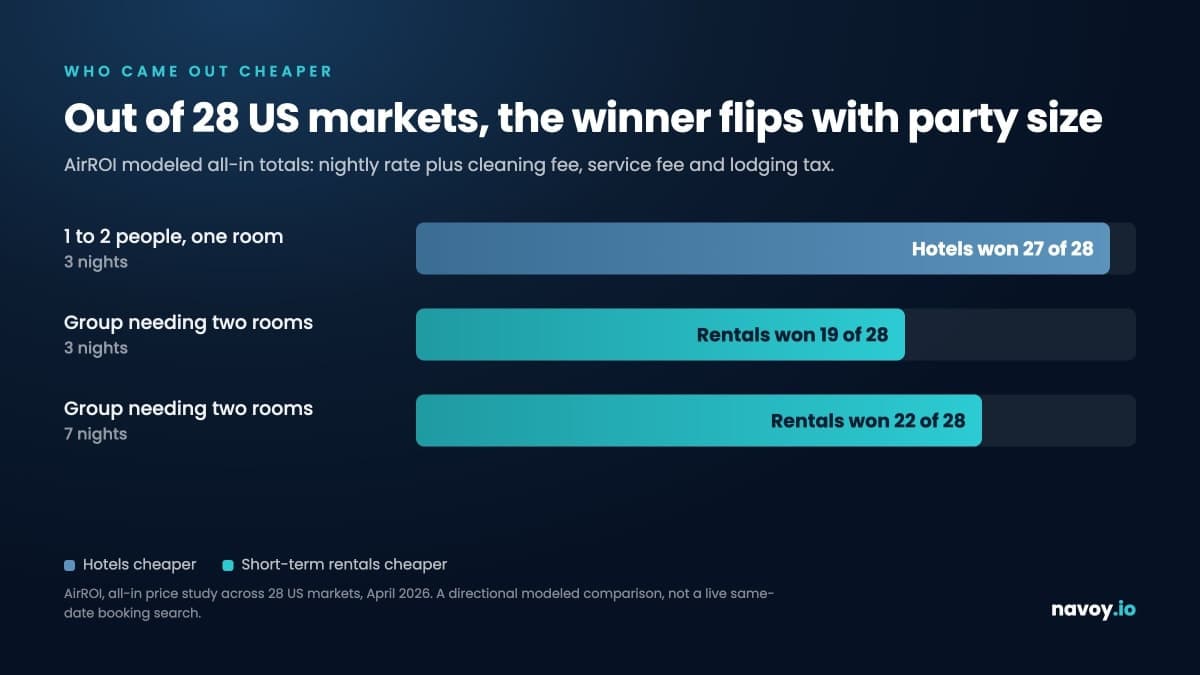
Two things are worth pulling out of that table.
The first is that one market bucked the short-trip pattern. New York City was the single exception where rentals still came out ahead for one or two people on a short stay, which tells you the pattern is strong but not universal, and that dense, high-rate markets can behave differently.
The second is that the group result reverses the conclusion. The moment your party would need two hotel rooms, you are comparing one set of rental charges against two room rates, and the arithmetic changes direction. Extend the stay to a full week and the rental advantage widens further, because the fixed cleaning fee is spread across seven nights instead of three.
Which Fee Should You Check First?

Check the cleaning fee against the length of your trip.
A cleaning fee that looks small next to a week looks very different next to two nights. Because it is charged once per stay, its effect per night falls as the stay gets longer. That makes a large fixed fee a genuine warning sign on a short booking, and largely irrelevant on a long one.
What it does not do is settle the question. A rental with a high cleaning fee can still win, and one with a low fee can still lose. The outcome depends on the base rate, the hotel's all-in price, party size, rooms needed, stay length, location, amenities, parking, resort fees, cancellation terms and any length-of-stay discounts.
The arithmetic, concretely: a $95 listing with a $70 cleaning fee costs about $130 a night over two nights, and about $102 over ten. Same listing, same photos. Only the number of nights the fixed fee is divided by has changed. Whether either is a good booking depends on what a comparable hotel would have cost over the same dates.
Are Short-Term Rental Prices Going Up in 2026?
These are US short-term-rental market figures, not a rental-versus-hotel price comparison. Read them as context.
AirDNA's most recent US market review covers July 2026, published 13 August. It was a rate-led month: average daily rates rose 6.9% year over year, revenue per available rental 7.2%, and occupancy gained 0.3 percentage points. In AirDNA's own summary, "U.S. short-term rentals strengthened in July 2026, with ADR up 6.9% YoY, demand growing, and World Cup markets continuing to outperform." AirDNA does not publish the national dollar values with that review, so the direction is the reliable part, not a headline price.
For dollar figures, the most recent published ones are AirDNA's May 2026 numbers: an average daily rate of $258.91 (up 2.1% year over year), occupancy of 57.2%, and revenue per available rental of $147.97. Summer rates run well above spring ones, so read those as a spring baseline rather than what you will pay in August.
One figure matters if you return to the same places: AirDNA's Repeat Rent Index, which tracks the same properties over time rather than the whole market, rose 3.5% in May, the most recent national figure published. Established hosts have been raising prices faster than the headline average suggests, which newer supply at lower rates partly masks.
How Do You Compare a Rental and a Hotel Properly?
- Compare the final total, never the teaser nightly price. Take both options through to the checkout screen before deciding anything. This one habit removes most of the problem.
- Weigh the cleaning fee against your trip length and the total. On a two-night stay a large fixed fee can erase the nightly-rate advantage. On a ten-night stay it usually will not matter much.
- Count the rooms you actually need. One or two people tend to do better in a hotel on a short trip. A group that would need two rooms tends to do better in a rental, and that advantage grows with the length of the stay.
None of this requires you to prefer one kind of stay. It requires you to compare the two numbers that are actually comparable.
Frequently asked questions
Are short-term rentals always more expensive than hotels now?
No. It varies by group size, stay length, rooms needed, destination, dates and property type. In AirROI's 2026 modeled comparison, hotels were cheaper in 27 of 28 US markets for one or two people over three nights, while rentals were cheaper in 19 of 28 for a group that would otherwise book two rooms, and 22 of 28 at seven nights.
Why does the cleaning fee matter so much?
Because it is typically charged once per stay rather than per night. Spread across a week it is minor. Across two nights the same fee has a much larger per-night impact, and it can cancel out the lower nightly rate that made the listing look cheaper. There is no benchmark for a "reasonable" fee worth memorizing: judge it against your total trip cost and against what a comparable hotel would charge over the same dates.
Does this apply outside the United States?
Do not assume so. The study covered 28 US markets. The underlying mechanism, a fixed fee plus a percentage service fee plus local taxes, exists in many other countries, but the specific percentages and the win rates should not be transferred internationally. Run the totals for your own destination.
Do hotels have extra fees too?
Yes. Hotels can add taxes, destination or resort fees and parking, and some of those are fixed nightly charges rather than percentages. AirROI puts mandatory destination and amenity fees at roughly $30 to $35 a night in urban hotels and $40 to $50 in resort markets, with lodging tax applied on top in most places. AirROI does not publish the sample behind those two figures, so treat them as its modeling assumption rather than a measured market average. For comparison, NerdWallet's own survey of 30 fee-charging US hotels found an average resort fee of $33 a night. The main structural difference is that hotels generally do not charge a per-stay cleaning fee.
Sources
- AirROI, Airbnb vs Hotel 2026: All-In Price Math Across 28 US Markets, April 16, 2026. A modeled comparison across 28 US markets, sampling 60 entire-home listings per market (1 to 2 bedrooms, 4.5+ rating, $10,000+ trailing-twelve-month revenue). Rental totals model the nightly subtotal plus cleaning fee, an approximately 14% guest service fee and local lodging taxes; the hotel side uses published 2025 average daily rates plus resort fees. Directional rather than a live, same-date booking comparison. https://www.airroi.com/blog/airbnb-vs-hotel-all-in-pricing-2026
- AirDNA, U.S. Review July 2026: World Cup Boost Gives Way to Broader Rate Growth, published 13 August 2026. Year-over-year changes only: ADR +6.9%, RevPAR +7.2%, occupancy +0.3 percentage points. AirDNA does not publish the national dollar values with this review. https://www.airdna.co/blog/u.s.-review-july-2026
- NerdWallet, Is an Airbnb or a Hotel Right for Your Next Trip?, citing AirDNA US market data for May 2026 (average daily rate, occupancy, RevPAR and the Repeat Rent Index). Market-level context, not a direct rental-versus-hotel price comparison. https://www.nerdwallet.com/travel/learn/airbnb-or-hotel
All figures verified 7 September 2026.
Related articles
About the Author
Ranym Garali
Ranym is the Marketing and Content Lead at Navoy. She's been writing about travel for two years and digs into the data behind each piece, flight prices, visa rules and what people are actually searching for , so the advice holds up in practice.