Key Takeaways
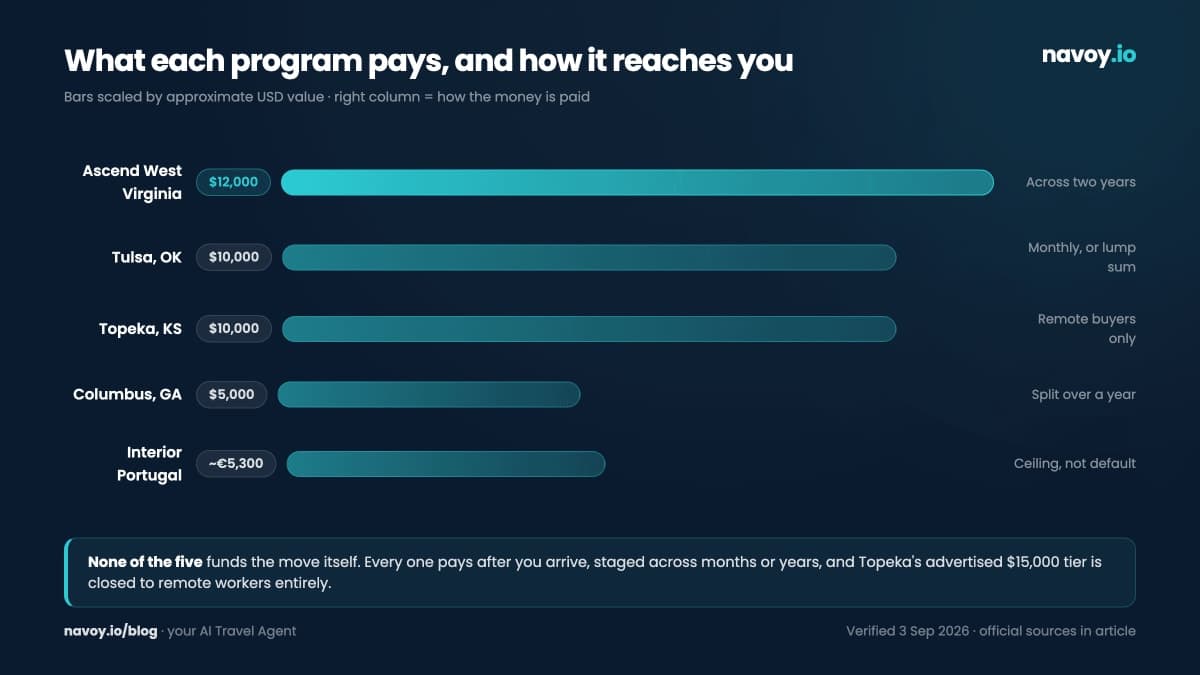
- Five programs pay eligible remote workers in 2026, from Ascend West Virginia's $12,000 down to interior Portugal's roughly EUR 5,300.
- Topeka advertises $15,000, but not to remote workers. That tier needs an on-site job with a participating local employer.
- Columbus, Georgia gates on income: $75,000 a year from a single source, and you must live 75 miles away before applying.
- Portugal's figure is a ceiling, not a default - it is built from a contract-type base, a household uplift and a transport allowance.
- None of these is an immigration route. Qualifying for the money and having the right to live there are separate applications.
Which places will pay you to move there in 2026?
Ascend West Virginia pays the most at up to $12,000, followed by Tulsa at $10,000, Choose Topeka at up to $10,000 for remote homebuyers, Columbus, Georgia at $5,000 in cash, and interior Portugal at up to roughly EUR 5,300. The largest figure is not the easiest one to collect.
| Place | Headline figure | What actually lands | What you must do | Open in 2026? |
|---|---|---|---|---|
| Ascend West Virginia | $12,000 | Paid across two years, plus free coworking and outdoor-recreation experiences valued well over $2,500 | Work remotely, move to a participating community, stay two years | Yes, applications open at five communities |
| Tulsa, Oklahoma | $10,000 | Renters receive monthly disbursements; homebuyers may take a lump sum after closing | Work remotely for an employer outside Oklahoma. One year as your primary residence | Yes |
| Choose Topeka | $10,000 remote | Up to $10,000 buying or $5,000 renting for remote workers. The $15,000 tier requires an on-site local employer | Buy or rent a primary residence in Shawnee County within a year. Stay twelve months | Yes |
| Columbus, Georgia | $5,000 | $2,500 on arrival, $2,500 after one year, plus coworking and local benefits worth roughly $8,700 in total | Earn $75,000+ a year from a single source. Live 75+ miles away before applying. Move to Muscogee County, stay a year | Yes |
| Interior Portugal | ~EUR 5,300 | A base tied to contract type, plus 20% per accompanying household member, plus a transport allowance | Move your main residence to a designated interior territory and commit to twelve months | Yes |
Relocation and immigration rules change constantly, and two programs on this page changed terms during 2026. Treat this as a shortlist, not advice. Verify current terms with the program office before you commit money, and get cross-border tax advice before you move.
What does "they'll pay you to move" actually mean?
Three different things, and the difference decides whether you can afford to take part. Some programs stage the money across months or years. One splits it around a twelve-month anniversary. One assembles it from components you may not all qualify for.
Here is the distinction that matters when you are deciding:
- Staged over time. Ascend West Virginia spreads up to $12,000 across two years. Tulsa pays renters in monthly disbursements. You are not handed a lump sum on arrival, so the money does not fund the move itself.
- Split around an anniversary. Columbus pays $2,500 when you arrive and $2,500 once you have completed a year. Leave early and the second half never arrives.
- Assembled from components. Portugal's support is a base amount set by your contract type, increased by 20% for each household member who moves with you, plus a transport allowance. The published maximum assumes you qualify for all three.
One structural point applies to all five: none of them funds your relocation up front. You move first, then the money follows on the program's schedule.
The five, in order
1. Ascend West Virginia - up to $12,000
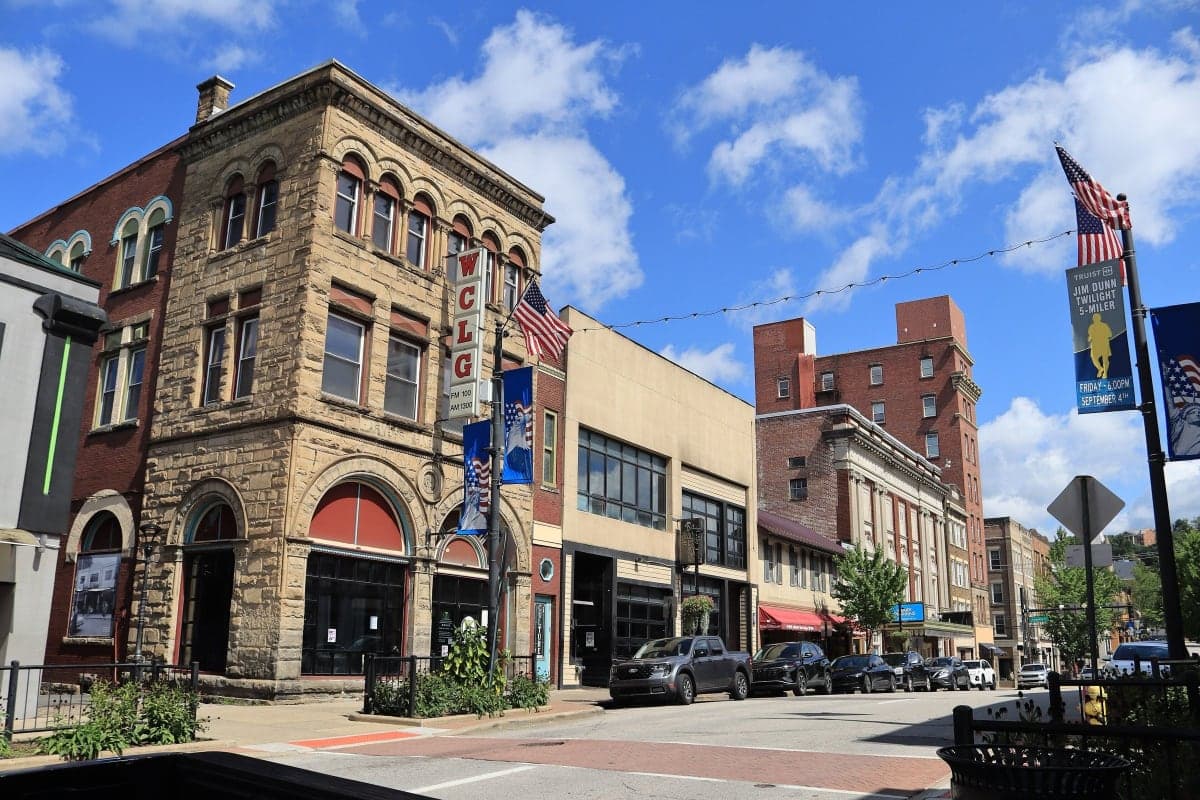
Ascend WV pays eligible remote workers $12,000 over two years to move to one of its participating mountain communities: the Morgantown area, Greenbrier Valley, the Eastern Panhandle, Greater Elkins, the New River Gorge and the Charleston area. Applications are open at five of the six.
The cash is not the whole package. Participants get free coworking space, a welcome trip, free outdoor gear rentals and a slate of recreation experiences the program values at well over $2,500. Homebuyers may qualify for an accelerated lump-sum payment rather than the standard schedule.
The commitment is two years in a participating community, which is the longest stay requirement of the five US programs here.
2. Tulsa, Oklahoma - $10,000
Tulsa Remote is the best-known program of this type, and the most competitive. Its own materials describe the $10,000 as a grant to help you make Tulsa your home base.
How you receive it depends on your housing choice. Renters get the money through monthly disbursements across the year. Homebuyers can choose between those monthly payments or a single lump sum after closing on a qualifying home, with a requirement to keep it as a primary residence for one year from closing.
You need to work remotely for an employer based outside Oklahoma, and you need US work authorisation. The program does not sponsor visas.
3. Choose Topeka - up to $10,000 for remote workers
This is the program most commonly misreported, and the error matters if you are planning around it.
Choose Topeka runs two separate tracks. For candidates taking an on-site job with a participating local employer, the incentive reaches $10,000 for renters and $15,000 for homebuyers, with the employer and GO Topeka each funding part of it. For remote workers, whose employer sits outside Shawnee County, the ceiling is $5,000 renting or $10,000 buying.
Almost every roundup we read quotes the $15,000 without naming the condition attached to it. If you are moving as a remote worker, $10,000 is your realistic maximum.
Either way you must buy or rent a primary residence in Shawnee County within a year, remain eligible to work in the US, and stay twelve months. Remote applicants face a minimum three-month waiting period and a limit of one incentive per household.
4. Columbus, Georgia - $5,000 plus local benefits
Columbus Remote pays $5,000 in cash, split $2,500 on arrival and $2,500 after a full year, alongside coworking access and a package of local benefits the program values at roughly $8,700 in total.
The eligibility gate is the strictest on this list. You need to earn at least $75,000 a year from a single income source, explicitly excluding commissions, and you must live at least 75 miles outside Columbus city limits at the time you apply. The move is to Muscogee County, and the full incentive requires you to stay a year.
That income floor is worth reading twice. It rules out applicants whose earnings are split across several clients, which describes a large share of freelance remote workers.
5. Interior Portugal - up to roughly EUR 5,300
Emprego Interior MAIS is the only non-US program here, and the only one open to people who are not already US-authorised. It supports employees, the self-employed, entrepreneurs and qualifying remote workers who move their main residence into a designated interior territory.
The amount is assembled rather than fixed. The base is 7 times the Indexante dos Apoios Sociais, EUR 3,759.91 in 2026, for an open-ended contract or for creating your own employment. A fixed-term contract of twelve months or more, or a qualifying scholarship contract, pays 5 times IAS instead, at EUR 2,685.65. On top of that sits a 20% increase for each household member relocating with you, and a transport allowance of 1.5 times IAS, EUR 805.70, toward moving your belongings.
The IEFP's own worked example, an open-ended contract with one additional household member plus transport costs, comes to EUR 5,317.59. That is the number circulating as the headline, and it is a ceiling rather than a default.
Eligibility covers EU, EEA and Swiss citizens, plus third-country nationals with legal residence in Portugal, including beneficiaries of temporary protection. Support is awarded once per person, and the residency commitment is a minimum of twelve months.
Can a foreigner actually get any of this?
This is where most roundups go quiet, and it is the most important question on the page. Four of the five are US programs that require existing US work authorisation, so they are not routes into the country. A relocation grant is never an immigration route, and qualifying for the money is a separate matter from having the right to live somewhere.
The split, as the programs themselves define it:
- Tulsa needs US work authorisation but not citizenship. The program does not sponsor visas.
- Ascend West Virginia, Columbus and Choose Topeka all require that you are already eligible to work in the United States.
- Portugal is the one genuine option for people outside those categories. It covers EU, EEA and Swiss citizens and third-country nationals who already hold legal residence in Portugal. It is not a visa, and it does not create a right of residence for someone who does not have one.
If you take one thing from this section: none of these programs gives you permission to live anywhere. That is a separate application, to a different authority, on a different timeline. Sort the right to be there first, then look at the money.
What these programs are really buying
Every one of these is a population strategy, not a giveaway. The town is paying to acquire a resident who earns money elsewhere and spends it locally, and the conditions are designed to make sure that resident actually stays.
That framing explains the conditions that otherwise look arbitrary. The income floors exist because the point is importing spending power. The distance requirements exist so the program is not paying people who would have moved anyway. The twelve and twenty-four month commitments exist because a resident who leaves after three months is a net loss to the town.
It also explains why these programs keep closing. They run on fixed budgets, and several well-known ones have quietly ended while their pages stayed live. Before you plan anything around one, open the program's own site and confirm there is a live application, not just a description.
Go and look before you commit
Every program here asks for a real commitment: twelve months in Tulsa, Topeka, Columbus and interior Portugal, two years in West Virginia. Those are not decisions to make from a listicle, and the places involved are not interchangeable. A town in the New River Gorge in February is a different proposition from the same town in July.
So go and look first. Navoy is an AI travel agent that plans the trip, books the hotel and arranges the airport transfer in one platform, which is useful when you are scouting three shortlisted towns in one run rather than planning a holiday. The free plan covers three trips of up to 14 days, roughly the shape of a proper scouting visit. Flights you still book with the airline.
Spend a fortnight somewhere before you spend two years there.
Frequently Asked Questions
Which place pays the most to move there in 2026?
Ascend West Virginia has the largest figure at up to $12,000, paid across two years alongside free coworking and outdoor-recreation experiences. Tulsa and Choose Topeka both reach $10,000 for eligible remote workers, though Topeka's higher $15,000 tier requires an on-site job with a participating local employer rather than remote work.
Can you get paid to move abroad if you are not a US citizen?
For four of these five, you need existing authorisation to work in the United States, so they are not routes into the country. Portugal's Emprego Interior MAIS is the exception: it covers EU, EEA and Swiss citizens as well as third-country nationals who already hold legal residence in Portugal. It is not a visa either.
Does Topeka really pay $15,000 to move there?
Not to remote workers. The $15,000 homebuyer tier and the $10,000 renter tier apply to candidates taking an on-site job with a participating Topeka employer, who funds part of the incentive. Remote workers employed outside Shawnee County top out at $10,000 for a home purchase or $5,000 renting.
Do any of these programs give you a visa or residency?
No. None of them is an immigration route. Grant eligibility and the legal right to live somewhere are handled by different authorities on different timelines. Four of the five require you to already be authorised to work in the US, and Portugal's program requires legal residence there before you apply.
Sources
- Tulsa Remote program details - the $10,000 grant, monthly disbursements for renters, lump-sum option after a home purchase, one-year primary residence
- Ascend West Virginia - $12,000 over two years, free coworking, outdoor-recreation experiences valued well over $2,500, participating communities
- Columbus Remote, Amazing Columbus GA - $5,000 split $2,500 on arrival and $2,500 after one year, the $75,000 single-source income requirement, the 75-mile rule and Muscogee County
- Choose Topeka - the remote-worker and on-site employer tracks, Shawnee County requirement and twelve-month commitment
- IEFP, Apoio a mobilidade geografica - Emprego Interior MAIS - base amounts of 7x and 5x IAS, the 20% household increase, the 1.5x IAS transport allowance and the EUR 5,317.59 worked example
- Emprego Interior MAIS, IEFP online - eligibility, nationality conditions and the twelve-month residency commitment
All figures and program statuses verified 3 September 2026.
Related reading: the cheapest countries to get residency in 2026, the cheapest digital nomad visas, and countries where you can live comfortably on $1,200 a month.
About the Author
Haroun Moula
Haroun Moula is the founder and CEO of Navoy. Before Navoy, he worked in luxury travel with VVIPs and high-profile travelers. He built Navoy to bring curated, adaptive trip planning to more travelers through an AI travel agent that plans and books core trip parts in one place.