
Key Takeaways
- The UK remittance basis ended on 6 April 2025. UK residents are now taxed on foreign income and gains as they arise, except in their first 4 tax years of residence after at least 10 consecutive years abroad (the FIG regime).
- Inheritance tax now follows residence, not domicile. You are a long-term UK resident after 10 of the previous 20 tax years, and your worldwide assets can stay in UK inheritance tax for 3 to 10 tax years after you leave.
- Leaving for under five years can backfire. If you were solely UK resident in 4 of the 7 tax years before you left and come back within 5 years, gains you made while away on assets you owned before leaving are taxed in the year you return.
- Cyprus, Malta and Ireland still run non-dom style rules. Cyprus non-doms pay only a 2.65% health contribution on foreign dividends and interest for up to 17 years; Malta and Ireland tax foreign income only when you bring it in.
- The flat-fee regimes cost very different amounts. Italy charges $333,900 (€300,000) a year on all foreign income for people moving from 2026, Greece $111,300 (€100,000) plus a $556,500 (€500,000) investment, and Türkiye exempts foreign income for 20 years with no fee.
Yes, the UK non-dom regime is abolished. Since 6 April 2025 the remittance basis is gone, UK residents pay tax on foreign income and gains as they arise, and only people in their first 4 years of UK residence after 10 years abroad get a break through the new foreign income and gains (FIG) regime. Inheritance tax now depends on long-term residence, not domicile, and for long-term residents it keeps worldwide assets in scope for 3 to 10 tax years after they leave. For British leavers, the closest replacements are Cyprus and Malta's non-dom rules, Ireland's remittance basis, Italy and Greece's flat-fee regimes, Türkiye's new 20-year exemption and the UAE's lack of personal income tax.
Everything below is as of October 2026 and comes from the UK and destination profiles in the Nostos tax data, checked against HMRC and each country's tax authority. Rules verified against official sources on 27 and 28 October 2026. It is general information, not tax advice. US citizens are taxed by the US wherever they live, and treaty rules can change the answer, so confirm your own case with a qualified adviser before you move.
What changed for UK non-doms on 6 April 2025?
Four things, all set out in Finance Act 2025 and HMRC's guidance:
- The remittance basis ended. Non-doms could previously leave foreign income and gains offshore and pay UK tax only on what they brought in. That option no longer exists; HMRC describes the FIG regime as its replacement.
- The 4-year FIG regime started. Anyone of any nationality who becomes UK resident after at least 10 consecutive tax years of non-residence can claim 100% relief on foreign dividends, interest, overseas rent and foreign gains for their first 4 tax years. In a year you claim, you lose the $16,740 (£12,570) personal allowance and the $4,000 (£3,000) capital gains exemption. Pay for work done in the UK is never covered.
- Overseas Workday Relief was extended. Qualifying new residents can exclude pay for days worked abroad, capped at the lower of 30% of the qualifying employment income or $399,500 (£300,000) a year.
- Inheritance tax moved to a residence test. Domicile and deemed domicile were replaced by long-term UK residence, meaning UK resident for 10 or more of the previous 20 tax years.
For former remittance basis users who stay, the Temporary Repatriation Facility lets them bring in pre-April 2025 foreign income and gains at 12% in 2025/26 and 2026/27, and 15% in 2027/28. The United Kingdom page on Nostos summarizes the full UK profile.
Who does the end of non-dom status hit hardest?
The change matters most for three groups:
- Long-standing non-doms with offshore investments. Anyone more than 4 years into UK residence now pays UK tax on foreign dividends, interest and gains as they arise, at the same rates as everyone else.
- Long-term residents with assets abroad. After 10 of 20 years in the UK, worldwide assets are in UK inheritance tax at 40% above the $432,800 (£325,000) nil-rate band, regardless of where you were born.
- Remote workers and founders paid from abroad. The FIG regime never covered UK workdays, but the old rules let non-doms keep investment income offshore. That shelter is gone.
People who arrived recently after 10 years abroad are in a better position than before for their first 4 years, because relieved foreign income can now be brought into the UK tax-free.
How do you stop being UK tax resident?
The Statutory Residence Test decides it for each tax year (6 April to 5 April). HMRC's guidance note RDR3 sets three automatic overseas tests. You are non-resident if:
- you were UK resident in one or more of the previous 3 tax years and spend fewer than 16 days in the UK, or
- you were resident in none of the previous 3 tax years and spend fewer than 46 days in the UK, or
- you work full-time overseas, spend fewer than 91 days in the UK and work more than 3 hours on fewer than 31 UK days, with no significant break from the overseas work.
If none applies, the sufficient ties test counts your UK ties. For leavers there are five: family, accommodation, work, the 90-day tie, and a country tie.
| Days in the UK in the tax year | UK ties that make a leaver resident |
|---|---|
| 16 to 45 | 4 or more |
| 46 to 90 | 3 or more |
| 91 to 120 | 2 or more |
| Over 120 | 1 or more |
A day counts if you are in the UK at midnight. Split-year treatment can end your UK residence partway through the tax year you leave, but only if you fit one of HMRC's departure cases, so check them before you set a moving date.
Scouting a base before you set that date? Plan the trip free with Navoy and compare hotels in Dubai.
What if you come back within five years?
HMRC's temporary non-residence rules apply if you had sole UK residence in at least 4 of the 7 tax years before you left and you are non-resident for 5 years or less. Gains on assets you owned before leaving, and certain income such as distributions from close companies, pension lump sums and offshore income gains, are then taxed in the year you return (HS278 and RFIG21560). So selling shares you already owned during a short spell abroad does not escape UK capital gains tax.
How long does UK inheritance tax follow you after you leave?
If you are a long-term UK resident when you leave, your worldwide assets stay within UK inheritance tax for a "tail" of 3 to 10 tax years. HMRC's guidance and section 6A of the Inheritance Tax Act 1984 set these lengths:
| Years of UK residence in the previous 20 | Inheritance tax tail after leaving |
|---|---|
| 10 to 13 | 3 tax years |
| 14 | 4 tax years |
| 15 | 5 tax years |
| 16 to 19 | 6 to 9 tax years (one more per extra year) |
| 20 | 10 tax years |
UK assets, such as a London flat, stay in scope whatever your residence. Separate transitional rules apply to people who were non-domiciled or deemed domiciled on 30 October 2024. The practical point: moving to a country with no inheritance tax does not end UK exposure on your worldwide estate until the tail runs out.
Where are British leavers moving, and how do the regimes compare?
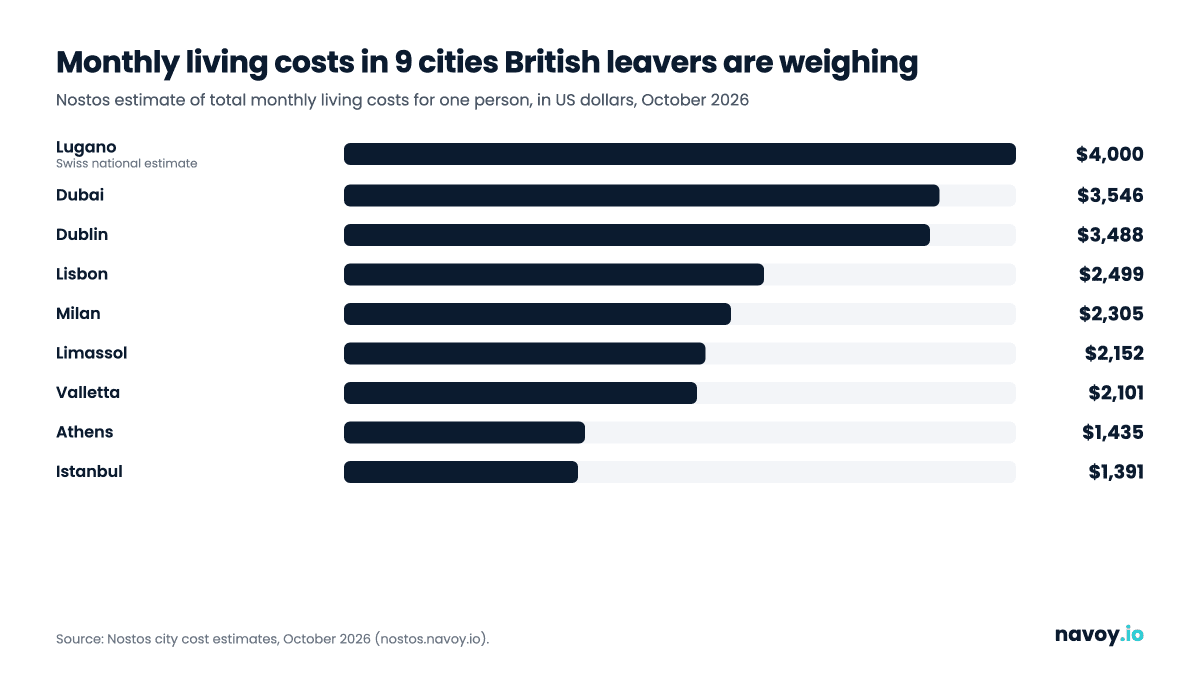
The table compares what each destination charges on foreign investment income and gains for a new resident who qualifies, roughly sorted from the lightest tax on foreign income to the heaviest. "Cost" is the fixed fee, minimum tax or investment the regime requires. City costs are Nostos estimates of total monthly living costs for one person.
| Destination | Regime for newcomers | Foreign dividends, interest, gains | Cost | How long | Inheritance tax on foreign assets | City on Nostos |
|---|---|---|---|---|---|---|
| UAE | No personal income tax | 0% | None | No limit | None | Dubai, $3,546/mo |
| Türkiye | Art. 20/D foreign-income exemption | 0% | None; apply by year-end | 20 years | A foreigner's foreign assets generally out of scope; 1% for exemption holders since June 2026 | Istanbul, $1,391/mo |
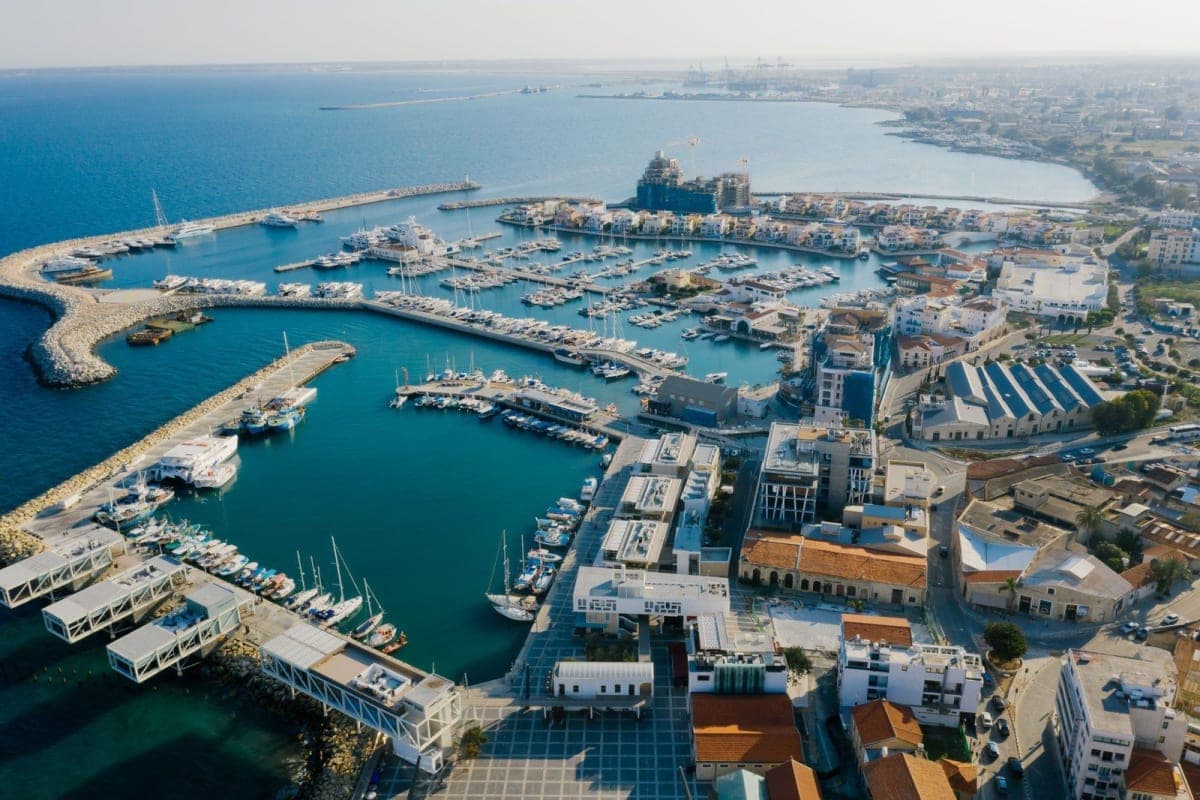
| Cyprus | Non-dom status | 2.65% health contribution on dividends and interest; share gains exempt | None | Until 17 of 20 years resident | None | Limassol, $2,152/mo |
| Malta | Remittance basis (non-domiciled) | 0% to 35% on income brought in; foreign gains untaxed | $5,570 (€5,000) minimum tax if $38,960 (€35,000) or more stays abroad | No limit | None (5% duty on Maltese property) | Valletta, $2,101/mo |
| Ireland | Remittance basis (non-domiciled) | Taxed only if brought in, except EU, EEA and OECD funds and ETFs | None | No limit | 33% CAT above thresholds after 5 consecutive years of residence | Dublin, $3,488/mo |
| Italy | 24-bis flat tax | Covered by the flat amount | $333,900 (€300,000) a year | 15 years | Italian assets only | Milan, $2,305/mo |
| Greece | Art. 5A flat tax | Covered by the flat amount | $111,300 (€100,000) a year plus $556,500 (€500,000) investment | 15 years | Foreign movable assets exempt | Athens, $1,435/mo |
| Andorra | Ordinary system, top rate 10% | 10% above $3,340 (€3,000); most share gains exempt | $1.1 million (€1 million) investment plus $55,650 (€50,000) for passive residence | No limit | None | Andorra la Vella, no cost estimate |
| Switzerland | Lump-sum taxation (no Swiss work) | Taxed on deemed living costs instead | Federal base of at least $525,000 (CHF 435,000) | No limit | Cantonal; spouses always exempt | Lugano, $4,000/mo (Swiss national estimate) |
| Portugal | NHR closed; IFICI for qualifying jobs only | 28% flat for most newcomers | None | IFICI 10 years | 10% stamp duty on Portuguese assets only; close family exempt | Lisbon, $2,499/mo |
The no-income-tax option: UAE
The UAE does not tax individuals' income, so foreign dividends, interest, gains, rent and pensions are all untaxed, and it has no wealth or inheritance tax. The exception is self-employment: freelance or consulting work done from the UAE falls under 9% corporate tax on profit above $102,100 (AED 375,000) once turnover tops $272,300 (AED 1 million) a year.
For the other countries with no personal income tax, and their catches, see countries with no income tax in 2026.
The flat-fee regimes: Italy, Greece and Switzerland
Italy's 24-bis regime replaces tax on all foreign income with $333,900 (€300,000) a year for people moving from 1 January 2026, for up to 15 years, if you were non-resident in at least 9 of the previous 10 years. Holders pay Italian inheritance tax only on Italian assets. Greece's Art. 5A charges $111,300 (€100,000) a year for 15 years, but you must invest at least $556,500 (€500,000) in Greece and have been non-resident in 7 of the previous 8 years. Neither covers pay for work done in the country.
Swiss lump-sum taxation taxes your living expenses instead of your income, on a federal base of at least $525,000 (CHF 435,000) in 2026. It is only for non-Swiss nationals doing no paid work in Switzerland, and Zurich, Basel-Stadt, Schaffhausen and Appenzell Ausserrhoden do not offer it. Every canton also levies a wealth tax. Our comparison of flat tax regimes for new residents covers these and the other regimes built for newcomers.
The non-dom regimes that survive: Cyprus, Malta and Ireland
Cyprus is the closest match to the old UK rules. A resident whose domicile of origin is abroad pays no Special Defence Contribution on dividends and interest until resident for 17 of the last 20 years, leaving only the 2.65% GESY health contribution. Share gains are exempt, and there is no inheritance tax. Employees starting a first Cyprus job after 15 years without salaried work there can also exempt 50% of their pay in any year it exceeds $61,220 (€55,000).
Malta and Ireland tax foreign income only when you bring it in. Malta also leaves foreign capital gains untaxed, but an ordinarily resident non-dom with $38,960 (€35,000) or more of foreign income kept abroad owes at least $5,570 (€5,000) a year. Ireland's catch is that gains on most EU, EEA and OECD funds and ETFs are taxed even if they stay abroad.
Türkiye's 20-year exemption
People who become Turkish resident on or after 1 January 2026, after three calendar years with no Turkish domicile or tax liability, can apply for a certificate that exempts all foreign-source income for 20 years. Work you do while in Türkiye stays taxable at 15% to 40%. Since June 2026, inheritances on a holder's death within the 20 years are taxed at a flat 1%.
Lower rates without a special regime: Andorra and Portugal
Andorra taxes residents on worldwide income, but never above 10%. Passive residence now requires a $1.1 million (€1 million) investment and a non-refundable $55,650 (€50,000) payment. Portugal closed NHR to newcomers. Its successor, IFICI, gives a 20% flat rate and exempts most foreign income for 10 years, but only for qualifying jobs, mostly with an employer in Portugal, so most British leavers pay 28% on foreign investment income.
Which destination fits which kind of leaver?
- Living on investment income without a large fixed fee: Cyprus, Türkiye or the UAE, where foreign dividends and gains pay little or nothing.
- Large foreign income: Italy or Greece, where a flat payment covers any amount, if $333,900 (€300,000) or $111,300 (€100,000) a year is below what you would otherwise pay.
- Still working: in 140 of the 152 countries Nostos covers, pay for work done while you are physically there is taxable locally. In this list the UAE, which has no tax on salaries, and Cyprus, with its 50% exemption for qualifying employees, soften that the most.
- Thinking about your estate: count your UK inheritance tax tail first. Cyprus, Malta, Andorra and the UAE have no inheritance tax, but none of them ends the UK tail.
If you are scouting cities before you commit, plan the trip free with Navoy and check hotels in Dubai and flights to Dubai. If you plan to keep working on the move, read our guide to which digital nomad visas make you pay tax.
Frequently asked questions
Is UK non-dom status completely abolished?
Yes. Since 6 April 2025 domicile no longer decides how UK residents are taxed, and the remittance basis is gone. It was replaced by the 4-year foreign income and gains (FIG) regime for people arriving after at least 10 consecutive tax years of non-residence. Inheritance tax moved to a long-term residence test of 10 out of the previous 20 tax years.
How long does UK inheritance tax apply after I leave the UK?
If you are a long-term UK resident when you leave, your worldwide assets stay within UK inheritance tax for between 3 and 10 tax years. HMRC says the tail is 3 years if you lived in the UK for 10 to 13 of the previous 20 years, 4 years for 14 and 5 years for 15, and longer stays lengthen it to a maximum of 10. UK assets stay in scope whatever your residence.
Which countries still have a non-dom regime in 2026?
In the Nostos tax profiles, Cyprus, Malta and Ireland all still give people who are not domiciled there a better deal on foreign income. Cyprus exempts non-doms from its defence contribution on dividends and interest for up to 17 of 20 years. Malta and Ireland use a remittance basis, taxing foreign income only when you bring it into the country. Italy and Greece offer flat annual payments instead.
Can I keep using the FIG regime if I leave the UK for a year?
No, not for that year. HMRC says that if you become non-UK resident during your 4-year window, you cannot claim the regime for the tax years you were away, and unused years cannot be carried forward. You can still claim for any qualifying years left in the window after you return.
Sources
- Finance Act 2025, legislation.gov.uk, https://www.legislation.gov.uk/ukpga/2025/8/contents, accessed 2026-10-27
- Reforming the taxation of non-UK domiciled individuals, HM Treasury and HM Revenue & Customs, GOV.UK, https://www.gov.uk/government/publications/tax-changes-for-non-uk-domiciled-individuals/reforming-the-taxation-of-non-uk-domiciled-individuals, accessed 2026-10-27
- Check if you can claim the 4-year foreign income and gains regime, HM Revenue & Customs, GOV.UK, https://www.gov.uk/guidance/check-if-you-can-claim-the-4-year-foreign-income-and-gains-regime, accessed 2026-10-28
- HS266 Foreign income and gains (FIG) regime (2026), HM Revenue & Customs, GOV.UK, https://www.gov.uk/government/publications/foreign-income-and-gains-fig-regime-self-assessment-helpsheet-hs266/hs266-foreign-income-and-gains-fig-regime-2026, accessed 2026-10-27
- EIM43600: Overseas Workday Relief: financial limit, HM Revenue & Customs, Employment Income Manual, https://www.gov.uk/hmrc-internal-manuals/employment-income-manual/eim43600, accessed 2026-10-27
- HS264 Remittance of pre-6 April 2025 foreign income and gains, and the temporary repatriation facility (TRF), HM Revenue & Customs, GOV.UK, https://www.gov.uk/government/publications/remittance-basis-hs264-self-assessment-helpsheet/hs264-remittance-of-pre-6-april-2025-foreign-income-and-gains-and-the-temporary-repatriation-facility-trf, accessed 2026-10-27
- Guidance note for Statutory Residence Test (RDR3), HM Revenue & Customs, GOV.UK, https://www.gov.uk/government/publications/rdr3-statutory-residence-test-srt/guidance-note-for-statutory-residence-test-srt-rdr3, accessed 2026-10-28
- HS278 Temporary non-residents and Capital Gains Tax (2026), HM Revenue & Customs, GOV.UK, https://www.gov.uk/government/publications/temporary-non-residents-and-capital-gains-tax-hs278-self-assessment-helpsheet/hs278-temporary-non-residents-and-capital-gains-tax-2026, accessed 2026-10-28
- RFIG21560: Statutory Residence Test: temporary non-residence, HM Revenue & Customs, Residence and FIG Regime Manual, https://www.gov.uk/hmrc-internal-manuals/residence-and-fig-regime-manual/rfig21560, accessed 2026-10-28
- Inheritance Tax if you're a long-term UK resident, HM Revenue & Customs, GOV.UK, https://www.gov.uk/guidance/inheritance-tax-if-youre-a-long-term-uk-resident, accessed 2026-10-28
- Inheritance Tax, GOV.UK, https://www.gov.uk/inheritance-tax, accessed 2026-10-27
- Inheritance Tax Act 1984, section 6A (Long-term UK residents), legislation.gov.uk, https://www.legislation.gov.uk/ukpga/1984/51/section/6A, accessed 2026-10-28
- Neo residenti: Regime opzionale, Che cos'è, Agenzia delle Entrate, https://www.agenziaentrate.gov.it/portale/schede/agevolazioni/opzione-per-i-neo-residenti/infogen-opzionale-neo-residenti, accessed 2026-10-28
- Agevolazioni per chi trasferisce la residenza in Italia, Agenzia delle Entrate, https://www.agenziaentrate.gov.it/portale/agevolazioni-per-chi-trasferisce-la-residenza-in-italia2, accessed 2026-10-28
- Imposta di successione: Aliquote e franchigie, Agenzia delle Entrate, https://www.agenziaentrate.gov.it/portale/schede/pagamenti/imposta-di-successione/aliquote-e-franchigie, accessed 2026-10-27
- Κώδικας Φορολογίας Εισοδήματος (ν. 4172/2013), consolidated to Law 5264/2025, Ministry of National Economy and Finance (minfin.gov.gr), https://minfin.gov.gr/wp-content/uploads/2026/04/%CE%9A%CE%A9%CE%94%CE%99%CE%9A%CE%9F%CE%A0%CE%9F%CE%99%CE%97%CE%A3%CE%97-%CE%A4%CE%9F%CE%A5-%CE%9A%CE%A9%CE%94%CE%99%CE%9A%CE%91-%CE%A6%CE%9F%CE%A1%CE%9F%CE%9B%CE%9F%CE%93%CE%99%CE%91%CE%A3-%CE%95%CE%99%CE%A3%CE%9F%CE%94%CE%97%CE%9C%CE%91%CE%A4%CE%9F%CE%A3-%CE%9C%CE%95%CE%A7%CE%A1%CE%99-%CE%A4%CE%9F-%CE%9D-5264-2025.pdf, accessed 2026-10-27
- Tax Residency/Domicility, Tax Department, Ministry of Finance (gov.cy), https://www.gov.cy/mof-tax/en/documents/tax-residency-domicility/, accessed 2026-10-27
- Συνοπτικός Διευκρινιστικός Πίνακας για εφαρμογή των εδαφίων 23 και 23Α του άρθρου 8, Tax Department (gov.cy), https://www.gov.cy/media/sites/167/2026/06/%CE%A0%CE%AF%CE%BD%CE%B1%CE%BA%CE%B1%CF%82-%CE%B1%CF%80%CE%B1%CE%BB%CE%BB%CE%B1%CE%B3%CF%8E%CE%BD-823-%CE%BA%CE%B1%CE%B9-823%CE%91.pdf, accessed 2026-10-27
- Tax Incentives, Ministry of Finance (gov.cy), https://www.gov.cy/mof/en/documents/tax-incentives/, accessed 2026-10-27
- Γενικό Σύστημα Υγείας (ΓεΣΥ), Tax Department (gov.cy), https://www.gov.cy/mof-tax/documents/geniko-systima-ygeias-gesy/, accessed 2026-10-27
- Ο Περί Φορολογίας των Κληρονομιών Νόμος του 1962 (67/1962), consolidated, Tax Department (gov.cy), https://www.gov.cy/media/sites/167/2026/07/%CE%9F-%CE%A0%CE%B5%CF%81%CE%AF-%CE%A6%CE%BF%CF%81%CE%BF%CE%BB%CE%BF%CE%B3%CE%AF%CE%B1%CF%82-%CF%84%CF%89%CE%BD-%CE%9A%CE%BB%CE%B7%CF%81%CE%BF%CE%BD%CE%BF%CE%BC%CE%B9%CF%8E%CE%BD-%CE%9D%CF%8C%CE%BC%CE%BF%CF%82-%CF%84%CE%BF%CF%85-1962-67_1962.pdf, accessed 2026-10-27
- Income Tax Act (Cap. 123), consolidated to 10 March 2026, Laws of Malta, legislation.mt, https://legislation.mt/eli/cap/123/eng, accessed 2026-10-27
- Tax Residence, Malta Tax and Customs Administration (MTCA), https://mtca.gov.mt/personal-tax/individual/tax-residence, accessed 2026-10-27
- Legal Notice 195 of 2026, Individual Tax Programme Rules, 2026, Laws of Malta, legislation.mt, https://legislation.mt/eli/ln/2026/195/eng, accessed 2026-10-27
- Duty on Documents and Transfers Act (Cap. 364), consolidated to 11 August 2025, Laws of Malta, legislation.mt, https://legislation.mt/eli/cap/364/eng, accessed 2026-10-27
- Tax and Duty Manual Part 05-01-21A: The Remittance Basis of Assessment, Revenue (Office of the Revenue Commissioners), https://www.revenue.ie/en/tax-professionals/tdm/income-tax-capital-gains-tax-corporation-tax/part-05/05-01-21a.pdf, accessed 2026-10-27
- Capital Acquisitions Tax Notes for Guidance, Part 3: Inheritance Tax, Revenue (Office of the Revenue Commissioners), https://www.revenue.ie/en/tax-professionals/documents/notes-for-guidance/cat/2024/part03.pdf, accessed 2026-10-27
- Steuermäppchen 2025: Besteuerung nach dem Aufwand, Federal Tax Administration (ESTV), https://www.estv2.admin.ch/stp/sm/aufwand-de-fr.pdf, accessed 2026-10-27
- Rundschreiben 2-215-D-2025: Ausgleich der Folgen der kalten Progression sowie Zinssätze bei der direkten Bundessteuer für das Steuerjahr 2026, Federal Tax Administration (ESTV), https://www.estv.admin.ch/dam/de/sd-web/vFK3ntWLQ4s4/2-215-D-2025-d.pdf, accessed 2026-10-28
- Dossier Steuerinformationen: Erbschafts- und Schenkungssteuern (Stand 1. Januar 2025), Federal Tax Administration (ESTV), https://www.estv2.admin.ch/stp/ds/d-erbschaft-schenkung-de.pdf, accessed 2026-10-27
- Estatuto dos Benefícios Fiscais, artigo 58.º-A (Incentivo fiscal à investigação científica e inovação), Autoridade Tributária e Aduaneira, Portal das Finanças, https://info.portaldasfinancas.gov.pt/pt/informacao_fiscal/codigos_tributarios/bf_rep/Pages/ebf58a.aspx, accessed 2026-10-27
- Código do IRS, artigo 72.º (Taxas especiais), Autoridade Tributária e Aduaneira, Portal das Finanças, https://info.portaldasfinancas.gov.pt/pt/informacao_fiscal/codigos_tributarios/cirs_rep/Pages/irs72.aspx, accessed 2026-10-27
- Código do Imposto do Selo, artigo 4.º (Territorialidade), Autoridade Tributária e Aduaneira, Portal das Finanças, https://info.portaldasfinancas.gov.pt/pt/informacao_fiscal/codigos_tributarios/selo/Pages/selo4.aspx, accessed 2026-10-27
- Taxation, u.ae, the official portal of the UAE Government, https://u.ae/en/information-and-services/finance-and-investment/taxation, accessed 2026-10-27
- Taxation of Natural Persons under the Corporate Tax Law (CTGTNP1), Federal Tax Authority (FTA), https://tax.gov.ae/Datafolder/Files/Guides/CT/Taxation%20of%20natural%20persons%20-%2025%2011%202023.pdf, accessed 2026-10-27
- Income Tax Law No 193 (Gelir Vergisi Kanunu), consolidated text, Mevzuat Bilgi Sistemi (mevzuat.gov.tr), https://www.mevzuat.gov.tr/mevzuatmetin/1.4.193.pdf, accessed 2026-10-27
- Income Tax General Communiqué Serial No 333 (exemption for income earned abroad), Resmî Gazete (resmigazete.gov.tr), https://www.resmigazete.gov.tr/eskiler/2026/07/20260704-14.htm, accessed 2026-10-27
- Law No 7582 amending certain laws, Official Gazette of 4 June 2026, Resmî Gazete (resmigazete.gov.tr), https://www.resmigazete.gov.tr/eskiler/2026/06/20260604-1.htm, accessed 2026-10-27
- Inheritance and Transfer Tax Law No 7338 (Veraset ve İntikal Vergisi Kanunu), consolidated text, Mevzuat Bilgi Sistemi (mevzuat.gov.tr), https://www.mevzuat.gov.tr/mevzuatmetin/1.3.7338.pdf, accessed 2026-10-27
- Guia pràctica de l'IRPF (Renda 2025), Govern d'Andorra, Ministeri de Finances, https://www.govern.ad/documents/d/guest/guia_irpf, accessed 2026-10-28
- Sistema tributari, Govern d'Andorra, https://www.govern.ad/ca/tematiques/impostos-taxes-i-duana/impostos-en-andorra/sistema-tributari, accessed 2026-10-28
- D.1. Residència sense treball: autorització inicial, Govern d'Andorra, Servei d'Immigració, https://www.govern.ad/ca/tematiques/immigracio/residencia/residencia-sense-treball-autoritzacio-inicial, accessed 2026-10-28
- Informe de la Comissió legislativa d'Economia al Projecte de llei de continuïtat i consolidació de les mesures per al creixement sostenible (January 2026), Consell General d'Andorra, https://gestor.consellgeneral.ad/external/document/get/29ee68a7-0562-4054-81a9-0f3bf5be2a97, accessed 2026-10-28
- Nostos tax profiles (152 countries), Navoy, https://nostos.navoy.io/data, accessed 2026-10-28
About the Author
Haroun Moula
Haroun Moula is the founder and CEO of Navoy. Before Navoy, he worked in luxury travel with VVIPs and high-profile travelers. He built Navoy to bring curated, adaptive trip planning to more travelers through an AI travel agent that plans and books core trip parts in one place.