
Key Takeaways
- Nine countries have no personal income tax in 2026. They are the Bahamas, Bahrain, Brunei, Kuwait, Oman, Qatar, Saudi Arabia, the United Arab Emirates and Vanuatu, out of 152 countries in the Nostos tax data.
- Freelancers can still owe tax in three of them. Saudi Arabia taxes a foreign resident's business profit at 20%, Qatar at 10%, and the UAE charges 9% corporate tax on profit above $102,110 (AED 375,000) once turnover passes $272,300 (AED 1 million).
- Oman starts a personal income tax on 1 January 2028. Residents (more than 183 days a year) will pay 5% on total income above $109,230 (OMR 42,000) a year.
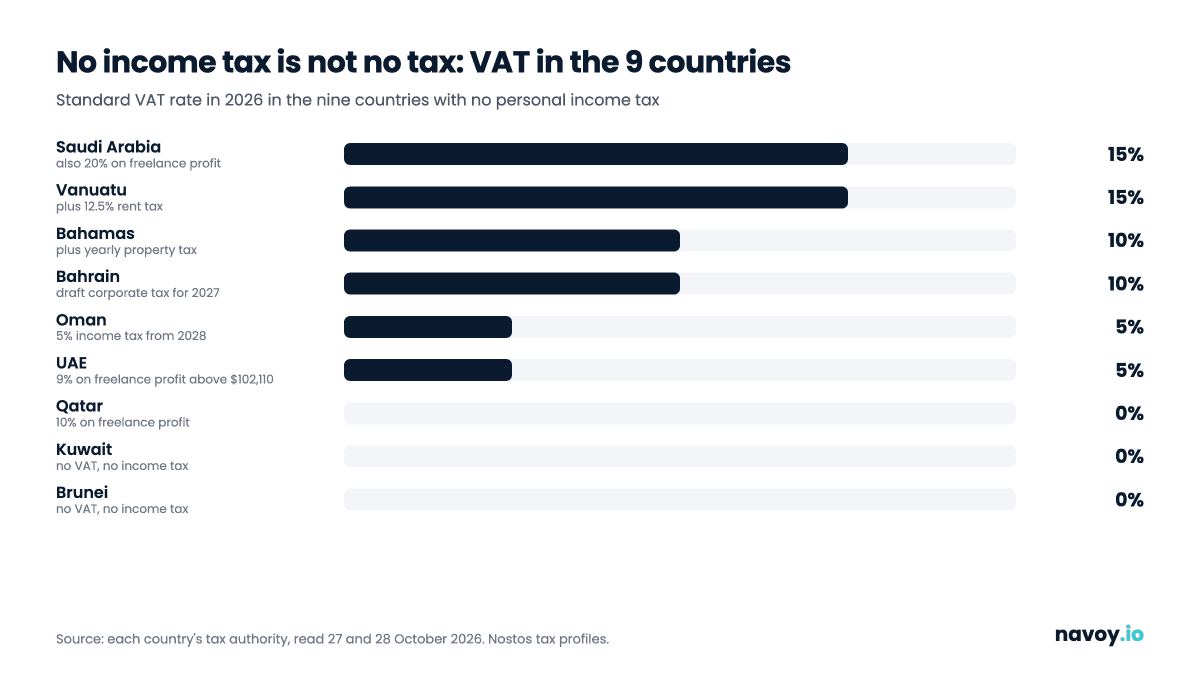
- No income tax does not mean no tax. VAT runs from 5% in the UAE to 15% in Saudi Arabia and Vanuatu, and buying property costs up to 10% in fees or VAT.
- Only the UAE has a remote work permit you can count on. The UAE visa needs a $3,500 monthly salary; the Bahamas BEATS permit ($1,025) is still advertised, but Immigration lists it as suspended.
Nine countries have no personal income tax in 2026: the Bahamas, Bahrain, Brunei, Kuwait, Oman, Qatar, Saudi Arabia, the United Arab Emirates and Vanuatu. In all nine, a salary from a foreign employer, dividends, interest, capital gains and pensions are untaxed. Each has a catch: freelancers pay tax on profit in Saudi Arabia, Qatar and the UAE, Oman brings in a 5% income tax in 2028, and six of the nine charge VAT.
We built this list from the Nostos tax profiles, one per country for 152 countries, each checked against the tax authority or the law. Rules verified against official sources on 27 and 28 October 2026, with the Bahrain, Oman and US figures re-checked on 29 October 2026. Amounts are in US dollars at the 29 October 2026 rate, with the local figure in brackets. This is general information, not tax advice: if you are a US citizen, or your home country taxes people for years after they leave, the answer for you can be different.
Which countries have no income tax in 2026?
Of the 152 countries in the Nostos data, 101 tax residents on worldwide income, 34 tax only local income, 8 tax foreign income when you bring it in, and 9 have no personal income tax at all. Those nine are below, sorted alphabetically.
| Country | Income tax on individuals | What you do pay | Residency route for a remote worker | Nostos city |
|---|---|---|---|---|
| Bahamas | None | 10% VAT; 10% VAT on buying property as a foreigner; yearly property tax if you own | BEATS remote work permit ($1,025, 12 months) still advertised, but Immigration lists it as suspended | Nassau |
| Bahrain | None | 10% VAT; 2% property registration fee (1.7% within 60 days) | No nomad visa; 10-year Golden Residency for 5-year residents earning $5,320 (BHD 2,000) a month | Manama |
| Brunei | None | No VAT; stamp duty of about 0.6% on property transfers | No nomad visa; up to 90 days visa-free for US, UK, Canada and most of Western Europe | Bandar Seri Begawan |
| Kuwait | None | No VAT; no social security for foreigners, so no Kuwaiti pension either | No nomad visa; tourist visa up to 90 days per visit for 54 nationalities | Kuwait City |
| Oman | None in 2026; 5% above $109,230 (OMR 42,000) from 2028 | 5% VAT; 3% property registration charge | No nomad visa; tourist, work and residence visas only | Muscat |
| Qatar | None on salary or personal investments | 10% on freelance or business profit (non-Qatari, non-GCC); no VAT | No nomad visa; property worth $200,500 (QAR 730,000) gives residence without a sponsor | Doha |
| Saudi Arabia | None on salary or personal investments | 20% on freelance or business profit (non-Saudi residents); 15% VAT; 5% property transfer tax | No nomad visa; Premium Residency from $26,670 (SAR 100,000) a year | Riyadh |
| United Arab Emirates | None | 9% corporate tax on freelance profit above $102,110 (AED 375,000); 5% VAT; 4% Dubai property fee | Remote work visa, 1 year, $3,500 monthly salary | Dubai |
| Vanuatu | None | 15% VAT; 12.5% rent tax on Vanuatu rental income; business license if you freelance locally | No nomad visa; Self-funded Resident visa, $2,130 (VT 250,000) a month income | Port Vila |
Sources: each country's tax authority, finance ministry or immigration department, read 27 and 28 October 2026; full list below. Every city page has a "Do you pay tax here on income from abroad?" section with the official sources.
One number sums up why these nine matter. In 140 of the 152 countries, pay for remote work done while you are physically there is taxable even when your employer or clients are abroad. All nine no-tax countries are among the 11 that leave a foreign salary untaxed.
Scouting a base first? Plan the trip free with Navoy and compare hotels in Dubai.
What is the catch in each country?
United Arab Emirates: is Dubai tax free?
For a salaried remote worker, Dubai is free of income tax. The UAE government states plainly that it "does not levy income tax on individuals", and the Federal Tax Authority excludes wages and personal investment income from corporate tax. The catch is freelancing: fees for work done from the UAE, even for clients abroad, count as business turnover. Once that turnover passes $272,300 (AED 1 million) in a calendar year, you pay 0% on the first $102,110 (AED 375,000) of taxable profit and 9% above it.
Living costs carry their own levies. VAT is 5%, Dubai tenants pay a 5% housing fee on their annual rent through the utility bill, and buying property costs a 4% Dubai Land Department fee. The UAE remote work visa guide covers the one-year permit, which needs a salary of $3,500 a month and covers employees of foreign companies only.
Saudi Arabia: 20% if you freelance
Salaries are outside Saudi income tax wherever the employer is. ZATCA's withholding guideline says people doing temporary work in the Kingdom owe income tax at 20% or withholding at 15%, depending on residency, unless the pay arises from an employment relationship. A non-Saudi resident (183 days, or a year-long lease plus 30 days) who freelances from Saudi Arabia therefore owes 20% on net profit. Add 15% VAT and a 5% Real Estate Transaction Tax on property sales.
Qatar: 10% on business profit
Qatar's Income Tax Law does not apply to salaries, wages and allowances, and there is no VAT. It does tax income from an activity carried on in Qatar at 10%, so a foreigner who freelances from Doha for foreign clients owes 10% on net profit, must register with the General Tax Authority, and can face a $5,490 (QAR 20,000) penalty for not registering. Qatari and GCC nationals are exempt. Letting out a Qatari flat may also attract 10% on the net rent.
Oman: a 5% income tax from 2028
Oman has no income tax on individuals in 2026 and 2027. Royal Decree 56/2025 starts a personal income tax on 1 January 2028. You will be resident if you spend more than 183 days in Oman in a calendar year, and the Tax Authority's FAQ sets the rate at 5% on total income above $109,230 (OMR 42,000) a year. Residents will be taxed on worldwide income, including foreign dividends, rent and pensions, though the law exempts a new resident's foreign income for the first 18 months (a Tax Authority Q&A booklet says 24). The executive regulations, which should settle how remote work for a foreign employer is treated, were not published as of late October 2026.

Bahrain: 10% VAT, and a draft corporate tax
Bahrain's only income tax hits oil and gas companies, so salaries, freelance fees and investment income are untaxed. VAT has been 10% since January 2022. In December 2025 the Cabinet approved a draft 10% corporate tax for 2027 on businesses with revenue over $2.7 million (BHD 1 million) or profit over $531,900 (BHD 200,000), still subject to Parliament on 29 October 2026; how it would treat sole traders is not yet clear.
Kuwait: no income tax or VAT, but hard to stay
Kuwait taxes only companies, and its rules exempt an individual's trade or business income, so even freelancers pay no income tax. There is no VAT. The catch is immigration: visit visas do not allow work, and a residence permit normally comes through a Kuwaiti employer, a family sponsor or a licensed business. Foreigners are also outside the social security system.
Brunei: no income tax and no VAT, but no long stays
Brunei's Revenue Division says no tax is levied on personal income from employment or self-employment. There is no GST or VAT, and the 2026/27 budget announced no new taxes. Setting up a Brunei company, though, brings 18.5% corporate tax. The harder limit is residency: there is no remote work visa, and Long Term Passes go to relatives of citizens, investors and invited professionals.
The Bahamas: VAT and property tax
The Bahamas runs on 10% VAT, customs duties and real property tax. A foreigner buying property pays 10% VAT on the purchase, and a home you own is taxed every year. The BEATS permit was built for exactly this: remote work for an overseas employer or your own overseas business, 12 months at a time, up to three years, for $1,025. The tourism ministry still advertises it, but the Department of Immigration's 2022 annual report lists BEATS as "presently suspended until further notice", so confirm with Immigration before you plan around it.
Vanuatu: 15% VAT and a rent tax
Vanuatu has no income, capital gains or inheritance tax; individuals meet only indirect taxes. VAT is 15%, rent from Vanuatu property pays 12.5% rent tax above $1,700 (VT 200,000) per half-year, and freelancing locally needs a business license. Tourist visas last up to 120 days and bar business activity.
Can foreigners live in a country with no income tax?
Yes, but only the UAE has a remote work permit you can count on in 2026. The Bahamas built one, BEATS, but Immigration lists it as suspended. Elsewhere the realistic routes are expensive or tied to a local job:
- Saudi Arabia: Premium Residency costs $26,670 (SAR 100,000) a year, or $213,300 (SAR 800,000) once for the unlimited version.
- Qatar: buying property worth $200,500 (QAR 730,000) or more gives a residence permit without a sponsor; Invest Qatar also runs a long-term Entrepreneur Residency.
- Bahrain: the 10-year Golden Residency costs $798 (BHD 300) and is open to people who have lived in Bahrain for five years earning at least $5,320 (BHD 2,000) a month, retirees with large pensions and property owners.
- Vanuatu: the Self-funded Resident visa needs $2,130 (VT 250,000) a month of certified income ($4,260, VT 500,000, with a partner).
- Kuwait, Oman and Brunei: no route for remote workers beyond visits.
If a permit matters more than the tax rate, compare the digital nomad visas with no income requirement and the cheapest countries to get residency.
Moving also does not end your tax residence at home by itself. Your home country's rules decide that, and US citizens stay taxable on worldwide income, with an exclusion of up to $132,900 of 2026 foreign earnings for those who qualify. Our article on which digital nomad visas make you pay tax explains the 183-day rule and the US tests.
Is "no tax on foreign income" the same as no income tax?
No. In 34 countries in the Nostos data, a territorial system taxes only income from local sources, so foreign dividends or rent go untaxed. But work you physically do in those countries usually counts as local income, even when the employer is abroad. A salary earned from a laptop in a territorial country is normally taxed there; in the nine countries above it is not.
Which countries have low income tax, 10% or less?
If none of the nine fits, nine more countries cap the top rate on wages at 10% or less, measured in the largest city and including local income taxes. Unlike the nine above, all of them can tax remote work done there.
| Country | Top rate on wages | How it works | What else to know |
|---|---|---|---|
| Guatemala | 7% | 5% to 7% on salary; only Guatemalan-source income is taxed | Work done in Guatemala counts as local income |
| Andorra | 10% | 0% up to $26,710 (€24,000), effectively 5% to $44,520 (€40,000), 10% above | Worldwide income; no wealth or inheritance tax |
| Bosnia and Herzegovina | 10% | Flat 10% in the Federation; 8% on salary in Republika Srpska | Social contributions of about 31% of pay |
| Bulgaria | 10% | Flat 10% on worldwide income | Dividends 5% |
| Kosovo | 10% | 0% up to $3,340 (€3,000), 8% to $6,010 (€5,400), 10% above | Dividends exempt |
| Kyrgyzstan | 10% | Flat 10% | Registered entrepreneurs often pay a 2% to 4% single tax |
| North Macedonia | 10% | Flat 10% on worldwide income | Social contributions of 28%; remote work is taxed monthly |
| Paraguay | 10% | 8% to 10%, only once gross pay passes $13,350 (G 80 million) a year | Foreign investment income is untaxed |
| Romania | 10% | Flat 10% on worldwide income | 25% pension and 10% health contributions; dividends 16% |
Source: Nostos tax profiles, from each country's tax law or tax authority, read 27 and 28 October 2026.
"10%" is rarely the whole bill. In Romania, an employee's pension and health contributions take total deductions to about 41.5% of gross pay, and in Bosnia and Herzegovina contributions often cost more than the tax. Andorra, Kosovo and Paraguay are the gentlest on modest incomes because of their zero bands or thresholds.
How to choose a base
Start with how you earn. A salaried remote worker pays no income tax on wages in all nine no-tax countries. A freelancer pays no income tax on profit in Bahrain, Brunei, Kuwait, the Bahamas and Vanuatu, in Oman until 2028, and in the UAE until turnover passes $272,300 (AED 1 million), but Saudi Arabia and Qatar tax it. Then check whether a permit lets you live and work there, because a tax rule you cannot use is no help.
The full dataset is open on the Nostos data page, and each city page shows cost of living, safety and internet next to the tax section. Once you have picked a base, plan a scouting trip free with Navoy, then check hotels in Dubai and flights to Dubai for the first visit.
Frequently asked questions
Is Dubai tax free?
Dubai has no personal income tax: the UAE government states that it does not levy income tax on individuals, so salaries, dividends, interest, capital gains and pensions are untaxed. It is not free of all taxes. VAT is 5%, Dubai tenants pay a 5% housing fee on their annual rent, buying property costs a 4% Dubai Land Department fee, and freelancers pay 9% corporate tax on profit above $102,110 (AED 375,000) once business turnover exceeds $272,300 (AED 1 million) in a calendar year.
Which countries have no income tax for foreigners?
The Bahamas, Bahrain, Brunei, Kuwait, Oman, Qatar, Saudi Arabia, the UAE and Vanuatu do not tax a foreigner's salary, dividends, interest or capital gains in 2026. Qatar and Saudi Arabia do tax foreigners who freelance or run a business from there, at 10% and 20% of profit, and Oman will tax residents' income above $109,230 (OMR 42,000) a year at 5% from 1 January 2028.
Will Oman have income tax?
Yes. Royal Decree 56/2025 brings in a personal income tax from 1 January 2028. Anyone who spends more than 183 days in Oman in a calendar year will be resident and will pay 5% on total income above $109,230 (OMR 42,000) a year. A new resident's foreign income is exempt for the first 18 months under the law. In 2026 and 2027, individuals in Oman pay no income tax.
Do I stop paying tax at home if I move to a country with no income tax?
Not automatically. Your home country's own rules decide when you stop being its tax resident, and some keep taxing you for years after you leave or charge an exit tax. US citizens owe US tax on worldwide income wherever they live, though they can exclude up to $132,900 of 2026 foreign earnings if they qualify. Moving to a no-tax country removes local income tax, not your home country's claim.
Sources
- Taxation, u.ae, the official portal of the UAE Government, https://u.ae/en/information-and-services/finance-and-investment/taxation, accessed 2026-10-28
- Corporate tax (CT), u.ae, the official portal of the UAE Government, https://u.ae/en/information-and-services/finance-and-investment/taxation/corporate-tax, accessed 2026-10-28
- Basis of Taxation - Natural Person, Federal Tax Authority (FTA), https://www.tax.gov.ae/en/taxes/corporate.tax/corporate.tax.topics/basis.of.taxation.natural.person.aspx, accessed 2026-10-28
- Tax Resident and Tax Residency Certificate Tax Procedures Guide (TPGTR1), Federal Tax Authority (FTA), https://tax.gov.ae/Datafolder/Files/Guides/VAT/VAT%20Guides/Tax-Resident-and-TRC--18-10-2024.pdf, accessed 2026-10-27
- Residence visa for working outside the UAE, u.ae, the official portal of the UAE Government, https://u.ae/en/information-and-services/visa-and-emirates-id/Types-of-visas/Residence-visa/residence-visa-for-working-outside-the-uae, accessed 2026-10-27
- Issuance of Visa Virtual Work Residence (Virtual Work Employee), Federal Authority for Identity, Citizenship, Customs and Port Security (ICP), https://icp.gov.ae/en/services-details/?serviceid=68e73fd45ae59b00117389f4, accessed 2026-10-04
- Leasing a property in the UAE, u.ae, the official portal of the UAE Government, https://u.ae/en/information-and-services/moving-to-the-uae/leasing-a-property-in-the-uae, accessed 2026-10-27
- Registering the Sale of a Mortgaged Property, Dubai Land Department, https://dubailand.gov.ae/en/eservices/registering-the-sale-of-a-mortgaged-property/, accessed 2026-10-27
- What is VAT?, National Bureau for Revenue (NBR), https://www.nbr.gov.bh/VAT/what_is_vat, accessed 2026-10-28
- Amiri Decree No. 22/1979, Bahrain Income Tax Law (unofficial translation), Ministry of Finance and National Economy, https://www.mofne.gov.bh/media/foqbwuwz/ci202-showdatafile10.pdf, accessed 2026-10-28
- The NBR's CEO affirms the Cabinet-approved initiatives aimed at enhancing the diversification of revenue sources, National Bureau for Revenue (NBR), https://www.nbr.gov.bh/releases/229, accessed 2026-10-28
- Golden Residency for Foreign Residents in Bahrain (Employees/Retirees), Bahrain National Portal (bahrain.bh), Ministry of Interior - Nationality, Passports and Residence Affairs, https://www.bahrain.bh/wps/portal/en/BNP/ServicesCatalogue/GSX-UI-PServiceDetails?psID=3023, accessed 2026-10-28
- Services Fees, Survey and Land Registration Bureau (SLRB), https://www.slrb.gov.bh/en/services-fees, accessed 2026-10-28
- Revenue Division FAQ: Corporate Tax, Ministry of Finance, Brunei Darussalam (Revenue Division), https://www.mof.gov.bn/div_revenue_faq_corporatetax/, accessed 2026-10-28
- Types of Taxes: Stamp Duty, Ministry of Finance, Brunei Darussalam (Revenue Division), https://www.mof.gov.bn/div_revenue_typesoftaxes_stampduty/, accessed 2026-10-28
- Media release: Tabling of the Supply Bill 2026/2027 (14 March 2026, in Malay), Ministry of Finance and Economy, Brunei Darussalam, https://www.mof.gov.bn/wp-content/uploads/2026/03/Press-Release-14.03.2026-Malay-Pembentangan-Rang-Belanjawan-2026-2027-Dan-Usul-Ketetapan-Kumpulwang-kemajuan.pdf, accessed 2026-10-28
- Visa Information and Visa Waiver Arrangement (90 days), Ministry of Foreign Affairs, Brunei Darussalam, https://www.mfa.gov.bn/Pages/Visa-Information.aspx, accessed 2026-10-28
- About VAT, Department of Inland Revenue, Ministry of Finance (The Bahamas), https://inlandrevenue.finance.gov.bs/value-added-tax/about-vat/, accessed 2026-10-28
- Value Added Tax (Amendment) Act, 2023, Department of Inland Revenue, Ministry of Finance (The Bahamas), https://inlandrevenue.finance.gov.bs/wp-content/uploads/2023/07/Value-Added-Tax-Amendment-Act-2023.pdf, accessed 2026-10-28
- FAQs: Real Property Tax, Department of Inland Revenue, Ministry of Finance (The Bahamas), https://inlandrevenue.finance.gov.bs/real-property-tax/faqs-rpt/, accessed 2026-10-28
- Annual Report 2022, p. 100 ("BEATS is presently suspended until further notice"), Department of Immigration (The Bahamas), https://www.immigration.gov.bs/wp-content/uploads/2023/09/Annual-Report-2022.pdf, accessed 2026-10-29
- Bahamas BEATS: Frequently Asked Questions, Bahamas Ministry of Tourism, Investments & Aviation (bahamasbeats.com), https://www.bahamasbeats.com/faq, accessed 2026-10-13
- Decree-laws: financial and tax affairs, Ministry of Finance, State of Kuwait, https://www.mof.gov.kw/MOFDesicions/mofDesicions2.aspx, accessed 2026-10-28
- Law No. 2 of 2008 amending Kuwait Income Tax Decree No. 3 of 1955, and the Executive Bylaw (Ministerial Order No. 29 of 2008), English translation, Ministry of Finance, State of Kuwait, https://www.mof.gov.kw/Desicions/Decree/PDF/Q3_1955e.pdf, accessed 2026-10-28
- Kuwait Visa portal: tourist visa and visit visa instructions, Ministry of Interior, General Administration of Residence Affairs, https://kuwaitvisa.moi.gov.kw/, accessed 2026-10-28
- Insured persons definition, Public Institution for Social Security (PIFSS), https://www.pifss.gov.kw/sites/En/pages/personsdefination.aspx, accessed 2026-10-28
- Royal Decree 56/2025 Issuing the Personal Income Tax Law (Official Gazette 1602), Tax Authority, Sultanate of Oman, https://tms.taxoman.gov.om/portal/documents/d/taxportal/-56_2025-1?download=true, accessed 2026-10-28
- Personal Income Tax FAQs, Tax Authority, Sultanate of Oman, https://tms.taxoman.gov.om/portal/web/taxportal/personal-income-tax-faqs, accessed 2026-10-28
- PIT Guidelines: Questions & Answers, Tax Authority, Sultanate of Oman, https://tms.taxoman.gov.om/portal/web/taxportal/pit-guidelines, accessed 2026-10-27
- VAT FAQs, Tax Authority, Sultanate of Oman, https://tms.taxoman.gov.om/portal/web/taxportal/vat-faqs, accessed 2026-10-28
- Register Sales Contract for Companies, Oman Government Services Portal (gov.om), https://gov.om/en/w/register-sales-contract-for-companies, accessed 2026-10-27
- Online visa services, Royal Oman Police, https://evisa.rop.gov.om/en/home, accessed 2026-10-27
- Income Tax Law (Law No. 24 of 2018) and its Executive Regulations, 2024 edition, General Tax Authority (GTA), https://www.gta.gov.qa/assets/pdf/Income%20Tax%20Law%20EN%202024.pdf, accessed 2026-10-28
- Taxes in Qatar, General Tax Authority (GTA), https://www.gta.gov.qa/en/taxes-info, accessed 2026-10-28
- Investors Guide: FAQ on Taxes in Qatar, General Tax Authority (GTA), https://www.gta.gov.qa/en/investors-guide, accessed 2026-10-28
- Frequently Asked Questions: Real estate registration, Ministry of Justice (Qatar), https://www.moj.gov.qa/en/faq, accessed 2026-10-28
- Residency Program, Invest Qatar, https://invest.qa/en/residency-program, accessed 2026-10-28
- General Guideline for Withholding Tax (Second Version, May 2026), Zakat, Tax and Customs Authority (ZATCA), https://zatca.gov.sa/en/HelpCenter/guidelines/Documents/General-Guideline-for-Withholding-Tax-In-accordance-with-the-provisions-of-the-Income-Tax-Law-and-its-Implementing-Regulations.pdf, accessed 2026-10-28
- Simplified Guideline for Income Tax (Second Version, May 2026), Zakat, Tax and Customs Authority (ZATCA), https://zatca.gov.sa/en/HelpCenter/guidelines/Documents/Simplified-Guideline-for-Income-Tax.pdf, accessed 2026-10-27
- Simplified Guideline: Real Estate Transaction Tax (Fifth Version, 3 May 2024), Zakat, Tax and Customs Authority (ZATCA), https://www.zatca.gov.sa/en/HelpCenter/guidelines/Documents/Simplified%20guide%20to%20the%20real%20estate%20transaction%20tax.pdf, accessed 2026-10-27
- VAT at 15% comes into effect, Zakat, Tax and Customs Authority (ZATCA), https://zatca.gov.sa/en/MediaCenter/News/Pages/News-342.aspx, accessed 2026-10-27
- Limited Duration and Unlimited Duration Premium Residency, Premium Residency Center, https://pr.gov.sa/pr?id=pr_product_details_limited_unlimited, accessed 2026-10-27
- Low tax jurisdiction, Vanuatu Foreign Investment Promotion Agency (VFIPA), https://investvanuatu.vu/untapped-potential/low-tax-jurisdiction/, accessed 2026-10-28
- Value Added Tax (VAT): Introduction, Department of Customs and Inland Revenue (Vanuatu), https://vanuatucustoms.gov.vu/taxes-and-licensing/taxes/value-added-tax-vat/introduction.html, accessed 2026-10-28
- Rent Tax, Department of Customs and Inland Revenue (Vanuatu), https://vanuatucustoms.gov.vu/taxes-and-licensing/taxes/rent-tax.html, accessed 2026-10-28
- Visit Vanuatu: visa categories, Department of Immigration and Passport Services (Vanuatu), https://immigration.gov.vu/visit/, accessed 2026-10-28
- Live in Vanuatu: residence visas, Department of Immigration and Passport Services (Vanuatu), https://immigration.gov.vu/live/, accessed 2026-10-28
- Impost sobre la renda de les persones físiques (IRPF), Govern d'Andorra, Seu electrònica (e-tramits.ad), https://www.e-tramits.ad/tramits/impostos/irpf, accessed 2026-10-28
- Zakon o porezu na dohodak (Službene novine FBiH 10/08, 9/10, 44/11, 7/13 i 65/13), Federalno ministarstvo finansija, https://www.fmf.gov.ba/Content/Open/102395?n=Zakon_o_porezu_na_dohodak.pdf, accessed 2026-10-27
- Income Taxes on Natural Persons Act (English translation), Ministry of Finance of the Republic of Bulgaria (minfin.bg), https://www.minfin.bg/upload/51248/Income_Taxes_on_Natural_Persons_Act.pdf, accessed 2026-10-27
- Decreto 10-2012, Ley de Actualización Tributaria (consolidated text, SAT version of 26 October 2026), Superintendencia de Administración Tributaria (SAT), https://portal.sat.gob.gt/portal/descarga/1899/legislacion-tributaria/97573/decreto-numero-10-2012-ley-de-actualizacion-tributaria-2, accessed 2026-10-27
- Tax Code of the Kyrgyz Republic No 3 of 18 January 2022 (consolidated edition of 6 August 2026), Ministry of Justice of the Kyrgyz Republic, Central Database of Legal Information (cbd.minjust.gov.kg), https://cbd.minjust.gov.kg/112340/edition/57656/ru, accessed 2026-10-27
- Pregled vo makedonskiot sistem na odanočuvanje na fizičkite lica (08-3061/1, April 2026), Uprava za javni prihodi (Public Revenue Office), https://ujp.gov.mk/files/attachment/0000/1627/08-3061_1_________________________________________________________________14.04.2026.pdf, accessed 2026-10-27
- Ley N° 6380/2019 de Modernización y Simplificación del Sistema Tributario Nacional, Biblioteca y Archivo del Congreso Nacional (bacn.gov.py), https://www.bacn.gov.py/leyes-paraguayas/9332/ley-n-6380-de-modernizacion-y-simplificacion-del-sistema-tributario-nacional, accessed 2026-10-27
- Legea nr. 227/2015 privind Codul fiscal (consolidated text with methodological norms, last updated by Legea nr. 170/2026), Agenția Națională de Administrare Fiscală (ANAF), https://static.anaf.ro/static/10/Anaf/legislatie/Cod_fiscal_norme_2023.htm, accessed 2026-10-27
- Njoftim për tatimpagues: Ndryshohen shkallët e tatimit për të ardhurat personale (Law 08/L-142), Administrata Tatimore e Kosovës (atk-ks.org), https://www.atk-ks.org/njoftim-per-tatimpagues-ndryshohen-shkallet-e-tatimit-per-te-ardhurat-personale/, accessed 2026-10-28
- Figuring the foreign earned income exclusion, Internal Revenue Service, https://www.irs.gov/individuals/international-taxpayers/figuring-the-foreign-earned-income-exclusion, accessed 2026-10-28
- Nostos tax profiles (152 countries), Navoy, https://nostos.navoy.io/data, accessed 2026-10-28
About the Author
Ranym Garali
Ranym is the Marketing and Content Lead at Navoy. She's been writing about travel for two years and digs into the data behind each piece, flight prices, visa rules and what people are actually searching for , so the advice holds up in practice.