Key Takeaways
- Italy's flat tax for new residents tripled to $333,900 (€300,000) a year. It was $111,300 (€100,000) until 10 August 2024, $222,600 (€200,000) for moves from 11 August 2024, and $333,900 (€300,000) for moves from 1 January 2026.
- Greece charges $111,300 (€100,000) a year on all foreign income for up to 15 years. You must not have been Greek resident in 7 of the previous 8 years and must invest at least $556,500 (€500,000) in Greece.
- Türkiye exempts all foreign income for 20 years. It applies to people who become resident from 1 January 2026 after three years with no Turkish domicile or tax liability.
- The fixed-fee regimes do not cover work done in the country. Italy and Greece tax local work normally, Poland very likely does too and Switzerland bars paid work entirely, so they suit investors, not remote workers.
- Employees have their own regimes. Spain taxes work income at 24% up to $667,800 (€600,000) for six tax years, and Portugal's IFICI charges 20% on qualifying work for 10 years.
A flat tax for new residents lets someone who moves to a country pay a fixed amount, or a low rate, on their foreign income instead of the normal scale. The best-known one is Italy's, which now costs $333,900 (€300,000) a year, three times what it cost before August 2024. Greece charges $111,300 (€100,000), Poland $50,660 (PLN 200,000) and Switzerland taxes your living costs instead of your income, while Türkiye and Uruguay exempt foreign income for years and Kazakhstan exempts it in exchange for a yearly state fee. Almost none of them cover pay for work you do in the country.
Everything below is as of October 2026, built from the 152 tax profiles in Nostos, Navoy's free city chooser, and checked against each country's law or tax authority. Rules verified against official sources on 27 and 28 October 2026. It is general information, not tax advice. If you are a US citizen, you stay taxed on worldwide income wherever you live, and your home country's exit rules can change the answer.
How much is Italy's flat tax for new residents in 2026?
Italy's flat tax is $333,900 (€300,000) a year for anyone who moves their tax residence to Italy from 1 January 2026. Under article 24-bis of the income tax code, that single payment covers all foreign-source income, whatever the amount, for up to 15 years. Each family member you add costs $55,650 (€50,000) a year.
The price has tripled in under two years, according to the Agenzia delle Entrate:
| Date you move to Italy | Flat tax per year | Per family member |
|---|---|---|
| Until 10 August 2024 | $111,300 (€100,000) | $27,830 (€25,000) |
| 11 August 2024 to 31 December 2025 | $222,600 (€200,000) | $27,830 (€25,000) |
| From 1 January 2026 | $333,900 (€300,000) | $55,650 (€50,000) |
Earlier movers keep the amount that applied when they arrived. The 2026 Budget Law (Law 199/2025) made the latest increase.
To qualify, you must not have been Italian tax resident in at least 9 of the previous 10 years. Holders skip IVIE and IVAFE, the annual levies on foreign property and financial assets, and pay inheritance and gift tax only on Italian assets. Italian income, including pay for work you do in Italy, is taxed normally, at up to 43% plus regional and municipal surcharges. People moving from 2027 cannot combine it with the impatriate workers' regime.
When does it pay off? Italy taxes residents' foreign dividends, interest and gains at a flat 26%, so the $333,900 (€300,000) flat tax only wins if that kind of income exceeds about $1.3 million (€1.15 million) a year. If you are weighing Milan or another city, the Italy country page shows how the ordinary rules apply.
Scouting Milan before you move? Plan the trip free with Navoy and compare hotels in Milan.
Which countries offer a flat tax or exemption for new residents?
We went through all 196 regimes listed in the 152 Nostos tax profiles and kept the ones built for people moving in. Switzerland comes first because it taxes a minimum spending base; then fixed amounts and minimum taxes, roughly highest first in euro terms; then flat rates from highest to lowest:
| Country | Regime | Annual cost or rate | What it covers | How long | Who qualifies | Catch |
|---|---|---|---|---|---|---|
| Switzerland | Lump-sum taxation | Tax on living costs, federal base at least $525,000 (CHF 435,000, 2026) | Worldwide income; wealth by canton | No limit | Non-Swiss, first arrival or after 10 years away | No paid work in Switzerland; not in Zurich, Basel-Stadt, Schaffhausen, Appenzell Ausserrhoden |
| Italy | Art. 24-bis | $333,900 (€300,000) + $55,650 (€50,000) per family member | All foreign income | Up to 15 years | Not resident 9 of previous 10 years | Italian income taxed normally |
| Greece | Art. 5A | $111,300 (€100,000) + $22,260 (€20,000) per relative | All foreign income | Up to 15 years | Not resident 7 of previous 8 years; $556,500 (€500,000) Greek investment | No credit for foreign tax |
| Kazakhstan | AIFC Investment Tax Residency | State fee of $66,430 (KZT 30,275,000) (2026) | All foreign income | Until 1 January 2066 | Foreigners, not resident in past 20 years; $60,000 investment | Kazakh income taxed normally |
| Poland | Art. 30j lump sum | $50,660 (PLN 200,000) + $25,330 (PLN 100,000) per family member | All foreign income | 10 years | Not resident 5 of previous 6 years | Must also spend $25,330 (PLN 100,000) a year on listed purposes |
| Malta | Individual Tax Programme | 15% on foreign income brought in, minimum $38,960 (€35,000) | Remitted foreign income | 5 years, renewable | Home bought for $779,100 (€700,000) or rented for $15,580 (€14,000); $9,460 (€8,500) fee | Starts 1 January 2027 |
| Malta | Global Residence Programme | 15% on foreign income brought in, minimum $16,700 (€15,000) | Remitted foreign income | To 31 December 2031 if applied for by end of 2026 | Home bought for $306,100 (€275,000) or rented for $10,680 (€9,600) a year | Other income 35% |
| Spain | Beckham law (art. 93) | 24% up to $667,800 (€600,000), 47% above | Work income; foreign investment income untaxed | 6 tax years | People moving for a job, incl. teleworking visa | Freelancers excluded |
| Portugal | IFICI | 20% on qualifying work; most foreign income exempt | Work and foreign income | 10 years | Listed research and tech roles | Foreign pensions taxed |
| Curaçao | Penshonadoregeling | 10% | Foreign pensions and investment income | No limit | Age 50+, 60 months abroad, home worth $251,400 (ANG 450,000) | No local work by you or your spouse |
| Andorra | Passive residence | Normal income tax, at most 10% | Residence permit, not a tax break | While resident | $1.1 million (€1 million) investment, $55,650 (€50,000) non-refundable payment | Live there 90 days a year |
| Italy | Art. 24-ter | 7% | All foreign income | 10 years | Foreign pensioners in small southern towns | Town of up to 30,000 people |
| Greece | Art. 5B | 7% | All foreign income | Up to 15 years | Foreign pensioners, not resident 5 of previous 6 years | Pension must come from abroad |
| Puerto Rico | Act 60 investor decree | 0% (4% for applications from 2027) | Interest, dividends, post-move gains | To 2035 (2055 at 4%) | Bona fide residents; $10,000 yearly donation | US tax still due on US-source income |
| Cyprus | Non-dom status | 0% defense tax on dividends and interest | Dividends and interest | 17 of 20 years | Domicile of origin outside Cyprus | 2.65% health contribution still due |
| Türkiye | Art. 20/D exemption | 0% | All foreign income | 20 years | Resident from 2026; no Turkish ties in 3 prior years | No credit for foreign tax |
| Uruguay | Art. 24-BIS tax holiday | 0% | Foreign investment income | Arrival year + 10 | Resident from 2026; 183 days or a set investment | Work income not covered |
| Thailand | LTR visa | 0% | Foreign income brought in | 10 years | Wealthy investors, pensioners, high-earning remote workers | Conditions must be kept each year |
| Sri Lanka | Investor visa | Treated as non-resident | Foreign income outside tax | 5 or 10 years | $100,000 or $200,000 investment | Work in Sri Lanka taxed |
Sources: each country's tax law or tax authority, listed below; Nostos tax profiles, read 27 and 28 October 2026.
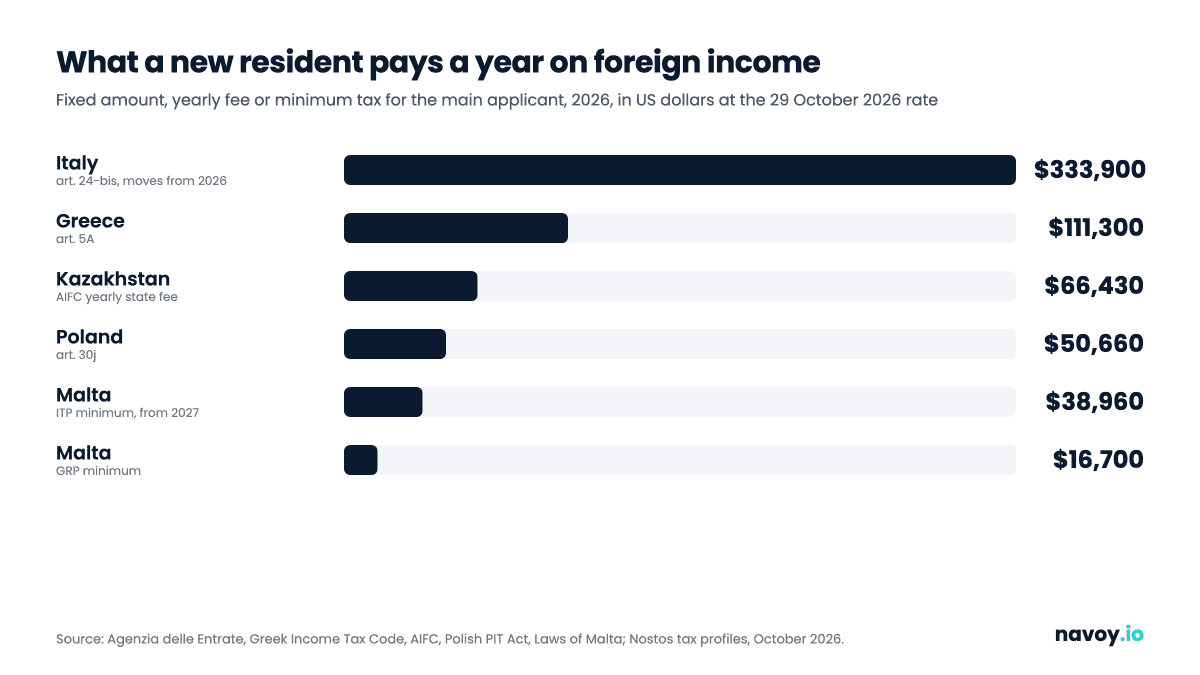
Which regimes charge a fixed amount every year?
Besides Italy, four countries put a fixed amount, a spending base or a minimum tax on foreign income.
Greece: $111,300 (€100,000) on everything abroad
Article 5A of the Greek Income Tax Code, which we read in the Ministry of Finance's consolidated text, sets a flat $111,300 (€100,000) a year "regardless of the amount" of foreign income, plus $22,260 (€20,000) per relative, for up to 15 tax years. You need $556,500 (€500,000) invested in Greek property, companies or securities within three years of applying, unless you already hold an investor residence permit. Foreign tax cannot be credited against it. Greece taxes residents' dividends at only 5% and interest at 15%, so the math depends on your mix: it beats the normal rules above about $742,400 (€667,000) of interest a year. See the tax section for Athens.
Switzerland: tax on what you spend
Swiss lump-sum taxation taxes your worldwide living expenses instead of your income, at a federal minimum base of $525,000 (CHF 435,000) for 2026, seven times your rent, or your Swiss income, whichever is highest. Cantons set their own minimums, from $241,400 (CHF 200,000) in Jura to $780,500 (CHF 646,700) in Lucerne in the federal tax administration's 2025 overview. Any paid work in Switzerland rules it out, even for foreign clients. Ticino, home to Lugano, still offers it; Zurich does not.
Poland: $50,660 (PLN 200,000) for 10 years
Poland's ryczałt on foreign income (PIT Act, articles 30j to 30p) costs $50,660 (PLN 200,000) a year, prorated in the year you arrive, and covers all income earned outside Poland. You also commit to spend $25,330 (PLN 100,000) a year on listed purposes. Since dividends and gains are normally taxed at 19%, it pays off above roughly $266,000 (PLN 1.05 million) of foreign income. Pay for work done in Poland is probably Polish-source, so ask for an advance ruling before relying on it from Warsaw.
Malta: the minimum tax is going up
Malta's Global Residence Programme taxes foreign income you bring into Malta at 15%, with a $16,700 (€15,000) yearly minimum. Its replacement, the Individual Tax Programme from 1 January 2027, keeps 15% but raises the minimum to $38,960 (€35,000) and the home purchase to $779,100 (€700,000). Statuses granted or applied for by 31 December 2026 run until 31 December 2031. Compare Valletta costs before you buy.

Which countries exempt foreign income completely?
Türkiye is the newest. Communiqué No 333, published in the Official Gazette on 4 July 2026, confirms that people who become resident from 1 January 2026, with no Turkish domicile or tax liability in the three prior calendar years, pay no income tax on foreign income for 20 years. You apply for the EK-1 certificate by the end of your first resident year. Work done from Istanbul is Turkish-source and taxed at 15% to 40%.
Uruguay gives people who become resident from 2026 a holiday on foreign investment income for the arrival year and 10 more. Those who pass the 183-day test need no investment. Afterward, investors pay 6% for five years, or a fixed tax of about $310,000 a year. Montevideo is the obvious base.
Cyprus non-dom status removes the defense tax on dividends and interest for 17 of your first 20 years, leaving only the 2.65% GESY health contribution. After that, a $278,300 (€250,000) payment per five-year period extends it. Pay for work in Limassol is taxed at up to 35%.
Kazakhstan, Thailand and Puerto Rico tie the exemption to an investment or visa. Americans should note that Puerto Rico's decree covers only Puerto Rico tax: the IRS still taxes US-source dividends and interest.
Some countries tax only local income for every resident, not just newcomers: see our list of territorial tax countries.
Who should use which regime?
- Wealthy investors with large portfolios: Italy, Greece, Poland and Switzerland. Against normal rates, the fixed fee wins only above about $266,000 (PLN 1.05 million) of foreign investment income a year in Poland, $742,400 (€667,000) of interest in Greece or $1.3 million (€1.15 million) in Italy.
- Investors with smaller portfolios: Türkiye, Uruguay and Cyprus cost nothing to join, though each has residence conditions.
- Retirees: Italy's and Greece's 7% pensioner regimes, Curaçao's 10% and Malta's remittance programmes.
- Employees moving for a job: Spain's 24% regime and Portugal's IFICI. Spain's names employees on the teleworking visa; most IFICI routes need a Portuguese employer, so check eligibility before planning around Lisbon.
- Remote workers and freelancers: few fit. Thailand's LTR visa covers high-earning remote employees of large foreign companies, but whether pay for work physically done in Thailand qualifies is not settled.
Andorra la Vella is different: passive residence is a permit, and the appeal is a normal income tax capped at 10%.
What are the catches?
- Local work is not covered. Italy and Greece tax pay for work you physically do in the country at normal rates, Poland very likely does too, and Switzerland rules out paid work entirely.
- Your old country may not let go. Exit taxes, extended residence rules and treaties can keep you taxable at home.
- US citizens stay taxed by the US. None of these regimes change that.
- Rules move fast. Italy changed its price twice in 17 months, Malta is replacing its programme and Türkiye's regime is less than a year old.
The UK replaced its non-dom regime in April 2025 with a four-year foreign income and gains regime; we do not cover it here.
How to use this when choosing a base
Pick the regime first, then the city. Every Nostos city page now has a "Do you pay tax here on income from abroad?" section, and the full dataset is on the Nostos data page. If you are already planning Italy or Greece, compare costs and climate there, then plan the trip free with Navoy and check hotels in Milan and flights to Milan. For the day-count rules that make you resident in the first place, see our 183-day rule by country guide and which digital nomad visas make you pay tax.
Frequently asked questions
How much is the Italian flat tax for new residents in 2026?
People who move their tax residence to Italy from 1 January 2026 pay a fixed substitute tax of $333,900 (€300,000) a year on all foreign-source income, plus $55,650 (€50,000) for each family member included, under article 24-bis of the Italian income tax code. People who moved between 11 August 2024 and 31 December 2025 pay $222,600 (€200,000), and earlier movers keep $111,300 (€100,000). The option lasts up to 15 years and does not cover Italian income.
Can a digital nomad use a flat tax for new residents?
Usually not for their work income. Pay for work you physically do in Italy or Greece counts as local income and is taxed at normal rates, Poland very likely treats it the same way, and Switzerland's lump-sum regime is closed to anyone who does paid work in Switzerland. Remote employees should look at Spain's 24% regime instead, which names employees on the teleworking visa.
Is the Greek non-dom tax still $111,300 (€100,000)?
Yes. Article 5A of the Greek Income Tax Code sets a flat $111,300 (€100,000) a year on all foreign-source income, whatever the amount, plus $22,260 (€20,000) for each relative added, for up to 15 tax years. Applicants must not have been Greek tax residents in 7 of the previous 8 years and must invest at least $556,500 (€500,000) in Greece within three years, unless they hold an investor residence permit.
Which country has the longest foreign income exemption for newcomers?
Kazakhstan's AIFC Investment Tax Residency Programme exempts foreign income until 1 January 2066, for a yearly state fee and an investment of at least $60,000. Among broader regimes, Türkiye's exemption lasts 20 years and covers all income earned outside Türkiye, for people who become resident from 1 January 2026.
Sources
- Neo residenti: Regime opzionale, Che cos'è, Agenzia delle Entrate (Italy), https://www.agenziaentrate.gov.it/portale/schede/agevolazioni/opzione-per-i-neo-residenti/infogen-opzionale-neo-residenti, accessed 2026-10-28
- Agevolazioni per chi trasferisce la residenza in Italia, Agenzia delle Entrate (Italy), https://www.agenziaentrate.gov.it/portale/agevolazioni-per-chi-trasferisce-la-residenza-in-italia2, accessed 2026-10-28
- Neo residenti: Normativa e prassi, Agenzia delle Entrate (Italy), https://www.agenziaentrate.gov.it/portale/schede/agevolazioni/opzione-per-i-neo-residenti/normativa-e-prassi-regi-opz-neo-residenti, accessed 2026-10-27
- Regime opzionale per i pensionati esteri: Che cos'è, Agenzia delle Entrate (Italy), https://www.agenziaentrate.gov.it/portale/schede/agevolazioni/regime-opzionale-per-i-pensionati-esteri-che-cose-cittadini, accessed 2026-10-27
- Decreto-legge 27 marzo 2026, n. 38 (testo vigente), article 2, Agenzia delle Entrate (Italy), https://www.agenziaentrate.gov.it/portale/documents/d/guest/decreto-legge-del-27_03_2026-n-38-, accessed 2026-10-27
- Circolare n. 17/E del 23 maggio 2017, Regimi agevolativi per persone fisiche che trasferiscono la residenza fiscale in Italia, Agenzia delle Entrate (Italy), https://www.agenziaentrate.gov.it/portale/documents/20143/297873/Circolare+n.+17+del+23+maggio+2017_CIRCOLARE+REGIMI+AGEVOLATIVI+PER+PERSONE+FISICHE+CHE+TRASFERISCONO+LA+RESIDENZA+FISCALE+IN+ITALIA+-REGISTRO+CIRCOLARI.0000017.23-05-2017-U+(2).pdf/8c361223-0cf1-b41b-be4a-db33664d5855, accessed 2026-10-27
- Aliquote e calcolo dell'Irpef, Agenzia delle Entrate (Italy), https://www.agenziaentrate.gov.it/portale/imposta-sul-reddito-delle-persone-fisiche-irpef-/aliquote-e-calcolo-dell-irpef, accessed 2026-10-27
- Testo unico delle imposte sui redditi, articolo 24-bis, Agenzia delle Entrate (Italy), https://www.agenziaentrate.gov.it/portale/documents/20143/241456/Articolo+24+bis+del+Testo+Unico_24bisTuir.pdf/7cc66a01-df4c-67b0-ddfd-f13bc80a5ae3, accessed 2026-10-27
- Circolare n. 19/E del 27 giugno 2014, Aliquota di tassazione dei redditi di natura finanziaria, Agenzia delle Entrate (Italy), https://www.agenziaentrate.gov.it/portale/documents/20143/298850/Circolare+n19E+del+27+giugno+2014_Cir19e+del+27+06+14.pdf/429c76f6-6236-4071-79ae-65af4aadd134, accessed 2026-10-27
- Income Tax Code (Law 4172/2013), consolidated to Law 5264/2025, articles 5A, 5B and 5C, Ministry of National Economy and Finance (Greece), https://minfin.gov.gr/wp-content/uploads/2026/04/%CE%9A%CE%A9%CE%94%CE%99%CE%9A%CE%9F%CE%A0%CE%9F%CE%99%CE%97%CE%A3%CE%97-%CE%A4%CE%9F%CE%A5-%CE%9A%CE%A9%CE%94%CE%99%CE%9A%CE%91-%CE%A6%CE%9F%CE%A1%CE%9F%CE%9B%CE%9F%CE%93%CE%99%CE%91%CE%A3-%CE%95%CE%99%CE%A3%CE%9F%CE%94%CE%97%CE%9C%CE%91%CE%A4%CE%9F%CE%A3-%CE%9C%CE%95%CE%A7%CE%A1%CE%99-%CE%A4%CE%9F-%CE%9D-5264-2025.pdf, accessed 2026-10-28
- Bundesgesetz über die direkte Bundessteuer (DBG), SR 642.11, article 14, Swiss Federal Chancellery (Fedlex), https://www.fedlex.admin.ch/eli/cc/1991/1184_1184_1184/de, accessed 2026-10-27
- Steuermäppchen 2025: Besteuerung nach dem Aufwand, Federal Tax Administration (ESTV, Switzerland), https://www.estv2.admin.ch/stp/sm/aufwand-de-fr.pdf, accessed 2026-10-27
- Kreisschreiben Nr. 44: Besteuerung nach dem Aufwand bei der direkten Bundessteuer, Federal Tax Administration (ESTV, Switzerland), https://www.estv.admin.ch/dam/de/sd-web/pl0PXAcAAxJq/dbst-ks-2018-1-044-d-de.pdf, accessed 2026-10-27
- Ustawa o podatku dochodowym od osób fizycznych (consolidated text, Dz. U. 2026 poz. 592), articles 30j to 30p, Sejm of the Republic of Poland (ISAP), https://isap.sejm.gov.pl/isap.nsf/DocDetails.xsp?id=WDU20260000592, accessed 2026-10-27
- Income Tax General Communiqué Serial No 333 (exemption for income earned abroad), Official Gazette No 33300 of 4 July 2026, Resmî Gazete (Türkiye), https://www.resmigazete.gov.tr/eskiler/2026/07/20260704-14.htm, accessed 2026-10-28
- Law No 7582 amending certain laws, Official Gazette No 33270 of 4 June 2026, Resmî Gazete (Türkiye), https://www.resmigazete.gov.tr/eskiler/2026/06/20260604-1.htm, accessed 2026-10-27
- Gelir Vergisi Kanunu (Law No 193), Mevzuat Bilgi Sistemi (Türkiye), https://www.mevzuat.gov.tr/mevzuatmetin/1.4.193.pdf, accessed 2026-10-27
- Tax Residency/Domicility, Tax Department, Ministry of Finance (Cyprus), https://www.gov.cy/mof-tax/en/documents/tax-residency-domicility/, accessed 2026-10-27
- Circular 2/2026: Alternative method of imposing the Special Contribution for the Defence (article 3D), Tax Department (Cyprus), https://www.gov.cy/media/sites/167/2026/06/2026_02.pdf, accessed 2026-10-27
- General Healthcare System (GESY) contributions, Tax Department (Cyprus), https://www.gov.cy/mof-tax/documents/geniko-systima-ygeias-gesy/, accessed 2026-10-27
- Subsidiary Legislation 123.148, Global Residence Programme Rules, Laws of Malta, https://legislation.mt/eli/sl/123.148/eng, accessed 2026-10-27
- Legal Notice 195 of 2026, Individual Tax Programme Rules, 2026, Laws of Malta, https://legislation.mt/eli/ln/2026/195/eng, accessed 2026-10-27
- Special Schemes, Malta Tax and Customs Administration, https://mtca.gov.mt/personal-tax/individual/special-schemes, accessed 2026-10-27
- Texto Ordenado 2023, Título 7, Artículo 24-BIS (Régimen de impatriados), IMPO (Uruguay), https://www.impo.com.uy/bases/todgi2023/101-2024/24_BIST7, accessed 2026-10-27
- IRPF: Rentas del exterior, Dirección General Impositiva (Uruguay), https://www.gub.uy/direccion-general-impositiva/comunicacion/publicaciones/irpf-rentas-del-exterior, accessed 2026-10-27
- Ley 35/2006 del IRPF, consolidated text, article 93, Boletín Oficial del Estado (Spain), https://www.boe.es/buscar/act.php?id=BOE-A-2006-20764, accessed 2026-10-27
- Estatuto dos Benefícios Fiscais, artigo 58.º-A (IFICI), Autoridade Tributária e Aduaneira (Portugal), https://info.portaldasfinancas.gov.pt/pt/informacao_fiscal/codigos_tributarios/bf_rep/Pages/ebf58a.aspx, accessed 2026-10-27
- Ofício-Circulado n.º 20276/2025 (IFICI: guia e perguntas frequentes), Autoridade Tributária e Aduaneira (Portugal), https://info.portaldasfinancas.gov.pt/pt/informacao_fiscal/legislacao/instrucoes_administrativas/Documents/Oficio_circulado_20276_2025.pdf, accessed 2026-10-27
- AIFC Regulations No 57 of 2026 on the AIFC Investment Tax Residency Programme, Astana International Financial Centre (Kazakhstan), https://aifc.kz/wp-content/uploads/2026/08/aifc-investment-tax-residency-programme-regulations.pdf, accessed 2026-10-27
- Investment Tax Residency Programme for Foreigners, Astana International Financial Centre (Kazakhstan), https://aifc.kz/itrp-1, accessed 2026-10-27
- Constitutional Law No 438-V on the Astana International Financial Centre, article 6(7), Adilet (Kazakhstan), https://adilet.zan.kz/rus/docs/Z1500000438, accessed 2026-10-28
- Law on the republican budget for 2026 to 2028, article 7 (MRP of KZT 4,325), Adilet (Kazakhstan), https://adilet.zan.kz/rus/docs/Z2500000239, accessed 2026-10-28
- Puerto Rico Incentives Code (Act No. 60-2019, as amended), English translation, Oficina de Gerencia y Presupuesto (Puerto Rico), https://bvirtualogp.pr.gov/ogp/Bvirtual/leyesreferencia/PDF/2-ingles/60-2019.pdf, accessed 2026-10-27
- Publication 1321 (October 2025), Special Instructions for Bona Fide Residents of Puerto Rico, Internal Revenue Service, https://www.irs.gov/pub/irs-pdf/p1321.pdf, accessed 2026-10-27
- Informative Bulletin DDEC No 2026-004 (Act 38-2026), Department of Economic Development and Commerce (Puerto Rico), https://docs.pr.gov/files/DDEC/Aviso%20Pu%CC%81blico/Informative%20Bulletin%20DDEC%20NO.%202026-004%20Final.pdf, accessed 2026-10-27
- Royal Decree issued under the Revenue Code No. 743 B.E. 2565 (2022), English translation, Thailand Board of Investment, https://ltr.boi.go.th/documents/Royal%20Decree%20issued%20under%20the%20Revenue%20Code%20No.743%20(EN).pdf, accessed 2026-10-27
- Long-Term Resident Visa, Thailand Board of Investment, https://ltr.boi.go.th/, accessed 2026-10-27
- Inland Revenue (Amendment) Act No 11 of 2026, Inland Revenue Department (Sri Lanka), https://www.ird.gov.lk/en/publications/Acts_Income%20Tax_2017/IR_Act_No_11-2026_E.pdf, accessed 2026-10-27
- Guideline: Investor Visa Category, Department of Immigration and Emigration (Sri Lanka), https://www.immigration.gov.lk/content/files/visa/Guideline%20Investor%20Visa%20Category%20doc%202.pdf, accessed 2026-10-27
- Penshonadoregeling, Belastingdienst Curaçao, https://belastingdienst.cw/particulier/themas/penshonadoregeling/, accessed 2026-10-28
- D.1. Residència sense treball: autorització inicial, Govern d'Andorra, https://www.govern.ad/ca/tematiques/immigracio/residencia/residencia-sense-treball-autoritzacio-inicial, accessed 2026-10-28
- Impost sobre la renda de les persones físiques (IRPF), Govern d'Andorra, https://www.e-tramits.ad/tramits/impostos/irpf, accessed 2026-10-28
- Informe de la Comissió legislativa d'Economia al Projecte de llei de continuïtat i consolidació de les mesures per al creixement sostenible (became Llei 2/2026), article 10, Consell General d'Andorra, https://gestor.consellgeneral.ad/external/document/get/29ee68a7-0562-4054-81a9-0f3bf5be2a97, accessed 2026-10-28
- Check if you can claim the 4-year foreign income and gains regime, HM Revenue & Customs (GOV.UK), https://www.gov.uk/guidance/check-if-you-can-claim-the-4-year-foreign-income-and-gains-regime, accessed 2026-10-27
- Nostos tax profiles (152 countries), Navoy, https://nostos.navoy.io/data, accessed 2026-10-28
About the Author
Ranym Garali
Ranym is the Marketing and Content Lead at Navoy. She's been writing about travel for two years and digs into the data behind each piece, flight prices, visa rules and what people are actually searching for , so the advice holds up in practice.