
Key Takeaways
- In 140 of 152 countries, remote pay earned on their soil is local income. It counts as earned where you physically work, even when your employer, clients and bank account are abroad.
- Staying under 183 days avoids residence, not the tax on work done there. Vietnam, Cambodia, Nepal, the Philippines and the UK can tax a visitor's remote pay from the first working day.
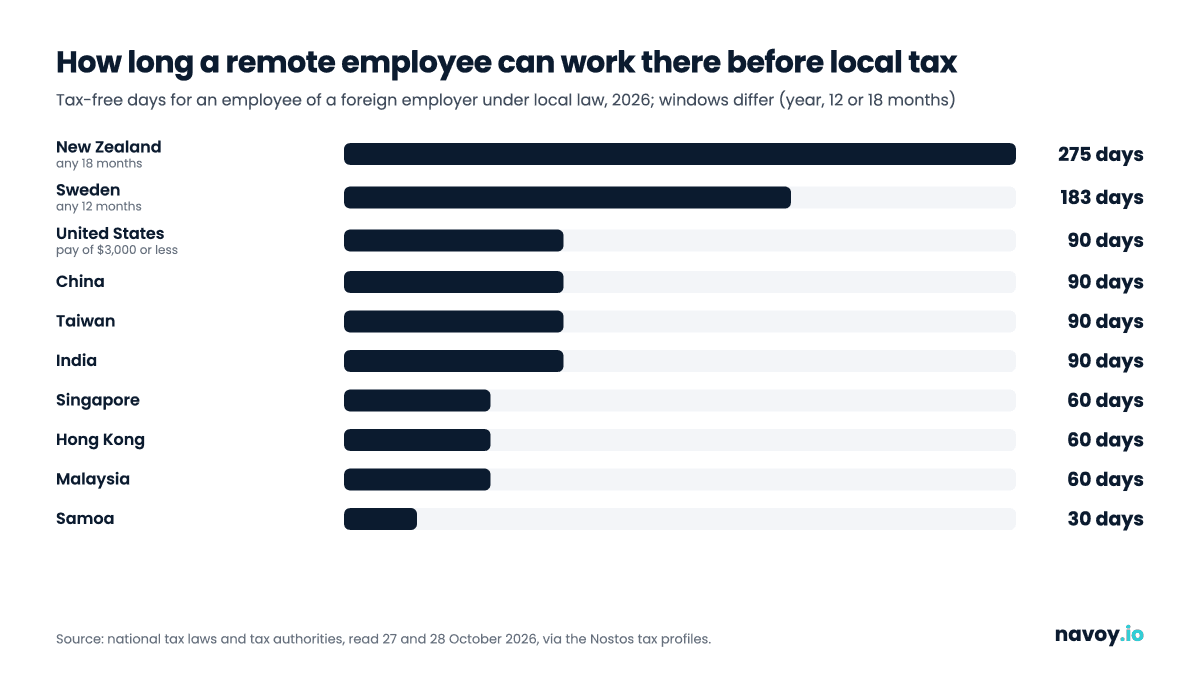
- Short-stay exemptions are written into some laws. Singapore, Hong Kong and Malaysia exempt qualifying employees of foreign employers for 60 days, China, Taiwan and India for 90, and the US for 90 days if pay stays at $3,000 or less.
- Tax treaties protect employees for up to 183 days, but only treaty residents. The employer must be foreign and no local branch may bear the pay, and a nomad with no tax home anywhere cannot claim a treaty.
- Some nomad permits exempt remote pay outright. Costa Rica, Montenegro, Barbados, Croatia (up to 18 months), Romania (up to 183 days) and Cabo Verde (one year) do, and Malta exempts the first 12 months, then charges 10%.
If you work from a laptop while physically in another country, that country usually treats the pay as income earned there, even when your employer, your clients and your bank are abroad. In 140 of the 152 countries in the Nostos tax profiles, remote pay for work done on their soil is taxable under local law. Whether you actually owe it depends on how long you stay, whether a short-stay or nomad-permit exemption covers you, and whether a tax treaty gives the right to tax back to your home country.
Everything below is as of October 2026, from one Nostos profile per country built from the law or the tax authority. Rules verified against official sources on 27 and 28 October 2026. This is general information, not tax advice. US citizens are taxed on worldwide income wherever they live, and some home countries keep taxing you after you leave, so check both ends before you move.
Do I have to pay taxes if I work remotely in another country?
Often, yes. Two separate rules decide it, and most people only know the second one.
- The source rule. Most tax laws say income from work is earned where the work is physically done. A salary paid by a Berlin company into a German bank account is still Vietnamese income for every day you write code in Da Nang.
- The residence rule. Stay long enough, usually more than 183 days, and you become a tax resident, taxed on your worldwide income. Our guide to which digital nomad visas make you pay tax covers those tests.
The source rule applies from your first working day. Vietnam charges non-residents a flat 20% on pay for work performed there, wherever it is paid. Cambodia also charges non-residents 20%, Nepal 25% with no allowances, and the Philippines a final 25% on the gross amount. HMRC says the UK taxes non-residents on earnings for duties carried out in the UK, unless a treaty says otherwise. Staying under 183 days protects you from residence, not from the source rule.
Why territorial and remittance countries still tax remote work
Of the 152 countries, 34 tax on a territorial basis (local income only) and 8 on a remittance basis (foreign income only when brought in). Both sound like remote-work havens, but pay for work done inside the country is local income, not foreign income.
- Singapore exempts foreign dividends, interest and rent, but IRAS says employment is exercised in Singapore on any day you are physically present, even for a foreign employer.
- Georgia taxes pay for services actually performed in Georgia at 20%, and the same source rule applies before you reach 183 days.
- Thailand's Revenue Department says income from work performed in Thailand is taxable whether it is paid inside or outside Thailand. On that reading, a remote worker on a Destination Thailand Visa owes Thai tax on pay earned there even if the money never arrives and they stay under 180 days.
- Malta and Mauritius tax foreign income on remittance, but both treat work done on the island as local income.
Testing a city before you commit? Plan the trip free with Navoy and compare hotels in Chiang Mai.
Which countries do not tax remote work at all?
In 11 of the 152 countries, a salary from a foreign employer earned while living there is not taxed. Nine levy no personal income tax: the Bahamas, Bahrain, Brunei, Kuwait, Oman, Qatar, Saudi Arabia, the United Arab Emirates and Vanuatu. Angola and Seychelles complete the list, with caveats.
- Freelancers are different in the Gulf. Qatar charges 10% on freelance income from work done in Qatar, even for foreign clients, and Saudi Arabia charges a resident non-Saudi 20% on net profit from work done there. In the UAE, an individual's business turnover above $272,300 (AED 1 million) a year falls under corporate tax: 0% on the first $102,100 (AED 375,000) of taxable profit and 9% above.
- Oman's window closes in 2028. Its personal income tax law takes effect on 1 January 2028, at 5% of a resident's total income above $109,200 (OMR 42,000) a year.
- Angola and Seychelles are less certain. Angola's rule lasts only until the end of 2026 and is untested for remote workers. Seychelles does not tax remote employees in practice, but its law is not explicit, and freelancers there owe business tax.
One more country sits in between: Sri Lanka taxes remote pay but caps the rate at 15% for services paid in foreign currency and remitted through a bank to Sri Lanka. Whether a salary counts as a service is not confirmed.
How long can I work remotely from another country without tax implications?
Two kinds of rule give you a tax-free window: exemptions in a country's own law, and the treaty 183-day rule. Both mostly protect employees of foreign employers, not freelancers.
Short-stay exemptions written into law
Most require that no local branch of the employer bears your pay.
- Samoa, 30 days in a tax year, if the work is for a non-resident and taxed at home.
- Singapore, 60 days. A non-resident employee who works there 60 days or less in a calendar year is exempt. Days 61 to 182 are taxed at 15% or resident rates, whichever is higher. Directors, public entertainers and professionals are excluded.
- Hong Kong, 60 days of genuine visits in a year of assessment (1 April to 31 March).
- Malaysia, 60 days. From day 61 the whole period is taxable.
- China, 90 days in a year, for wages a foreign employer pays and no Chinese establishment bears.
- Taiwan, 90 days in a calendar year. From day 91 to day 182, a non-resident files and pays a flat 18% on foreign-employer pay before leaving.
- India, 90 days in the April to March tax year, for a foreign national employed by a foreign enterprise with no business in India.
- Serbia and Botswana, 90 days in any 12 months, if the payer is foreign; Botswana also requires the pay to be taxed at home.
- United States, 90 days and $3,000. IRS Publication 519 exempts a nonresident alien working for a foreign employer not engaged in a US trade or business, present 90 days or less in the tax year, and paid $3,000 or less for that work. Above $3,000 the whole amount is taxable, so this is a business-trip rule.
- Mexico, under 183 days in any 12 months, for pay from a foreign employer or client with no establishment in Mexico. Unusually, this covers freelancers too.
- Sweden, 183 days in any 12 months, for pay from a foreign employer with no Swedish establishment.
- New Zealand, 275 days in any 18 months. For arrivals from 1 April 2026, a non-resident visitor who stays tax resident elsewhere and works only for foreign employers or clients is exempt, and becomes resident on day 276.
Estonia goes further: a foreign employer's salary is not taxed there before you become resident, which takes 183 days in 12 months, but residence then backdates to your arrival.
The treaty 183-day rule
Most tax treaties share the same employment article. In the US Model treaty (Article 14), your salary for work in the other country stays taxable only at home if all three conditions hold:
- You are there no more than 183 days in any 12-month period.
- Your employer is not resident in that country.
- No permanent establishment the employer has there bears the pay.
There are three catches. The treaty must link the country you work in with your country of tax residence. A nomad with no tax residence anywhere cannot claim any treaty. And freelancers fall under a different article that varies by treaty. Slovenia's tax authority puts it plainly: without a treaty with your country, even a short stay is taxable.
Which digital nomad permits exempt remote income?
For longer stays, a nomad permit with its own tax rule is the main legal route:
- Costa Rica: Law 10008 gives remote-worker permit holders a full income-tax exemption, and they never become habitual tax residents.
- Montenegro: digital nomad status means no income tax and no social contributions on pay from an employer not registered in Montenegro.
- Barbados: Welcome Stamp holders are deemed not resident and pay no Barbados income tax. Cabinet approved the program until 31 December 2026, and we found no later extension.
- Croatia: pay from an employer not registered in Croatia is exempt for non-EU digital nomads, for the life of the permit (at most 18 months). Freelancers without their own company may not be covered.
- Romania: nomad-visa holders' salary from a foreign employer or their own foreign company is exempt while they spend 183 days or less in any 12 consecutive months. Go past that and you are resident from your first day, at 10%.
- Cabo Verde: the 2026 budget law exempts non-resident remote workers serving foreign employers or clients for one year. The law does not say how this fits the 183-day residence test.
- Malta: Nomad Residence Permit income is exempt for the first 12 months, then taxed at a flat 10%.
- Latvia: remote-work visa holders who move their tax residence can elect a flat 15% for 365 days.
Not every nomad visa works this way. Many guides describe a first-year tax exemption for Albania's permit, but neither Albania's income tax law nor its foreigners law contains one.

Country by country: when does remote pay become taxable?
Sorted from never taxed to taxed from day one. "Day 91" means the exemption covers 90 days.
| Country | When remote pay becomes taxable | Exemption or way out | Nostos city |
|---|---|---|---|
| Bahamas | Never: no personal income tax | BEATS permit still advertised, but Immigration lists it as suspended | Nassau |
| United Arab Emirates | Never for salary; freelance turnover over $272,300 (AED 1 million) a year meets corporate tax | No income tax on individuals | Dubai |
| Oman | Not before 1 January 2028 | No personal income tax until then | Muscat |
| Costa Rica | Day one, under the source rule | Remote-worker permit: full exemption | San José |
| Montenegro | As a resident, at 0% to 15% plus surtax | Digital nomad status: no income tax | Budva |
| Barbados | Day one, even on short stays | Welcome Stamp: no income tax | Bridgetown |
| Croatia | As a resident, at 15% to 33% | Non-EU nomad stay: exempt up to 18 months | Split |
| Cabo Verde | Day one, under the source rule | One-year exemption for remote workers | Praia |
| Romania | Over 183 days in 12 months: resident from day one | Nomad visa: salary exempt up to 183 days | Bucharest |
| Malta | Day one | Nomad permit: 0% for 12 months, then 10% | Valletta |
| Mauritius | Day one, even before residence | Premium Visa: taxed only when remitted | Grand Baie |
| New Zealand | Day 276 in any 18 months | Non-resident visitor rule | Auckland |
| Mexico | Day 183 in any 12 months | Foreign employer or client, no Mexican establishment | Mexico City |
| Sweden | Day 184 in any 12 months | Foreign employer, no Swedish establishment | Stockholm |
| United States | Day 91, or day one if pay tops $3,000 | Foreign employer with no US business | New York |
| China | Day 91 in a year | Foreign employer, pay not borne in China | Shanghai |
| Taiwan | Day 91 in a calendar year | Employer outside Taiwan | Taipei |
| India | Day 91 in the April to March year | Foreign enterprise with no Indian business | Goa |
| Serbia | Day 91 in any 12 months | Foreign payer with no Serbian activity | Belgrade |
| Singapore | Day 61 in a calendar year; day one for freelancers | Employees only, not directors or professionals | Singapore |
| Hong Kong | Day 61 of visits, 1 April to 31 March | Genuine visits only | Hong Kong |
| Malaysia | Day 61 in a year, then the whole stay | Employees, 60 days or less | Kuala Lumpur |
| Georgia | Day one, at 20% | 1% turnover tax for eligible freelancers | Tbilisi |
| Thailand | Day one on the Revenue Department's reading, even if never brought in | Treaty only | Chiang Mai |
| Vietnam | Day one, flat 20% for non-residents | Treaty only | Da Nang |
| United Kingdom | Day one | Treaty only | London |
Sources: each country's law or tax authority; Nostos tax profiles, October 2026, free on the Nostos data page.
Working remotely from another country: taxes in Europe
Europe mostly follows the source rule. The UK taxes non-residents on UK workdays, and Slovenia's tax authority says its new digital nomad permit, available since November 2025, changes no one's tax position. For a short stay, your protection is usually the treaty 183-day rule, which only helps employees with a tax home in a treaty country. Non-EU visitors also face the Schengen limit of 90 days in any 180, covered in our Schengen 90/180 guide.
The European exceptions are few:
- Exemptions: Croatia, Montenegro and Romania exempt nomad-permit pay, and Malta exempts it for 12 months. Croatia, Romania and Malta's schemes are for non-EU nationals only.
- Short-stay rules: Serbia exempts 90 days, Sweden 183 days for foreign-employer pay, and Estonia does not tax a foreign employer's salary before you are resident.
What should you check before you work from another country?
- Count working days per country, in its own period: calendar year, rolling 12 months, or April to March in Hong Kong and India. The 183-day rule by country guide gives the window for 30 countries.
- Know whether you are an employee or a freelancer. Most exemptions cover employees of foreign employers only.
- Keep a tax residence somewhere, with a certificate of residence if you rely on a treaty.
- Read the permit's tax rule, not the marketing. Exemptions have day, date and nationality limits.
To compare places, the Nostos city ranker scores 1,000 cities on cost, safety, internet and climate, and every city page has a section titled "Do you pay tax here on income from abroad?". When you have a shortlist, plan the trip free with Navoy, then check hotels in Chiang Mai and flights to Chiang Mai.
Frequently asked questions
How long can I work remotely from another country without tax implications?
It depends on the country and on whether you are an employee. Under domestic law, Singapore, Hong Kong and Malaysia exempt qualifying employees of foreign employers for up to 60 days a year, and China, Taiwan and India for up to 90 days. The US allows 90 days only if pay for the US work stays at $3,000 or less. Tax treaties usually protect employees of a foreign employer for up to 183 days in any 12 months, if they are tax resident in the treaty partner. In countries like Vietnam or the UK, without a treaty, remote pay is taxable from the first day.
Does the 183-day rule protect digital nomads?
Only partly. Staying 183 days or less usually keeps you from becoming a tax resident, but most countries can still tax pay for work you physically do there from the first day. The treaty version of the 183-day rule removes that tax only for employees who are tax resident in a country that has a treaty with the one they work in, whose employer is not local and whose pay is not borne by a local branch. A nomad with no tax residence anywhere cannot claim it.
Do I pay Thai tax on a DTV if I never bring the money into Thailand?
Possibly. Thailand's Revenue Department says income from work performed in Thailand is taxable whether it is paid inside or outside Thailand, and a 1993 ruling applied this to a foreign employer paying into a German bank account. On that reading, remote pay earned while you are in Thailand is Thai-source income even if you never remit it and stay under 180 days. The Revenue Department has published no guidance specific to the Destination Thailand Visa.
Which countries do not tax remote work?
In 11 of the 152 countries Nostos profiles, a salary from a foreign employer is not taxed. Nine have no personal income tax: the Bahamas, Bahrain, Brunei, Kuwait, Oman (until 2028), Qatar, Saudi Arabia, the United Arab Emirates and Vanuatu. Angola and Seychelles do not tax it under current rules or practice, with caveats. Freelancers can still owe business tax in Qatar, Saudi Arabia, Seychelles and the UAE.
Sources
- Scenario-based FAQs: I am working for a foreign employer, Inland Revenue Authority of Singapore (IRAS), https://www.iras.gov.sg/taxes/individual-income-tax/employees/scenario-based-faqs-for-working-in-singapore-and-abroad/i-am-working-for-a-foreign-employer, accessed 2026-10-28
- Working out my tax residency, Inland Revenue Authority of Singapore (IRAS), https://www.iras.gov.sg/taxes/individual-income-tax/basics-of-individual-income-tax/tax-residency-and-tax-rates/working-out-my-tax-residency, accessed 2026-10-28
- A guide to Salaries Tax for people coming to work in Hong Kong (PAM 42(e), April 2026), Inland Revenue Department (Hong Kong), https://www.ird.gov.hk/eng/pdf/pam42e.pdf, accessed 2026-10-28
- Public Ruling No. 2/2026: Tax Treatment of Foreign Nationals Exercising Employment in Malaysia, Inland Revenue Board of Malaysia (LHDN), https://www.hasil.gov.my/wp-content/uploads/pr-2-2026-tax-treatment-of-foreign-nationals-exercising-employment-in-malaysia.pdf, accessed 2026-10-27
- DE Rantau Pass FAQ, version 10.0 (28 August 2026), Malaysia Digital Economy Corporation (MDEC), https://www.mdec.my/api/media/file/DE-Rantau_Pass_FAQ_v10.pdf, accessed 2026-10-27
- Regulations for the Implementation of the Individual Income Tax Law (State Council Decree No. 707), article 5, State Taxation Administration (China), https://fgk.chinatax.gov.cn/zcfgk/c100010/c5194444/content.html, accessed 2026-10-27
- Alien income tax and length of stay, Ministry of Finance Tax Portal (Taiwan), https://www.etax.nat.gov.tw/etwmain/alien-tax-service/alien-individual-income-tax/15r2N1n, accessed 2026-10-28
- Income recognition for foreigners, Ministry of Finance Tax Portal (Taiwan), https://www.etax.nat.gov.tw/etwmain/alien-tax-service/alien-individual-income-tax/rbbABDr, accessed 2026-10-27
- The Income-tax Act, 2025 (No. 30 of 2025), Schedule IV, Gazette of India, https://egazette.gov.in/WriteReadData/2025/265620.pdf, accessed 2026-10-27
- Zakon o porezu na dohodak građana, article 9b, Pravno-informacioni sistem Republike Srbije, https://www.pravno-informacioni-sistem.rs/SlGlasnikPortal/eli/rep/sgrs/skupstina/zakon/2001/24/1/reg, accessed 2026-10-27
- Income Tax Act, 2026 (Act No. 13 of 2026), Botswana Unified Revenue Service, https://www.burs.org.bw/index.php/tax/tax-laws-2026?download=954:income-tax-act-amendment-2026, accessed 2026-10-27
- Income Tax Act 2012, Schedule 2, Ministry of Revenue (Samoa), https://revenue.gov.ws/wp-content/uploads/2022/08/Income-Tax-Act-2012.pdf, accessed 2026-10-28
- Publication 519 (2025), U.S. Tax Guide for Aliens, Internal Revenue Service, https://www.irs.gov/publications/p519, accessed 2026-10-28
- United States Model Income Tax Convention (2016), article 14, U.S. Department of the Treasury, https://home.treasury.gov/system/files/131/Treaty-US-Model-2016_1.pdf, accessed 2026-10-27
- Ley del Impuesto sobre la Renta, Cámara de Diputados (Mexico), https://www.diputados.gob.mx/LeyesBiblio/pdf/LISR.pdf, accessed 2026-10-27
- Lag (1991:586) om särskild inkomstskatt för utomlands bosatta (SINK), section 6 a, Sveriges riksdag, https://www.riksdagen.se/sv/dokument-och-lagar/dokument/svensk-forfattningssamling/lag-1991586-om-sarskild-inkomstskatt-for_sfs-1991-586/, accessed 2026-10-27
- IR294 Tax information for visitors to New Zealand (April 2026), Inland Revenue (New Zealand), https://www.ird.govt.nz/-/media/project/ir/home/documents/forms-and-guides/ir200---ir299/ir294/ir294.pdf?modified=20260331211622, accessed 2026-10-27
- Income Tax Act (Tulumaksuseadus), consolidated English translation, Riigi Teataja (Estonia), https://www.riigiteataja.ee/en/eli/530012014003/consolide/current, accessed 2026-10-27
- Decree No 253/2026/ND-CP detailing the Law on Personal Income Tax, Official Gazette of Vietnam, https://congbao.chinhphu.vn/van-ban/nghi-dinh-so-253-2026-nd-cp-469959.htm, accessed 2026-10-27
- Law on Taxation (Royal Kram NS/RKM/0523/004), General Department of Taxation (Cambodia), https://www.tax.gov.kh/u6rhf7ogbi6/gdtstream/816f7e7b-e4be-4d8f-a789-e587b92dbe2e, accessed 2026-10-27
- Income Tax Act, 2058 (as amended by the Finance Act, 2082), sections 6 and 67, Inland Revenue Department (Nepal), https://giwmscdnone.gov.np/media/pdf_upload/%E0%A4%86%E0%A4%AF%E0%A4%95%E0%A4%B0%20%E0%A4%90%E0%A4%A8%2C%20%E0%A5%A8%E0%A5%A6%E0%A5%AB%E0%A5%AE%20(%E0%A4%86%E0%A4%B0%E0%A5%8D%E0%A4%A5%E0%A4%BF%E0%A4%95%20%E0%A4%90%E0%A4%A8%2C%E0%A5%A8%E0%A5%A6%E0%A5%AE%E0%A5%A8%20%E0%A4%B2%E0%A5%87%20%E0%A4%97%E0%A4%B0%E0%A5%87%E0%A4%95%E0%A5%8B%20%E0%A4%B8%E0%A4%82%E0%A4%B6%E0%A5%8B%E0%A4%A7%E0%A4%A8%20%E0%A4%B8%E0%A4%B9%E0%A4%BF%E0%A4%A4)_7h85rod.pdf, accessed 2026-10-27
- National Internal Revenue Code of 1997, as amended, Bureau of Internal Revenue (Philippines), https://www.bir.gov.ph/tax-code, accessed 2026-10-27
- Globally mobile employees: effect of residence on an employee's liability to UK income tax, HM Revenue & Customs, https://www.gov.uk/government/publications/globally-mobile-employees/effect-of-residence-on-an-employees-liability-to-uk-income-tax, accessed 2026-10-27
- Tax Code of Georgia (consolidated version of 15 October 2026), Legislative Herald of Georgia, https://matsne.gov.ge/en/document/view/1043717, accessed 2026-10-27
- How do foreigners living in Thailand pay tax? (2024), Revenue Department of Thailand, https://www.rd.go.th/fileadmin/user_upload/lorkhor/newspr/2024/FOREIGNERS_PAY_TAX2024.pdf, accessed 2026-10-27
- Tax ruling Kor Kor 0811(Kor Mor 06)/1735, Revenue Department of Thailand, https://www.rd.go.th/24165.html, accessed 2026-10-27
- Taxation of foreign persons with a temporary residence permit for digital nomads under the ZDoh-2 and international agreements (January 2026), Financial Administration of the Republic of Slovenia (FURS), https://www.fu.gov.si/fileadmin/Internet/Davki_in_druge_dajatve/Podrocja/Mednarodno_obdavcenje/Opis/GB_Taxation_of_foreign_persons_with_a_temporary_residence_permit_for_digital_nomads_under_the_ZDoh-2_and_international_agreements.doc, accessed 2026-10-27
- Basis of Taxation: Natural Person, Federal Tax Authority (UAE), https://www.tax.gov.ae/en/taxes/corporate.tax/corporate.tax.topics/basis.of.taxation.natural.person.aspx, accessed 2026-10-27
- Royal Decree 56/2025 Issuing the Personal Income Tax Law, Tax Authority (Oman), https://tms.taxoman.gov.om/portal/documents/d/taxportal/-56_2025-1?download=true, accessed 2026-10-27
- Law No. 11 of 2022 Amending Several Provisions of the Income Tax Law, General Tax Authority (Qatar), https://www.gta.gov.qa/assets/pdf/Amending%20Several%20Provisions%20of%20Income%20Tax%20Law.pdf, accessed 2026-10-28
- Simplified Guideline for Income Tax (May 2026), Zakat, Tax and Customs Authority (Saudi Arabia), https://zatca.gov.sa/en/HelpCenter/guidelines/Documents/Simplified-Guideline-for-Income-Tax.pdf, accessed 2026-10-27
- Inland Revenue Act No 24 of 2017, consolidated text, Inland Revenue Department (Sri Lanka), https://www.ird.gov.lk/en/publications/Acts_Income%20Tax_2017/IRA_Cons_Act_-_2025_Changes.pdf, accessed 2026-10-27
- Ley 10008, articles 3 and 16, SINALEVI, Procuraduría General de la República (Costa Rica), https://sinalevi.go.cr/ResultadosNormativa/Informacion?param1=95085¶m2=129850¶m3=1, accessed 2026-10-27
- Zakon o izmjenama i dopunama Zakona o porezu na dohodak fizičkih lica (Sl. list CG 152/2022), article 32d, Službeni list Crne Gore, https://www.sluzbenilist.me/propisi/334487, accessed 2026-10-27
- Zakon o izmjenama i dopunama Zakona o strancima (Sl. list CG 3/2026), Službeni list Crne Gore, https://www.sluzbenilist.me/propisi/389913, accessed 2026-10-27
- Remote Employment Bill, 2020, Parliament of Barbados, https://barbadosparliament.com/uploads/bill_resolution/1060cadd77eb3b54bb81b5b5b7ba1177.pdf, accessed 2026-10-28
- Barbados Welcome Stamp Statistics As Of April 30, 2024, Ministry of Tourism and International Transport (Barbados), https://tourism.gov.bb/News/Press-Releases/Barbados-Welcome-Stamp-Statistics, accessed 2026-10-28
- Annual Report 2022, p. 100 ("BEATS is presently suspended until further notice"), Department of Immigration (The Bahamas), https://www.immigration.gov.bs/wp-content/uploads/2023/09/Annual-Report-2022.pdf, accessed 2026-10-29
- Bahamas BEATS: Frequently Asked Questions, Bahamas Ministry of Tourism, Investments & Aviation, https://www.bahamasbeats.com/faq, accessed 2026-10-13
- Zakon o izmjenama i dopunama Zakona o porezu na dohodak (NN 138/2020), Narodne novine (Croatia), https://narodne-novine.nn.hr/clanci/sluzbeni/2020_12_138_2625.html, accessed 2026-10-27
- Lei n.º 69/X/2025 (Orçamento do Estado para 2026), article 47, Boletim Oficial (Cabo Verde), https://boe.incv.cv/Bulletins/DownloadAct?id=89137, accessed 2026-10-27
- Legea nr. 227/2015 privind Codul fiscal, article 228, Agenția Națională de Administrare Fiscală (Romania), https://static.anaf.ro/static/10/Anaf/legislatie/Cod_fiscal_norme_2023.htm, accessed 2026-10-27
- Subsidiary Legislation 123.210, Nomad Residence Permits (Income Tax) Rules, Legislation Malta, https://legislation.mt/eli/sl/123.210/eng, accessed 2026-10-27
- FAQs: Premium Visa (October 2022), Mauritius Revenue Authority, https://www.mra.mu/download/FAQsPremiumVISA.pdf, accessed 2026-10-27
- 15% income tax on remote-work income (information material, updated 1 January 2025), Valsts ieņēmumu dienests (Latvia), https://vid.gov.lv/lv/media/21057/download, accessed 2026-10-28
- Ligj nr. 29/2023 Për tatimin mbi të ardhurat (consolidated), Qendra e Botimeve Zyrtare (Albania), https://qbz.gov.al/eli/ligj/2023/03/30/29, accessed 2026-10-27
- Nostos tax profiles (152 countries), Navoy, https://nostos.navoy.io/data, accessed 2026-10-28
About the Author
Haroun Moula
Haroun Moula is the founder and CEO of Navoy. Before Navoy, he worked in luxury travel with VVIPs and high-profile travelers. He built Navoy to bring curated, adaptive trip planning to more travelers through an AI travel agent that plans and books core trip parts in one place.