
Key Takeaways
- Thailand taxes foreign income only when a resident brings it in. Spend 180 days or more in Thailand in a calendar year and foreign income you earned from 1 January 2024 is taxed at 0% to 35% in the year you remit it.
- Savings from before 2024 can be brought in tax-free. Revenue Department Order Paw. 162/2566 keeps income that arose before 1 January 2024 outside the rule, and income from a year you were not resident is not taxed either.
- Pay for work done while you are in Thailand is Thai income. The Revenue Department says it is taxable whether it is paid inside or outside Thailand, so a foreign employer or client does not change that.
- The DTV has no tax break; the LTR visa does. Three LTR categories, including Wealthy Pensioners and Work-from-Thailand Professionals, are exempt on foreign income they bring in under Royal Decree No. 743.
- The proposed remittance exemption is not law, as far as official sources show on 28 October 2026. The Revenue Department's register of new laws for 2026 contains no decree or regulation on foreign income, and its 2026 forms still ask the year each remitted amount was earned.
Yes, Thailand taxes foreign income, but only in specific cases. If you spend 180 days or more in Thailand in a calendar year, foreign income you earned from 1 January 2024 onward is taxed at 0% to 35% in the year you bring it into the country. Money you leave abroad, savings from before 2024 and income from a year you were not resident are not taxed. Pay for work you do while physically in Thailand is a separate case: the Revenue Department treats it as Thai income wherever it is paid.
Rules verified against official sources on 27 and 28 October 2026. This guide is built from the Thailand tax profile in Nostos, Navoy's free city chooser, checked against the Revenue Code, Revenue Department orders and the Board of Investment. It is general information, not tax advice: US citizens are taxed by citizenship wherever they live, and your home country's exit rules can change the answer, so confirm your own case with a qualified adviser.
Does Thailand tax foreign income in 2026?
Yes, on a remittance basis. Section 41 of the Revenue Code has two parts that matter to expats:
- Thai-source income (employment, business or property in Thailand) is taxed "whether such income is paid within or outside Thailand", for residents and non-residents alike.
- Foreign-source income of a resident is taxed "upon bringing such assessable income into Thailand".
You are resident if you stay in Thailand for 180 days or more in a calendar year, in one stay or several. The Code says "180 days or more"; the Revenue Department's English summary page says "more than 180 days", so plan around the stricter wording. There is no other residence test.
The 2024 change came from Revenue Department Order Paw. 161/2566, signed on 15 September 2023. It says a resident's foreign income is taxed in whichever tax year it is brought into Thailand, it applies to money brought in from 1 January 2024, and it cancels any earlier practice that conflicts with it. Two months later, Order Paw. 162/2566 added that the rule does not apply to income that arose before 1 January 2024.
The Department's own guide for foreigners sums it up: foreign income is taxed if it was earned from 2024 onward in a year you stayed 180 days or more, and it is remitted, "even if that remittance occurs in a later tax year".
Scouting a base first? Plan the trip free with Navoy and compare hotels in Bangkok.
Has the remittance rule changed in 2026?
No. You may have read about a proposal to exempt foreign income brought in during the year it is earned or the following year, but as far as official sources show, it has not become law. On 4 November 2026 we checked three official sources:
- The Revenue Department's register of new laws lists royal decrees up to No. 810 and ministerial regulations up to No. 403 issued in 2026. None concerns foreign income; they cover donations, solar panels, SME digitization, a VAT rate extension and similar measures.
- Order Paw. 161/2566 is still published on rd.go.th as the operative rule, with the Paw. 162/2566 amendment shown inside it.
- The Department's 2026 "Income Declaration for Foreign-Sourced Income" asks, for each kind of foreign income, the country, the tax year it was earned and the amount remitted. That question only matters because the remittance rule still applies.
If an exemption is enacted, it would normally appear as a royal decree or ministerial regulation in the same register and in the Royal Gazette.
Thailand foreign income tax by situation
| Situation (resident, 180+ days) | What Thailand taxes | Rate | Legal ways to reduce it |
|---|---|---|---|
| Retiree on a foreign pension | Pension paid from 2024 and brought into Thailand | 0% to 35% | Live on pre-2024 savings; LTR Wealthy Pensioner exemption; treaty rules (US Social Security is taxable only in the US); foreign tax credit |
| Investor living on dividends, interest or gains | Investment income earned from 2024 and brought in | 0% to 35% | Leave it abroad; remit pre-2024 capital first; LTR Wealthy Global Citizen or Pensioner; foreign tax credit |
| Remote employee of a foreign company | Pay for work done in Thailand, wherever it is paid | 0% to 35% | LTR Work-from-Thailand Professional (scope uncertain); treaty employment article; foreign tax credit |
| Freelancer with foreign clients | Fees for work done in Thailand, wherever they are paid | 0% to 35% | Deductions for professional income; foreign tax credit under a treaty |
| Visitor under 180 days a year | Thai-source income only, including work done in Thailand | 0% to 35% | Foreign income is not taxed, even if remitted later |
Sources: Revenue Code section 41, Orders Paw. 161/2566 and 162/2566, Royal Decree No. 743, US-Thailand tax treaty. Rates apply to net income after deductions and allowances.
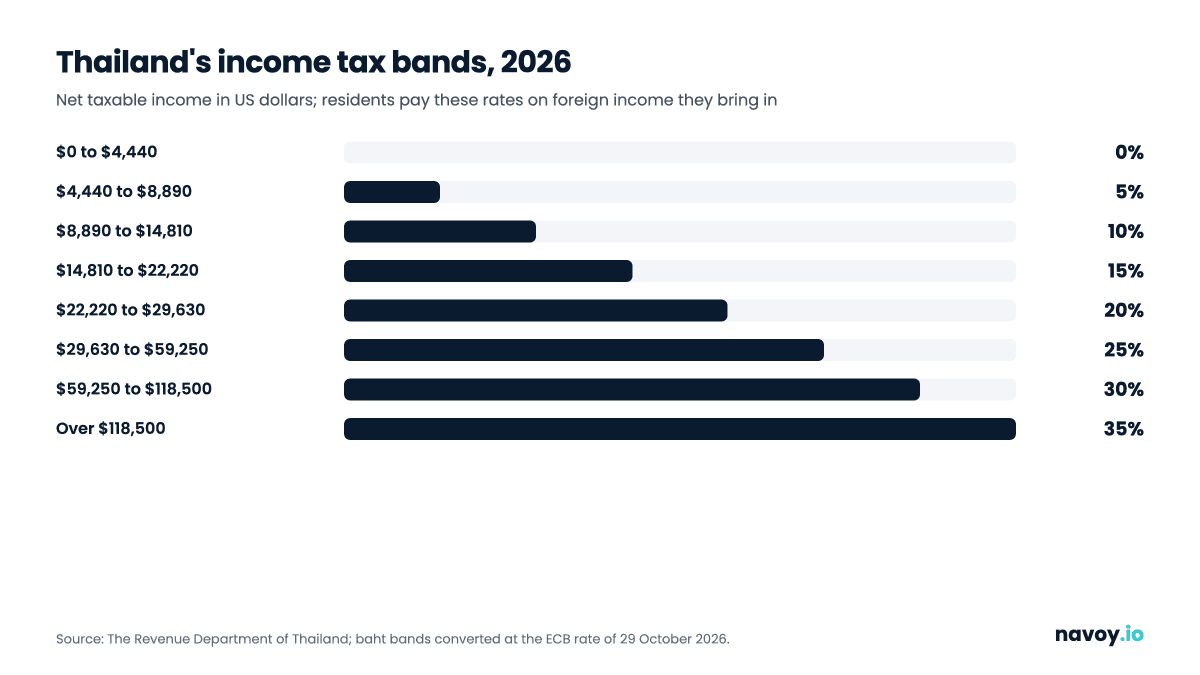
The rates are the same for every row. The Revenue Department's scale on net taxable income:
| Net taxable income | Rate | Tax on the band | Total tax at top of band |
|---|---|---|---|
| $0 to $4,440 (THB 0 to 150,000) | 0% | $0 | $0 |
| $4,440 to $8,890 (THB 150,001 to 300,000) | 5% | $222 (THB 7,500) | $222 (THB 7,500) |
| $8,890 to $14,810 (THB 300,001 to 500,000) | 10% | $593 (THB 20,000) | $815 (THB 27,500) |
| $14,810 to $22,220 (THB 500,001 to 750,000) | 15% | $1,110 (THB 37,500) | $1,930 (THB 65,000) |
| $22,220 to $29,630 (THB 750,001 to 1,000,000) | 20% | $1,480 (THB 50,000) | $3,410 (THB 115,000) |
| $29,630 to $59,250 (THB 1,000,001 to 2,000,000) | 25% | $7,410 (THB 250,000) | $10,810 (THB 365,000) |
| $59,250 to $118,500 (THB 2,000,001 to 4,000,000) | 30% | $17,780 (THB 600,000) | $28,590 (THB 965,000) |
| Over $118,500 (THB 4,000,000) | 35% |
So $29,630 (THB 1,000,000) of net taxable income costs $3,410 (THB 115,000), an average of 11.5%.
What counts as bringing income into Thailand?
Transfers into Thailand
A transfer from a foreign account to a Thai account is the core case. If you bring in only part of an amount, the Revenue Department's guide says the taxable amount is apportioned accordingly. You report remitted foreign income on the normal return, P.N.D. 90 or 91, together with any Thai income.
Savings from before 2024
Income that arose before 1 January 2024 is outside the rule (Paw. 162/2566), and so is income earned in a year you were not a Thai resident, even if you bring it in later. The catch is proof. The guide warns that you may need documents, in English or Thai, to show where and when the money came from. A practical habit is to keep pre-2024 savings in a separate account you do not add to.
Card spending and ATM withdrawals
The Revenue Department's published guidance does not say whether paying in Thailand with a foreign card, or withdrawing cash from a foreign account at a Thai ATM, counts as bringing income in. We found no official answer, so treat this as uncertain rather than as a safe route.
Tax already paid abroad
If a tax treaty allows it, foreign tax on the same income is credited against the Thai tax, capped at the Thai tax on that income. The guide recommends a tax payment certificate from the foreign authority as evidence. Thailand's treaties are listed on the Revenue Department's DTA page.
How is foreign retirement income taxed in Thailand?
A resident retiree who brings in a foreign pension paid from 2024 onward adds it to Thai taxable income. Two things can change that.
Your treaty. Under the US-Thailand treaty, US Social Security paid to a Thai resident is taxable only in the United States (article 20(2)), and US government pensions for government service are generally taxable only in the US (article 21(2)). Private pensions for past employment are taxable only in your country of residence (article 20(1)), but the treaty's saving clause lets the US keep taxing its own citizens. Other countries' treaties differ, so read yours on the DTA page.
The LTR Wealthy Pensioner visa. Applicants aged 50 or over need at least $80,000 a year of pension or passive income, or $40,000 plus a $250,000 investment in Thai government bonds, Thai companies or Thai property, according to the Board of Investment. Holders are exempt on foreign income they bring in.
Retirees who live on savings built before 2024 owe no Thai tax when they bring that money in, provided their records show when it was earned.
Does the DTV visa mean you pay tax in Thailand?
The Destination Thailand Visa carries no tax concession. The DTV1 "Workcation" category is for digital nomads, remote workers and freelancers. The Royal Thai Embassy in London lists a 5-year multiple-entry visa, 180 days per entry, one extension of up to 180 days, and proof of at least $14,810 (THB 500,000) in funds. Stay 180 days or more in one calendar year, which a single entry can reach, and you are a tax resident.
The harder question is the work itself. The Revenue Department's guide for foreigners says income from work performed in Thailand is taxable whether paid inside or outside Thailand, and a 1993 ruling applied this to foreign staff a German company sent to work for its Thai affiliate, including the pay transferred to their German bank accounts. On that reading, a salary or freelance fees earned while you sit in a Bangkok coworking space are Thai-source, even if you never remit them and stay under 180 days.
Many remote workers instead treat such pay as foreign income, taxed only when remitted. That view is not supported by the official guidance, and the Department has published no DTV-specific rules. A treaty can help employees on short stays: under the US treaty, a US resident's pay for work done in Thailand is taxable only in the US if they are there 183 days or less in a 12-month period, the employer is not resident in Thailand and the pay is not borne by a Thai branch. For the full picture, see the Thailand visa guide and our overview of which nomad visas make you pay tax.

Who gets the LTR visa tax exemption?
The Long-Term Resident visa is a 10-year visa run by the Board of Investment, with a $1,480 (THB 50,000) fee when collected in Thailand. Royal Decree No. 743 (2022) exempts foreign employment, business and property income brought into Thailand for three of its four categories:
- Wealthy Global Citizens: at least $1 million in assets and $500,000 invested in Thailand.
- Wealthy Pensioners: aged 50 or over, as above.
- Work-from-Thailand Professionals: remote employees of a listed company, or of a private company at least 3 years old with $50 million of combined revenue over 3 years, earning at least $80,000 a year on average over the past two years ($40,000 with a master's degree).
The fourth category, Highly-Skilled Professionals working for Thai companies in targeted industries, pays a flat 17% on that salary instead. Every condition must be maintained, and the decree suspends the benefit for any year you fall short. One open point: the decree's text does not settle whether pay for work physically done in Thailand counts as employment "carried on abroad", so a remote employee should not assume it is covered.
How does Thailand compare with its neighbors?
For people choosing a base in Southeast Asia, here is how Thailand's rules sit next to five neighbors, from the Nostos tax profiles:
| Country | Becomes resident after | Foreign investment income of a resident foreigner | Top rate |
|---|---|---|---|
| Philippines | No day count; residence depends on facts and intent | Not taxed: foreigners pay only on Philippine-source income | 35% |
| Malaysia | 182 days or more in a calendar year (or linked periods) | Exempt when brought in, until 31 December 2036 (conditions apply) | 30% |
| Thailand | 180 days or more in a calendar year | Taxed if earned from 2024 and brought in | 35% |
| Cambodia | More than 182 days in any 12 months, or a home there | 20% capital gains tax since 2026; foreign dividends and interest unclear | 20% |
| Indonesia | More than 183 days in any 12 months, or living there | Taxed at 5% to 35%; foreign dividends exempt if reinvested in Indonesia | 35% |
| Vietnam | 183 days in a calendar year or the 12 months from arrival | Taxed; 5% on dividends and loan interest | 35% |
Sorted by how foreign investment income is treated: not taxed, exempt, taxed only when brought in, then always taxed (alphabetical). In all six, pay for work done in the country is local income. Sources: each country's tax law or tax authority, listed below.
Where to base yourself in Thailand
The tax rules are national, so they are the same in every city; cost and lifestyle are what differ. Nostos puts a month at about $1,341 in Bangkok, $984 in Chiang Mai, $1,311 in Phuket and $1,025 in Pattaya (city data, July to September 2026). Retirees often also look at Hua Hin and Chiang Rai; island bases include Koh Samui, Koh Phangan and Krabi (Ao Nang). Every city page shows the "Do you pay tax here on income from abroad?" section, and the Thailand country page lists all 19 Thai cities in Nostos. The full tax dataset for 152 countries is on the Nostos data page.
Once you know how long you will stay and how you will fund it, you can plan the trip free with Navoy, compare hotels in Bangkok and look up flights to Bangkok.
Frequently asked questions
Is money I saved before 2024 taxed when I bring it into Thailand?
No. Revenue Department Order Paw. 162/2566, signed on 20 November 2023, says the remittance rule in Order Paw. 161/2566 does not apply to income that arose before 1 January 2024. You may need to prove it, so keep bank statements that show the money was in the account before 2024, ideally in an account you have not topped up since.
Do I pay Thai tax on a foreign pension?
If you are resident in Thailand (180 days or more in the calendar year) and you bring into Thailand a pension paid from 2024 onward, it is taxable at 0% to 35%, with credit for foreign tax where a tax treaty allows. Treaties can change this: under the US-Thailand treaty, US Social Security paid to a Thai resident is taxable only in the United States. Holders of the LTR Wealthy Pensioner visa are exempt on foreign pension income they bring in.
Does the DTV visa make me pay tax in Thailand?
The Destination Thailand Visa has no tax rules of its own. If you stay 180 days or more in a calendar year you become a Thai tax resident, and foreign income earned from 2024 that you bring in is taxed. Separately, the Revenue Department treats pay for work you do while physically in Thailand as Thai-source income wherever it is paid, and it has published no DTV-specific guidance.
Has Thailand passed the foreign income remittance exemption?
Not as far as official sources show on 4 November 2026. A proposal to exempt foreign income brought in during the year it is earned or the following year has been reported, but the Revenue Department's register of new royal decrees and ministerial regulations for 2026 contains nothing on foreign income, Order Paw. 161/2566 is still published as in force, and the 2026 foreign income declaration still asks the tax year each remitted amount was earned.
Sources
- Revenue Code, Chapter 3 Income Tax, section 41 (English translation), The Revenue Department of Thailand, https://www.rd.go.th/english/37749.html, accessed 2026-10-28
- Personal Income Tax, The Revenue Department of Thailand, https://www.rd.go.th/english/6045.html, accessed 2026-10-28
- How do foreigners living in Thailand pay tax? (2024), The Revenue Department of Thailand, https://www.rd.go.th/fileadmin/user_upload/lorkhor/newspr/2024/FOREIGNERS_PAY_TAX2024.pdf, accessed 2026-10-28
- Revenue Department Order Paw. 161/2566 on income tax under section 41 paragraph 2 (consolidated, Thai), The Revenue Department of Thailand, https://www.rd.go.th/fileadmin/user_upload/kormor/newlaw/dn161A.pdf, accessed 2026-10-28
- Revenue Department Order Paw. 162/2566 (Thai), The Revenue Department of Thailand, https://www.rd.go.th/fileadmin/user_upload/kormor/newlaw/dn162A.pdf, accessed 2026-10-28
- Income Declaration for Foreign-Sourced Income (personal income tax forms, 2026), The Revenue Department of Thailand, https://www.rd.go.th/fileadmin/download/english_form/2026/incomeforeign_eng_040869.pdf, accessed 2026-10-28
- New laws register (royal decrees, ministerial regulations and orders, 2025 and 2026, Thai), The Revenue Department of Thailand, https://www.rd.go.th/21221.html, accessed 2026-10-28
- Tax ruling Kor Kor 0811(Kor Mor 06)/1735: withholding tax on pay for work in Thailand paid abroad (Thai), The Revenue Department of Thailand, https://www.rd.go.th/24165.html, accessed 2026-10-27
- Royal Decree issued under the Revenue Code No. 743 B.E. 2565 (2022), English translation, Thailand Board of Investment, https://ltr.boi.go.th/documents/Royal%20Decree%20issued%20under%20the%20Revenue%20Code%20No.743%20(EN).pdf, accessed 2026-10-27
- LTR Visa Thailand: Long-Term Resident Program, Thailand Board of Investment, https://ltr.boi.go.th/, accessed 2026-10-28
- Destination Thailand Visa (DTV), Royal Thai Embassy London (Ministry of Foreign Affairs of Thailand), https://london.thaiembassy.org/en/page/destination-thailand-visa, accessed 2026-10-28
- Double Tax Agreements (DTA), The Revenue Department of Thailand, https://www.rd.go.th/english/766.html, accessed 2026-10-28
- Convention between the United States and Thailand for the avoidance of double taxation (signed 26 November 1996), articles 1, 16, 20 and 21, Internal Revenue Service, https://www.irs.gov/pub/irs-trty/thailand.pdf, accessed 2026-10-28
- Tax Treatment: Residents & Non-Residents (update 08/04/2026), Inland Revenue Board of Malaysia, https://www.hasil.gov.my/wp-content/uploads/Tax-Treatment-Residents-Non-Residents.pdf, accessed 2026-10-27
- Income Tax (Exemption) (No. 5) Order 2022 (Amendment) Order 2024 [P.U. (A) 451/2024], Attorney General's Chambers of Malaysia, https://lom.agc.gov.my/ilims/upload/portal/akta/outputp/2584396/PUA%20451_2024.pdf, accessed 2026-10-27
- National Internal Revenue Code of 1997, as amended, sections 22, 23 and 42, Bureau of Internal Revenue (Philippines), https://www.bir.gov.ph/tax-code, accessed 2026-10-27
- Law on Personal Income Tax No 109/2025/QH15, Government of Vietnam, https://vanban.chinhphu.vn/?pageid=27160&docid=216495&classid=1&typegroupid=3, accessed 2026-10-27
- Prakas No 1130 MEF.Prk.GDT on Capital Gains Tax (31 December 2025), General Department of Taxation (Cambodia), https://www.tax.gov.kh/u6rhf7ogbi6/gdtstream/db67bc15-3ee3-40ca-9ae4-4ca5caaca0d4, accessed 2026-10-27
- Peraturan Direktur Jenderal Pajak PER-23/PJ/2025, Direktorat Jenderal Pajak (Indonesia), https://pajak.go.id/id/node/118835, accessed 2026-10-27
- Undang-Undang Nomor 7 Tahun 2021 (UU HPP), JDIH Kementerian Keuangan (Indonesia), https://jdih.kemenkeu.go.id/dok/uu-7-tahun-2021, accessed 2026-10-27
- Law on Taxation, Royal Kram NS/RKM/0523/004 (16 May 2023), General Department of Taxation (Cambodia), https://www.tax.gov.kh/u6rhf7ogbi6/gdtstream/816f7e7b-e4be-4d8f-a789-e587b92dbe2e, accessed 2026-10-27
- Nostos tax profiles (152 countries), Navoy, https://nostos.navoy.io/data, accessed 2026-10-28
About the Author
Ranym Garali
Ranym is the Marketing and Content Lead at Navoy. She's been writing about travel for two years and digs into the data behind each piece, flight prices, visa rules and what people are actually searching for , so the advice holds up in practice.