Key Takeaways
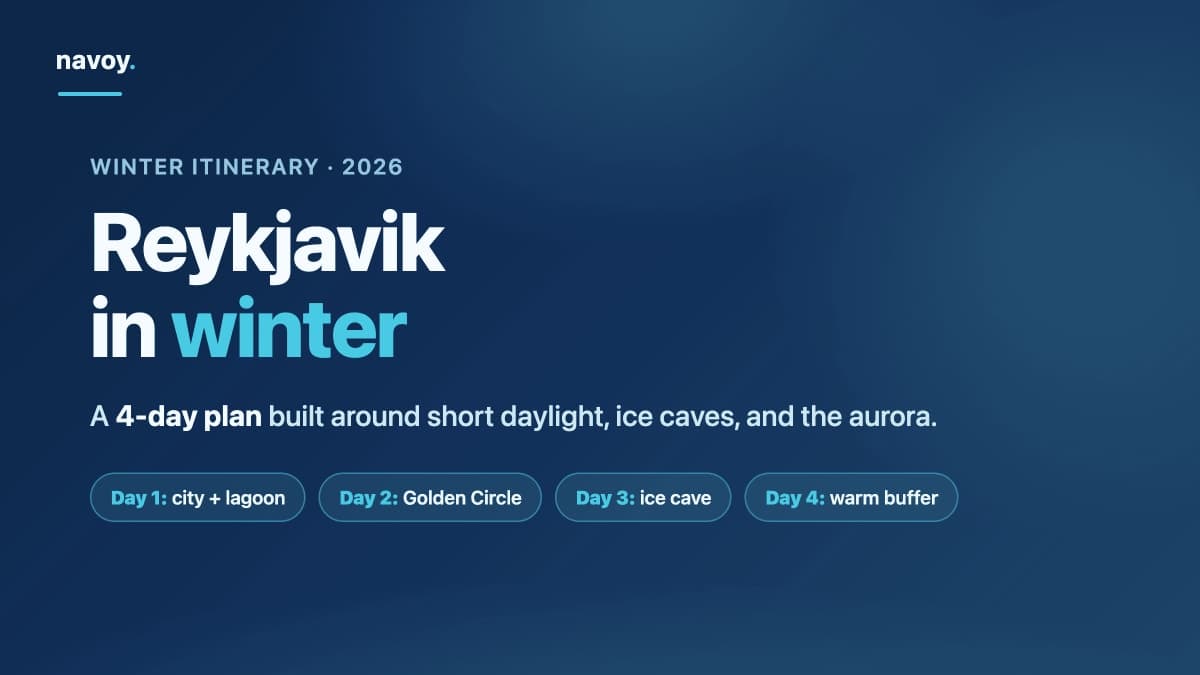
- Four days is the winter sweet spot for Reykjavik: the city, the Golden Circle, a south-coast ice-cave day, and two real chances at the northern lights.
- Plan around the light, not the clock: December gives you roughly 4–5 hours of daylight (sunrise near 11:20 a.m.); February stretches to about 8.
- You don't need a rental car — winter day tours pick up in Reykjavik for the Golden Circle, south coast, and ice caves, and skip icy-road stress.
- Natural ice caves run mid-November to mid-March, and Solar Cycle 25's elevated activity makes 2026 a strong aurora winter.
- Winter is Reykjavik's value season: rooms cost less than summer, on a mid-range budget of roughly $200–350 per person, per day.
Is 4 days in Reykjavik enough in winter?
Yes — four days is the winter sweet spot for a Reykjavik-based trip. It fits the city itself, the Golden Circle, a south-coast day with an ice cave, and enough evenings for two serious northern-lights attempts. Shorter trips work but lose the aurora margin; longer ones start wanting the full Ring Road.
Winter Iceland runs on different math than summer. Daylight is short, weather cancels plans, and the best experiences — ice caves, auroras, steaming lagoons in the snow — are winter-only. Basing in Reykjavik and day-tripping outward is the format that makes all of that work without icy long-haul driving.
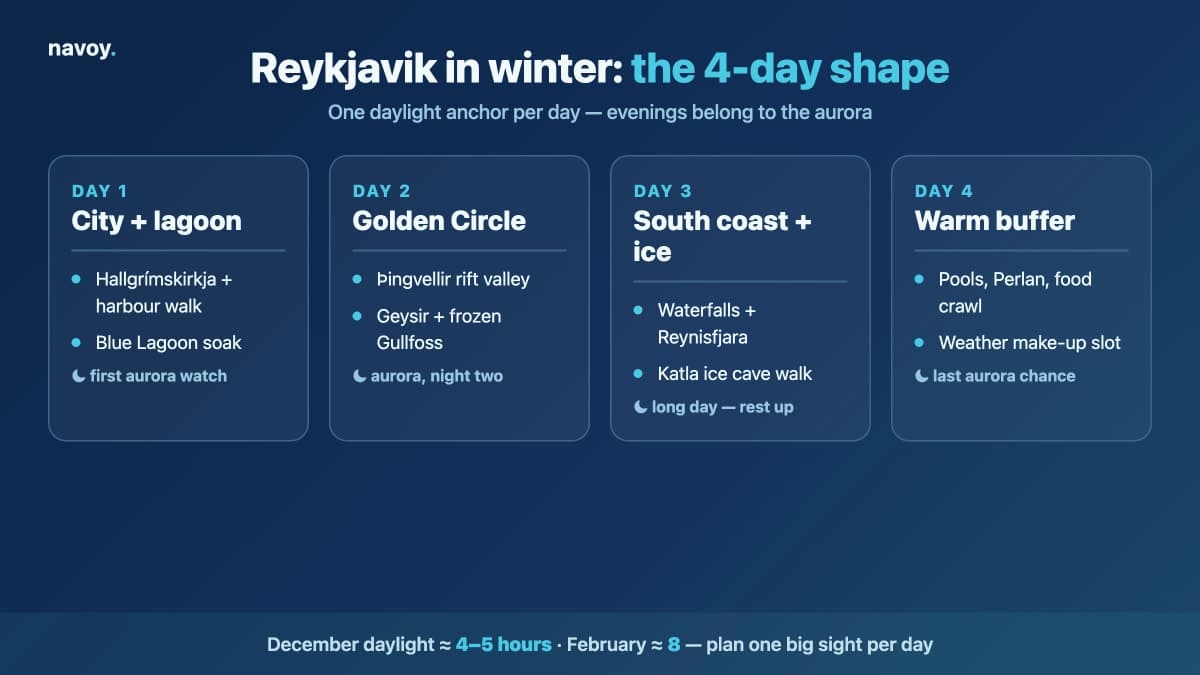
Here's the shape of the four days, then the detail.
| Day | Theme | Anchors |
|---|---|---|
| 1 | Arrive + the city | Hallgrímskirkja, Old Harbour, Blue Lagoon, first aurora watch |
| 2 | Golden Circle | Þingvellir, Geysir, Gullfoss — snow-dusted edition |
| 3 | South coast + ice | Seljalandsfoss, Skógafoss, Reynisfjara, Katla ice cave |
| 4 | Warm Reykjavik | Geothermal pools, Perlan, food scene, flexible buffer |
What should you know before a winter trip to Reykjavik?
Two things run every winter decision: the daylight window and the weather's veto power. Reykjavik in December offers roughly 4–5 hours of usable light — the sun rises around 11:20 a.m. and sets near 3:30 p.m. — while February stretches to about 8 hours. Build each day around one daylight anchor, and keep plans flexible.
| Month | Approx. daylight | What it means |
|---|---|---|
| November | ~6 hours | Ice-cave season opens mid-month; aurora-dark evenings |
| December | ~4–5 hours | One big sight per day; festive city lights fill the dark |
| January | ~5–6 hours | Deepest aurora darkness; coldest stretch |
| February | ~8 hours | The balance pick: real daylight + strong aurora odds |
| March | ~11 hours | Ice caves until mid-month; days feel almost normal |
Temperatures are milder than the latitude suggests — Reykjavik winters hover around freezing thanks to the Gulf Stream — but wind and ice are the real adversaries. Pack layers, waterproofs, and shoe spikes, and treat every outdoor plan as weather-permitting.
What's the ideal 4-day Reykjavik winter itinerary?
Anchor each day to one daylight highlight, keep evenings for the aurora, and let tours do the winter driving. Here's a day-by-day version you can lift straight into a trip planner.
Day 1 — The city and the lagoon
Land, drop your bags, and spend the light hours on foot: Hallgrímskirkja's tower view, the sculpture-lined waterfront to Harpa concert hall, and the Old Harbour. In the afternoon, soak in the Blue Lagoon (about 40 minutes away) — steam, snow, and silica in the dark is the right introduction to winter Iceland. Check the aurora forecast before bed; clear night = go.
Day 2 — The Golden Circle in the snow
A full-day loop past Þingvellir National Park's frozen rift valley, the erupting Geysir hot springs, and a half-frozen Gullfoss waterfall. Winter tours run daily from Reykjavik with pickup, so the icy driving is someone else's job. Back in the city by evening — night two of aurora watching.
Day 3 — South coast waterfalls and an ice cave
The big one: Seljalandsfoss and Skógafoss in their winter armor, the black-sand beach at Reynisfjara, and a guided walk inside the Katla ice cave's black-and-blue ice — natural ice caves are only accessible roughly mid-November to mid-March with licensed guides. It's a long day; that's why it sits in the middle of the trip.
Day 4 — Warm Reykjavik and the buffer
Slow morning at a local geothermal pool or Sky Lagoon, then Perlan's glacier exhibition and a proper food crawl — lamb soup, fresh fish, the famous hot-dog stand. Day 4 is also your insurance: if weather stole Day 2 or 3, this is where the rescheduled tour lands.
Can you see the northern lights from Reykjavik?
Yes — and 2026 is a strong year to try. The aurora season runs late August to mid-April, with the deepest darkness from November to January, and Solar Cycle 25's elevated activity carries into 2026, producing stronger displays than most of the past decade.
From the city itself, light pollution is the enemy: on active nights locals head to the Grótta lighthouse at the peninsula's tip or simply darker suburbs. Aurora hunts by bus or boat leave nightly when skies cooperate and know where the clear gaps are. The honest rules: check the forecast, give it more than one night — four evenings is a real margin — and treat any sighting as a bonus, not a promise.
Should you rent a car in Reykjavik in winter?
For this itinerary, no. Every anchor — Golden Circle, south coast, ice caves, aurora hunts — runs as a guided day tour with Reykjavik pickup, and winter roads demand 4×4 experience, studded-tire confidence, and comfort with sudden closures. Unless you drive winters at home, tours are safer, warmer, and usually cheaper than a 4×4 plus insurance.
If you do rent: a 4×4 runs roughly $160–320 per day in winter, and since January 2026 Iceland also charges a per-kilometre road tax (6.95 ISK/km, about $0.05) that rental companies pass on. The full cost picture — including that new tax — is in our guide to how many days you need in Iceland.
How much does 4 winter days in Reykjavik cost in 2026?
Winter is Reykjavik's value season: plan roughly $200–350 per person, per day mid-range, with hotels meaningfully cheaper than summer. The savings on rooms and cars get partially reinvested in winter-only experiences — ice caves and aurora tours are the splurge lines.
| Cost line (winter 2026) | Typical range |
|---|---|
| Mid-range daily budget | $200–350 per person |
| Hotel night (central, winter) | Below summer peak — the season's biggest saving |
| Golden Circle day tour | ~$70–120 |
| South coast + ice cave day tour | ~$150–250 |
| Northern lights hunt | ~$50–90 (many rebook free if no sighting) |
| Blue Lagoon entry | ~$70–100 |
Ranges compiled July 2026 from tour operators and cost guides; verify at booking — winter pricing moves with demand and holidays.
Two timing notes: the weeks around Christmas and New Year spike back to peak pricing, and January–February is the quietest, cheapest window with the darkest skies. If value plus aurora is the goal, that's the slot.
Plan and book your Reykjavik winter trip in one platform with Navoy
A winter trip is mostly sequencing: the right days for tours, a weather buffer, a hotel near the pickup points, and evenings kept free for the sky. Navoy is an AI travel agent that handles the sequencing for you. Describe your trip — your dates, pace, and budget split between hotels and experiences — and Navoy builds a day-by-day Reykjavik itinerary, then lets you book hotels and airport transfers in one platform. Our Reykjavik destination guide shows a relaxed 5-day winter version built for families alongside a full summer Ring Road expedition.
Navoy's free plan covers up to three trips of up to 14 days each, so a 4-day winter break fits easily at no cost. Navoy does not book flights; it focuses on planning, hotels, and transfers.
Frequently Asked Questions
Is Reykjavik worth visiting in winter?
Yes. Winter is when Iceland's signature experiences happen: northern lights, natural ice caves, and geothermal lagoons in the snow. Rooms cost less than in summer, the city is festive and walkable, and day tours still run to the Golden Circle and south coast. The trade-off is short daylight — plan one big sight per day.
How cold is Reykjavik in winter?
Milder than most people expect. Thanks to the Gulf Stream, Reykjavik winter temperatures hover around freezing, typically between about -3°C and +3°C (27–37°F). Wind and ice are the bigger challenges: pack windproof layers, waterproof boots, and shoe spikes, and you'll be comfortable on all of this itinerary.
Can you see the northern lights from Reykjavik city?
Sometimes, on strong nights — but city light pollution mutes them. Locals head to darker spots like the Grótta lighthouse, or join evening aurora hunts that chase clear skies by bus or boat. Give yourself several nights; four evenings offers a realistic margin for at least one clear, active sky.
Do you need to rent a car for a Reykjavik winter trip?
No. This 4-day plan runs entirely on guided day tours with hotel pickup, which handle the icy driving for you. Renting only makes sense for confident winter drivers, and a 4×4 costs roughly $160–320 per day in winter, plus Iceland's new per-kilometre road tax introduced in January 2026.
Sources
- Perlan — Northern Lights in Iceland Month by Month
- Arctic Adventures — Ice Cave Tours Iceland 2026: Katla & Crystal Caves
- Guide to Iceland — The Best Ice Cave Tours in Iceland
- Center Hotels — Guide to Reykjavík in Winter: Things To Do, Weather & Packing
- Ísland.is (Government of Iceland) — Kilometer fee on vehicles
Related reading: pair this with our Reykjavik destination guide, how many days you need in Iceland, and coolcation face-off: Iceland vs Norway vs Scotland.
Ready to turn "Reykjavik in winter" into a booked plan?
Plan and book your trip with Navoy →
Tell Navoy your dates, pace, and budget, and it builds your day-by-day winter itinerary and books your hotels and airport transfers in one platform.
About the Author
Haroun Moula
Haroun Moula is the founder and CEO of Navoy. Before Navoy, he worked in luxury travel with VVIPs and high-profile travelers. He built Navoy to bring curated, adaptive trip planning to more travelers through an AI travel agent that plans and books core trip parts in one place.