Key Takeaways
- 5 to 7 days is the sweet spot for a first Iceland trip: Reykjavik, the Golden Circle, and the south coast without brutal driving days.
- The full Ring Road needs 8–10 days minimum — 7 is technically possible but rushed; most experienced drivers recommend 10.
- From January 2026, Iceland charges a per-kilometre road tax (6.95 ISK/km, about $0.05) — a typical Ring Road trip adds roughly $80–105 most older guides don't mention.
- Northern lights season runs late August to mid-April, and Solar Cycle 25's elevated activity carries into 2026 — a strong aurora year.
- Budget roughly $200–350 per person, per day for mid-range travel; the rental car is the single biggest line after flights.
How many days in Iceland is enough?
For most first-time visitors, 5 to 7 days in Iceland is enough. That covers Reykjavik, the Golden Circle, and the south coast's waterfalls, glaciers, and black-sand beaches at a humane pace. The full Ring Road around the island needs 8–10 days; a 3–4 day stopover works, but only as a highlights sprint.
Iceland punishes rushing more than most destinations. Distances are long, weather closes roads without warning, and the best moments — an empty black beach, an aurora flare at midnight — reward slack in the schedule. So choose your trip length by how much driving you genuinely want, not by how much of the map you can touch.
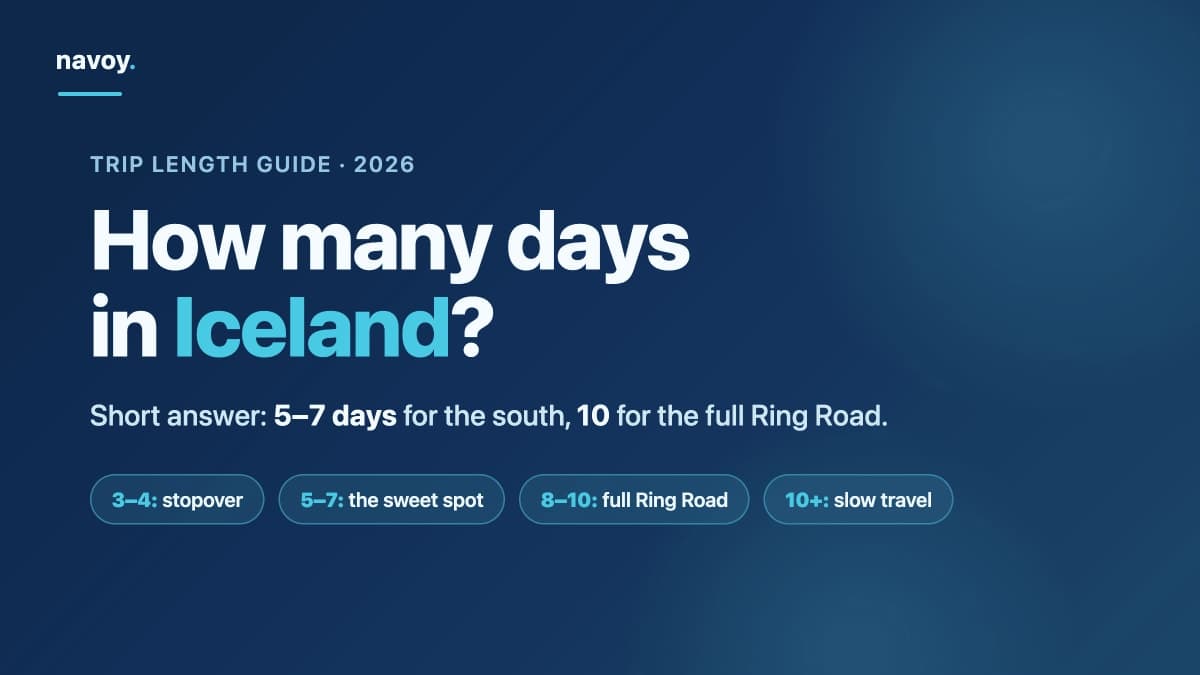
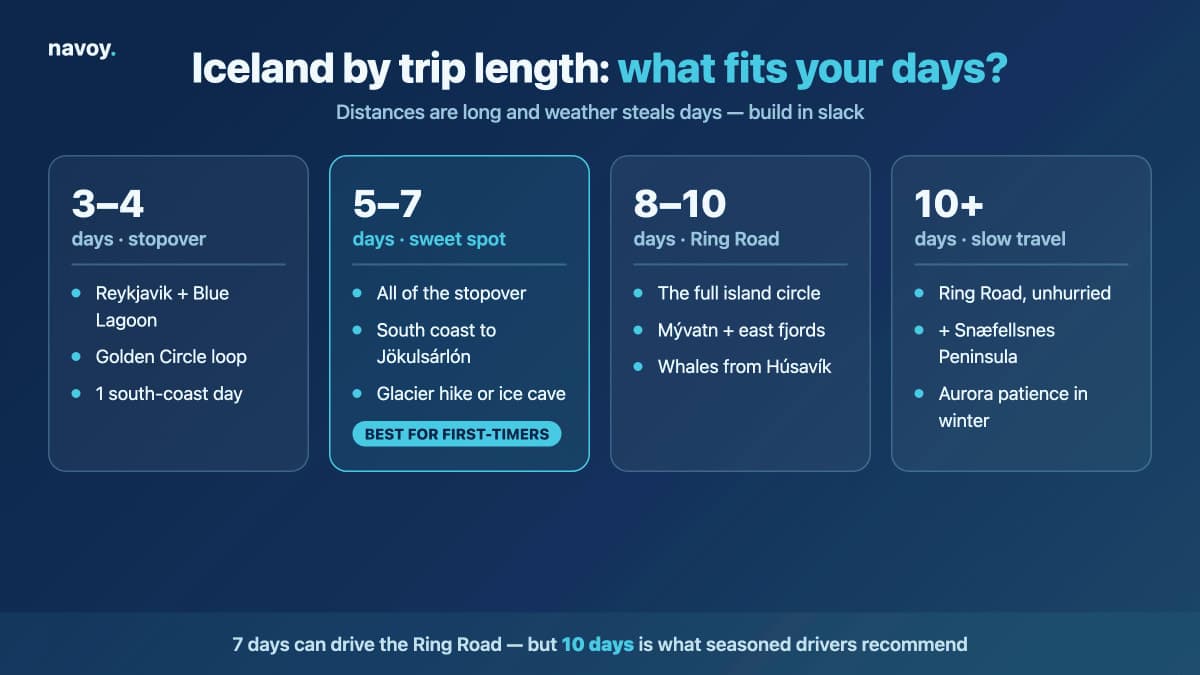
Here is what each trip length realistically gets you.
| Trip length | Best for | What you'll cover | What you'll miss |
|---|---|---|---|
| 3–4 days | A stopover or long weekend | Reykjavik, Golden Circle, Blue Lagoon, a south-coast day | Glacier lagoons, the east and north |
| 5–7 days | The sweet spot for first-timers | All of the above + south coast to Jökulsárlón glacier lagoon, ice caves or a glacier hike | The full circle; the Westfjords |
| 8–10 days | The full Ring Road | The entire island: east fjords, Mývatn, Akureyri, whale watching from Húsavík | Only the remote Westfjords and highlands |
| 10+ days | Slow travellers and photographers | Ring Road plus Snæfellsnes Peninsula or the Westfjords at a relaxed pace | Very little |
What can you see in Iceland in 3 to 4 days?
Three to four days covers the classic stopover triangle: Reykjavik, the Golden Circle, and a day along the south coast. It's a genuinely good short trip — Iceland packs its most accessible icons into the southwest corner — but it is a taste, not the meal.
Day one is Reykjavik and the Blue Lagoon (about 40 minutes from the city). Day two is the Golden Circle — the roughly 300 km loop past Þingvellir National Park, the Geysir hot springs, and Gullfoss waterfall. Day three runs the south coast to the waterfalls Seljalandsfoss and Skógafoss and the black-sand beach at Reynisfjara. A fourth day lets you push on to the Sólheimajökull glacier or simply slow down.
The catch with a short trip: the famous glacier lagoon Jökulsárlón sits about five hours' drive from Reykjavik, so it doesn't fit comfortably until you have five days or more.
Is a week enough to drive the Ring Road?
Seven days is enough to physically drive the Ring Road, but it will feel like a checklist; 8–9 days is the realistic minimum and 10 is the number most experienced drivers recommend. The circle is about 1,320 km before detours, and the detours are the point.
With 10 days you stop being a driver and start being a traveller: whale watching from Húsavík, the geothermal fields around Mývatn, an unhurried east-fjords day, and buffer for the weather days Iceland will throw at you in any season. If you have the days, the hub's 13-day Ring Road expedition on our Reykjavik destination guide shows what a full-comfort version looks like — glaciers, highlands, and black sands without a single rushed morning.
One 2026-specific note for drivers: Iceland replaced its fuel tax with a per-kilometre road charge in January 2026 (details in the cost section below), so longer drives now carry a visible per-km cost. It doesn't change what's worth seeing — it just belongs in the budget.
Golden Circle or Ring Road: which fits your trip length?
Under 5 days, do the Golden Circle and south coast; 8 days or more, do the Ring Road; in between, do the south coast properly and skip the circle entirely. They are different trips, not competing versions of the same one.
- Golden Circle — a 300 km day loop from Reykjavik. Þingvellir, Geysir, Gullfoss. Fits any trip length, including a layover.
- South coast (2–3 days) — the best reward-per-kilometre in Iceland: waterfalls, glaciers, Reynisfjara, and Jökulsárlón at the far end.
- Ring Road (8–10 days) — the whole island. The east and north are quieter, wilder, and the reason people come back raving.
If you're choosing between Iceland and another northern destination entirely, our coolcation comparison of Iceland, Norway, and Scotland breaks down which country fits which traveller.
When is the best time to visit Iceland?
Summer (June–August) is best for road trips and the midnight sun; late September to mid-April is northern lights season — and 2026 is a strong aurora year. There is no bad answer, only different trips.
Summer brings 20+ hours of daylight, every road open, and peak prices. Winter brings the aurora, ice caves, and cheaper rooms, at the cost of short days and weather that can close the Ring Road. The shoulder months — September–October and late February–March — are the quiet compromise: aurora-dark skies with more manageable roads.
On the aurora specifically: Solar Cycle 25 peaked around 2025 and elevated solar activity carries into 2026, which means stronger and more frequent displays than most of the past decade. If the northern lights are your main reason to go, a 2026 winter trip is well timed — plan at least 4–5 nights to ride out cloudy spells.
How much does an Iceland trip cost in 2026?
Budget roughly $200–350 per person, per day for mid-range travel in Iceland in 2026 — and add the country's new per-kilometre road tax to any road-trip budget. Iceland is expensive, but it's predictable-expensive: the car, fuel, and accommodation do most of the damage, and all three are bookable in advance.
The change worth knowing this year: from 1 January 2026, Iceland moved from fuel taxes to a kilometre-based road charge of 6.95 ISK per km (about $0.05) for passenger cars. Rental companies pass it on either by odometer reading or as a flat daily rate of around 1,390 ISK (~$10).
| Cost line (2026) | Typical range |
|---|---|
| Mid-range daily budget | $200–350 per person |
| Economy rental car | $60–100/day off-season · $110–160+ in summer |
| 4×4 (winter or highlands) | $160–320/day |
| Fuel | ~$2.45 per litre |
| New km tax (from Jan 2026) | 6.95 ISK/km ≈ $80–105 for a full Ring Road trip |
Ranges compiled January–July 2026; see Sources. Verify exact rates at booking — rental pricing swings hard by season.
The practical takeaway: a 7-day south-coast trip costs meaningfully less than a 10-day Ring Road not just in nights, but in kilometres — the new tax makes trip length and route a real budget lever for the first time.
Plan and book your Iceland trip in one platform with Navoy
Iceland trips live or die on logistics: the right trip length, a realistic route, rooms in tiny towns that sell out months ahead, and now a road tax to keep straight. Navoy is an AI travel agent that turns all of that into one plan. Describe your trip — how many days, your pace, your budget split between hotels and experiences — and Navoy builds a day-by-day Iceland itinerary, then lets you book hotels and airport transfers in one platform. Start with our Reykjavik destination guide to see a full Ring Road expedition and a relaxed 5-day winter version side by side.
Navoy's free plan covers up to three trips of up to 14 days each, so even a full 10-day Ring Road fits at no cost. Navoy does not book flights; it focuses on planning, hotels, and transfers.
Frequently Asked Questions
Is 5 days enough for Iceland?
Yes, 5 days is enough for an excellent first trip: Reykjavik, the Golden Circle, and the south coast as far as the Jökulsárlón glacier lagoon. You won't circle the island — the full Ring Road needs 8–10 days — but you'll see Iceland's most famous landscapes without spending every day behind the wheel.
Can you do Iceland in 3 days?
Yes, as a stopover. Three days covers Reykjavik, the Blue Lagoon, the Golden Circle, and one south-coast day with its waterfalls and black-sand beach. It works best as a taster or a long layover; skip the glacier lagoon, which sits about five hours from the capital.
Is one week enough to drive the Ring Road?
Seven days is the bare minimum and it will feel rushed, with long daily drives and no weather buffer. Most experienced Ring Road drivers recommend 8–10 days, which adds the north's whale watching and geothermal areas, the east fjords, and slack for the storms Iceland delivers in any season.
Is Iceland expensive to visit?
Yes. Plan on roughly $200–350 per person, per day for mid-range travel in 2026, with the rental car as the biggest cost after flights. New for 2026: a per-kilometre road tax (6.95 ISK/km) replaced fuel taxes in January, adding about $80–105 to a full Ring Road drive.
Sources
- Ísland.is (Government of Iceland) — Kilometer fee on vehicles
- Hertz Iceland — Iceland New Road Tax 2026: Kilometer Charge Guide
- Lonely Planet — A 7-day Ring Road itinerary in Iceland
- Earth Trekkers — The Perfect 7 to 10 Day Iceland Ring Road Itinerary
- Perlan — Northern Lights in Iceland Month by Month
- Guide to Iceland — The Golden Circle
Related reading: pair this with our Reykjavik destination guide, coolcation face-off: Iceland vs Norway vs Scotland, and how many days you need in Kyoto.
Ready to turn "how many days in Iceland" into a booked plan?
Plan and book your trip with Navoy →
Tell Navoy your dates, pace, and budget, and it builds your day-by-day Iceland itinerary and books your hotels and airport transfers in one platform.
About the Author
Ranym Garali
Ranym is the Marketing and Content Lead at Navoy. She's been writing about travel for two years and digs into the data behind each piece, flight prices, visa rules and what people are actually searching for , so the advice holds up in practice.