
Key Takeaways
- EU law makes allergen information mandatory for every restaurant meal. It does not make it written. Each country chooses the medium.
- Ireland is the strictest. The information must be written and accessible before you order, and you must not have to ask for it.
- Spain, Germany, Austria, the Netherlands and Greece allow a verbal answer, but only alongside a visible notice and a written record kept on the premises.
- "Gluten-free" is a legal term meaning 20 mg/kg or less. "Very low gluten" means 100 mg/kg or less.
- Natasha's Law does not cover restaurant meals. It applies to food packaged on site before you order, not to a dish cooked to order.
Everywhere in the European Union, a restaurant must tell you whether a dish contains any of the 14 declarable allergens. That much is settled law and it does not vary. What varies, and what almost nobody writing about gluten-free travel mentions, is whether that information has to be written down. Article 44 of the food information regulation lets each member state decide the medium, and they decided differently. In Ireland you are entitled to read it without asking. In Spain a waiter is legally allowed to simply tell you.
What does EU law actually guarantee?
Regulation (EU) 1169/2011 makes allergen declaration mandatory for non-prepacked food, which includes every restaurant meal. Allergens are the only particular that is mandatory for food sold loose: calorie counts, origin labelling and the rest are not required. But Article 44(2) allows member states to set their own rules on the means by which that information is provided.
The relevant wording is short:
the provision of the particulars specified in point (c) of Article 9(1) is mandatory
Member States may adopt national measures concerning the means through which the particulars are to be made available and, where appropriate, their form of expression and presentation.
Two things follow, and the second is the one that affects your dinner. The entitlement is uniform: you can always find out. The delivery is national: sometimes you read it, sometimes you have to ask.
The allergens themselves are fixed across the EU in Annex II. The first entry is worth quoting precisely, because it is routinely paraphrased wrongly. It is not "gluten". It is cereals containing gluten, namely wheat including spelt and khorasan, rye, barley, oats, and their hybridised strains. Oats are inside the list, which surprises people who assume oats are a safe substitute.
The other thirteen are crustaceans, eggs, fish, peanuts, soybeans, milk including lactose, nuts, celery, mustard, sesame, sulphur dioxide and sulphites above 10 mg/kg, lupin, and molluscs.
Which countries must write it down?
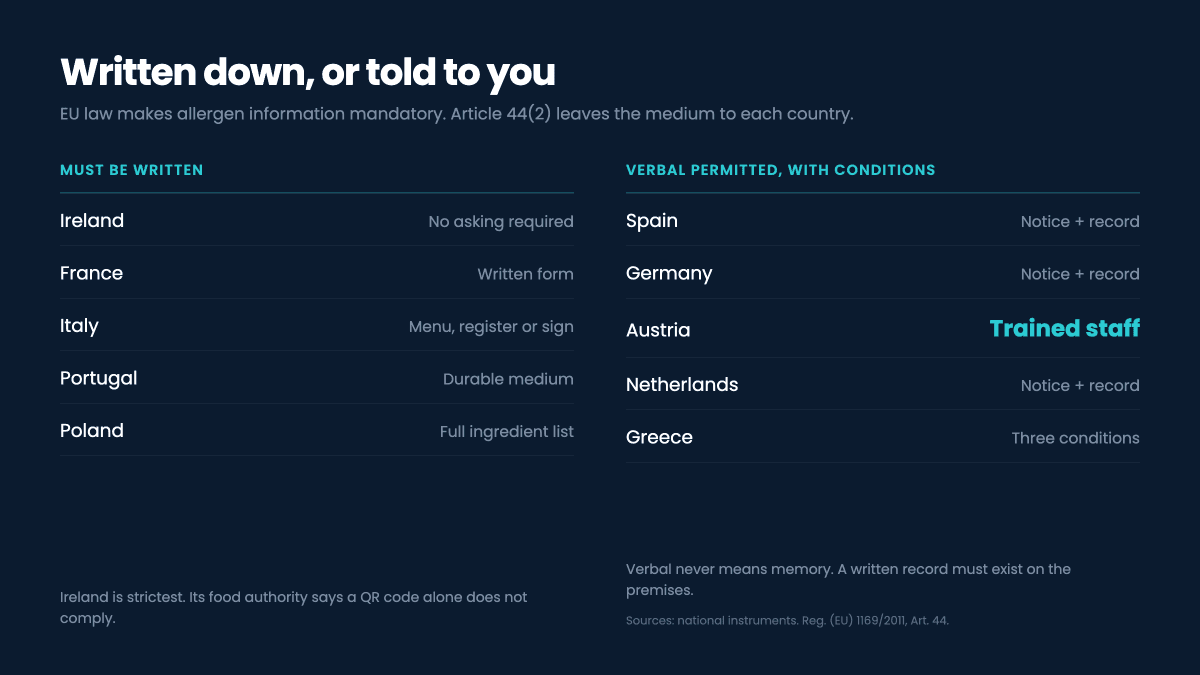
Ireland, France, Italy, Portugal and Poland require allergen information in writing. Ireland goes furthest: the information must be freely and easily accessible before the sale, and the food safety authority states explicitly that consumers must not have to ask for it.
| Country | Requirement | Instrument |
|---|---|---|
| Ireland | Written particulars, accessible before sale, conspicuous and legible. You must not have to ask | S.I. No. 489/2014 |
| France | Written, legible, visible in public areas, provided directly and freely in written form | Code de la consommation, art. R. 412-14 |
| Italy | Menu, register, sign or equivalent system including digital, kept clearly in view | D.Lgs. 231/2017, art. 19 |
| Portugal | Must be available on a durable information medium. The general "ask us" escape does not extend to allergens | Decreto-Lei n.º 26/2016 |
| Poland | Displayed on a notice at the point of sale or otherwise, in a place directly accessible to the consumer | Rozporządzenie of 23 December 2014 |
Ireland's rule has a modern consequence worth knowing: the Food Safety Authority of Ireland has stated that a QR code alone does not comply. If a restaurant's only allergen information is behind a code you have to scan, that is not accessible in the sense the regulation requires.
Poland is the outlier in a different direction. Its rule requires not just allergens but the full ingredient list, plus the name of the food and its producer, which goes beyond the EU minimum. One caveat on how to read that: the Polish regulation does not actually use the word "in writing". The requirement that it be displayed where the consumer can reach it directly is what the national inspectorates interpret as ruling out a verbal-only answer.
Which countries let staff tell you verbally?
Spain, Germany, Austria, the Netherlands and Greece permit allergen information to be given orally. In every one of them the permission is conditional: there must be a clearly visible notice telling you that you may ask, and a written or electronic record must exist on the premises for staff and inspectors.
So "verbal" never means "the waiter's memory". It means a written record exists behind the counter and the waiter is reading from it, or has been trained on it.
| Country | Conditions attached |
|---|---|
| Spain | Available on request before purchase, recorded in writing or electronically on site, visible notice saying where it is |
| Germany | Staff must be sufficiently informed, written or electronic record accessible to authorities and consumers, clearly visible notice |
| Austria | Oral transmission only by trained persons with documented proof of training, information resting on written documentation |
| Netherlands | Conveyable without delay before purchase, available to staff and the food authority, clearly visible notice |
| Greece | Three cumulative conditions: visible sign, printed or electronic record accessible to consumer, staff and inspectors, and given before sale by trained staff at no cost |
Austria is the strictest of the verbal group, because the training requirement is documented and inspectable rather than assumed. Note that the widely repeated claim that Austrian staff must be retrained every three years is no longer accurate: that requirement was removed by a 2017 amendment.
Czechia sits between the two groups and is the most carefully drafted rule of all of them. It offers four routes, and every one begins with the word písemně, in writing. One of those routes is a written sign reading, in translation, "Ask the staff for information about the presence of specific allergens in the dish", followed by a legal duty to actually provide that answer. The binding condition is verifiability: an inspector can require the restaurant to produce the documentation its staff are relying on.
The United Kingdom's legal floor remains verbal plus a signpost. The Food Standards Agency published best-practice guidance in February 2025 recommending written information alongside a conversation, but it states plainly that you are not required by law to follow best practice guidance. The minimum legislative requirement has not changed.
What do "gluten-free" and "very low gluten" legally mean?
Both are regulated terms with numerical thresholds. "Gluten-free" means the food contains no more than 20 mg/kg of gluten. "Very low gluten" means no more than 100 mg/kg. Oats used in a food carrying either claim must themselves be at 20 mg/kg or below.
These come from Regulation (EU) No 828/2014, which has been in force since August 2014 and has never been amended. That stability is useful: it means a "gluten-free" label in Lisbon and one in Helsinki mean the same measured thing.
What the threshold does not tell you is anything about the kitchen. A legal claim about the composition of a food is not a statement about cross-contamination during preparation, and the regulation does not address how a dish is cooked. The number is about the food, not the process.
What changed for the UK after Brexit?
Two things, and both are commonly got wrong. The UK's allergen list has begun to diverge from the EU's, and Natasha's Law is much narrower than most travellers assume.
The UK's copy of the allergen annex was assimilated as it stood on 31 December 2020 and has not tracked EU amendments since. The EU added an exemption to the mustard entry, applying from 1 April 2025; the UK entry is still plain "mustard and products thereof". The lists are no longer word-identical, so describing the UK as having "the same 14 allergens" is now inaccurate, even though the count is unchanged.
Natasha's Law is the bigger misunderstanding. It requires a full ingredient list with allergens emphasised, which sounds like exactly what a traveller wants. It applies to prepacked for direct sale food only: items packaged on the premises before being ordered, such as the sandwich sitting in a chiller cabinet. A meal cooked to order in a restaurant is not prepacked for direct sale, and for that meal the verbal-plus-signpost floor still applies. The law was a significant change for grab-and-go food and made no difference at all to restaurant menus.

What should you do before you travel?
Check which side of the written-verbal line your destination sits on, and plan the conversation accordingly. In the written countries you can research before you arrive. In the verbal countries the information exists but you have to ask for it, so knowing the phrase matters more than reading the menu.
Four practical steps:
- Look at the table above for your destination. If it is a written country, the restaurant should have the information available in a form you can read, and you are entitled to see it without asking.
- If it is a verbal country, ask before ordering, not after. The legal condition in every case is that the information is provided before the sale.
- Ask to see the written record. Even where verbal is permitted, a written or electronic record must exist on the premises. Asking to see it is reasonable and legally supported.
- Carry a written statement of your requirement in the local language. This is not a legal point, it is a practical one. It removes the translation risk from a conversation that the law has already guaranteed you.
One thing this article cannot tell you is whether any given meal is safe to eat. The law determines what you must be told about ingredients. It does not govern how a kitchen handles cross-contamination, and no legal entitlement substitutes for a direct conversation about how a dish is prepared.
Planning a trip with dietary requirements
Knowing whether a country writes it down or tells you changes how you plan a trip, not just how you order. Navoy can build an itinerary around destinations and neighbourhoods rather than leaving you to work out each country's rules on arrival.
Frequently asked questions
Do European restaurants have to list allergens on the menu?
They have to provide the information, but not necessarily on the menu. Ireland, France, Italy, Portugal and Poland require it in writing. Spain, Germany, Austria, the Netherlands and Greece allow staff to tell you verbally, provided a notice is displayed and a written record is kept on site.
What does gluten-free legally mean in Europe?
No more than 20 milligrams of gluten per kilogram of food, under Regulation (EU) No 828/2014. "Very low gluten" means no more than 100 mg/kg. The thresholds are identical across the EU and have not changed since 2014.
Does Natasha's Law mean UK restaurants list allergens?
No. Natasha's Law covers food packaged on the premises before being ordered, such as a pre-made sandwich in a chiller. A meal cooked to order is not covered, and for those the legal minimum remains verbal information alongside a visible sign.
Are oats gluten-free in EU law?
Oats are listed as a cereal containing gluten in Annex II, so they must be declared as an allergen. Oats used in a product labelled "gluten-free" must themselves test at 20 mg/kg or below, which is why specially produced oats exist for that purpose.
Sources
- Regulation (EU) No 1169/2011, consolidated text, Article 44 and Annex II
- Regulation (EU) No 828/2014, gluten-free and very low gluten thresholds
- S.I. No. 489/2014, Ireland and FSAI guidance on non-prepacked food
- Code de la consommation, article R. 412-14, France
- Real Decreto 126/2015, Spain
- Lebensmittelinformations-Durchführungsverordnung § 4, Germany
- Warenwetregeling allergeneninformatie, Netherlands
- Decreto-Lei n.º 26/2016, Portugal
- FSA, allergen information for non-prepacked foods and PPDS guidance
Related articles
- Tipping Etiquette by Country 2026
- Can You Bring Food on a Plane?
- ETIAS Requirements for US Travelers
Travelling with dietary requirements? Let Navoy plan the route and the neighbourhoods around them.
About the Author
Ranym Garali
Ranym is the Marketing and Content Lead at Navoy. She's been writing about travel for two years and digs into the data behind each piece, flight prices, visa rules and what people are actually searching for , so the advice holds up in practice.