Key Takeaways
- No independent study of transacted airfares across Black Friday exists. The only fare analysis anyone cites is built on 2018 search data.
- The statistics you see every November count deals advertised and trips planned, which is promotional volume, not price movement.
- Airline fares are up 23.4% over twelve months on the most recent US government figures, and rose another 2.7% in August alone.
- Specific airline sales are real and bookable. A general fare drop is a different claim, and it has not been tested.
- Black Friday 2026 is 27 November, Cyber Monday is 30 November and Travel Tuesday is 1 December.
Individual airlines run genuine, bookable sales on Black Friday with published terms. Whether airfare in general is cheaper on those dates has never been independently measured. The only fare study anyone cites is KAYAK's, built on 2018 search data and published in 2019, and it measured searches rather than bookings. Everything else circulating each November counts deals advertised, not prices paid.
Those are two different claims, and almost every article treats them as one. Here is what the evidence actually supports.
Is there proof that flights get cheaper on Black Friday?
No. Searching for a before-and-after study of transacted fares on the same routes across Black Friday returns nothing. The closest thing is a KAYAK analysis of 2018 search data, published in 2019, which predates the pandemic reset of airline pricing entirely and measured what people searched for rather than what they paid.
This is not a claim that fares do not fall. It is a claim that nobody has published the work.
Those are different, and the distinction matters because the absence gets filled with numbers that measure something else.
| What gets quoted | What it actually measures |
|---|---|
| "Airfare drops 6 to 10%" | KAYAK, 2018 search queries, published 2019 |
| "Millions of deals this Black Friday" | Deals advertised by sellers |
| "Trips planned up X%" | Consumer intent, not transactions |
| "Up to 50% off" | Usually hotels and packages, not flights |
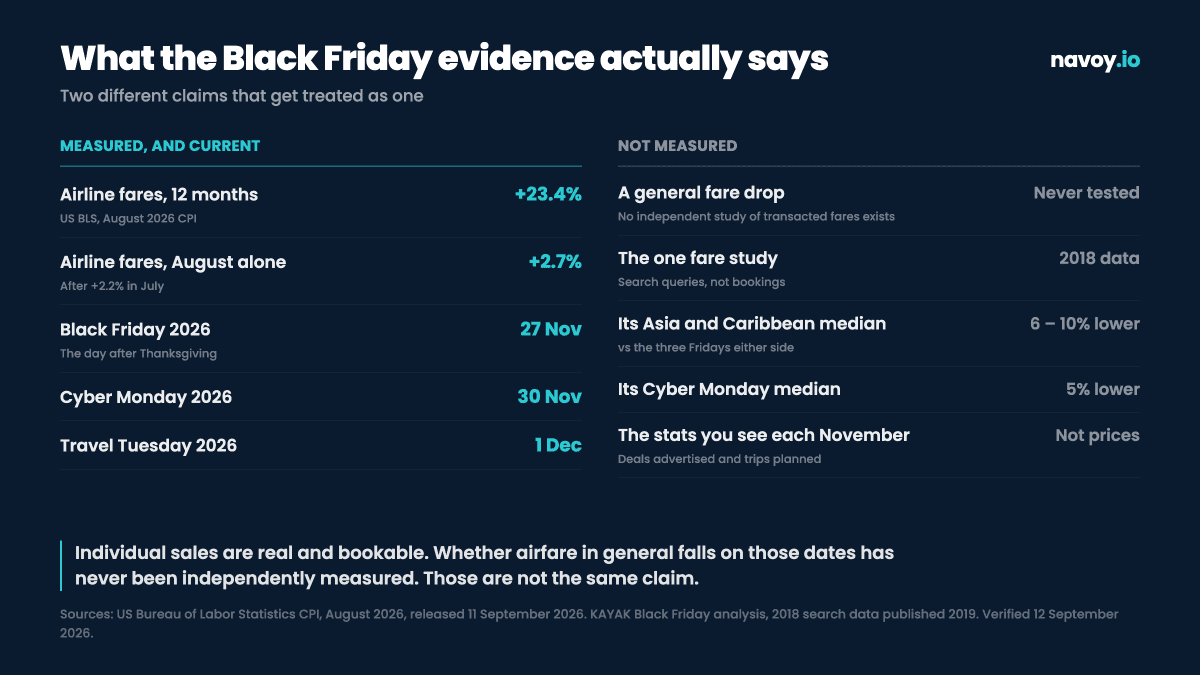
For completeness, the KAYAK figures as published: median airfare to Asian and Caribbean destinations ran 6 to 10% below the three Fridays either side, with Hong Kong at 23% and both Tokyo and Georgetown in the Bahamas at 18%. Cyber Monday's median sat 5% below neighbouring Mondays.
Read those as a hint about magnitude from a particular year, not as a current number. Single-digit medians on eight-year-old search data are not a forecast for 2026.
What are airfares actually doing in 2026?
Airline fares rose 23.4% over the twelve months to August 2026, and 2.7% in August alone, according to the US Bureau of Labor Statistics. That is the most recent official figure available and it was released on 11 September 2026.
This is the number worth carrying into any Black Friday decision, because it reframes the question. Against a 23.4% annual increase, a single-digit sale on a single day is a small offset, not a reversal.
It also puts the advice in proportion. If your dates are fixed and you see an acceptable fare in October, the risk of waiting five weeks for a sale that may not materialise on your route is larger than the saving that sale would deliver if it did.
When are Black Friday and Travel Tuesday in 2026?
Black Friday is Friday 27 November 2026, Cyber Monday is Monday 30 November, and Travel Tuesday is Tuesday 1 December. Thanksgiving itself falls on Thursday 26 November, being the fourth Thursday of the month.
These dates shift every year because they are all defined relative to Thanksgiving rather than fixed to the calendar. It is worth checking rather than assuming, since a surprising number of pages publish last year's weekday alongside this year's date.
| Event | 2026 date |
|---|---|
| Thanksgiving | Thursday 26 November |
| Black Friday | Friday 27 November |
| Cyber Monday | Monday 30 November |
| Travel Tuesday | Tuesday 1 December |
Why is there so little evidence either way?
Because the data needed to settle it sits with the airlines and the booking platforms, and none of them has an incentive to publish it. Measuring whether fares genuinely fall would require transaction records for the same routes across the same dates in multiple years, and the organisations holding those records are the ones selling the tickets.
What gets published instead is whatever supports the sale. That is not a conspiracy, it is ordinary commercial behaviour, but it explains the shape of the evidence.
Three specific gaps are worth naming:
Search data is not price data. The one fare study measures what people searched for. A drop in median searched fares can reflect people searching for cheaper trips rather than the same trips getting cheaper.
Advertised discounts have no baseline. A discount is measured against a reference price that the seller chooses. Without knowing what the fare was a fortnight earlier, a percentage off tells you very little.
Nobody publishes the negative result. If an analysis found no meaningful effect, there would be little commercial reason to promote it. Absence of published evidence therefore skews optimistic, which is worth remembering when the only figures available are positive ones.
What is worth doing instead?
Track your own route. A fare you have watched for three weeks tells you more about whether a Black Friday price is good than any market-wide statistic could, because it is the only baseline that describes the trip you are actually taking.
Route-level behaviour varies enormously. A fare on a competitive transatlantic route with several carriers behaves nothing like a fare on a thin regional route with one operator. Market-wide averages, even good ones, wash out exactly the variation that determines what you pay.
This is also why the advice to "book on a specific day" tends to disappoint. The day matters far less than the route, the season and how far ahead you are looking. A sale that lands on a route you are not flying is not a saving.
So should you wait for Black Friday to book?
Only if your dates are flexible and you are willing to lose the fare you can see today. Airline sales in that window are real, but they are route-specific and time-limited, and there is no published evidence that fares across the market fall. With fares up 23.4% year over year, waiting has a measurable cost.
A reasonable approach:
- Price your route now and write down the number. Without a baseline you cannot tell a sale from a normal fare with a banner on it.
- Set a price alert rather than waiting for a date. A fare drop on your specific route matters more than a sale on someone else's.
- If the fare you want appears before Black Friday, take it. The evidence does not support holding out.
- Read the terms on any sale you do find. Advertised discounts frequently attach to specific cabins, routes or travel windows rather than to everything.
The honest summary is that Black Friday is a good time to look, because sellers concentrate their promotions there. It is not established that it is a good time to wait for.
Planning around a fare decision
Navoy is an AI travel agent that plans trips and books hotels and airport transfers in one platform. On a trip where the flight is rising 23.4% a year, the useful comparison is not one day against another but the whole trip cost across different dates, which is the part a sale banner never shows you.
Frequently asked questions
Do airlines really discount flights on Black Friday?
Yes, individual airlines run genuine sales with published terms in that window. What has not been demonstrated is that airfare in general falls. A specific sale on a specific route is a real thing; a market-wide price drop is an unproven claim.
Is Travel Tuesday better than Black Friday for flights?
There is no reliable evidence either way. Travel Tuesday is a more recent invention and the statistics attached to it typically count deals offered rather than prices paid. Treat both as periods when promotions are concentrated, not as dates when fares are known to be lower.
Should I cancel and rebook if a sale appears after I book?
Check the fare rules on your existing ticket first. Some fares allow changes for a fee or a credit, and in the United States most tickets can be cancelled without penalty within 24 hours of booking. Rebooking only makes sense if the saving exceeds the change cost.
How much have flights gone up this year?
Airline fares rose 23.4% in the twelve months to August 2026 according to the US Bureau of Labor Statistics, and 2.7% in August alone after a 2.2% rise in July. That is government data and it updates monthly.
Sources
- US Bureau of Labor Statistics, Consumer Price Index, August 2026 - airline fares up 23.4% over twelve months and 2.7% in August, released 11 September 2026.
- USAGov federal holidays - Thanksgiving is the fourth Thursday in November.
- US Office of Personnel Management, 2026 federal holiday schedule - confirms Thanksgiving 2026 falls on 26 November.
- KAYAK Black Friday airfare analysis - the only published fare study, based on 2018 search data and released in 2019.
All figures verified 12 September 2026.
Related articles
- When to book Christmas flights in 2026
- The cheapest day to book flights in 2026
- How far in advance to book international flights
Compare the whole trip, not just the sale price. Try Navoy.
About the Author
Haroun Moula
Haroun Moula is the founder and CEO of Navoy. Before Navoy, he worked in luxury travel with VVIPs and high-profile travelers. He built Navoy to bring curated, adaptive trip planning to more travelers through an AI travel agent that plans and books core trip parts in one place.