
Key Takeaways
- Vienna, Dresden, Nuremberg and Brussels have published official 2026 dates on their own websites. Those four you can book flights around.
- Cologne has published dates and labelled them provisional itself. The organiser says they will be confirmed closer to the season.
- Strasbourg, the most photographed market in Europe, has announced nothing. Its dates are set by municipal decree each year and the decree is not out.
- The date tables you are reading mix all of this together and present it as settled fact.
- Wikipedia gives two different date ranges for Strasbourg in the same article, neither of them cited.
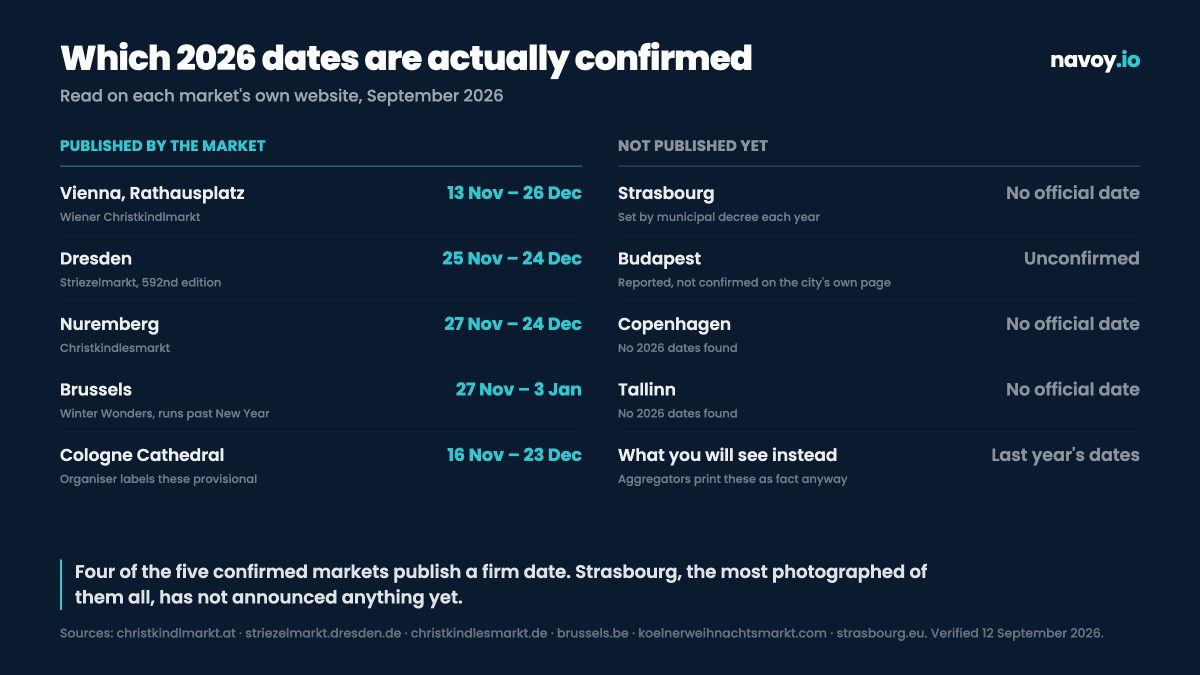
Four major European Christmas markets have published official 2026 dates on their own websites: Vienna's Rathausplatz market runs 13 November to 26 December, Dresden's Striezelmarkt 25 November to 24 December, Nuremberg's Christkindlesmarkt 27 November to 24 December, and Brussels Winter Wonders 27 November to 3 January. Cologne has published dates but calls them provisional. Strasbourg, Copenhagen and Tallinn have published nothing at all, and the dates circulating for them are guesses.
That distinction does not appear in a single date table we could find, and it is the difference between booking a non-refundable flight with confidence and booking one on a projection.
Which Christmas markets have confirmed their 2026 dates?
Five have published dates on their own sites: Vienna, Dresden, Nuremberg, Brussels and Cologne. Of those, only the first four state them as settled. Cologne's own page carries the words "these dates are provisional" and says the organiser will confirm closer to the season.
Here is what each market's own website says, read in September 2026.
| Market | 2026 dates | Status |
|---|---|---|
| Vienna, Rathausplatz | 13 Nov – 26 Dec | Confirmed |
| Dresden Striezelmarkt | 25 Nov – 24 Dec | Confirmed |
| Nuremberg Christkindlesmarkt | 27 Nov – 24 Dec | Confirmed |
| Brussels Winter Wonders | 27 Nov – 3 Jan 2027 | Confirmed |
| Cologne Cathedral | 16 Nov – 23 Dec | Provisional, per the organiser |
| Strasbourg | None published | Not announced |
| Budapest | None published | Reported, not confirmed on the city's page |
| Copenhagen | None published | Not announced |
| Tallinn | None published | Not announced |
A few details worth knowing before you book around them.
Vienna opens earliest and closes latest of the German-speaking markets, running six weeks. It is open daily 10:00 to 22:00, closing at 18:30 on Christmas Eve.
Dresden's is the 592nd edition. Opening day runs a short 16:00 to 21:00, and on 24 December it closes at 14:00, which catches people who plan a Christmas Eve afternoon there.
Nuremberg opens with a ceremony at 17:30 on 27 November, then runs daily 10:00 to 21:00.
Cologne is closed on Sunday 22 November. That is Totensonntag, a statutory day of remembrance in North Rhine-Westphalia, and it is a real closure rather than an error in the listing.
Why has Strasbourg not announced its 2026 dates?
Because Strasbourg's market dates are fixed by municipal decree each year, and the 2026 decree has not been issued. The city's own Christmas pages say the dates and programme are still being finalised. Every specific 2026 date you can currently read for Strasbourg is either an extrapolation from previous years or last year's dates with the year changed.
This is worth showing in full, because it is the clearest example of how these tables get built.
Searching for Strasbourg's official 2026 dates returns:
- The official Christmas site with an expired security certificate, which browsers block
- The city tourism page returning HTTP 403
- Wikipedia contradicting itself in the same article: the infobox says 24 November to 24 December, the History section says 29 November to 31 December. Neither is cited
- Aggregator sites split across 22, 26 and 27 November openings, closing on either 24 or 27 December
An independent verification pass against the city's own site found that the undated 26 November to 24 December text appearing there describes the previous edition, not 2026.
The pattern is genuine and old: Strasbourg's market has opened on the fourth Friday of November since 1570. That is a useful thing to know. It is not the same as a published date, and nobody should book a non-refundable trip on it.
What does this mean if you are booking now?
Book flights and hotels confidently around Vienna, Dresden, Nuremberg and Brussels. For Cologne, keep your booking flexible until the organiser confirms. For Strasbourg, Copenhagen and Tallinn, either wait for the announcement or book refundable, because nobody publishing a date for those cities is working from an official source.
A practical way to think about it:
| If your trip is to… | Then… |
|---|---|
| Vienna, Dresden, Nuremberg, Brussels | Book normally. Dates are published and firm |
| Cologne | Book flexible rates. Dates are stated but provisional |
| Strasbourg, Copenhagen, Tallinn | Wait, or book refundable only |
The safest general window, if you want to see several markets and do not have a fixed city in mind, is the first week of December. Every confirmed market above is open then, the decorations are fully up, and it sits before the pre-Christmas weekend peak.

Why do markets announce at such different times?
Because the decision sits with different bodies. A market run by a long-established private organiser can publish next year's dates the moment this year's ends. A market whose dates are set by a city council has to wait for that council to pass the decision, which happens on a municipal timetable rather than a travel-planning one.
That is the whole explanation for the pattern above, and it is worth understanding because it tells you which markets will always announce early and which will always announce late.
Nuremberg's opening is fixed by a tradition that predates modern tourism: the market opens on the Friday before the first Sunday in Advent, which makes it calculable years ahead. Vienna's Rathausplatz market is run as a city event with a stable annual footprint. Both can publish early because neither decision is genuinely open.
Strasbourg is the opposite case. Its dates are confirmed by municipal decree each year, and while the fourth-Friday-of-November pattern has held since 1570, the decree is still a decision that has to be taken. Until it is, the city has nothing official to publish, even though everyone involved has a strong expectation of what the dates will be.
This also explains the Cologne wording. An organiser who publishes provisional dates is telling you the arrangement is settled enough to plan around but not yet formally fixed. That is more useful information than a confident date with no status attached.
What happens to the dates that are still missing?
They firm up through October and early November, usually a few weeks before each market opens. Strasbourg in particular tends to confirm late, which is why so many publishers simply reuse last year's dates rather than wait.
If you are watching for an announcement, the useful places to check are the city's own Christmas pages and the organiser's site, not travel listings. Aggregators rarely update a date table once it is published, so a page that showed an estimate in September will often still show that estimate in December, by which point the real dates are public and different.
A reasonable rhythm if you are planning around an unconfirmed market:
| When | What to do |
|---|---|
| Now | Book refundable accommodation on the expected pattern |
| Mid-October | Check the city's own Christmas pages |
| Early November | Most remaining markets have confirmed by this point |
| On confirmation | Convert to a firm booking if the dates hold |
The expected pattern is usually right. The point is not that these markets will open on surprising dates, it is that "usually right" and "published" are different standards, and only one of them is worth a non-refundable fare.
How do I check a market's dates myself?
Go to the market's own website, not a listicle. If the site does not state 2026 dates, nobody else's 2026 dates for that market are reliable either. Aggregator sites rarely distinguish between a date they read on an official page and a date they inferred from last year.
Three quick tests:
- Does the page name the year explicitly? "27 November to 24 December" without a year is often recycled.
- Does it hedge? Cologne's "these dates are provisional" is a sign of a careful publisher, not a sloppy one.
- Can you find the same dates on the city or organiser domain? If the only sources are travel blogs, treat it as unconfirmed.
Planning around a market trip
Navoy is an AI travel agent that plans trips and books hotels and airport transfers in one platform. Christmas market cities price accommodation by the week rather than the season, so the gap between the first week of December and the week before Christmas is usually larger than the gap between cities. Comparing both at once is the useful move here.
Frequently asked questions
When do European Christmas markets usually open?
Most open between mid-November and the fourth Friday of November, and most close on 24 December. A minority run past Christmas into early January, including Brussels Winter Wonders, which runs to 3 January 2027. Vienna's Rathausplatz market closes on 26 December rather than Christmas Eve.
Are Christmas markets open on Christmas Day?
Most are not. Nuremberg, Dresden and Cologne all close on or before 24 December, and several close early on Christmas Eve itself. If you are travelling over Christmas Day specifically, check the individual market, because the ones that stay open are the exception.
Is it cheaper to visit Christmas markets in November?
Generally yes. Accommodation in market cities rises through December and peaks in the week before Christmas. The trade-off in mid-November is that not every market has opened, which is exactly why the confirmed opening dates above matter.
Why do different websites give different dates for the same market?
Because some markets have not published 2026 dates yet, so publishers fill the gap with last year's dates or an estimate based on the usual pattern. Very few say which they are doing. That is the reason for this article.
Sources
- Wiener Christkindlmarkt - official Vienna Rathausplatz dates and opening hours.
- Dresdner Striezelmarkt - official Dresden dates, 592nd edition.
- Nürnberger Christkindlesmarkt - official Nuremberg dates and opening ceremony.
- City of Brussels, Winter Wonders - official Brussels dates.
- Christmas Market at Cologne Cathedral - Cologne dates, labelled provisional by the organiser.
- City of Strasbourg, Christmas - confirms dates and programme are still being finalised.
All dates verified 12 September 2026.
Related articles
- When to book Christmas flights in 2026
- Is Lisbon expensive? What three days actually costs in 2026
- Shoulder season price windows for 2026
Plan the trip around dates that are actually confirmed. Try Navoy.
About the Author
Ranym Garali
Ranym is the Marketing and Content Lead at Navoy. She's been writing about travel for two years and digs into the data behind each piece, flight prices, visa rules and what people are actually searching for , so the advice holds up in practice.