Key Takeaways
- Three days is enough for Lisbon* if you give each day one area: the centre, Belem, and Alfama with a Sintra option.
- Do Belem on the day you are willing to start early.* The Jeronimos cloisters cost 18 EUR and the queue is the single biggest time sink in the city.
- A 24-hour transport card is 7.25 EUR*, a single ticket 1.90 EUR, and the metro from the airport is 1.90 EUR.
- Do not build a day around Tram 28.* Ride it early or treat it as transport, not a sight.
- Sintra is a full day, not an afternoon.* Attempting it as a half day is the most common way visitors lose a day.
Three days is the right length for Lisbon. The itinerary that works gives each day a single area: the central hills on day one, Belem on day two, and Alfama on day three, with Sintra as a full-day alternative. The two things that cost visitors the most time are queueing at Jeronimos Monastery and trying to compress Sintra into an afternoon.
Lisbon is a small city built on hills, which is a combination that punishes zigzagging. Most three-day itineraries fail not because they miss something, but because they cross the city four times a day and lose an hour each time to gradients and tram queues.
Is three days enough for Lisbon?
Yes, comfortably, for the city itself. Three days covers central Lisbon, Belem and Alfama at a reasonable pace with time to sit down. What three days does not cover is Lisbon plus Sintra plus the coast. If Sintra matters to you, it takes one of the three days, and the city gets two.
That is the trade-off to settle before you book anything else, because it changes the shape of the whole trip.
Day 1: Baixa, Chiado and Bairro Alto
Start in the flat part and walk uphill deliberately rather than accidentally.
Morning. Begin at Praca do Comercio, the big riverside square, and walk north through the grid of Baixa. This is the part of Lisbon rebuilt after the 1755 earthquake, and it is the only genuinely flat walking in the centre. Work up to Rossio and the Santa Justa lift.
A note on Santa Justa: the viewpoint terrace at the top has been temporarily closed, though the lift ride itself still runs and is covered by the 24-hour transport ticket. If the terrace is your reason for going, check before queueing, because the queue is long and the ride is ninety seconds.
Afternoon. Chiado for lunch and the bookshops, then up into Bairro Alto. The Miradouro de Sao Pedro de Alcantara is the viewpoint worth the climb, and it is free.
Evening. Bairro Alto is the nightlife district, and it starts late by northern European standards. Nothing much happens before 22:00.
Day 2: Belem, and starting early
Belem is where the queues are, and it is six kilometres west of the centre. Treat it as a half-day minimum, and go early.
| What | Cost 2026 | Notes |
|---|---|---|
| Jeronimos Monastery cloisters | 18 EUR adult | Church is free. Under 12s free |
| Belem Tower | Separate ticket | Long queue, small interior |
| Padrao dos Descobrimentos | Separate ticket | Lift to the viewing platform |
| Pasteis de Belem | A few euros | The original custard tart bakery, 1837 |
The Jeronimos queue is the single biggest time sink in Lisbon. The cloisters open at 10:00, closing at 18:30 from May to September and 17:30 from October to April, and they are closed on Mondays. Arriving at opening on a weekday is worth an hour of your trip.
The church itself is free and separate from the paid cloisters, which a surprising number of visitors do not realise. If your interest is the architecture and the Vasco da Gama tomb, the free part may be all you need.
Afternoon. Walk the riverfront east, or take the tram back and spend what is left of the day in the LX Factory, a converted industrial complex under the bridge.
Day 3: Alfama, or Sintra
This is where the itinerary forks.
Option A: Alfama and the castle
Alfama is the oldest district, the one that survived the earthquake, and it is a genuine maze. The approach that works is to go to the top and walk down.
Take a taxi or the 737 bus up to Sao Jorge Castle, see the castle and the view, then walk downhill through the lanes toward the river. Doing it in reverse means climbing for two hours.
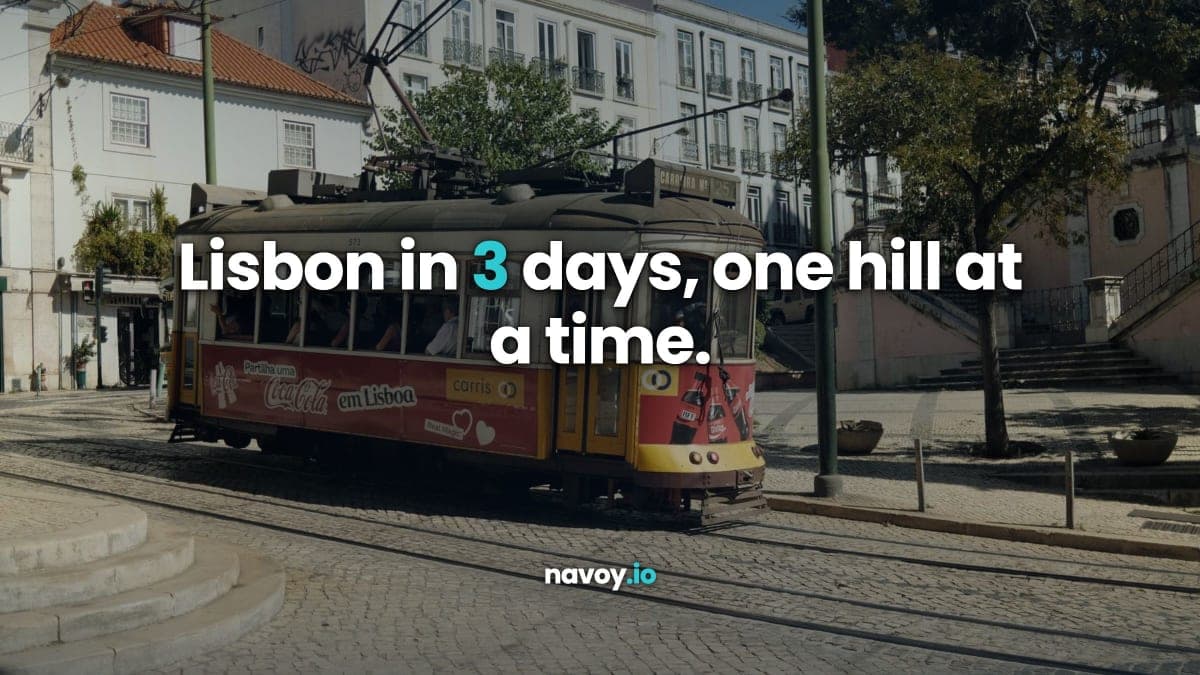
On Tram 28. It runs through Alfama and it is on every Lisbon list. It is also a functioning public tram that is full of tourists from mid-morning, with pickpocketing to match. Ride it before 09:00 from the Martim Moniz terminus if you want the experience. Otherwise treat it as transport you might happen to take, not a scheduled sight.
Option B: Sintra as a full day
Sintra is 40 minutes by train from Rossio station. It contains Pena Palace, the Moorish Castle, Quinta da Regaleira and the town itself, spread across a steep wooded hillside with a bus connecting them.
Sintra is a full day. The single most common Lisbon planning error is treating it as a half-day trip, arriving at 13:00, and spending the afternoon in queues and shuttle buses. Pena Palace alone, with the walk or bus up and the timed entry, absorbs three hours.
If you go, go first thing, book Pena's timed entry in advance, and accept that you will see two of the four sites properly rather than four badly.
What it costs to move around
Lisbon's transport is cheap and the numbers are fixed:
- Single Carris/Metro ticket: 1.90 EUR, or 1.72 EUR using pre-loaded Zapping credit
- 24-hour Carris/Metro pass: 7.25 EUR
- Navegante card itself: 0.50 EUR, reusable
- Airport to the centre by metro: 1.90 EUR, against roughly 10 to 15 EUR for an official taxi
The 24-hour pass pays for itself at four journeys, which a Belem day easily reaches. For a walking day in the centre, single tickets are usually cheaper.
For what three days costs in total, including beds, food and the 4.00 EUR per person nightly tourist tax, we priced it separately in is Lisbon expensive in 2026.
The two mistakes worth avoiding
- Compressing Sintra. It is a day or it is nothing. A half day in Sintra is mostly transport and queueing.
- Crossing the city repeatedly. Belem in the morning, Alfama at lunch and Bairro Alto for dinner looks efficient on a map and costs you two hours on hills and trams. One area per day is the whole trick.
Navoy is an AI travel agent that plans the trip, books the hotel and arranges the airport transfer in one platform. For a city where the airport transfer is a 1.90 EUR metro ride or a 15 EUR taxi depending on your luggage and your arrival time, having the whole thing decided before you land is worth more than it sounds.
FAQ
Is 3 days enough in Lisbon?
Three days comfortably covers central Lisbon, Belem and Alfama at a walking pace. It is not enough for Lisbon and Sintra together: Sintra needs a full day of its own, which leaves two days for the city. Decide which you want before booking.
How much is the Jeronimos Monastery in 2026?
Entry to the Jeronimos cloisters costs 18 EUR for adults in 2026, with under 12s free. The church next to the cloisters is free to enter and is a separate visit. The monastery is closed on Mondays and opens at 10:00.
Is Tram 28 worth it?
Tram 28 is worth riding before 09:00 from the Martim Moniz terminus, when it is still a tram rather than a queue. From mid-morning it is crowded with visitors and known for pickpocketing. The route through Alfama can be walked, downhill, for free.
Is Sintra a day trip from Lisbon?
Yes, and it needs the whole day. The train from Rossio takes about 40 minutes, and the sites are spread across a steep hillside connected by bus. Pena Palace alone takes around three hours including the climb and timed entry. Arriving after lunch means seeing very little.
Sources
- Carris: prices table 2026 - the 1.90 EUR single ticket, the 1.72 EUR Zapping fare and the 7.25 EUR 24-hour Carris/Metro pass
- Metropolitano de Lisboa: new fares 2026 - confirmation of the 2026 metro fares effective 1 January 2026
- Jeronimos Monastery official visitor information - the 18 EUR cloisters admission, the free church, and the seasonal opening hours
All figures verified 23 September 2026.
Related reading: is Lisbon expensive in 2026, shoulder season price windows, and the European cities changing their tourist rules.
Plan it in one platform. navoy.io - Navoy: your AI Travel Agent
About the Author
Haroun Moula
Haroun Moula is the founder and CEO of Navoy. Before Navoy, he worked in luxury travel with VVIPs and high-profile travelers. He built Navoy to bring curated, adaptive trip planning to more travelers through an AI travel agent that plans and books core trip parts in one place.