Key Takeaways
- A group of 3 can save $600+ per night by staying outside downtown host cities
- Airport districts and rail-connected suburbs offer better prices and easier exits
- Miss the last commuter rail and you're facing $120+ rideshare surge pricing
- Choose cities with strong rail links like NYC, Seattle, and Chicago — avoid car-only traps
Where to Stay for the USA World Cup 2026 (And Save $600 Per Night)
The smartest way to experience the FIFA World Cup 2026 in the United States is not to sleep downtown.
The USA is hosting the majority of matches across 11 cities, including New York/New Jersey, Los Angeles, Miami, Dallas, and Seattle. During major sporting events, hotel prices in these cities surge quickly — something we've already seen during the Super Bowl and major finals. World Cup demand will be bigger.
During peak match days, Downtown 3–4 star hotels in central districts can reach:
$450–$700 per night.
That isn't exaggeration — it's typical event pricing reality.
What many guides fail to explain clearly is this:
You do not need to stay in the city center.
Many U.S. host cities have commuter rail systems that connect surrounding areas directly to stadium zones. If you position yourself correctly by staying in these transit-connected areas, you can save 30–50% per night without sacrificing experience and convenience.
How Does the "Commuter Math" Save You $600+ Per Night?
For a group of three traveling together, staying in transit-connected suburbs instead of downtown can save $600–$700 per night.
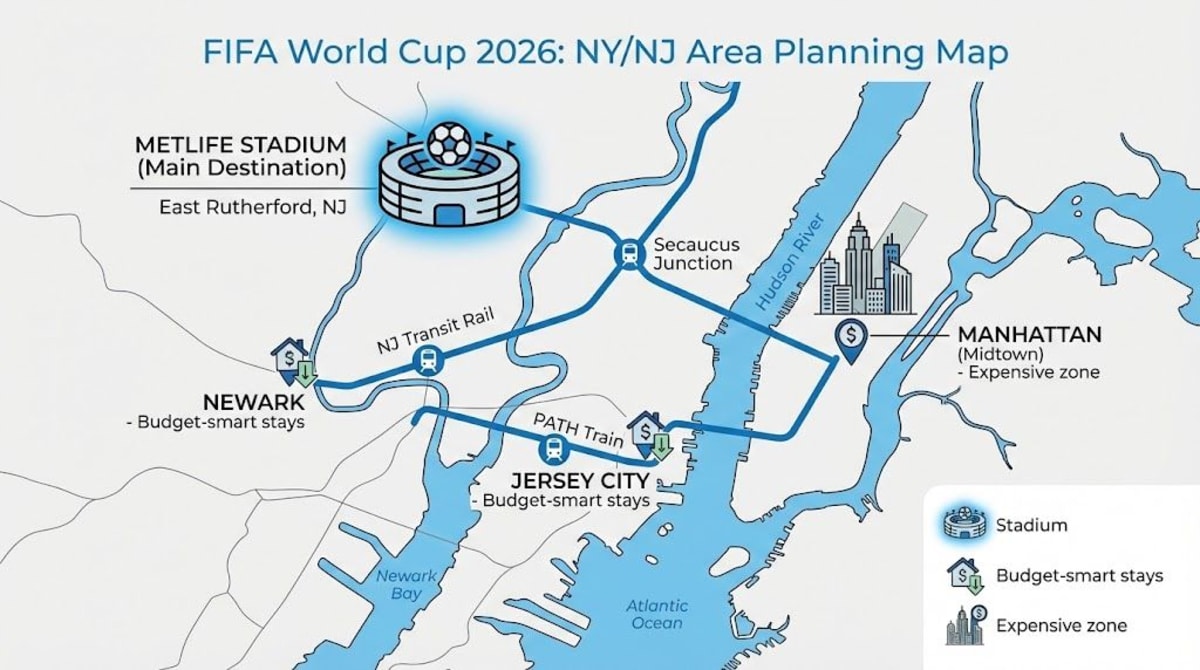
Example: New York / New Jersey (MetLife Stadium)
MetLife Stadium is in East Rutherford, New Jersey — not Manhattan.
| Expense | Manhattan (Midtown) | Newark/Jersey City | Difference |
|---|---|---|---|
| Hotel (3-star avg event rate) | $550 × 3 = $1,650 | $320 × 3 = $960 | $690 saved |
| Transport | Subway + NJ Transit ~$15–25 | PATH/NJ Transit ~$15–25 | Same |
| Total | ~$1,650 | ~$960 | ~$690 saved |
Over 3 nights? That's roughly $2,000+ saved.
That money covers:
- Match ticket upgrades
- Flights
- Or your entire Miami extension trip
Why fund hotel markups when you can fund your experience?
Which USA Host Cities Are Best for Transit-Smart Stays?
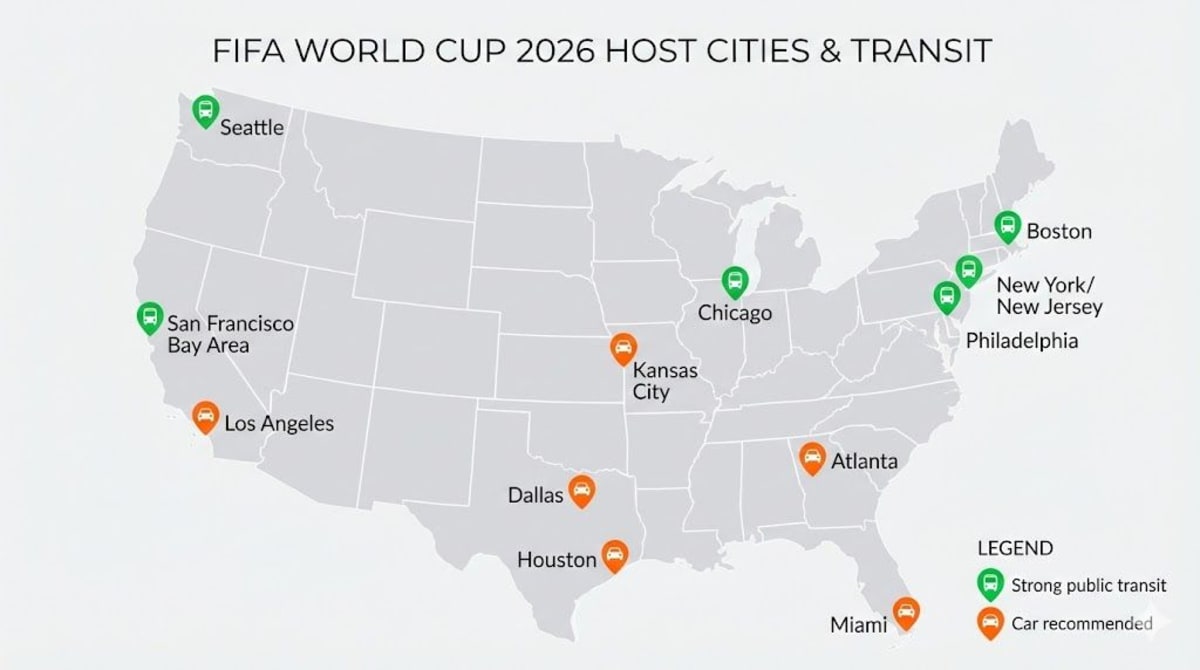
Not all host cities are equal when it comes to transportation. Some are train-friendly. Others are car-heavy. Here's where strategy matters.
New York / New Jersey (MetLife Stadium) — The Rail Advantage
Stay in Newark or Jersey City instead of Manhattan.
MetLife Stadium is accessible via NJ Transit rail from Secaucus Junction on match days. Newark Penn Station and Jersey City have strong PATH and NJ Transit connections.
Why this works:
- You avoid Manhattan hotel surge pricing
- Direct rail access to stadium transfers
- Faster exit than Midtown bottlenecks
Risk Level: Low (strong transit network)
Los Angeles (SoFi Stadium) — The Airport Strategy
Stay near LAX airport or along Metro rail lines instead of Downtown LA.
SoFi Stadium is in Inglewood — not downtown LA. LA is car-centric. That's the challenge.
Why this works:
- Airport zones have competitive hotel pricing due to high supply
- Easier rideshare access compared to congested downtown cores
- More predictable travel times
Risk Level: Medium (traffic dependent)
Pro Tip: Leave immediately at final whistle. LA traffic surge is brutal after events.
Miami (Hard Rock Stadium) — Avoid South Beach
Stay in Downtown Miami near Brightline, the airport area, or Aventura.
Hard Rock Stadium is in Miami Gardens — not South Beach. South Beach hotels during global events skyrocket.
Smarter areas:
- Downtown Miami near Brightline station
- Miami Airport area
- Aventura (north of stadium)
Brightline connects Miami to Fort Lauderdale and beyond, which opens regional stay options.
Risk Level: Medium (limited late-night rail options)
Seattle (Lumen Field) — The Transit Winner
Seattle is one of the easiest U.S. host cities for transit.
Lumen Field is downtown and connected by Link Light Rail.
Best areas:
- Near Sea-Tac Airport (direct light rail)
- Capitol Hill
- University District
Transit runs frequently and avoids traffic chaos.
Risk Level: Low
How Do You Travel Between USA Host Cities?
The USA spans multiple time zones. Planning matches in different cities requires flight strategy.
The 11 host cities are spread across the country — from Seattle to Miami, Boston to Dallas. You cannot drive between most of them practically.
The Northeast Corridor Advantage: If you're targeting matches in Boston, New York/New Jersey, or Philadelphia — you can travel between them by Amtrak train. This is the one region where rail-based multi-city planning works.
For everything else (Texas, West Coast, Midwest), plan domestic flights. Book early — prices surge closer to match dates.
What Happens If You Miss the Last Train?
Unlike Germany, U.S. transit does not always run all night. Missing the last train means $100+ surge pricing.
After major NFL games:
- Rideshare surge pricing can exceed $100–$150
- Wait times hit 60+ minutes
- Traffic gridlock can double commute times
Your timeline:
- Final Whistle: Leave immediately
- +15 minutes: Start moving toward rail or rideshare zone
- +30–45 minutes: You should already be on transit
If you linger for photos and miss the main departure wave, you pay the surge.
Should You Rent a Car or Use Public Transit?
In car-dependent cities like Dallas, Houston, and Kansas City — renting a car is smarter. In transit cities, skip the car.
Transit is more efficient than driving in:
- New York/New Jersey
- Seattle
- San Francisco Bay Area
- Chicago
- Boston
- Philadelphia
Always check:
- Stadium parking prices (often $50–$100 per event)
- Road closures on match day
What Should You Book First for USA World Cup 2026?
Book accommodation 6–9 months ahead minimum. Flexible cancellation rates are essential.
Booking priority:
- Accommodation with flexible cancellation
- Match tickets (when available)
- Domestic flights between host cities
Do not:
- Book based on map distance alone
- Assume downtown = closer to stadium
- Ignore commuter rail lines
Is It Safe to Attend World Cup Matches in the USA?
Yes. U.S. stadiums have strong security, and transit is safe when traveling with match-day crowds.
What to know:
- U.S. stadiums have strict bag policies (clear bags often required)
- Bring a portable phone charger
- Expect thorough security screening
- Alcohol sales stop before match end in some stadiums
For city-specific safety, transit is safest when traveling with the crowd immediately after matches. Lingering alone at empty stations late at night is avoidable if you follow the exit strategy above.
FAQ
Is public transit safe after World Cup matches in the USA?
Generally yes, especially in cities like NYC and Seattle where thousands of fans use it simultaneously. The key is leaving with the crowd rather than waiting until stations empty out.
Will Uber and Lyft be available after matches?
Yes, but surge pricing is highly likely after matches. Expect 2–3x normal rates and 30–60 minute wait times. Rail is almost always faster and cheaper post-match.
Do I need a car for the USA World Cup?
Depends on the host city. In New York, Seattle, San Francisco, Boston, Philadelphia, and Chicago — transit is better. In Dallas, Houston, and Kansas City — a car gives you more flexibility.
Which USA host city is easiest for first-time visitors?
Seattle or New York/New Jersey. Both have strong transit, walkable areas, and straightforward stadium access. Seattle is smaller and simpler; NYC has more to see but requires more planning.
The Bottom Line
The USA World Cup is not about staying "in the center."
It's about staying:
- On the right rail line
- Near airport hotel clusters
- Outside surge pricing zones
The edge isn't finding a cheaper hotel. It's knowing where the rail lines are before everyone else books.
Ready to plan your FIFA World Cup 2026 USA trip strategically?
Plan Your USA World Cup Trip with Navoy →
Use Navoy to compare rail-connected hotels, map stadium access, and build your match-day logistics the smart way.
Planning for other host countries? See our guides to World Cup 2026 in Canada and World Cup 2026 in Mexico.
About the Author
Ranym Garali
Ranym is the Marketing and Content Lead at Navoy. She's been writing about travel for two years and digs into the data behind each piece, flight prices, visa rules and what people are actually searching for , so the advice holds up in practice.