Key Takeaways
- The total solar eclipse is on Monday 2 August 2027. The Moon's shadow crosses southern Spain, Gibraltar, northern Morocco, Algeria, central Tunisia, Libya, Egypt, Saudi Arabia, Yemen and Somalia.
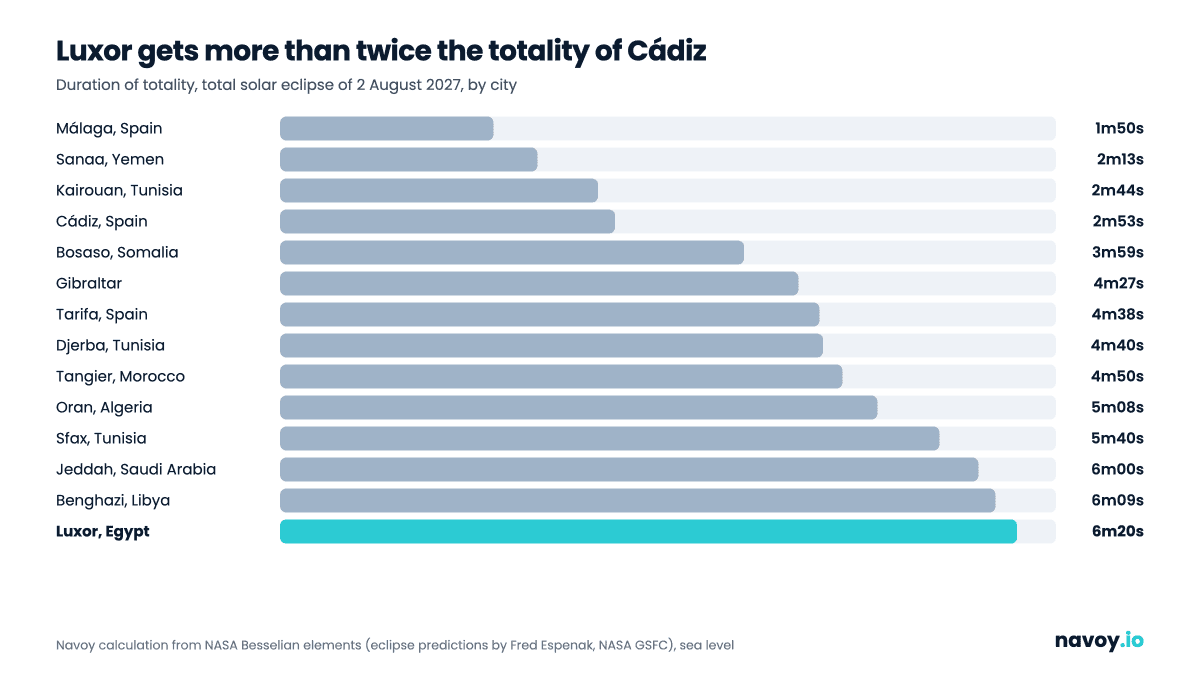
- Luxor gets about 6 minutes 20 seconds of totality, starting around 13:02 local time. Tarifa gets 4m38s, Cádiz under 3 minutes.
- NASA's catalogue lists no longer total eclipse until 3 June 2114. The longest totality, 6m23s, falls on the centre line in central Egypt.
- Tunis, Algiers, Seville, Cairo and Aswan are all outside the path and see only a partial eclipse. A few kilometres decide everything.
- Book now on a refundable rate. Southern Spain's hotels and Luxor's rooms are already filling, ten months out.
The total solar eclipse of 2 August 2027 is longest in Egypt: about 6 minutes 20 seconds in Luxor, starting around 13:02 local time. Tarifa in Spain gets 4 minutes 38 seconds, Sfax in Tunisia 5 minutes 40 seconds. Rooms along the path are already going, so book a refundable stay now and firm it up later.
We calculated totality for 14 cities from NASA's eclipse data, so you can pick a spot on duration, weather and how easy it is to reach, not on hype. Compare flights for 2 August 2027 or start planning the trip free.
When and where is the total solar eclipse of 2027?
On Monday 2 August 2027, from mid-morning local time in Spain and Morocco to about 14:00 in Somalia. NASA's path table puts the band of totality about 235 to 260 km wide over land, running from the Atlantic through the Strait of Gibraltar, along North Africa, across Egypt and the Red Sea, and out over the Horn of Africa.
The shadow first touches land on the coast of southern Spain and northern Morocco, then crosses:
- Spain: most of Cádiz province, much of Málaga province, the southern tips of Granada and Almería, plus Ceuta and Melilla, according to Spain's National Geographic Institute (IGN).
- Gibraltar and northern Morocco (Tangier, Tetouan).
- Algeria: a coastal-inland strip that includes Oran, but not Algiers.
- Tunisia: the centre of the country, including Kairouan, Sfax, Gabès and Djerba. Tunis and Bizerte are outside.
- Libya: Benghazi and the north-east coast. Tripoli is just outside.
- Egypt: the Western Desert and the Nile Valley around Luxor.
- Saudi Arabia (Jeddah), Yemen (Sanaa) and Somalia (Bosaso) as it leaves land.
NASA's point of greatest eclipse is at 25.5°N, 33.2°E, in the desert about 60 km east of Luxor, with the Sun 82° up, almost straight overhead. The longest totality on the centre line, 6 minutes 23 seconds, comes a few minutes earlier, near Asyut, north-west of Luxor.
How long does totality last in each city?
From under 2 minutes in Málaga to about 6 minutes 20 seconds in Luxor. The closer you are to the centre line, the longer it lasts, which is why Tarifa gets 4m38s while Cádiz, about 85 km up the coast, gets under 3 minutes. Benghazi (6m09s) and Jeddah (about 6 minutes) come close to Luxor.
We computed these from the Besselian elements NASA publishes for this eclipse (Fred Espenak's predictions), at sea level. Our Tarifa figures match IGN's official times to the second. Other calculators use slightly different city-centre points, so expect a few seconds' difference, and more near the edge of the path: for Sanaa, one popular calculator gets 2m28s.
| Place | Totality starts (local time) | Duration | Sun height |
|---|---|---|---|
| Cádiz, Spain | 10:45 (UTC+2) | 2m53s | 37° |
| Tarifa, Spain | 10:45 (UTC+2) | 4m38s | 38° |
| Gibraltar | 10:45 (UTC+2) | 4m27s | 38° |
| Málaga, Spain | 10:48 (UTC+2) | 1m50s | 39° |
| Tangier, Morocco | 08:45 (UTC+0) | 4m50s | 38° |
| Oran, Algeria | 09:51 (UTC+1) | 5m08s | 43° |
| Kairouan, Tunisia | 10:09 (UTC+1) | 2m44s | 55° |
| Sfax, Tunisia | 10:09 (UTC+1) | 5m40s | 56° |
| Djerba, Tunisia | 10:10 (UTC+1) | 4m40s | 57° |
| Benghazi, Libya | 11:28 (UTC+2) | 6m09s | 68° |
| Luxor, Egypt | 13:02 (UTC+3) | 6m20s | 82° |
| Jeddah, Saudi Arabia | 13:22 (UTC+3) | 6m00s | 76° |
| Sanaa, Yemen | 13:44 (UTC+3) | 2m13s | 67° |
| Bosaso, Somalia | 13:58 (UTC+3) | 3m59s | 58° |
Egypt's time assumes its summer time (UTC+3), which on current rules runs from 30 April to 28 October 2027. Morocco moved back to GMT (UTC+0) on 20 September 2026, so older guides that give Tangier's time as 09:45 are an hour out.
Which popular places just miss the path?
Tunis, Algiers, Seville, Tripoli, Cairo, Aswan and Hurghada all sit outside the band and see only a deep partial eclipse. So do Sousse and Monastir, by a few kilometres. Even a 95% partial eclipse looks nothing like totality: the sky never goes dark and you can't look up without eye protection.
Sousse and Monastir are Tunisia's big beach resorts, but our calculation puts both just north of the path's edge. Kairouan, about 50 km inland, is inside with 2m44s; Sfax and Djerba get far more. In Egypt, Aswan is just south of the band and Hurghada just north of it, while Luxor sits close to the centre line. In Spain, Seville is outside; the whole of the coast from Cádiz to Málaga is inside, with the longest durations near Tarifa and Algeciras.
If your hotel is near an edge, check its exact location on NASA's interactive path map before you pay. Near the edge, a short drive towards the centre line can add minutes.
Where are the weather odds best?
Egypt and Libya. Eclipse meteorologist Jay Anderson writes that from Benghazi to the Red Sea, Luxor included, cloud cover "doesn't get much better", with thin high cirrus the main risk in Luxor. Southern Spain is good but less certain: in his survey Cádiz had sun-visible days 88% of the time, the Tarifa coast and Gibraltar about 74%.
Anderson's analysis on eclipsophile.com draws on 20 years of satellite cloud data. Its other findings for the path:
- Tunisia and Algeria: "promising" eclipse weather, with morning cloud "very subdued". The Sfax region has the lowest average cloud on the western half of the track.
- Northern Morocco: Tangier often gets low marine cloud in the morning, with a good chance of it burning off by eclipse time.
- Libya: Benghazi "looks like a very good site".
- Inland Spain: away from the Strait's sea clouds, average cloud drops below 15%.
The trade-off is heat. Early August in Upper Egypt and inland Andalusia is very hot, and in Luxor totality happens just after 13:00, with the Sun nearly overhead. Plan shade, water and a chair you can lean back in.
Luxor or southern Spain: which is the better pick?
Luxor if you want the longest totality and the surest sky: about 6m20s with some of the lowest cloud on the path. Southern Spain if you want the easiest trip from Europe: Tarifa gives 4m38s, a mid-morning eclipse and Gibraltar and Málaga airports within reach. Central Tunisia sits in between on both counts.
| Luxor, Egypt | Tarifa, Spain | Sfax or Djerba, Tunisia | |
|---|---|---|---|
| Totality | 6m20s | 4m38s | 5m40s / 4m40s |
| Local time | 13:02 | 10:45 | 10:09 to 10:10 |
| Sun height | 82° | 38° | 56° to 57° |
| Weather | Among the best on the path | Good, sea cloud risk | Promising |
| Nearest airport | Luxor (LXR) | Gibraltar (GIB), Málaga (AGP) | Sfax (SFA), Djerba (DJE) |
We wrote about the last eclipse over Spain in our 2026 solar eclipse guide. The 2027 one is longer, further south and much higher in the sky.
When should you book for the August 2027 eclipse?
Now, on a free-cancellation rate. Ten months out, hotels along the path are already filling and repricing. In Spain, one rural rental platform reports eclipse-date bookings up fivefold, and one Tarifa listing asks about $19,900 for the night of 1 to 2 August, against about $105 a month earlier.
What has been reported, as of early October 2026:
| Where | What's been reported | Source |
|---|---|---|
| Tarifa | One listing at €17,680 (about $19,900) for 1 to 2 August 2027, vs €93 (about $105) for 30 June to 1 July | Infobae search, reported by Qué!, 28 Aug 2026 |
| Cádiz and Málaga provinces | Rural bookings up fivefold; occupancy for the dates already 12% in Cádiz, 8% in Málaga | Ruralidays, reported by Área Costa del Sol |
| Luxor | A Luxor eclipse tour operator says virtually all hotel capacity is pre-sold to travel companies | theluxoreclipse.com |
We haven't verified Luxor's availability hotel by hotel, and some Spanish hotels haven't loaded August 2027 rates yet, so "unavailable" can mean "not on sale". The pattern is still clear: the best-placed rooms go first.
How we'd book it:
- Pick your spot on duration and weather, using the table above.
- Reserve a refundable room for 1 to 3 August in Luxor, Cádiz province, Gibraltar, Djerba or Sfax.
- Watch flights into Luxor or Málaga and book once fares settle; see how far ahead to book international flights.
- Stay two nights or more. It protects you from a delayed flight on eclipse morning.
Navoy is an AI travel agent that plans the trip and books the flights, hotel and airport transfer in one place, so you can check eclipse-week flights to Luxor and line up the room in the same session.
How do you watch the eclipse safely?
Wear certified eclipse glasses (ISO 12312-2) for every partial phase, before and after totality. NASA says you can take them off only while the Sun is completely covered, and must put them back on as soon as the bright Sun reappears. Outside the path of totality, keep them on the whole time.
Ordinary sunglasses are not safe. If you are bringing a camera or binoculars, they need a proper solar filter on the front.
FAQ
What time is the 2027 solar eclipse?
It depends on where you are. Totality starts around 10:45 local time on Spain's south coast, 08:45 in Tangier, 10:09 in Sfax, 11:28 in Benghazi and 13:02 in Luxor. The partial phases begin more than an hour earlier and end more than an hour later.
Where is the 2027 eclipse longest?
In Egypt. NASA's maximum of 6 minutes 23 seconds falls on the centre line in central Egypt, near Asyut, and Luxor gets about 6 minutes 20 seconds by our calculation. Benghazi in Libya (6m09s) and Jeddah in Saudi Arabia (about 6 minutes) are close behind.
Can you see the 2027 total eclipse from Tunis?
No. Tunis and Bizerte are north of the path and see only a partial eclipse. In Tunisia, totality covers the centre and south-east: Kairouan, Sfax, Gabès and Djerba are inside. Sousse and Monastir are just outside, by our calculation.
Is there another total solar eclipse in Europe soon after 2027?
Not soon. Spain gets an annular eclipse on 26 January 2028, when the Moon leaves a ring of Sun visible, not a total one. The next total eclipses after 2027, on 22 July 2028 and 25 November 2030, cross Australia, New Zealand and southern Africa, according to NASA's catalogue.
Sources
- NASA, Besselian elements and greatest eclipse for 2 August 2027 - greatest eclipse at 25.5°N 33.2°E, Sun altitude 81.7°, path width 257.7 km, maximum duration 6m23s. Eclipse predictions by Fred Espenak, NASA's GSFC
- NASA, path of the total solar eclipse of 2 August 2027 - northern and southern limits, central line, path widths, 6m23.2s peak on the centre line around 10:00 UT
- Royaume du Maroc, Bulletin officiel no. 7521, decree 2.26.530 on legal time - Morocco returns to GMT from 20 September 2026
- NASA, interactive Google map of the path - check a hotel's exact position
- NASA, Five Millennium Catalog of Solar Eclipses, 2001 to 2100 and 2101 to 2200 - 2009 (6m39s), 2027 (6m23s), next longer: 3 June 2114 (6m32s)
- Instituto Geográfico Nacional (Spain), eclipse of 2 August 2027 - areas of Spain in totality, Cádiz 2m54s, Málaga 1m48s, Ceuta 4m48s
- Jay Anderson, eclipsophile.com, 2027 eclipse weather - cloud statistics along the path
- NASA, eclipse safety - ISO 12312-2 glasses, when to remove them
- Qué!, 28 August 2026 - Tarifa listing at €17,680 vs €93, rural bookings up fivefold
- Área Costa del Sol - rural occupancy 12% in Cádiz, 8% in Málaga for the eclipse dates
- theluxoreclipse.com, logistics - tour operator statement on Luxor hotel capacity
- European Central Bank reference rate, 6 October 2026 - €1 = $1.1269, used for all conversions
Durations and local times are Navoy's calculation from NASA's Besselian elements (ΔT 76.0 s, sea level), checked against NASA's central-line table and IGN's figures for Spain. All figures verified 6 October 2026.
Related articles
- 2026 Solar Eclipse: Spain or Iceland? An Honest Pick
- How Far Ahead to Book International Flights
- 7 Things to Book Before Summer Prices Spike
Chasing the 2027 eclipse? Plan the trip free, then compare flights and hotels with live prices - Navoy: your AI Travel Agent
About the Author
Haroun Moula
Haroun Moula is the founder and CEO of Navoy. Before Navoy, he worked in luxury travel with VVIPs and high-profile travelers. He built Navoy to bring curated, adaptive trip planning to more travelers through an AI travel agent that plans and books core trip parts in one place.