Key Takeaways
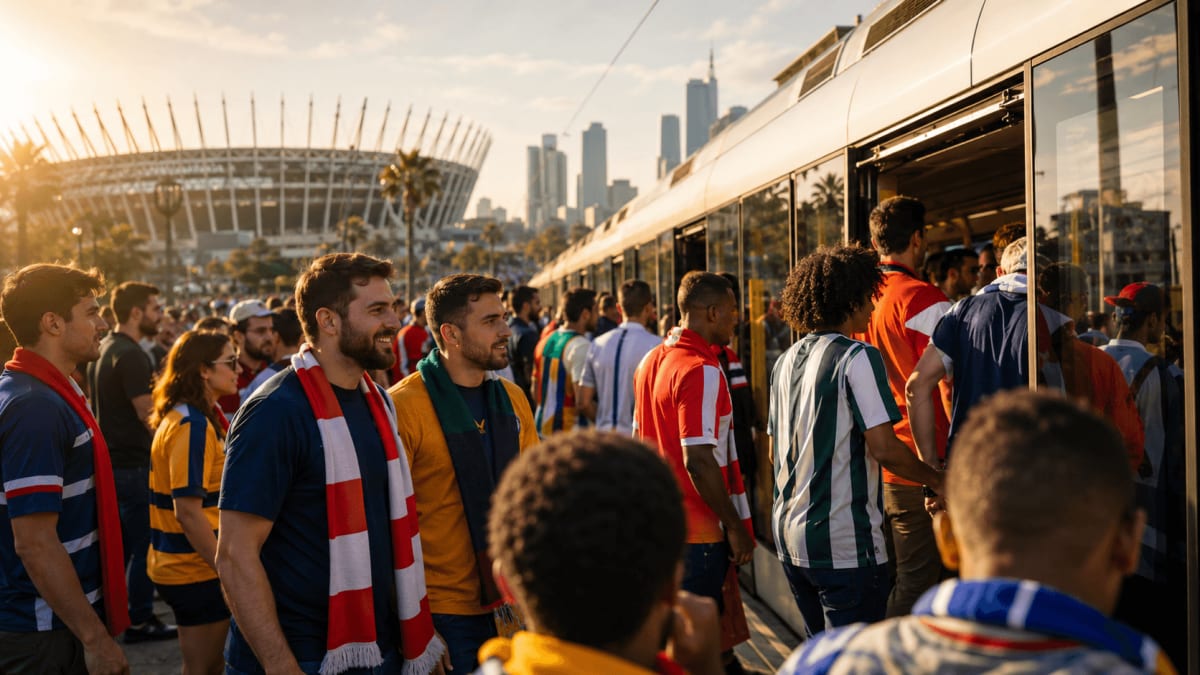
- Transit-only is the new normal: Most 2026 World Cup stadiums ban general match-day parking and tailgating — MetLife and SoFi included.
- Transport is a second ticket: Match-day transport is capped and advance-purchase — the MetLife NJ Transit option is $150 round-trip, limited to 40,000 per match, and not sold on match day.
- The hard ones: AT&T Stadium in Arlington (no public transit) and Estadio Azteca (light-rail gridlock with 80,000+ fans) need the most planning.
- The easy ones: Seattle, Vancouver and Atlanta drop you within a 10-minute walk of the gates by rail — no advance booking.
- Plan match days in one place: Use Navoy to organise hotels, airport transfers, and a match-day-aware itinerary across all 16 host cities.
How Do You Get Around World Cup 2026 Host Cities?
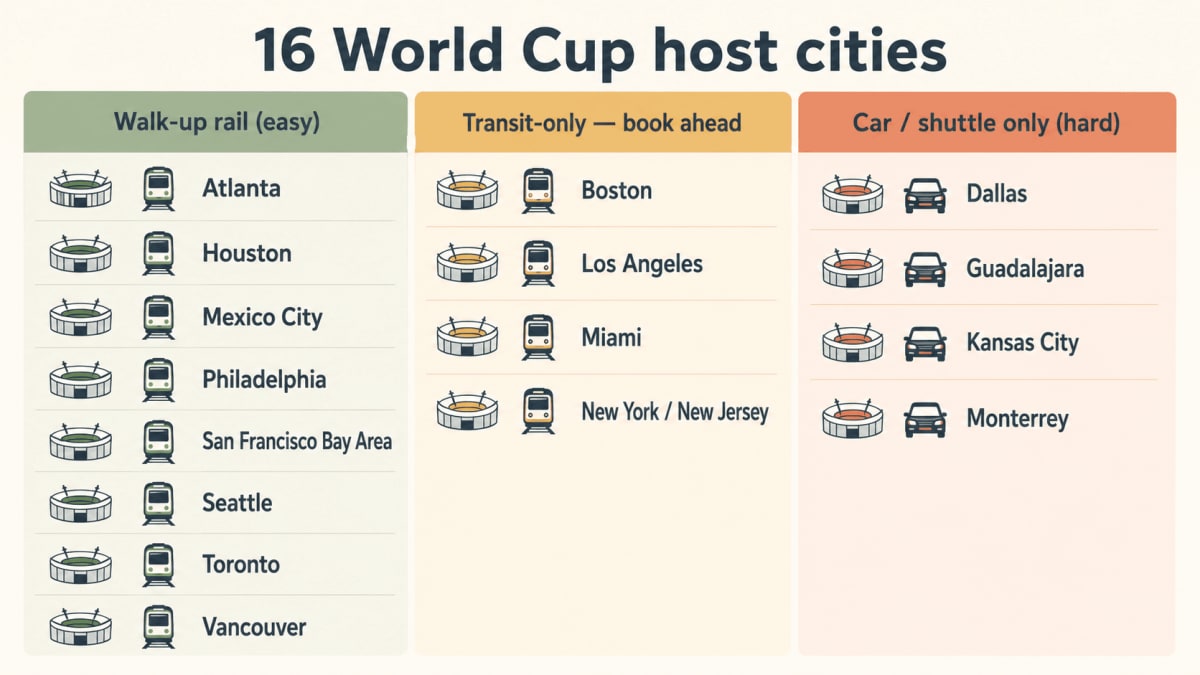
For the 2026 World Cup, plan to reach every stadium by public transit or an official shuttle — not by car. Most host stadiums are running match days as transit-only operations, with general spectator parking and tailgating banned and a valid match ticket required to buy stadium transport. The two hardest venues to reach are AT&T Stadium in Arlington (no public transit at all) and Estadio Azteca in Mexico City (light-rail gridlock). The easiest are Seattle, Vancouver and Atlanta, where rail drops you a short walk from the gates.
The tournament runs across 16 host cities in three countries from June 11 to July 19, 2026, and the venues could not be more different — a downtown stadium you can walk to in Seattle, a suburban fortress in Arlington with no train for miles. This guide maps how to get to each one, which cities force you onto advance-booked transport, and how early to leave on match day.
Plan each match day in one place. Use Navoy to build a day-by-day World Cup itinerary with hotels and airport transfers at navoy.io — organised around your match dates and base neighborhood.
World Cup 2026 Stadium Transport at a Glance
The table below maps all 16 host cities to their stadium, the best way in on match day, and whether you need to book that transport in advance. "Transit-only" means general spectator parking is restricted or banned and you are expected to arrive by train, official shuttle, or drop-off.
A note on changing details: Transport plans, prices, ticket caps, and stadium parking rules are being finalised city by city and can change during the tournament (June 11 – July 19, 2026) — sometimes match to match. Treat the figures here as a planning baseline, and always confirm against the official host-city transit authority and the FIFA tournament page before each game.
| Host city | Stadium (tournament name) | Best match-day route | Parking / car status | Book transport ahead? |
|---|---|---|---|---|
| New York / NJ | MetLife Stadium | NJ Transit rail via Secaucus → match-day shuttle train | No general parking; transit-only | Yes — capped, sells out |
| Los Angeles | SoFi Stadium (Inglewood) | Metro K Line + free WC shuttle, or direct Metro bus | No regular transit parking on match days | Reserve parking; shuttle yes |
| Dallas | AT&T Stadium (Arlington) | Charter bus from TRE CentrePort or DART/TEXRail hubs | Limited lots; no rail to stadium | Yes — shuttle / charter |
| Mexico City | Estadio Azteca ("Estadio Ciudad de México") | Metro L2 → Tren Ligero to Estadio Azteca | Cars discouraged; restricted streets | Park-and-ride advisable |
| Miami | Hard Rock Stadium (Miami Gardens) | Brightline/Tri-Rail + rideshare; mostly car | Paid lots; rideshare default | Optional |
| Atlanta | Mercedes-Benz Stadium | MARTA rail (GWCC/Dome, Vine City) | Limited downtown parking | No — walk-up rail |
| Boston | Gillette Stadium (Foxborough) | MBTA "Foxboro" special commuter rail | Paid lots; ~22 mi from city | Train ticket advisable |
| Houston | NRG Stadium | METRORail Red Line to Stadium Park | Paid lots available | No — walk-up rail |
| Kansas City | Arrowhead Stadium | Car, rideshare, or organized shuttle | Lots available; no rail | Shuttle advisable |
| Philadelphia | Lincoln Financial Field | SEPTA Broad Street Line to NRG/sports complex | Paid lots; rail preferred | No — walk-up rail |
| San Francisco Bay | Levi's Stadium (Santa Clara) | VTA light rail + Caltrain to Great America | Paid lots; ~45 mi from SF | No — walk-up rail |
| Seattle | Lumen Field | Link Light Rail (Stadium station) | Limited; rail preferred | No — walk-up rail |
| Toronto | BMO Field (Exhibition Place) | GO Transit to Exhibition + streetcar 509/511 | Very limited on-site | No — walk-up rail |
| Vancouver | BC Place | SkyTrain (Stadium–Chinatown station) | No stadium parking; downtown | No — walk-up rail |
| Guadalajara | Estadio Akron (Zapopan) | Mi Macro Periférico bus + shuttle | Lots; outside city | Shuttle advisable |
| Monterrey | Estadio BBVA (Guadalupe) | Car, bus, or shuttle (no direct metro) | Lots; extreme heat | Shuttle advisable |
The 2026 Rule That Changes Everything: Stadium Transport Is a Second Ticket
The biggest shift for 2026 is that your ride to the stadium is now something you buy in advance, often alongside your match ticket — not something you sort out on the day. Several host venues are capping match-day transport and requiring a valid ticket to use it, which means the "I'll just grab an Uber" plan can fail outright.
The clearest example is New York/New Jersey. NJ Transit and the local host committee are selling only 40,000 round-trip rail tickets per match at $150 each, and those tickets are not available on match day — you buy them ahead, tied to your match ticket. Miss the window and your fallback options (an $80 official park-and-ride shuttle, or a rideshare drop-off near the property) are also finite.
The practical rule: the moment you have a match ticket, lock the stadium transport for that specific game. Treat it with the same urgency as the hotel.
Transit-Only Stadiums: MetLife (NY/NJ) and SoFi (LA)
These two host the highest-demand matches — the final at MetLife on July 19 and a packed LA schedule at SoFi — and both are running match days without normal parking.
How to Get to MetLife Stadium for the World Cup Final
Plan to ride NJ Transit rail through Secaucus Junction, and buy your round-trip rail ticket well in advance. MetLife Stadium in East Rutherford, NJ, will have no general spectator parking and no tailgating on match days — the lots are being used for a fan village, shuttles, and staging.
Your options, in order of reliability:
- NJ Transit rail (recommended): Expanded service from New York Penn Station and NJ stations, all connecting through Secaucus Junction, where ticket holders transfer to a match-day-only train direct to the stadium. $150 round-trip, capped at 40,000 per match, sold in advance only.
- Official stadium shuttle: Round-trip bus from a New Jersey park-and-ride (Hackensack Meridian School of Medicine), $80, non-refundable, advance purchase.
- Rideshare: Drop-off and pick-up are off-property at Meadowlands Racing & Entertainment, with a walking path to the gates — expect heavy surge and long post-match waits.
- Premium parking: A limited number of advance-only spots at the nearby American Dream mall, around $225.
For where to base around the final, see our guide to where to stay in the US for the World Cup 2026 — Midtown Manhattan and Jersey City both sit on the Secaucus line.
How to Get to SoFi Stadium for the World Cup
Ride the Metro K Line to a transit hub and take the free dedicated World Cup shuttle, or board a direct Metro bus from across LA. SoFi sits in Inglewood, about four miles from LAX, and there is no regular transit parking at the stadium on match days.
- Metro K Line + free shuttle: Take the K Line to the LAX/Metro Transit Center or Westchester/Veterans, then the free event-day shuttle to the gates.
- Direct Metro buses: Nonstop service from multiple LA pick-up points, starting about 3 hours 15 minutes before kickoff and running roughly every 10 minutes.
- Parking: If you must drive, reserve in advance via Metro's official World Cup page (SpotHero) rather than turning up.
The Hardest Stadiums to Reach: AT&T (Dallas) and Estadio Azteca (Mexico City)
If your group plays in Arlington or Mexico City, build extra time into match day — these are the two genuine logistics traps of the tournament.
How to Get to AT&T Stadium in Arlington
There is no public transit to AT&T Stadium, so plan on an official charter bus from a rail hub or a pre-booked shuttle. Arlington is the largest city in the United States with no public transportation system, and no rail line reaches the stadium.
The workable routes for 2026:
- From the TRE CentrePort/DFW Airport Station: Exit the Trinity Railway Express and board complimentary charter buses for ticket holders to a bus hub near the stadium, then a ~10-minute walk.
- From Dallas: Charter buses run from DART hubs on "dynamic" demand — they leave once full.
- From Fort Worth: TEXRail and Trinity Metro connections feed dedicated shuttle buses, since the commuter trains don't stop at the stadium.
Because everything funnels through shuttles, basing near a DART or TRE station in Dallas or Fort Worth is often smarter than basing in Arlington itself. AT&T Stadium hosts a 2026 semifinal, so demand will be extreme.
How to Get to Estadio Azteca (Mexico City Stadium)
Take Metro Line 2 to Tasqueña, then the Tren Ligero (light rail) to the Estadio Azteca station — but expect heavy crowding. During the tournament the venue is officially the "Estadio Ciudad de México," and it hosts the opening match (Mexico vs. South Africa) on June 11, plus the only stadium to feature in three World Cups.
- Metro + Tren Ligero (cheapest): Line 2 to Tasqueña, transfer to the Xochimilco light rail to Estadio Azteca — roughly 8 pesos. The light rail runs at full capacity from about three hours before kickoff, and with 80,000+ fans it gets genuinely packed.
- Alternative: Metro Line 3 to Universidad, then an electric bus to the stadium.
- Park-and-ride: Around 500 pesos round-trip (350 from Parque México), with shuttles every ~15 minutes to the Cetram Huipulco interchange.
- On foot: Seven signposted, staffed walking routes with QR-coded maps lead in from nearby transit points.
For neighborhoods and the full Azteca commute reality, see where to stay in Mexico City for the World Cup 2026.
The Easy Ones: Walkable and Rail-Connected Host Cities
Several host cities let you walk up to rail with no advance transport booking at all — these are the lowest-stress match days of the tournament:
- Seattle (Lumen Field): Link Light Rail to Stadium station; walkable from downtown and Pioneer Square in ~10 minutes.
- Vancouver (BC Place): SkyTrain to Stadium–Chinatown; the stadium is dead-center downtown with no parking needed.
- Atlanta (Mercedes-Benz Stadium): MARTA rail to GWCC/CNN Center or Vine City; a short walk to the gates.
- Philadelphia (Lincoln Financial Field): SEPTA Broad Street Line straight to the South Philly sports complex.
- Houston (NRG Stadium): METRORail Red Line connects downtown directly to the stadium.
- Toronto (BMO Field): GO Transit to Exhibition station plus the 509/511 streetcar.
In these cities you can base downtown, skip the car entirely, and ride public transit both ways. If you're connecting from the airport to your hotel, a pre-booked transfer still beats an airport taxi line — you can arrange one through transfers.navoy.io.
How Early Should You Arrive at a World Cup 2026 Stadium?
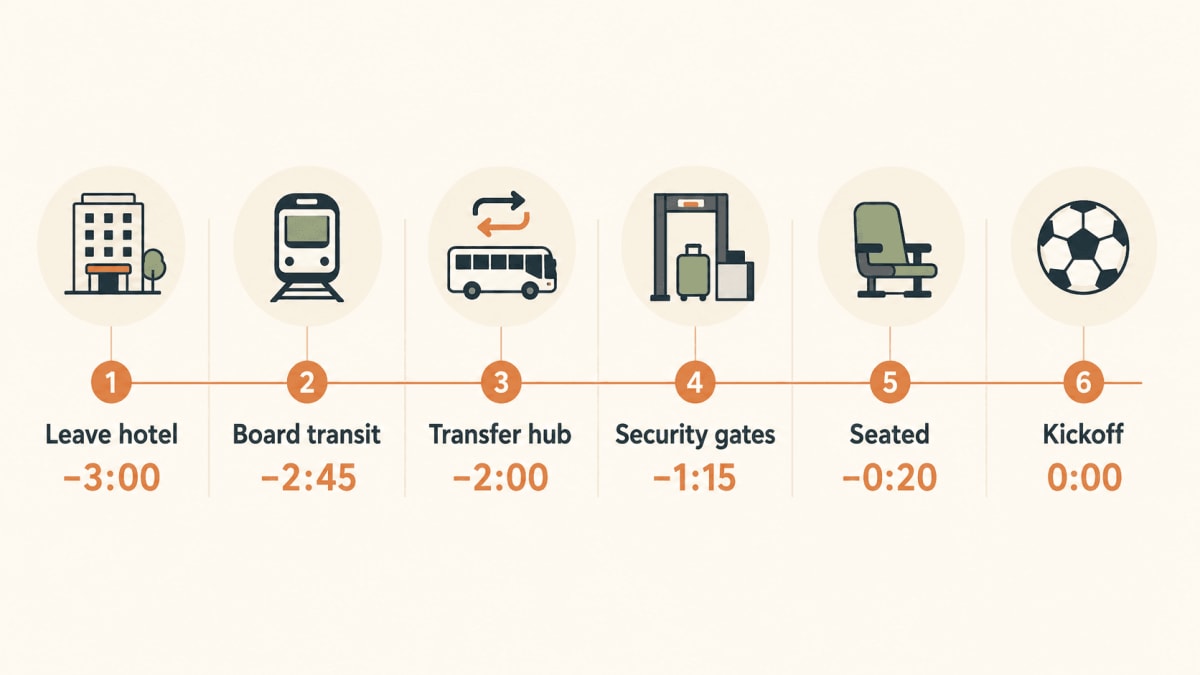
Aim to be on your match-day train or shuttle at least three hours before kickoff for transit-only venues, and 90 minutes to two hours for walk-up rail cities. Security screening, capped transport, and record crowds mean the old "show up an hour before" habit won't work.
| Stadium type | Leave your hotel | Why |
|---|---|---|
| Transit-only (MetLife, SoFi) | 3–3.5 hrs before | Capped trains/shuttles, single transfer points, security queues |
| Car/shuttle only (AT&T, Azteca, Monterrey) | 3 hrs before | Shuttle waits, gridlock, heat, long final walk |
| Walk-up rail (Seattle, Vancouver, Atlanta) | 1.5–2 hrs before | Trains crowd up but run frequently |
Getting Between Host Cities
For travel between host cities, fly — the venues are far apart, and only a few regional pairs make sense by train or car. The Northeast Corridor (New York–Philadelphia–Boston) is genuinely rail-friendly via Amtrak, and Dallas–Houston is a quick flight or a 3.5-hour drive. Everything else — LA to Miami, Vancouver to Toronto, Mexico City to Monterrey — is a flight.
Plan your inter-city legs against hotel check-in and check-out dates, and verify match assignments on FIFA's official tournament page before booking non-refundable flights. For the money side of a multi-city run, see how expensive World Cup 2026 tickets are.
Plan Your Match-Day Logistics With Navoy
Once you know your matches, the World Cup becomes a logistics puzzle: the right base neighborhood, the right transfer, and the right arrival window in every host city — across up to three countries and several time zones. That's exactly what Navoy is built to assemble.
- Generate your full match-week trip: navoy.io — a day-by-day itinerary with hotels and airport transfers in one flow, for any combination of host cities.
- Browse hotels by transit anchor: navoy.io/hotels — filter by city and neighborhood so you can base on the rail line that reaches your stadium.
- Lock your airport transfer: transfers.navoy.io — pre-booked rides so you're not stuck in an airport taxi line after a long-haul flight.
For more tournament planning, see our companion guides on where to stay in the US for the World Cup 2026, where to stay in Mexico City, and the FIFA World Cup 2026 USA guide.
Navoy does not sell match tickets or stadium transport — match tickets go through FIFA's official channels, and stadium transport through each host city's official transit authority and host committee.
FAQ: Getting Around World Cup 2026 Host Cities
Do I need a car for the 2026 World Cup?
No — for most host cities a car is a liability, not a help. Stadiums like MetLife and SoFi have no general match-day parking, and Arlington has no public transit, so you'll rely on transit or official shuttles either way. Base on a rail line where you can, and pre-book shuttles for car-dependent venues like AT&T Stadium, Estadio Azteca and Monterrey.
How do I get to the World Cup 2026 final at MetLife Stadium?
Take NJ Transit rail through Secaucus Junction to a ticket-holders-only stadium shuttle train, and buy the $150 round-trip ticket in advance. Only 40,000 rail tickets are sold per match and they aren't available on match day. Backups are an $80 official park-and-ride shuttle or an off-property rideshare drop at Meadowlands — both fill fast.
Which World Cup 2026 stadiums are easiest to reach by public transport?
Seattle (Lumen Field), Vancouver (BC Place) and Atlanta (Mercedes-Benz Stadium) are the easiest. All three sit on light rail or metro lines that drop you within about a 10-minute walk of the gates, with no advance transport booking required. Philadelphia, Houston and Toronto are nearly as simple.
How early should I leave for a World Cup match?
Leave your hotel about three hours before kickoff for transit-only or shuttle-only stadiums, and 90 minutes to two hours for walk-up rail cities. Capped transport, single transfer points, security screening and record crowds all eat time, so the safer move is to arrive early and explore the fan zone.
Final Word: Solve the Stadium, Then Book Around It
The country you're visiting matters less than whether your stadium sits on a rail line. Solve that first — figure out exactly how you'll reach each venue, book any capped transport the moment you have a match ticket, then choose a hotel on the right transit anchor. Get the logistics right and the football takes care of itself.
Build your full World Cup trip — hotels, transfers and a match-day-aware itinerary — at navoy.io.
Sources:
About the Author
Ranym Garali
Ranym is the Marketing and Content Lead at Navoy. She's been writing about travel for two years and digs into the data behind each piece, flight prices, visa rules and what people are actually searching for , so the advice holds up in practice.