
Chongqing, China
A mountain city built on the meeting of two rivers, where streets stack on cliffs, a monorail runs through an apartment block and hotpot is the local religion. Day trips reach two UNESCO sites.
Updated
Key Takeaways
- Chongqing sits where the Jialing and Yangtze rivers meet, and its streets, bridges and buildings are stacked up steep hills, so the map lies about distances.
- At Liziba station on metro Line 2, the monorail runs straight through the middle of a residential building.
- The best months are late April to May and late September to October; summers are hot and humid, and winters are grey and often foggy.
- Hotpot is the city's signature meal, built on chilli and Sichuan pepper, and it is meant to be shared.
- Wulong Karst and the Dazu Rock Carvings, both UNESCO sites, are the classic day trips from the city.
Why Is Chongqing Worth Visiting?
Chongqing is one of the most dramatic cities in China: a riverside metropolis built straight up the hillsides, with a nightscape, a food scene and two UNESCO World Heritage day trips you will not find in the usual Beijing-Shanghai route.
The old city grew on the Yuzhong peninsula between the Yangtze and the Jialing rivers, and today spreads far across both banks; and the terrain shaped everything. Roads loop over roads, a lobby on one street can be on the roof of a building on another, and the metro rides above the rooftops as often as under them. Nowhere is that clearer than at Liziba, where the Line 2 monorail glides through an apartment block. Navoy builds a day-by-day itinerary and books the stays and transfers in the same flow, which helps in a city where the straight-line distance between two places is rarely the walking distance.
Where Should You Stay in Chongqing?
Stay in Yuzhong, the peninsula around Jiefangbei and Hongyadong, for the shortest trip to the sights, and use the north bank (Jiangbeizui) or the Nanbin Road riverfront as quieter alternatives.
Yuzhong and Jiefangbei
The historic core on the peninsula between the two rivers. The Liberation Monument pedestrian district is the centre of shopping and dining, with the Yangtze River Cableway and Hongyadong a short walk away.
Nanbin Road
The south bank of the Yangtze, facing the peninsula. Quieter at street level, with the best views of the skyline across the water at night.
North bank (Jiangbeizui)
The north bank near the confluence, with modern towers, a growing food scene and easy metro links toward the airport.
Shapingba and Ciqikou
The western side of the city, home to the old riverside town of Ciqikou with its lanes and tea houses, better as a half-day visit than a base.
| Area | Best For | Atmosphere | Getting Around |
|---|---|---|---|
| Yuzhong / Jiefangbei | First visits, sights, food | Dense, lively, steep | Walk plus metro Lines 1 and 6 |
| Nanbin Road | Skyline views, quieter evenings | Calm, riverside | Short taxi or bridge walk to the peninsula |
| North bank (Jiangbeizui) | Airport access, modern comforts | Polished, business-like | Metro Lines 3 and 10 |
| Shapingba / Ciqikou | Old-town lanes, day visits | Traditional, busy at weekends | Metro, then a short walk |
What Are the Best Things to Do in Chongqing?
Ride the monorail through Liziba, cross the Yangtze on the cable car, see Hongyadong lit up at night, wander Ciqikou, and spend at least one evening over a hotpot.
- Liziba station: On Line 2, the train enters a residential building and the station sits on its upper floors. A viewing platform nearby lets visitors watch it pass.
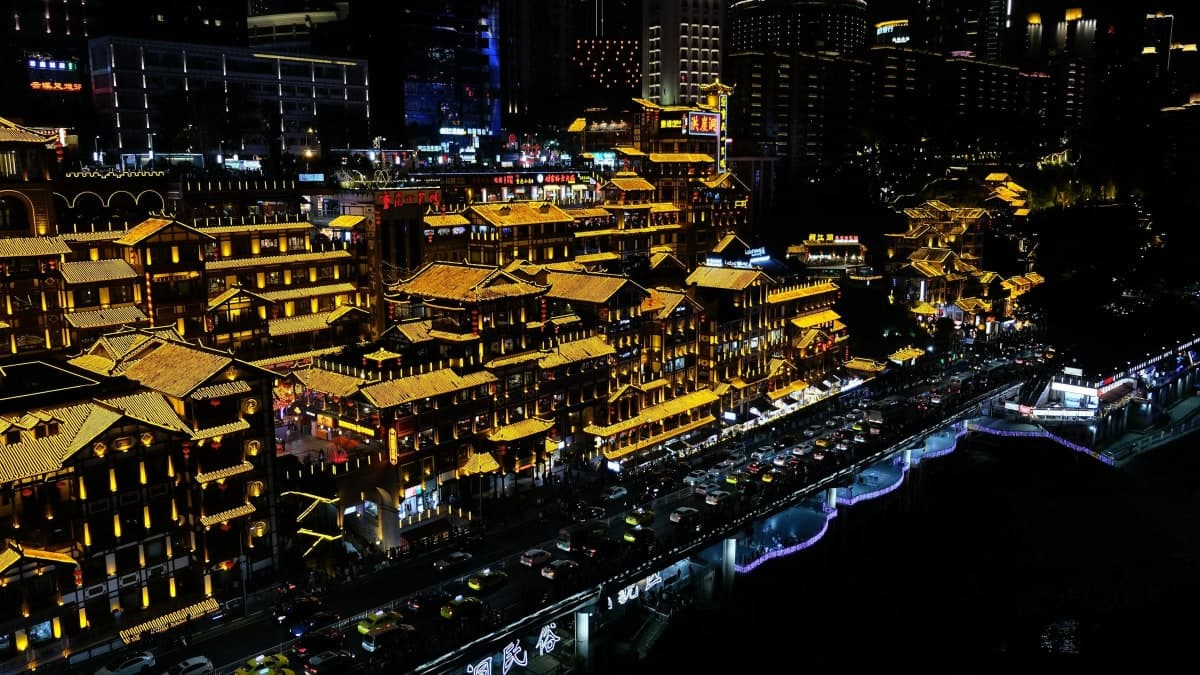
- Hongyadong and Jiefangbei: Stacked riverside towers beside the Jialing, a short walk from the Liberation Monument district. Best after dark.
- Yangtze River Cableway: A short ride across the Yangtze that shows the city's layers from above.
- Ciqikou old town: Stone lanes, tea houses and snack stalls on the western riverbank, best on a weekday morning.
- Chongqing hotpot: The dish is traditionally linked to boatmen and dock workers along the rivers, with a spicy broth of chilli and Sichuan pepper. Order a milder or split pot if you are unused to the heat.
- Wulong Karst: A UNESCO-listed landscape of natural bridges, gorges and caves, part of the South China Karst, best as a full-day trip or overnight.
- Dazu Rock Carvings: UNESCO-listed Buddhist, Taoist and Confucian carvings in the hills northwest of the city, roughly 100 km away by road, a full day with a driver.
- Yangtze cruise: Multi-day cruises toward the Three Gorges board at Chaotianmen, at the confluence; four-day, three-night sailings to Yichang are typical.
What Should You Know Before Visiting Chongqing?
Plan around hills and heat: pack comfortable shoes, use the metro for most hops, and visit in spring or autumn when the weather suits walking.
Many streets are staircases, so a short distance on a map can mean a steep climb; taxis and ride-hailing help with luggage. Summer days often climb above 30°C with heavy humidity, while winter is cooler, grey and frequently foggy, so views are best in the shoulder seasons. The airport, Chongqing Jiangbei International (CKG), is linked to the centre by metro Lines 3 and 10, roughly 40 minutes to an hour depending on your stop. Hotpot arrives with a lot of chilli, so say if you want it mild. Carry a translation app and download offline maps before you arrive, and have your hotel write your destination in Chinese for taxis. Planning a trip at navoy.io is free.
Frequently Asked Questions
How many days do you need in Chongqing?
Three days covers the city core: Jiefangbei and Hongyadong, Liziba, Ciqikou and a hotpot dinner. Five days adds a day trip to Dazu or Wulong, each a long day from the city. Add a few more days if you plan to join a multi-day Yangtze cruise toward the Three Gorges.
Which area is better as a base in Chongqing?
Yuzhong, around Jiefangbei and Hongyadong, is best for first visits, with the main sights, food streets and metro within reach. Nanbin Road suits travellers who want quieter evenings and skyline views across the river. The north bank (Jiangbeizui) works if easy airport access and modern hotels matter more than being in the historic centre.
When is the best time to visit Chongqing?
Late April to May and late September to October bring the most comfortable temperatures for walking the hilly streets. Summer is hot and humid, often above 30°C, while winter is cooler, grey and often foggy. Hotpot is good in any season, but the shoulder months make it easier to explore between meals.
Featured Itineraries
Swipe to see more →