Key Takeaways
- Tulum hotel occupancy fell from 66.7% to 49.2% between September 2024 and September 2025, according to Quintana Roo's state tourism ministry.
- Direct international air routes dropped from 12 to 4. Only Atlanta, Dallas, Houston and Miami still fly direct, and international passengers fell 34% in the first four months of 2026.
- Crime is not the reason. Tulum recorded zero homicides in May, June and July 2026. The decline is driven by price, record sargassum and lost air access.
- Winter occupancy has already recovered to 73%, and a 128-action federal recovery plan is running. Tulum is at a fork, not an ending.
- The pattern has a name and a published model, which means the warning signs are readable before you book.
Tulum hotel occupancy fell from 66.7% to 49.2% in twelve months, and direct international air routes went from twelve to four. What happened there is not unique or mysterious. It follows a cycle that tourism researchers mapped in 1980, and that cycle leaves warning signs you can check before you book anything.
What actually happened to Tulum?
Occupancy dropped 17.5 percentage points in a year, from 66.7% in September 2024 to 49.2% in September 2025, according to Sedetur, the Quintana Roo state tourism ministry. Mexico's federal tourism minister cited the same figures when launching a recovery plan. The causes were price, record seaweed and collapsing air access, in that order.
The air access number is the one most people miss. Tulum International Airport opened in December 2023 with twelve international destinations. By 2026 it had four: Atlanta, Dallas, Houston and Miami. Delta dropped Minneapolis-St. Paul and Detroit, American cut Charlotte, United dropped Chicago O'Hare, and JetBlue reduced its JFK service. Spirit and Air Canada also cut back.
The passenger figures followed. International traffic fell 34% in the first four months of 2026, down more than 90,000 travellers year on year, with domestic traffic down 25%. Full-year 2026 is projected at roughly 700,000 passengers, a drop of more than 40%. One aviation outlet has already asked whether the airport will become a white elephant.

On price, the strongest evidence is not a rate comparison. It is that Mexican authorities temporarily shut more than a dozen Tulum businesses for price gouging. When a government starts closing restaurants over what they charge, the pricing problem has stopped being a matter of opinion. A social post about 200-peso sodas in Tulum collected more than 69,000 likes, which tells you how widely the frustration was shared.
Local business numbers moved too, though less dramatically than the viral version suggests. The Quintana Roo Commerce Council recorded a 15% reduction in long-standing local businesses over the eighteen months to May 2025. Named hotels including Kore Tulum and Villa Miramar closed voluntarily, citing low occupancy.
One thing the popular story gets wrong: this is not a crime story. Tulum recorded 46 homicides between September 2024 and August 2025, and that period was genuinely bad. But Tulum recorded zero homicides in May 2026, zero in June, and none in July as of reporting, while homicides across Quintana Roo fell 85%. Visitors kept leaving through a period when the safety picture was improving sharply. Blaming cartels for the 2026 numbers gets the timeline backwards.
Is there a name for what happened to Tulum?
Yes. Geographer Richard Butler published the Tourism Area Life Cycle in the Canadian Geographer in 1980, and it describes exactly this arc. A place is discovered, gets built out, prices climb, quality slips, and visitor numbers stall. The model's final stage is a fork: decline or rejuvenation. Tulum is standing at it now.
The model plots visitor numbers against time across six stages. What makes it useful to a traveller rather than an academic is that each stage looks and feels different on the ground.
| Stage | What it looks like when you visit |
|---|---|
| Exploration | Few visitors, no dedicated tourism infrastructure, you deal with locals directly |
| Involvement | Locals start hosting, small guesthouses, a season begins to form |
| Development | Outside investment arrives, hotels and beach clubs get built, marketing starts |
| Consolidation | Tourism dominates the local economy, chains arrive, the original character thins |
| Stagnation | Peak capacity reached, prices high, quality complaints rise, repeat visitors drop away |
| Decline or Rejuvenation | Either visitors leave for the next place, or the destination reinvents what it offers |
Butler's work is where the idea of tourism carrying capacity came from. The stages are not a prediction and places move through them at wildly different speeds. But the sequence holds well enough that recognising which stage a destination sits in tells you a lot about what your trip will actually be like.
Tulum went from Development to Stagnation in roughly a decade, which is fast. The 2023 airport arrived near the top of the curve, adding capacity right as demand was about to turn.
How can you tell a destination is about to break?
Six signals, all of them checkable before you book. Air routes being cut, price rising faster than quality, government enforcement against local operators, a worsening seasonal environmental problem, long-standing local businesses closing, and public space getting harder to reach. Tulum showed all six. Most destinations in trouble show three or four.
Airlines cutting routes. This is the most reliable early signal and the easiest to check: search the same flight for next month and for eight months out. Airlines drop routes on demand data long before the story reaches travel media. Twelve routes to four is not a subtle warning.
Price rising faster than what you get. Not absolute price. Expensive places can be worth it. The signal is a widening gap between cost and experience, which shows up in recent reviews complaining about value rather than quality.
Government enforcement against operators. Price-gouging closures, licence suspensions and consumer-protection actions are public records, and they indicate a problem that got past the point of self-correction.
A seasonal environmental problem on a worsening trend. For the Caribbean that is sargassum. The University of South Florida's Sargassum Watch System tracks it monthly and publishes the data. June 2026 hit 34 million metric tons across the Atlantic, Caribbean and Gulf, with the Gulf at 5 million metric tons, nearly double its 2025 record. Sargassum builds from February, peaks around June and July, and clears by December. This makes 2026 one of the two worst years on record.
Long-standing local businesses closing. Chains closing means a bad quarter. The family restaurant that has been there twenty years closing means the economics of the place have changed.
Public space getting harder to reach. Beaches that are legally public but practically gated, viewpoints behind a paid entrance, streets that require a wristband. This one is visible in recent traveller photographs and reviews, and it usually appears late in the cycle.
Where is the same pattern running right now?
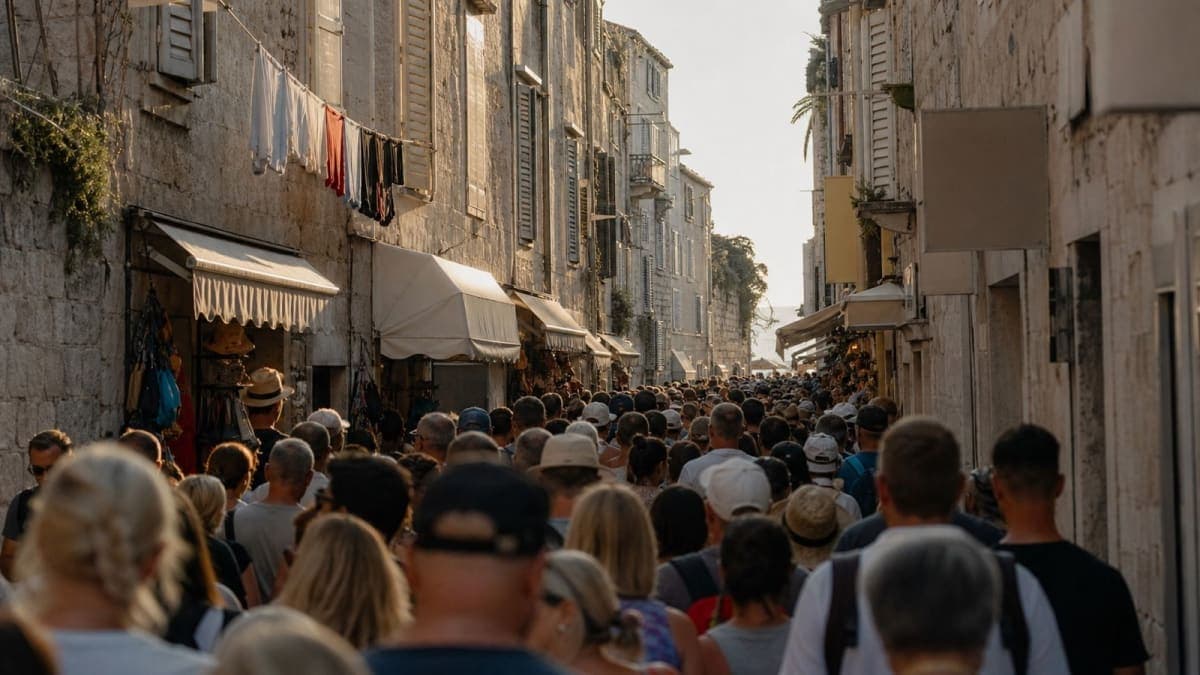
Several places, and the useful signal is what local governments are doing about it. Barcelona is eliminating all 10,101 licensed tourist apartments by November 2028. Amsterdam is cutting cruise calls from 190 to 100 a year and capping tour groups at fifteen people. These are capacity controls, and they tell you where the pressure is highest.
Barcelona's measure is the most drastic in Europe: every licensed short-term tourist apartment in the city goes, with no new licences issued, and more than 3,500 have already returned to residential use as of June 2026. The policy survived a constitutional challenge. Amsterdam has cut short-term rentals to fifteen nights a year in the centre and De Pijp, capped tour groups at fifteen people with a 10pm curfew, and is closing its cruise terminal by 2030. Venice has made its day-tripper access fee permanent, applying it across sixty peak days. Bali's visitor levy is in force but running at roughly 35% compliance, which is its own kind of signal.
If you want the full picture on what these visitor charges actually cost, we covered the numbers separately in our guide to 2026 tourist taxes.
Closer to Tulum, two places in the same region are further along the same path than most travellers realise.
Isla Holbox has accumulated roughly 90,000 metric tons of waste. Its sewage system was built about eighteen years ago for 800 residents and now serves more than 6,000 people a week. The island generates up to ten tons of garbage a day, much of it dumped illegally, buried in sand or reaching the ocean, and it has documented blackouts and water shortages. Hotel owners once cut off access to the island over the sewage problem.
Bacalar's lagoon, the reason anyone goes, has shifted from oligotrophic to eutrophic under contamination from human activity, a change documented in peer-reviewed research. Fewer than 1.5% of structures are connected to proper sewage, and hotels discharge untreated wastewater into the groundwater that feeds the lagoon. A local civil organisation says some areas are now unfit for recreational use.
Both get recommended constantly as the authentic alternative to Tulum. On the infrastructure evidence, Holbox is arguably further into overtourism damage than Tulum is.
Is Tulum recovering or still declining?
Both signals are live, which is what a fork looks like. Winter 2025/26 occupancy recovered to 73%, and the federal government launched Tulum Renace, a 128-action recovery plan that includes four new public beach access points. Against that: international passengers still fell 34% in early 2026, and sargassum set records.
The recovery plan is a serious document rather than a press release. Led by Tourism Minister Josefina Rodriguez Zamora, it covers regulation of attractions, urban and environmental management, tourism development, and infrastructure. The four new public beach access points matter more than they sound, because blocked access to legally public beaches was one of the loudest complaints against Tulum for years.
The honest read is that Tulum in 2026 is cheaper, quieter and easier to move around than Tulum in 2023, with worse air connections and a real seaweed problem from April to August. Whether that is a good trip depends entirely on what you wanted from it. If you were going for the scene, the scene has moved. If you were going for cenotes, ruins and a beach in December, the case is arguably better than it has been in years.
Officials projected 90% occupancy by the end of December 2025. That was a forecast rather than a result, and it is worth treating as such.
Navoy is an AI travel agent that plans the trip, books the hotel and arranges the airport transfer in one platform. Tell it you want a week on the Yucatan peninsula in low sargassum season and it will build the itinerary with stays attached, rather than handing you a list of places to go and price up yourself. You can start from our Tulum destination guide or compare hotels in Tulum, Valladolid and Isla Mujeres directly.
Book it now: see live hotel prices in Tulum, search flights into Cancun or start planning free.
FAQ
Is Tulum safe to visit in 2026?
Quintana Roo sits at Level 2, "Exercise Increased Caution," on the US State Department's advisory scale. Tulum recorded zero homicides in May and June 2026, and homicides across the state fell 85%. Standard precautions apply, particularly after dark in the town centre.
When is sargassum worst in Tulum?
The bloom builds from February, escalates through April to June, and usually peaks in June and July before declining. December through February is the cleanest window. The University of South Florida publishes monthly satellite tracking, which is worth checking before you commit to beach dates.
Is Tulum still worth visiting?
It depends what you want. Prices have come down, crowds have thinned and it is easier to get around than it was in 2023. Air access is worse and sargassum is a real problem in summer. For cenotes, ruins and winter beach days it holds up well. For the party scene it was famous for, that has largely moved on.
Which airlines still fly direct to Tulum?
As of 2026, direct US service runs from Atlanta, Dallas, Houston and Miami, down from twelve international destinations in 2024. Delta, American, United, JetBlue, Spirit and Air Canada have all cut or reduced routes. Flying into Cancun and driving down is now often the better option. You can compare flights into Cancun on Navoy.
Sources
- Mexico News Daily - A drop in Tulum hotel occupancy - Sedetur occupancy figures, 66.7% to 49.2%.
- Mexico News Daily - Tulum Reborn strategy addresses tourism slump - the 128-action federal recovery plan, and independent corroboration of the occupancy figures.
- Mexico News Daily - Tulum businesses temporarily shut down - price-gouging enforcement.
- Mexico News Daily - Quintana Roo homicides drop 85% - SESNSP crime data.
- Tulum Times - Tulum airport international passengers decline - AFAC passenger figures and route cuts.
- Tulum Times - Tulum tourism recovery gains momentum as occupancy reaches 73 percent - winter recovery.
- University of South Florida Optical Oceanography Lab - Sargassum Watch System - primary source for sargassum tonnage and seasonality.
- US State Department - Mexico Travel Advisory - Quintana Roo advisory level.
- Butler's Tourism Area Life Cycle model - explainer for the 1980 Canadian Geographer paper.
- Mongabay - In Mexico's Holbox, a natural paradise suffers from its own popularity - Holbox waste and sewage figures.
- Yucatan Magazine - Sewage-plagued Holbox cuts access - Holbox infrastructure.
Facts verified 19 August 2026. Occupancy, passenger and crime figures change with each reporting period; check the current data before making plans around them.
Plan it in one platform ✈️ navoy.io - Navoy: your AI Travel Agent
About the Author
Haroun Moula
Haroun Moula is the founder and CEO of Navoy. Before Navoy, he worked in luxury travel with VVIPs and high-profile travelers. He built Navoy to bring curated, adaptive trip planning to more travelers through an AI travel agent that plans and books core trip parts in one place.